
As automotive technology advances, the demands on steering systems have evolved significantly, with higher expectations for lightness, road feel, and precision. The hydraulic power steering system, particularly the rack and pinion gear type, has become a critical component in modern passenger vehicles, accounting for over 80% of the market share in such applications. A comprehensive and detailed test specification is essential to evaluate the performance and reliability of these systems, serving as a key tool for quality assessment. In this article, I will analyze the differences between existing industry standards, corporate standards, and international test specifications for rack and pinion hydraulic power steering systems. Based on this analysis, I propose enhancements and refinements to current test methods and technical requirements to better align with contemporary vehicle safety, energy efficiency, and operational stability demands.
The rack and pinion gear mechanism is fundamental to these steering systems, converting rotational input into linear motion to steer the wheels. Its design directly impacts steering responsiveness and driver comfort.
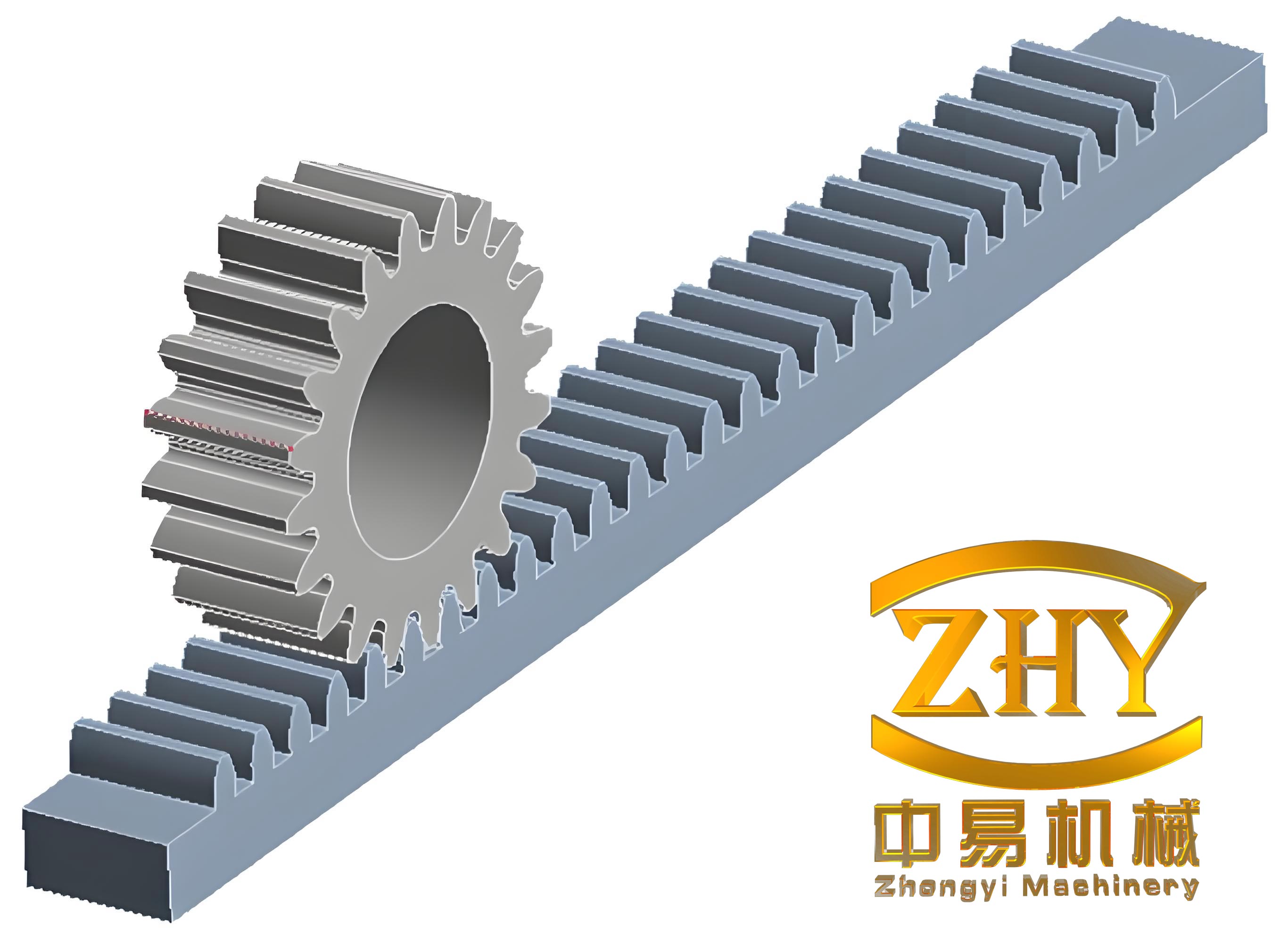
This image illustrates a typical rack and pinion gear assembly, highlighting its compact and efficient design. Understanding its operation is crucial for developing effective test protocols.
Current industry standards, such as QC/T 529-2000 “Bench Test Methods for Automotive Hydraulic Power Steering Gears” and QC/T 530-2000 “Technical Specifications for Automotive Hydraulic Power Steering Gears,” were established in 2000 and cover all types of power steering systems, including recirculating-ball and rack and pinion gear types. However, with the rapid development of passenger vehicles, these standards may not fully address the heightened performance requirements for rack and pinion gear systems, such as improved lightness at low speeds, stability at high speeds, sensitivity, and accuracy. Therefore, there is a pressing need to update and specialize these standards for rack and pinion gear applications.
Through comparative analysis, I have identified significant variations in test items and methods between industry standards and other specifications. Below, I summarize these differences using tables and delve into specific test aspects, incorporating formulas where applicable to quantify performance metrics.
Comparative Analysis of Test Specifications
To better understand the gaps, I have tabulated the performance and reliability test items from various standards. The tables highlight where industry standards fall short and where enhancements are needed for rack and pinion gear systems.
| Test Item | QC/T 529-2000 | Standard A | Standard B | Standard C | Proposed Refinements |
|---|---|---|---|---|---|
| Total Steering Wheel Turns | ✓ | ✓ | ✓ | ✓ | Include tolerance ranges for rack and pinion gear systems |
| No-Load Steering Torque | ✓ | ✓+ | ✓+ | ✓ | Add torque difference and fluctuation limits under power |
| Free Play | ✓ | ✓ | ✓+ | ✓ | Reduce allowable angle and add rack support free travel |
| Function Test | ✓ | ✓ | ✓ | ✓+ | Specify torque range and fluctuation during operation |
| Steering Force Characteristic | ✓ | ✓ | ✓ | ✓ | Detail symmetry, hysteresis, and torque differences |
| Internal Leakage | ✓ | ✓ | ✓ | ✓ | Maintain with stricter thresholds for rack and pinion gear |
| External Leakage | ✓ | ✓ | ✓ | ✓ | Same as above |
| Returnability | ✓ | ✓ | ✓ | ✓ | Shift to inverse drive force measurement |
| Steering Sensitivity | ✓ | ✓ | ✓ | × | Consider removal for rack and pinion gear due to inherent stiffness |
| Negative Pressure Resistance | × | ✓ | ✓ | × | Add as new test for vacuum conditions |
| Mechanical Efficiency | × | ✓ | × | ✓ | Include based on QC/T 29096-1992 |
| Pressure Loss | × | ✓ | ✓ | ✓ | Add to minimize system losses |
| Noise Test | × | ✓ | ✓ | × | Add for acoustic performance evaluation |
| Rack Friction Force | × | ✓ | ✓ | ✓ | Include to assess smoothness in rack and pinion gear |
| Rack Support Travel | × | ✓ | ✓ | × | Add as part of free play test |
| High-Pressure Hand Feel Test | × | ✓ | ✓ | ✓ | Add for subjective assessment under max pressure |
| Test Item | QC/T 529-2000 | Standard A | Standard B | Standard C | Proposed Refinements |
|---|---|---|---|---|---|
| Fatigue Test | ✓ | ✓ | ✓ | ✓ | Align cycles with higher demands for rack and pinion gear |
| Wear Test | ✓ | × | × | ✓ | Increase cycles and combine with environmental tests |
| Forced Steering Test | ✓ | × | × | ✓ | Maintain but adjust loads for rack and pinion gear |
| Reverse Overload Test | ✓ | ✓ | × | × | Refine for extreme conditions |
| Overpressure Test | ✓ | ✓ | ✓ | ✓ | Keep with updated pressure limits |
| Static Torsion Test | × | ✓ | ✓ | ✓ | Add to evaluate input shaft and overall strength |
| Impact Force Test | × | ✓ | ✓ | ✓ | Include for step-response strength assessment |
| Forward-Reverse Durability Test | × | ✓ | ✓ | ✓ | Add as a form of wear test |
| Mud-Water Durability Test | × | ✓ | ✓ | ✓ | Include to simulate harsh environments |
| Cold Resistance Test | × | × | ✓ | ✓ | Add for low-temperature performance |
| High-Temperature Test | × | × | ✓ | ✓ | Include for thermal stability |
| Thermal Cycle Test | × | × | ✓ | × | Add to assess material endurance under temperature swings |
| Rack Static Strength Test | × | ✓ | ✓ | ✓ | Include for deformation limits under load |
These tables reveal that current industry standards lack several critical tests for rack and pinion gear systems, particularly in performance nuances and environmental robustness. In the following sections, I will explore key test methods in detail, proposing enhancements with supporting formulas and data.
Detailed Analysis of Performance Tests
Performance tests are crucial for ensuring that a rack and pinion gear steering system meets driver expectations for comfort and control. Below, I discuss several tests where improvements are needed.
No-Load Steering Torque Test
The industry standard QC/T 529-2000 specifies measuring no-load torque by rotating the input shaft from left to right extreme positions without hydraulic power, at an oil temperature of 45–55°C. However, this does not reflect real-world conditions where the system is operational. For rack and pinion gear systems, I propose testing under power with an input speed of 10–15 r/min, covering 100% travel from extremes. The torque should be within design limits, with additional criteria:
- Maximum torque difference between left and right turns: typically ≤ 0.50 N·m (some allow ≤ 0.80 N·m).
- Torque fluctuation: measured over full travel, with adjacent tooth variations limited.
The torque curve can be analyzed using the formula for rotational dynamics: $$T = J \alpha + T_f$$ where \(T\) is the input torque, \(J\) is the moment of inertia, \(\alpha\) is angular acceleration, and \(T_f\) is the frictional torque. For steady rotation at constant speed (\(\alpha = 0\)), torque primarily overcomes friction in the rack and pinion gear mesh. A sample torque curve might show peaks and valleys corresponding to gear engagement; the variance should be minimized for smooth operation.
| Parameter | Condition | Value |
|---|---|---|
| Input Speed | With hydraulic power | 10–15 r/min |
| Travel Range | From extreme to extreme | 100% |
| Oil Temperature | Controlled | 50–60°C |
| Max Torque Difference (Left vs. Right) | Full travel | ≤ 0.50 N·m |
| Adjacent Tooth Torque Variation | Measured per tooth engagement | ≤ 0.20 N·m |
Steering Force Characteristic Test
This test evaluates the relationship between input torque and hydraulic pressure, critical for steering feel. The industry standard requires measuring torque up to maximum working pressure, with symmetry ≥85%. For rack and pinion gear systems, I recommend more granular criteria:
- Torque at specific pressures (e.g., 0.8 MPa, 4.9 MPa) with tolerances.
- Hysteresis value: difference in torque during increasing and decreasing pressure cycles.
- Left-right torque difference at any pressure.
The force characteristic can be modeled as: $$T(P) = k_1 P + k_2$$ where \(T\) is input torque, \(P\) is hydraulic pressure, and \(k_1\), \(k_2\) are constants derived from the rack and pinion gear design. Hysteresis \(H\) can be quantified as: $$H = \max |T_{\text{up}}(P) – T_{\text{down}}(P)|$$ for all \(P\), where \(T_{\text{up}}\) and \(T_{\text{down}}\) are torques during pressure rise and fall, respectively. A sample dataset might show \(H \leq 0.8 \, \text{N·m}\) at 4.9 MPa.
| Pressure (MPa) | Input Torque (N·m) | Hysteresis Limit (N·m) | Symmetry Requirement |
|---|---|---|---|
| 0.8 | 2.5 ± 0.3 | ≤ 1.1 | ≥ 90% across full range |
| 4.9 | 3.5 ± 0.4 | ≤ 0.8 | |
| Max (e.g., 10.0) | 5.0 ± 0.5 | ≤ 1.0 | N/A |
Returnability Test
Instead of measuring return time under an 8% load as per industry standard, which is impractical for rack and pinion gear systems, I propose evaluating inverse drive force. This involves applying a load to the output rack while the input is unpowered, simulating wheel feedback. The force \(F_{\text{inverse}}\) should satisfy: $$F_{\text{inverse}} = C \cdot P_{\text{hydraulic}} + F_0$$ where \(C\) is a proportionality constant, \(P_{\text{hydraulic}}\) is system pressure, and \(F_0\) is baseline friction. The force should be within design limits, e.g., 200–400 N, with fluctuations < 10% over travel.
Noise Test
Abnormal noise in hydraulic systems often stems from the pump, lines, or steering gear. For rack and pinion gear units, I suggest testing at rated flow with oil at 80°C. Noise \(L\) in decibels should be measured 100 mm from the valve inlet: $$L = 10 \log_{10}\left(\frac{I}{I_0}\right)$$ where \(I\) is sound intensity and \(I_0\) is reference intensity. Requirement: \(L \leq 55 \, \text{dB(A)}\) during pressure sweep from min to max. This ensures that the rack and pinion gear operates quietly, enhancing driver comfort.
Negative Pressure Resistance Test
This new test addresses vacuum conditions that may occur during rapid steering maneuvers. The rack and pinion gear assembly should withstand an absolute internal pressure ≤ 1.3 kPa for 5 minutes without air ingress into seals. The pressure differential \(\Delta P\) across seals can be expressed as: $$\Delta P = P_{\text{atm}} – P_{\text{internal}}$$ where \(P_{\text{atm}}\) is atmospheric pressure (~101.3 kPa). Ensuring \(\Delta P > 100 \, \text{kPa}\) tolerance prevents seal failure.
Detailed Analysis of Reliability and Environmental Tests
Reliability tests ensure durability under strenuous conditions, while environmental tests validate performance across temperature extremes. For rack and pinion gear systems, these tests are vital for long-term safety.
Static Torsion Test
This test assesses the strength of the input shaft and overall assembly when the vehicle is stationary but wheels are obstructed. Apply a torque \(T_{\text{static}}\) to the input in both directions: $$T_{\text{static}} = k \cdot T_{\text{max}}$$ where \(k\) is a factor (e.g., 2.0) and \(T_{\text{max}}\) is maximum operational torque. For a rack and pinion gear, \(T_{\text{static}}\) might be 50–100 N·m. No deformation or damage should occur.
Impact Force Test
Simulating step-response loads, this test involves applying an impact force \(F_{\text{impact}}\) to the output rack at extreme positions: $$F_{\text{impact}} = 2 \times F_{\text{full load}}$$ where \(F_{\text{full load}}\) is the maximum force during normal operation (e.g., 8–10 kN for a rack and pinion gear). The system must remain intact and functional post-test.
Thermal Cycle Test
Expose the rack and pinion gear to temperature cycles, e.g., from -30°C to 100°C, for 10 cycles. The temperature profile can be modeled as: $$T(t) = T_{\text{avg}} + A \sin(2\pi f t)$$ where \(T_{\text{avg}}\) is average temperature, \(A\) is amplitude, and \(f\) is frequency. After testing, check for seal degradation, rack support wear, and leakage. This ensures material resilience in the rack and pinion gear components.
Rack Static Strength Test
With the rack at its limit, apply a perpendicular load \(F_{\text{rack}}\) to the tooth face: $$\delta = \frac{F_{\text{rack}} L^3}{3EI}$$ where \(\delta\) is deflection at the rack end, \(L\) is length, \(E\) is Young’s modulus, and \(I\) is moment of inertia. Require \(\delta \leq \delta_{\text{max}}\) (e.g., 0.5 mm) to prevent excessive deformation in the rack and pinion gear mesh.
Proposed Standard Framework for Rack and Pinion Gear Systems
Based on the analysis, I recommend a revised standard that specializes in rack and pinion hydraulic power steering. The framework should include the following enhancements:
Performance Test Additions
- No-Load Torque: Test under power with speed control, adding torque difference and fluctuation limits.
- Steering Force Characteristic: Detail pressure-specific torque, hysteresis, and symmetry ≥90%.
- Returnability: Replace time measurement with inverse drive force evaluation.
- Free Play: Include rack support free travel measurement, limiting free play to ≤6° for rack and pinion gear.
- Function Test: Specify torque range (e.g., 2–5 N·m) and fluctuation ≤1 N·m during full travel.
- New Tests:
- Noise Test: ≤55 dB(A) at max pressure.
- Negative Pressure Resistance: Seal integrity under vacuum.
- Mechanical Efficiency: Calculate as $$\eta = \frac{T_{\text{out}} \omega_{\text{out}}}{T_{\text{in}} \omega_{\text{in}}}$$ for both forward and reverse modes, referencing QC/T 29096-1992.
- Pressure Loss: Measure at rated flow: $$\Delta P_{\text{loss}} = P_{\text{in}} – P_{\text{out}}$$ require ≤0.3 MPa.
- High-Pressure Hand Feel: Subjective check for smoothness at max pressure.
Reliability Test Additions
- Wear Test: Increase cycles to ≥50,000 with combined mud-water spray, as shown in Table 5.
- New Tests:
- Static Torsion Test: For input shaft strength.
- Impact Force Test: For dynamic load capacity.
- Rack Static Strength Test: For deformation limits.
| Phase | Input Torque | Rack Force | Frequency | Cycles | Environmental Condition |
|---|---|---|---|---|---|
| Forward | ±9.8 N·m | ±7.65 kN | 0.17–0.25 Hz | 50,000 | Dry |
| Reverse | N/A | ±7.65 kN (sine wave) | 1 Hz | 10,000 | Mud-water spray (0.8–1.0 L/min) |
Environmental Test Additions
- Cold Resistance Test: At -30°C, operate for 104 cycles without seal failure.
- High-Temperature Test: At 135°C oil temperature, withstand 1.5× rated pressure for 2 minutes.
- Thermal Cycle Test: As described earlier.
- Mud-Water Durability Test: Integrate with wear test to simulate real-world conditions.
Mathematical Modeling for Performance Prediction
To support test standardization, mathematical models can predict rack and pinion gear behavior. For instance, the overall efficiency \(\eta_{\text{total}}\) of the system can be expressed as: $$\eta_{\text{total}} = \eta_{\text{hydraulic}} \times \eta_{\text{mechanical}}$$ where \(\eta_{\text{hydraulic}}\) accounts for valve and pump losses, and \(\eta_{\text{mechanical}}\) represents the rack and pinion gear mesh efficiency, typically 85–95% for well-designed systems. Another key formula is for pressure loss in lines: $$\Delta P = \frac{128 \mu L Q}{\pi d^4}$$ where \(\mu\) is oil viscosity, \(L\) is pipe length, \(Q\) is flow rate, and \(d\) is pipe diameter. Minimizing \(\Delta P\) is crucial for maintaining steering responsiveness in rack and pinion gear systems.
Furthermore, the natural frequency \(f_n\) of the rack and pinion gear assembly should be considered to avoid resonance: $$f_n = \frac{1}{2\pi} \sqrt{\frac{k_{\text{eq}}}{m_{\text{eq}}}}$$ where \(k_{\text{eq}}\) is equivalent stiffness and \(m_{\text{eq}}\) is equivalent mass. Testing should ensure operational frequencies away from \(f_n\) to prevent noise and vibration.
Conclusion
In summary, the existing industry standards for hydraulic power steering systems require significant updates to address the specialized needs of rack and pinion gear configurations. Through comparative analysis, I have identified gaps in performance and reliability testing, proposing enhancements such as refined torque measurements, additional environmental tests, and new criteria for noise and negative pressure resistance. By adopting a standardized framework that includes these elements, manufacturers can better evaluate rack and pinion gear systems, ensuring they meet modern vehicle demands for safety, efficiency, and driver comfort. Future work should focus on validating these proposed methods through extensive testing and collaboration across the automotive industry to establish a unified global standard for rack and pinion hydraulic power steering.
The rack and pinion gear remains a cornerstone of steering technology, and its evolution must be supported by robust testing protocols. I hope this research contributes to the development of more comprehensive standards, ultimately enhancing vehicle performance and reliability for consumers worldwide.