
The design of a steering system is a critical aspect of automotive engineering, balancing competing requirements for maneuverability, driver effort (lightness), and response speed (sensitivity). Among various steering mechanisms, the rack and pinion gear system is renowned for its simplicity, compactness, high efficiency, and relatively low cost. Its fundamental principle involves a pinion gear attached to the steering column meshing directly with a linear rack, which is connected to the steering knuckles via tie rods, thereby converting the rotational motion of the steering wheel into lateral motion to turn the wheels.
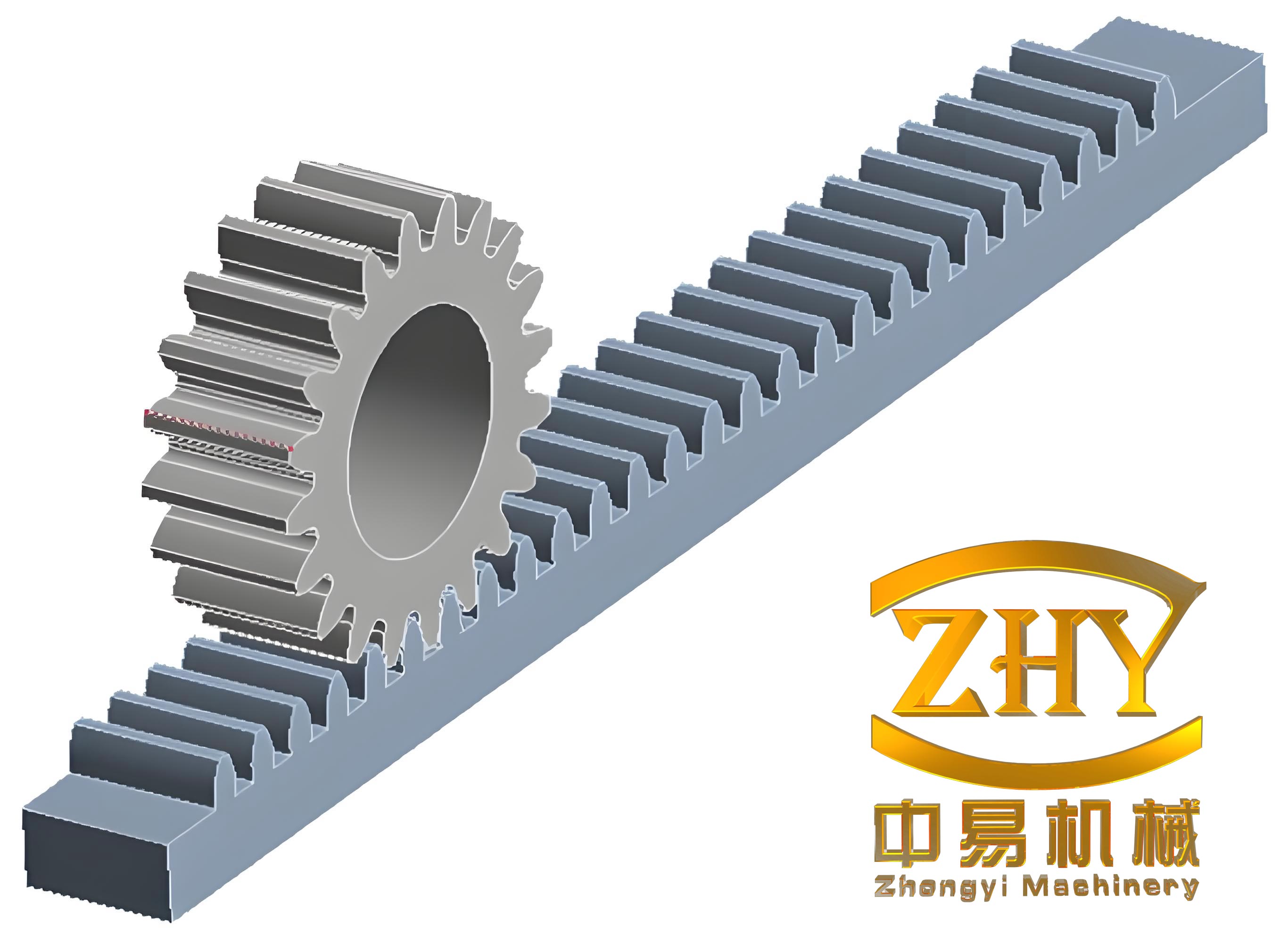
Optimizing the parameters of a rack and pinion gear steering system involves determining key variables such as the steering ratio, maximum steering wheel angle, tie-rod length, pinion pitch, and rack travel to meet specific vehicle dynamics targets. This article presents a comprehensive methodology that integrates kinematic and force analysis with multi-criteria decision-making. We utilize MATLAB for systematic computation and parameter search, and employ the TOPSIS (Technique for Order Preference by Similarity to Ideal Solution) method to select the optimal design from a set of feasible solutions that best balances light steering effort, high steering sensitivity, and good vehicle maneuverability.
1. Theoretical Foundation and Parameter Relationships
The design process begins with establishing the fundamental geometric and force relationships within the steering system. The primary goal is to calculate parameters like handwheel force, steering gear ratio, turning radius, and kingpin offset based on vehicle specifications and performance constraints.
1.1 Kinematic Geometry of Turning
For correct steering without tire scrub (Ackermann condition), the inner and outer wheel angles, denoted by $$ \beta $$ and $$ \alpha $$ respectively, satisfy the ideal relationship for a given wheelbase $$ L $$ and track width $$ B $$:
$$ \cot(\alpha) – \cot(\beta) = \frac{B}{L} $$
The turning radius $$ R $$ is primarily governed by the outer wheel angle $$ \alpha $$ and the wheelbase $$ L $$:
$$ R = \frac{L}{\sin(\alpha)} + a – \frac{B}{2} $$
where $$ a $$ is the kingpin offset (the lateral distance from the wheel center to the steering axis at the ground). The kingpin offset $$ a $$ influences steering effort and feel; a common initial design range is 40 mm ≤ a ≤ 60 mm. The minimum turning radius is typically constrained by the vehicle’s overall length and target maneuverability, often falling within the range of $$ 2L < R_{min} < 2.5L $$.
The inner wheel angle $$ \beta $$ can be derived from the combination of the ideal steering equation and the turning radius equation, establishing its relationship with $$ R $$, $$ L $$, $$ B $$, and $$ a $$.
1.2 Force Analysis and Steering Effort
The pivotal calculation for driver comfort is the handwheel force $$ F_h $$ required to turn the wheels, especially during low-speed or static maneuvers. This stems from the steering resistance moment $$ M_R $$ at the tires.
A common empirical formula for the steering resistance moment on a rigid surface is:
$$ M_R = \frac{f}{3} \sqrt{ \frac{G_1^3}{p} } $$
where:
• $$ f $$ is the coefficient of friction between tire and road (≈0.7),
• $$ G_1 $$ is the load on the steering axle,
• $$ p $$ is the tire pressure.
The force $$ F_w $$ required at the rack and pinion gear interface to overcome this moment is related to the kingpin offset $$ a $$:
$$ F_w = \frac{M_R}{a} $$
The steering system amplifies the driver’s input force through its mechanical advantage. The overall steering ratio $$ i_{\omega} $$ is the ratio of steering wheel angle to the average turn angle of the wheels. For a rack and pinion gear, it is directly related to the pinion’s rotational travel and the rack’s linear travel per revolution. It can also be expressed in terms of the maximum steering wheel revolutions $$ n $$ and the total wheel angle change:
$$ i_{\omega} = \frac{n \cdot 360^\circ}{(\alpha + \beta)} $$
Finally, the handwheel force $$ F_h $$ is calculated by considering the force balance, the overall ratio, and the system’s efficiency $$ \eta $$ (typically 0.85-0.95 for a rack and pinion gear system):
$$ F_h = \frac{2 M_R}{D \cdot i_{\omega} \cdot \eta} $$
where $$ D $$ is the steering wheel diameter. Design constraints usually specify a maximum allowable $$ F_h $$ (e.g., < 200 N for light trucks) and a maximum number of steering wheel turns $$ n $$ (e.g., < 6 turns lock-to-lock for commercial vehicles).
1.3 The TOPSIS Method for Multi-Criteria Decision Making
The kinematic and force equations often yield not one, but multiple sets of parameters ($$ \alpha, \beta, a, R, i_{\omega}, n $$) that satisfy the basic geometric and force constraints. The challenge is to select the single best set that optimally balances the often-conflicting objectives:
- Steering Lightness (Minimize $$ F_h $$)
- Steering Sensitivity (Minimize $$ i_{\omega }$$ or $$ n $$)
- Maneuverability (Minimize $$ R_{min} $$)
TOPSIS is an effective multi-criteria decision analysis method. Its core principle is to identify the solution that is simultaneously closest to the “ideal” best solution and farthest from the “nadir” worst solution. The steps are as follows:
Step 1: Construct the Normalized Decision Matrix. For $$ m $$ candidate designs and $$ n $$ evaluation criteria, create matrix $$ X = (x_{ij})_{m \times n} $$. Normalize it to matrix $$ Z = (z_{ij})_{m \times n} $$ to eliminate unit differences:
$$ z_{ij} = \frac{x_{ij}}{\sqrt{\sum_{i=1}^{m} x_{ij}^2}} $$
Step 2: Construct the Weighted Normalized Matrix. Assign weights $$ w_j $$ to each criterion (with $$ \sum_{j=1}^{n} w_j = 1 $$) reflecting their relative importance. The weighted matrix $$ V = (v_{ij})_{m \times n} $$ is calculated as:
$$ v_{ij} = w_j \cdot z_{ij} $$
For rack and pinion gear optimization, a typical weight distribution prioritizing lightness and sensitivity might be: $$ w_{F_h} = 0.45 $$, $$ w_{i_{\omega}} = 0.45 $$, $$ w_{R_{min}} = 0.10 $$.
Step 3: Determine the Ideal (A*) and Nadir (A-) Solutions.
$$ A^* = \{ (\max_i v_{ij} | j \in J_1), (\min_i v_{ij} | j \in J_2) \} = \{v_1^*, v_2^*, …, v_n^*\} $$
$$ A^- = \{ (\min_i v_{ij} | j \in J_1), (\max_i v_{ij} | j \in J_2) \} = \{v_1^-, v_2^-, …, v_n^-\} $$
where $$ J_1 $$ is the set of benefit criteria (to be maximized) and $$ J_2 $$ is the set of cost criteria (to be minimized). For our case, all three ($$ F_h $$, $$ i_{\omega} $$, $$ R $$) are cost criteria to be minimized.
Step 4: Calculate the Separation Measures. The Euclidean distance of each alternative $$ i $$ from the ideal and nadir solutions is computed:
$$ S_i^* = \sqrt{ \sum_{j=1}^{n} (v_{ij} – v_j^*)^2 } $$
$$ S_i^- = \sqrt{ \sum_{j=1}^{n} (v_{ij} – v_j^-)^2 } $$
Step 5: Calculate the Relative Closeness to the Ideal Solution.
$$ C_i^* = \frac{S_i^-}{S_i^* + S_i^-} $$
The alternative with the highest $$ C_i^* $$ value (closer to 1) is the best compromise solution.
2. Integrated Optimization Procedure: A MATLAB and TOPSIS Framework
The optimization procedure combines the analytical models with computational search and decision-making algorithms. The flowchart below illustrates the integrated process for optimizing the rack and pinion gear system parameters.
Phase 1: Feasible Parameter Search via MATLAB.
A MATLAB script is developed to systematically search the design space defined by the constraints.
1. Define fixed vehicle parameters: Wheelbase $$ L $$, Track $$ B $$, Gross Weight $$ G $$, Tire Pressure $$ p $$, Steering Wheel Diameter $$ D $$, Efficiency $$ \eta $$.
2. Define constraint ranges: $$ 2L < R < 2.5L $$, $$ a_{min} \le a \le a_{max} $$, $$ F_h < F_{h_{max}} $$, $$ n < n_{max} $$.
3. Implement a nested search loop:
• Outer loop: Iterate over potential minimum turning radii $$ R $$ within its range.
• Inner loop: Iterate over kingpin offset $$ a $$ within its range.
4. For each $$ (R, a) $$ pair, solve the kinematic equations to find the corresponding outer and inner steering angles $$ \alpha $$ and $$ \beta $$ that satisfy both the Ackermann condition $$ \cot(\alpha) – \cot(\beta) = B/L $$ and the turning radius equation $$ R = L/\sin(\alpha) + a – B/2 $$. Also, enforce $$ \alpha < \beta $$.
5. For each valid $$ (\alpha, \beta, a, R) $$ set, loop over possible steering wheel turns $$ n $$ (e.g., from 4.0 to 5.5 in steps of 0.1).
• Calculate the steering ratio $$ i_{\omega} = (n \cdot 360) / (\alpha + \beta) $$.
• Calculate the steering resistance moment $$ M_R $$ and rack force $$ F_w $$.
• Calculate the handwheel force $$ F_h = 2 M_R / (D \cdot i_{\omega} \cdot \eta) $$.
6. Store all design sets $$ [a, \alpha, \beta, R, n, i_{\omega}, F_h] $$ that satisfy the force and turn constraints ($$ F_h < F_{h_{max}}, n < n_{max} $$).
This process generates a matrix of feasible design alternatives.
Phase 2: Optimal Selection via TOPSIS.
1. Extract the columns for the key evaluation criteria from the feasible set matrix, typically $$ F_h $$, $$ i_{\omega} $$, and $$ R_{min} $$.
2. Construct the decision matrix $$ X $$ with these three columns.
3. Normalize matrix $$ X $$ to get $$ Z $$.
4. Apply the predetermined weight vector (e.g., [0.45, 0.45, 0.10]) to create the weighted normalized matrix $$ V $$.
5. Determine the ideal best $$ A^* $$ and ideal worst $$ A^- $$ vectors. Since all are cost criteria: $$ A^* = [\min(V_{F_h}), \min(V_{i_{\omega}}), \min(V_R)] $$ and $$ A^- = [\max(V_{F_h}), \max(V_{i_{\omega}}), \max(V_R)] $$.
6. Calculate the separation measures $$ S_i^* $$ and $$ S_i^- $$, and subsequently the relative closeness $$ C_i^* $$ for each feasible design.
7. Sort all designs in descending order of $$ C_i^* $$. The design with the highest $$ C_i^* $$ is the optimal compromise solution for the rack and pinion gear system.
3. Case Study: Optimization of a Light Truck Steering System
To demonstrate the methodology, we consider the design of a rack and pinion gear system for a micro-truck with the following specifications and constraints:
| Parameter | Symbol | Value / Constraint |
|---|---|---|
| Wheelbase | $$ L $$ | 3300 mm |
| Track Width | $$ B $$ | 1400 mm |
| Gross Vehicle Weight | $$ G $$ | 3000 kg |
| Steering Axle Load | $$ G_1 $$ | $$ 0.3 \times G = 9000 \, N $$ |
| Tire Pressure | $$ p $$ | 0.2 MPa |
| Steering Wheel Diameter | $$ D $$ | 425 mm |
| Steering System Efficiency | $$ \eta $$ | 0.97 |
| Friction Coefficient | $$ f $$ | 0.7 |
| Min. Turning Radius Constraint | $$ R_{min} $$ | $$ 6600 \, mm < R < 8250 \, mm $$ |
| Kingpin Offset Search Range | $$ a $$ | 45 mm to 55 mm |
| Max. Handwheel Force | $$ F_{h_{max}} $$ | 200 N |
| Max. Steering Wheel Turns (lock-to-lock) | $$ n_{max} $$ | 6 turns |
The MATLAB search algorithm, implementing the logic from Phase 1, produced numerous feasible parameter sets. A subset of the results, along with the calculated force transmission ratio $$ i_p = F_w / F_h $$ and rack force $$ F_w $$, is shown below. The search for steering wheel turns $$ n $$ was conducted from 4.2 to 5.2 turns.
| Candidate # | Kingpin Offset $$ a $$ (mm) | Outer Angle $$ \alpha $$ (°) | Inner Angle $$ \beta $$ (°) | Min. Turn Radius $$ R $$ (mm) | Steering Wheel Turns $$ n $$ | Steering Ratio $$ i_{\omega} $$ | Handwheel Force $$ F_h $$ (N) | Rack Force $$ F_w $$ (N) | Force Ratio $$ i_p $$ |
|---|---|---|---|---|---|---|---|---|---|
| 1 | 49 | 28.91 | 33.89 | 6890 | 4.5 | 25.87 | 84.71 | 18220 | 215.1 |
| 2 | 50 | 28.75 | 33.72 | 6910 | 4.8 | 27.66 | 78.14 | 17819 | 228.1 |
| 3 | 51 | 28.59 | 33.55 | 6930 | 4.9 | 28.15 | 76.53 | 17470 | 228.2 |
| 4 | 52 | 28.43 | 33.38 | 6950 | 5.0 | 28.64 | 75.01 | 17141 | 228.5 |
| 5 | 53 | 28.28 | 33.22 | 6970 | 5.1 | 29.14 | 73.57 | 16830 | 228.8 |
| … | … | … | … | … | … | … | … | … | … |
TOPSIS Analysis: The three main criteria for evaluation are $$ F_h $$ (minimize), $$ i_{\omega} $$ (minimize for sensitivity), and $$ R $$ (minimize). The weight vector $$ w = [0.45, 0.45, 0.10] $$ is applied, emphasizing a balance between lightness and sensitivity over maneuverability. Following the steps outlined in Section 1.3, the relative closeness $$ C_i^* $$ was calculated for all candidate designs.
The candidate with the highest $$ C_i^* $$ score was identified as the optimal solution. Its parameters are summarized as the final design recommendation for the rack and pinion gear system.
| Optimized Parameter | Symbol | Optimal Value | Constraint Check |
|---|---|---|---|
| Steering Ratio (Overall) | $$ i_{\omega} $$ | 27.66 | Within typical range (e.g., 23-32) |
| Minimum Turning Radius | $$ R_{min} $$ | 6910 mm (≈2.09L) | ✓ 6600 < 6910 < 8250 mm |
| Kingpin Offset | $$ a $$ | 50 mm | ✓ 45 ≤ 50 ≤ 55 mm |
| Maximum Outer Wheel Angle | $$ \alpha $$ | 28.75° | – |
| Maximum Inner Wheel Angle | $$ \beta $$ | 33.72° | ✓ $$ \alpha < \beta $$, Ackermann satisfied |
| Steering Wheel Turns (lock-to-lock) | $$ n $$ | 4.8 turns | ✓ 4.8 < 6.0 turns |
| Handwheel Force (Theoretical Max) | $$ F_h $$ | 78.14 N | ✓ 78.14 < 200 N |
| Steering Resistance Moment | $$ M_R $$ | 890.96 Nm | – |
| Rack Force | $$ F_w $$ | 17819 N | – |
| Force Transmission Ratio | $$ i_p $$ | 228.05 | – |
4. Discussion and Conclusion
The presented methodology provides a systematic, quantitative framework for the design and optimization of rack and pinion gear steering systems. By leveraging MATLAB’s computational power for exhaustive search within defined constraints, engineers can generate a comprehensive set of feasible design alternatives that meet basic kinematic and force requirements. The subsequent application of the TOPSIS multi-criteria decision-making method introduces a rigorous and transparent process for selecting the best compromise solution when faced with conflicting performance objectives.
The case study demonstrates the practical utility of this approach. The optimal design point selected by TOPSIS successfully balances the key attributes: a relatively low handwheel force of 78.1 N ensures good steering lightness, a steering ratio of 27.66 offers a reasonable balance for sensitivity, and a turning radius of 6.91 meters provides adequate maneuverability for a vehicle of this size, all while respecting all specified geometric and performance constraints. The number of steering wheel turns at 4.8 is also within an acceptable range for driver usability.
This integrated rack and pinion gear optimization process, combining analytical modeling, computational search, and formal decision theory, moves beyond traditional iterative or experience-based design. It offers a repeatable, data-driven strategy that can be adapted to various vehicle classes and performance targets by adjusting the input parameters and TOPSIS weighting factors, ultimately contributing to the development of more efficient and driver-friendly steering systems.