
In our factory, the drive to overcome production bottlenecks and meet urgent manufacturing goals has often led us down a path of self-reliance and innovation. Faced with the need to efficiently machine complex components like brake shoe assemblies and, most critically, the helical bevel gear for heavy-duty mining trucks, conventional universal machine tools proved insufficient. They were slow, failed to guarantee consistent quality, and became a constraint on our output. This narrative details our hands-on journey in designing a specialized multi-spindle drilling machine and, more significantly, retrofitting a standard lathe into a functional spiral helical bevel gear generator. These solutions, born from necessity, embody simplicity in design, calculation, and operation.
Our first challenge was machining multiple rivet holes on brake shoes. The requirement for high precision and consistent spacing across several holes called for a dedicated setup. We conceptualized and built a multi-spindle drilling machine with a planetary gear system to drive multiple spindles simultaneously from a single power source.
The core transmission mechanism is designed around a central “sun” gear. The motor transmits power to this main gear, which is connected to the central drive shaft via a one-way clutch. This clutch incorporates a protective device with rollers and springs, allowing transmission in one direction and slipping in reverse to prevent damage. The key to multi-spindle operation lies in a large bevel gear mounted on this assembly. Arranged around its circumference are several small bevel gears, the quantity of which equals the number of holes to be drilled. Each small bevel gear drives an intermediate gear set, culminating in the rotation of an individual drill spindle. The rotational speed of each spindle is precisely determined by the gear train.
Simultaneously, the large bevel gear also drives a pair of planetary gears meshing with an output gear. This stage provides a significant speed reduction, driving a cam at a very slow rate. The cam’s profile then actuates a push rod, which, through a system of hinged levers (one per spindle), converts the rotary motion into a controlled axial feed for all drill spindles. The feed per revolution is a critical parameter set by this mechanism. Each spindle is housed in a sleeve with a return spring to retract the drill after the operation. The entire gear system is enclosed in an oil-filled cylindrical body, ensuring excellent lubrication, reduced noise, and easier assembly. The workpiece fixture, complete with drill bushings, locating pins, and a quick-clamp mechanism, completes the system. The machine’s design allows one half to process front brake shoe holes while the other half handles rear shoe holes, doubling efficiency.
While the multi-spindle drill solved one problem, a greater challenge awaited: manufacturing the crucial spiral helical bevel gear pairs for our 32-ton mining truck. Without dedicated gear-cutting equipment, we turned our attention to a ubiquitous machine tool in our workshop: the standard lathe. Our goal was to retrofit it to perform the complex generation of a spiral helical bevel gear tooth form.
The fundamental principle we adopted involves the synchronous motion of a rotating cutter and the workpiece. A crown wheel (or “swing” frame) is mounted to the lathe’s headstock. This crown wheel holds an adjustable eccentric cutter head. The cutter head rotates on its own axis (the “cutter spin”) driven by gearing from the lathe spindle. Furthermore, the entire crown wheel is made to undergo a slow rotational oscillation (“cutter tilt” or generating motion) via a gear train connected to the lathe’s lead screw. The workpiece is mounted on a fixture on the lathe’s saddle. This fixture can be adjusted for height and tilt angle. Most importantly, it is connected through a set of change gears (the “ratio gears”) back to the lathe’s bed motion, causing the workpiece to rotate slowly in a precise timed relationship with the oscillation of the crown wheel. The lathe carriage feed provides the radial infeeding motion. This setup simulates the relative rolling motion between a theoretical generating gear and the workpiece, essential for producing the correct helical bevel gear tooth geometry.
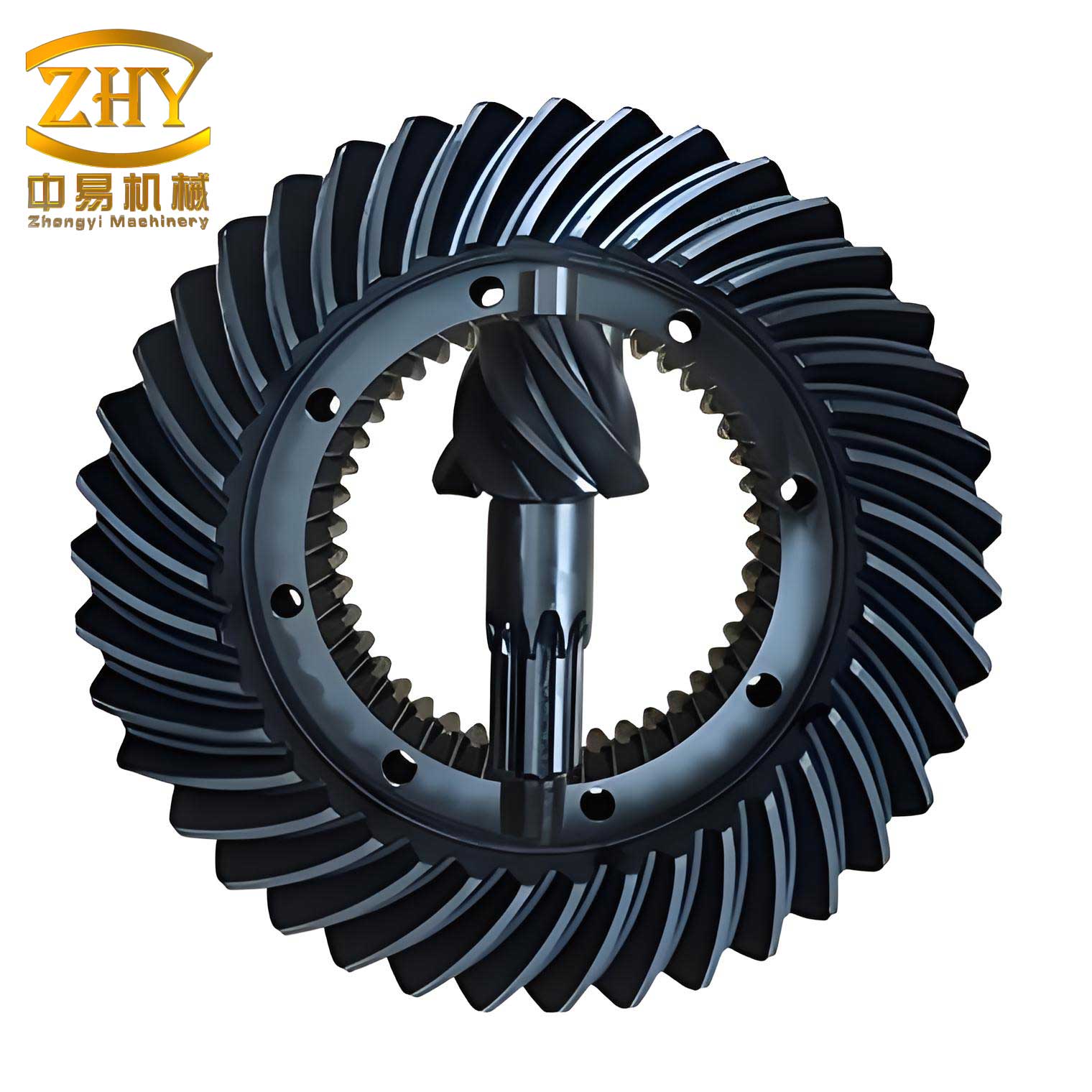
The setup and adjustment for cutting a helical bevel gear pair are methodical. First, the workpiece position is adjusted so its pitch cone apex lies on the centerline of the crown wheel’s oscillation. The angle between the workpiece axis and the crown wheel axis is set to $(90^\circ – \gamma)$, where $\gamma$ is the root angle of the gear, ensuring the tooth root is parallel to the plane of the crown wheel. The cutter head’s eccentricity is a critical setting, calculated to position the cutting tools correctly relative to the tooth space. The rolling ratio between the workpiece rotation and the crown wheel oscillation, fundamental to generating the correct tooth profile, is determined by the gear teeth numbers.
For the gear (larger member of the pair), our process was two-stage. Roughing was done without the generating motion (no workpiece rotation), using three cutters on the head to quickly remove bulk material, leaving a defined finish allowance. Finishing employed the full generating motion with two cutters on the head to simultaneously generate both flanks of the tooth. After each tooth is finished, the tool retracts, the workpiece is indexed manually, and the machine cycle reverses to start the next tooth.
Machining the pinion (smaller gear) was more involved, requiring three generating passes. A roughing cut with three tools was followed by two separate finish cuts: one using an “outer” blade to finish the concave side of the tooth, and another using an “inner” blade to finish the convex side. This separation ensures proper control over the tooth contact pattern.
Lacking a dedicated sharpening machine, we fabricated our own cutter head with adjustable blade diameters. The cutting tools were ground manually from high-speed steel (white steel) on a standard grinder, using angle templates as guides. Despite this manual approach, we achieved satisfactory results. The cutting speed (cutter head rotation) was maintained at approximately 100 rpm. The geometry of the inner (convex) and outer (concave) cutting tools is paramount. The key angles are summarized below:
| Tool Type | Function | Critical Angles (Example) |
|---|---|---|
| Inner Cutting Tool | Cuts convex side of pinion tooth / concave side of gear tooth | Clearance Angle, Hook Angle, Edge Angle specific to gear design. |
| Outer Cutting Tool | Cuts concave side of pinion tooth / convex side of gear tooth | Clearance Angle, Hook Angle, Edge Angle (mirrored relative to inner tool). |
| Roughing/Chamfer Tool | Initial stock removal and tooth space opening | Designed for high metal removal. |
The heart of the setup lies in a few core calculations, which we simplified from complex standard formulae. The first is the calculation for the cutter head eccentricity ($E$), which positions the cutting circle relative to the gear blank.
$$E = R_c \cdot \sin(\beta)$$
Where $R_c$ is the nominal cutter radius, and $\beta$ is the spiral angle at the mean point of the tooth. The mean point radius $R_m$ is derived from the outer cone distance ($A_o$) and the face width ($F$):
$$R_m = A_o – \frac{F}{2}$$
The spiral angle $\beta_m$ at this point is a design given. This $E$ value is physically set on the eccentric cutter head mount.
The second, and most crucial, set of calculations determines the rolling ratio ($i$), which dictates the change gear combination. For generating the pinion, the ratio is based on the number of teeth in the theoretical generating gear (often a virtual crown wheel with $Z_p$ teeth) and the actual pinion ($z_1$).
$$i_{pinion} = \frac{Z_p}{z_1}$$
For generating the gear, the ratio is based on the same generating gear and the actual gear ($z_2$).
$$i_{gear} = \frac{Z_p}{z_2}$$
These ratios ensure the workpiece and cutter tilt maintain the correct kinematic relationship to generate an exact conjugate helical bevel gear tooth form. The machine’s gear train is configured to realize this ratio $i$.
The following table summarizes key parameters and outcomes from our initial trial production of a helical bevel gear pair for a truck application:
| Parameter | Pinion | Gear | Notes |
|---|---|---|---|
| Number of Teeth | $z_1 = 6$ | $z_2 = 41$ | High ratio, common in truck differentials. |
| Module (approx.) | ~10 mm | ~10 mm | Indicating a large, heavy-duty gear. |
| Spiral Angle | $35^\circ$ – $40^\circ$ | $35^\circ$ – $40^\circ$ | Standard range for spiral bevel gears. |
| Cutting Process | 3 passes (Rough, Finish Concave, Finish Convex) | 2 passes (Rough, Finish) | Pinion requires more precise, separate flank finishing. |
| Surface Finish Achieved | ~Ra 3.2 μm | ~Ra 3.2 μm | Achieved via manual tool grinding and proper setup. |
| Contact Pattern Check | Satisfactory after lapping | Satisfactory after lapping | The final validation of a correctly generated helical bevel gear mesh. |
The results were encouraging. We successfully produced three pairs of spiral helical bevel gears that met basic technical specifications. The tooth contact pattern, verified through a standard lapping procedure, was acceptable for the application. This demonstrated the viability of the retrofit concept. However, the setup was not without its limitations. The primary issue was backlash in the long kinematic chain of change gears driving the workpiece rotation. This could cause non-uniform motion during the delicate generating cut, potentially affecting surface finish. We identified that replacing the spur gear change gear train with a worm gear drive could significantly reduce this play and improve cutting stability. Furthermore, the process involved considerable manual intervention—indexing, reversing the machine cycle, and tool changing—which presented an opportunity for future automation or semi-automation to boost productivity and consistency.
In parallel to the gear project, to streamline other production lines, we also designed and built a dedicated transfer line using modular unit principles for machining the steering gear housing of the same 32-ton mining truck. This line comprised four special machine stations built on standardized bases, slide units, and power heads, all hydraulically operated. The key was the use of interchangeable fixtures and tools, allowing the same line to machine different housing variants with minimal changeover time. This philosophy of modular, purpose-built machines complemented our approach of retrofitting existing equipment, together forming a strategy of pragmatic manufacturing innovation.
In retrospect, the journey of transforming a common lathe into a helical bevel gear cutter was a profound learning experience. It underscored that with a clear understanding of fundamental gear generation principles, even limited resources can be leveraged to solve complex manufacturing challenges. The simplified calculations for cutter positioning and rolling ratio formed the theoretical backbone. The practical implementation—from building the eccentric cutter head and manually grinding tools to the meticulous alignment and multi-stage cutting process—validated the approach. While the machine lacked the refinement and automation of commercial gear generators, it served its purpose effectively, breaking a critical dependency and enabling in-house production of a vital component. The experience with the multi-spindle drill and the steering housing line further reinforced the value of tailored, simple automation. These projects collectively highlight a mindset: that innovation in a manufacturing context is often about intelligent adaptation, simplifying complexity, and a hands-on willingness to bridge the gap between theory and shop-floor reality to produce essential components like the durable helical bevel gear.