
The precision forging process for helical bevel gears represents a significant advancement in manufacturing technology, offering an effective means to reduce costs and enhance production efficiency. Compared to traditional gear cutting methods, this process possesses several distinct characteristics: it increases the strength and wear resistance of the gear teeth, minimizes heat treatment deformation, ensures stable meshing noise, facilitates easy tooth profile modification (such as achieving a crowned tooth form), saves steel material, lowers costs, and improves work efficiency. Consequently, since the 1960s, countries including Germany, the United Kingdom, France, the United States, and Japan have successively engaged in trial forging and batch production. Domestically, while precision forging of straight bevel gears has been adopted for batch production by many factories, the precision forging of helical bevel gears remains limited to experimental research or small-batch production by a few entities. Key challenges persist, including low mold processing efficiency, insufficient precision, and low yield rates for precision-forged gears.
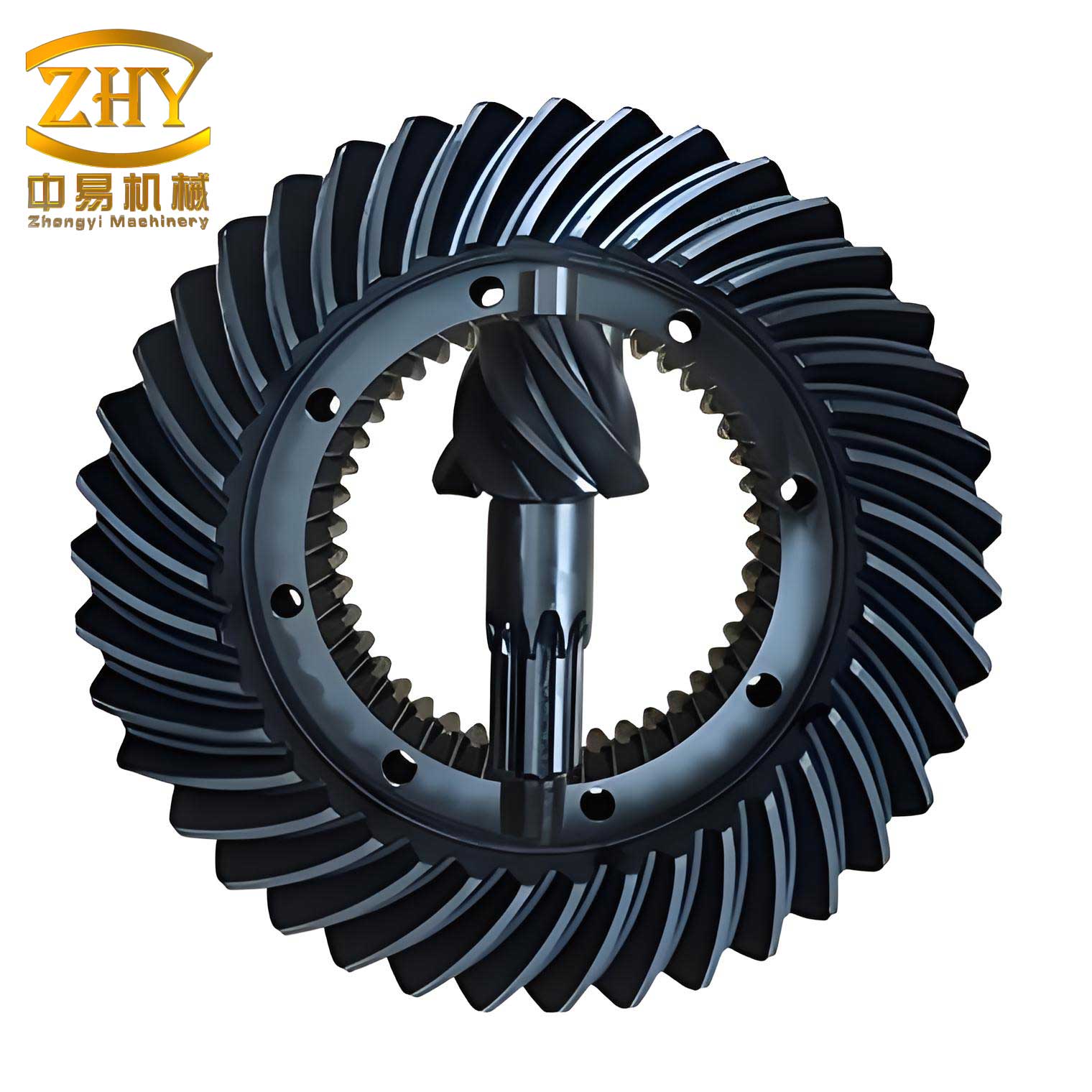
In 1978, based on a mandated task, relevant experimental research was conducted, leading to the development of a set of multi-electrode Electrical Discharge Machining (EDM) processes for machining the die cavities of driven helical bevel gear precision forging molds. This article provides a brief introduction to this methodology.
Electrode Design and Manufacturing
Electrode design and manufacturing constitute a critical aspect of the EDM process, encompassing the selection of electrode material, determination of the electrode structure, and calculation of electrode dimensions. According to the requirements of the precision forging process, three types of tooth profile cavities are needed for each helical bevel gear: the hot precision forging die, the cold sizing die, and the tooth profile fixture positioning plate.
1. Selection of Electrode Material
In domestic EDM for cavity molds, graphite and copper are commonly used as electrode materials. A comparative analysis of their properties is presented in the table below.
| Property | Copper | Graphite |
|---|---|---|
| EDM Performance | Excellent performance, good stability, resistant to arcing. Low wear achievable in roughing and semi-finishing with adjusted parameters. Low wear in finishing possible with specific pulse sources. Good surface finish (~V5). | Excellent performance, high productivity, lower wear than copper under same conditions. More prone to arcing. Difficult to achieve low wear in finishing. Wear less sensitive to flushing pressure. |
| Formability | Good ductility, can be forged, dense structure. Can achieve high surface finish, less prone to chipping/burring. Difficult to grind, large burrs after machining. | Poor ductility, low strength, easy to form but prone to chipping/burring. Machining creates dust harmful to equipment and health. |
| Manufacturing Methods | Machining, forging, electroforming, spraying, etc. | Machining, press vibration molding, etc. |
| Other Characteristics | High density (heavy electrode), good thermal conductivity, low resistivity. | Low density (light electrode), poor thermal conductivity, high resistivity. |
| Material Requirements | Must be forged, free of impurities/defects. | Dense, fine grain, uniform, low porosity, low ash content, high strength. |
Experiments with both materials indicate that, overall, copper is more suitable. Copper electrodes offer stable machining, and with modified power supplies, low wear can be achieved in roughing and semi-finishing. Using comb-shaped or continuous pulse sources enables low-wear finishing, greatly benefiting die cavity accuracy. The machined cavity surface finish is good, reaching approximately V5. The poorer formability of copper is not an issue here, as the electrodes can be conveniently machined on a helical bevel gear milling machine. Furthermore, copper has better mechanical strength and is less prone to chipping or corner collapse compared to graphite. Since helical bevel gear milling machines are precision tools (often imported), graphite dust can contaminate the machine, wear down guides, and pose health risks, making workshops reluctant to use it. Graphite’s low strength also leads to poor positioning accuracy when using cylindrical pin repeat-positioning fixtures, potentially causing one-sided machining. However, copper’s high density makes electrodes heavy, which can degrade the dynamic performance of the spindle head if its load capacity is insufficient. Additionally, electrode wear is sensitive to changes in flushing pressure, sometimes leading to increased or uneven wear. Therefore, graphite electrodes may also be used for roughing in certain scenarios. Other materials like brass, copper-tungsten, silver-tungsten, or steel are not suitable.
2. Determination of Electrode Structure
Considering the multi-electrode machining approach, the electrode structure is as shown in the schematic. To ensure repeatable accuracy during gear cutting and during electrode更换 in EDM, precision cylindrical locating pin holes are machined on the cutting fixture, the EDM repeat-positioning fixture, and the electrodes themselves. These holes, with a diameter of $\phi$ D and located at a distance L from the centerline, allow a precision cylindrical pin to be inserted, ensuring the positional accuracy of the tooth slot relative to the pin hole during both gear cutting and EDM operations.
3. Determination of Electrode Dimensions
The dimensions for electrodes used to machine the hot forging die, cold sizing die, and fixture positioning plate cavities are determined considering the following aspects:
- The tooth profile of the cold sizing die and fixture positioning plate cavity should match the standard product gear, though the diameters at the toe and heel differ.
- Based on the EDM spark gap and the tooth profile requirements of the cold sizing die and fixture plate, the electrode tooth profile for these is determined.
- For the hot forging die, the tooth profile dimensions are determined based on the cold sizing allowance from the forging process and the thermal expansion规律 of the tooth profile. Then, considering the EDM spark gap, the corresponding electrode tooth profile is finalized.
- The EDM discharge gap is considered to be uniformly distributed along the normal direction of the tooth flank. The finishing gap is typically taken as $\delta_j \approx 0.02$ mm.
Since a multi-electrode process is used, machining one cavity requires two (rough/finish) or three (rough/semi-finish/finish) electrodes. For cavities with straight sidewalls or those with large spiral angles, the following factors must be considered:
- To ensure dimensional accuracy and surface finish of the straight wall section, the outer diameter of the roughing and semi-finishing electrodes is reduced by (1-2) mm, while other dimensions remain unchanged.
- For cavities with large spiral angles and large modules, to ensure the finishing electrode can fully dress the profile, the tooth profile section of the roughing/semi-finishing electrodes is uniformly reduced in size (typically reducing the single-side tooth thickness by 0.1-0.2 mm), with other dimensions unchanged.
The required surface finish for the electrode tooth profile is V6. To achieve a final forged gear accuracy of grade 8 (per GB 11365-89) after heat treatment, the electrode and standard gear machining accuracy should reach grade 6 or better (towards grade 5).
4. Electrode Manufacturing
Currently, mechanical milling is used. The copper blank must be forged before machining to ensure a dense structure, which helps reduce wear and improve surface finish. To uniformly reduce the electrode tooth profile dimensions by a specific amount, chemical etching can be employed.
EDM of the Die Cavity
The EDM process for helical bevel gear precision forging die cavities primarily includes: mold structure and pre-machining, electrode alignment and centering, comparison of machining methods, selection and transition of electrical parameters, control of cavity depth, and related issues. The adoption of the multi-electrode method and the selection/transition of electrical parameters form the core of this process.
1. Mold Structure and Pre-machining
Common structures for hot forging and cold sizing dies are shown in schematics. From the perspective of facilitating flushing and debris removal during EDM, certain structures are preferable. Regardless of the type, pre-machining is required before EDM: all dimensions except the tooth slots are turned. EDM is then used primarily to machine the tooth profile slots, shortening the overall mold processing cycle.
2. Electrode Alignment and Centering
To ensure uniform cavity depth and minimize tooth profile error, the electrode’s reference plane must be parallel to the module surface (or worktable). This is typically checked with a dial indicator, requiring non-parallelism error $< 0.01$ mm over 100 mm. An end-face imprint method can also be used for verification. To ensure the electrode and module (or fixture plate) centerlines coincide (centering), several methods can be used: outer diameter positioning, positioning sleeve, feeler gauge alignment, V-block with dial indicator, and dedicated centering tools. The dedicated tool offers the highest accuracy, with a concentricity error of about $\pm 0.01$ mm.
3. Comparison of Machining Methods
The tooth profile of a helical bevel gear forging die cavity is a complex spatial curved surface requiring high precision. Therefore, the conventional single-electrode penetration with orbital finishing method is unsuitable. Based on experiments, the following methods can be employed:
- Multi-electrode Machining: Using two or more electrodes to machine one cavity. A repeat-positioning fixture is essential. A high-precision cylindrical pin定位 method is used. This method is simple, convenient, and offers good repeatability. It requires high machining accuracy for both electrodes and fixtures. The number of electrodes depends on wear, accuracy, and finish requirements. Currently, 2-3 electrodes are considered appropriate and this is the primary method used.
- Multi-electrode with Orbital Motion: Using multiple electrodes while applying a slight orbital motion (e.g., 0.1-0.2 mm bilateral) during finishing. Experiments show this improves debris removal, helps dress the cavity, results in a more uniform and better surface finish, and reduces machining time. However, it increases the measured side clearance variation. It still meets requirements for small-batch forging trials.
- Electrode Rotation Method: For cavities with large spiral angles, if electrodes are identical, the concave tooth flank is difficult to dress fully. An electrode rotation fixture can be used. After roughing, for each parameter change, a screw is adjusted to rotate the electrode by a certain angle, ensuring the concave surface is dressed. When electrode wear occurs, rotation causes unequal machining amounts at the toe and heel, affecting form accuracy. However, with low-wear semi-finishing/finishing power supplies, the impact is smaller. This method is relatively simple and yields a cavity with uniform finish. It can also replace the repeat-positioning fixture in multi-electrode machining, but requires high fixture accuracy and coaxiality.
- Electrode Rotary Feed Method: For driving gear die cavities or driven gear cavities with very large spiral angles where the tooth profile投影 overlaps in the vertical direction, this method can be used. The spindle is mounted on bearings to rotate freely. During feed, the electrode’s rotation speed is synchronized with the axial feed direction at any given position, achievable via independent lead control cams, standard tooth profile guidance, or helical groove guidance. This method solves the machining problem for cavities with overlapping projections and ensures uniform material removal, benefiting accuracy and finish. Care must be taken to avoid interference between the electrode and the already-formed cavity, which can cause significant profile errors.
4. Selection and Transition of Electrical Parameters
Forging die cavities demand high form accuracy, good surface finish (~V5), and improved efficiency compared to current levels. Thus, specific requirements for power supply parameters are:
- Roughing: High productivity, low electrode wear, small machining gap and surface roughness to aid subsequent finishing.
- Semi-finishing: Moderate productivity, low electrode wear, gap and finish介于 roughing and finishing.
- Finishing: Finish ~V5, electrode wear as low as possible (ideally $<1\%$), with practical productivity.
Initial tests with existing power supplies (transistor-based RLC and thyristor-based JF-80) showed that even roughing/semi-finishing with copper electrodes could not achieve low wear. After modifying the JF-80 thyristor supply, requirements were preliminarily met. The roughing parameters used a post-peak waveform circuit, reliable for long-duration, high-current machining. Semi-finishing used a pre-peak circuit, offering good stability and low wear. Finishing used a triangular wave circuit, stable and efficient but with higher wear, as summarized in the table below (Parameter Set A).
| Stage | Waveform | Pulse Width ($\mu s$) | Interval ($\mu s$) | Peak Current (A) | Avg. Current (A) | Wear Ratio | Productivity (mm³/min) | Gap (mm) | Finish (Ra $\mu m$) |
|---|---|---|---|---|---|---|---|---|---|
| Roughing | Post-peak | 500 | 100 | 60 | 15 | $< 0.5\%$ | ~180 | ~0.20 | >12.5 |
| Semi-finish | Pre-peak | 150 | 50 | 25 | 8 | $< 1\%$ | ~60 | ~0.10 | ~6.3 |
| Finishing (A) | Triangular | 25 | 25 | 10 | 2.5 | ~10-15% | ~12 | ~0.04 | ~3.2 |
To reduce finishing wear, a thyristor-based comb-shaped pulse power supply was adopted. Its characteristics include low electrode wear during finishing with practical productivity. With process measures like flushing and periodic electrode lift, it can machine large areas and is well-suited for helical bevel gear forging dies. Its parameters are summarized below (Parameter Set B).
| Waveform | Pulse Width ($\mu s$) | Interval ($\mu s$) | Peak Current (A) | Polarity / Flushing | Wear Ratio | Productivity (mm³/min) | Gap (mm) | Finish (Ra $\mu m$) |
|---|---|---|---|---|---|---|---|---|
| Comb-shaped | 10-50 | 10-50 | 5-15 | (-) / Flush | $< 3\%$ | 8-20 | 0.02-0.05 | 1.6-3.2 |
The transition of electrical parameters is primarily aimed at progressively dressing the rough surface left by roughing while maintaining form accuracy. The tooth profile cross-section is approximately trapezoidal (actually an involute), and the lateral dressing amount can be achieved through axial feed, as illustrated schematically. The relationship is given by:
$$ \Delta L = \frac{\Delta S + (R_{a1} – R_{a2})}{\sin \beta} $$
where:
$\Delta L$ is the axial feed amount for dressing (semi-finishing/finishing).
$\Delta S = S_1 – S_2$ is the difference in spark gap before and after dressing.
$R_{a1} – R_{a2}$ is the difference in surface roughness, representing the actual minimum lateral dressing amount.
$\beta$ is the angle between the tooth flank and the spindle feed direction.
For a helical bevel gear, $\beta$ is a variable (larger on the convex side, smaller on the concave side, making the concave side harder to dress). Therefore, a relatively small value for $\beta$ is used in calculation, and the resulting $\Delta L$ is verified through process trials.
5. Control of Cavity Depth Dimension
Utilizing the characteristics of a stepping hydraulic head, cavity depth control is effectively managed. The specific procedure is:
- Machine a standard plate with a known, measurable thickness $H_s$.
- Place it on the die block. Initiate a finishing discharge between the electrode and the standard plate, setting this as the zero point (e.g., clearing the digital readout).
- Input the required feed amount for the electrode toe tooth tip. The calculation formula is: $$ L_f = H_c + H_s + \Delta H $$ where $L_f$ is the feed depth for the toe, $H_c$ is the required cavity depth, $H_s$ is the standard plate thickness, and $\Delta H$ is a compensation amount for electrode wear during finishing (typically 0.05-0.10 mm).
- Retract the electrode to the top zero position (see schematic), and note the digital readout value $D_0$ at this zero.
- If machining stops or power fails, one can reset at the zero position with value $D_0$ and continue. Machining proceeds until the digital readout decreases to zero, indicating the required depth is reached.
This method offers clear and intuitive reading, facilitates parameter transition, and controls depth error to within about $\pm 0.02$ mm, essentially meeting the requirements for precision forging die cavities.
6. Related Issues
Key issues are machining accuracy, cavity accuracy inspection, and surface finish.
Machining Accuracy: This is paramount. Factors include:
- Electrode Accuracy & Wear: Electrode machining errors or damage are fully replicated on the cavity. Therefore, electrode manufacturing accuracy must be high, typically two grades higher than the target forged gear accuracy. Electrodes must be rigorously inspected before EDM. Wear, primarily from finishing, rounds sharp corners, increases side clearance variation, and degrades form accuracy. However, since wear is relatively uniform across teeth and is mainly axial (compensated for), the resulting error is small.
- Machine & Fixture Accuracy/Rigidity: Poor spindle feed accuracy or weak fixture rigidity increases error. Spindle error should be $< 0.01$ mm over 100 mm travel. The repeat-positioning fixture must be rigid to prevent movement.
- Alignment & Centering Error: Large leveling error causes inconsistent slot depth and affects single-tooth pitch and runout. For fixture plates, high centering accuracy is critical to avoid eccentricity causing periodic runout error.
- Electrical Parameter Selection: Parameters should be adjusted as machining area changes. Current density should generally be $< 0.1 A/cm^2$. Excessive density or improper parameter matching can cause arcing, damaging accuracy.
- Flushing Pressure: Essential for efficiency and stability. Pressure is typically lower for roughing (~0.1-0.2 kgf/cm²) and slightly higher for finishing. Once set, pressure should not be changed arbitrarily to avoid electrode shift due to force variation.
- Electrode Change Operation: Must be performed carefully and precisely to maintain定位 accuracy.
Cavity Accuracy Inspection: This remains a challenge. One approach is to use low-melting-point alloy casting, but results are often unsatisfactory. Given the multi-electrode process, upon finishing, the electrode and cavity differ only by a uniform finishing spark gap. Therefore, cavity accuracy can be indirectly assessed by inspecting the finishing electrode. Inspection results for a sample motorcycle helical bevel gear finishing electrode are shown below.
| Item | Standard Gear | Hot Forging Electrode (Pre-EDM) | Hot Forging Electrode (Post-EDM) | Cold Sizing Electrode (Pre-EDM) | Cold Sizing Electrode (Post-EDM) |
|---|---|---|---|---|---|
| Tooth-to-Tooth Composite Error | Grade 5 | Grade 4 | Grade 5 | Grade 4 | Grade 5 |
| Total Composite Error | Grade 6 | Grade 5 | Grade 6 | Grade 5 | Grade 6 |
| Runout | Grade 5 | Grade 4 | Grade 5 | Grade 4 | Grade 5 |
| Side Clearance Variation | Grade 7 | Grade 6 | Grade 7 | Grade 6 | Grade 7 |
Surface Finish: For hot forging dies, a finish of V5 is generally adequate. The small craters from EDM can help retain lubricant. Furthermore, the cavity surface becomes smoother with repeated forging. For cold sizing dies and fixture plates, a higher finish is desired, necessitating a finishing process. Factors affecting finish include: limitations of the multi-electrode method (small $\beta$ on concave side), mold structure hindering flushing, improper parameter transition, flushing pressure changes or dirty fluid, and electrode deformation or improper handling during changes.
Machining Examples
Using a machine equipped with a stepping hydraulic head and a modified JF-80 thyristor high/low voltage dual-pulse power supply, over twenty sets of cavities for hot forging dies, cold sizing dies, and fixture positioning plates for various helical bevel gears have been machined. Examples include:
| Workpiece | Electrode (Material, Qty) | Workpiece Material | Working Fluid / Flushing | Max Current (A) | Machining Time (hr:min) | Surface Finish (Ra $\mu m$) |
|---|---|---|---|---|---|---|
| φ58mm Motorcycle Driven Helical Bevel Gear Hot Forging Die | Copper (2) | 5CrNiMo | Kerosene / Bottom Flush | 60 | 5:20 | ~3.2 |
| φ128mm Taishan-12 Tractor Driven Helical Bevel Gear Hot Forging Die | Copper (2) | 5CrNiMo | Kerosene / Bottom Flush | 80 | 12:00 | ~3.2 |
| φ128mm Taishan-12 Tractor Driven Helical Bevel Gear Fixture Plate | Copper (1) | T10A | Kerosene / Bottom Flush | 30 | 3:30 | ~1.6 |
| φ108mm Dongfanghong-20 Tractor Driven Helical Bevel Gear Hot Forging Die (Prototype) | Copper (3) | 5CrNiMo | Kerosene / Bottom Flush | 60 | 15:00 | ~3.2 |
Technical-Economic Results and Future Directions
Through nearly two years of experimentation, actual mold machining, and batch trial production, the multi-electrode EDM process for precision forging die cavities has proven fundamentally successful, yielding the following technical-economic benefits:
- Using the modified thyristor dual-pulse power supply, low electrode wear with copper electrodes was achieved under high-current roughing/semi-finishing conditions, ensuring both high productivity and good accuracy. Although wear occurs in finishing, the efficiency is relatively high. Therefore, while maintaining accuracy and finish comparable to domestic standards, machining efficiency has been significantly improved, reaching advanced domestic levels and exceeding the efficiency reported by a US company in a 1972 report for a similar helical bevel gear forging die.
- With electrode manufacturing accuracy approximately at grade 4 (leaning towards grade 3 per GB 11365), the EDM die cavity accuracy, measured indirectly via the electrode, reaches grade 5 (half to one grade lower than the electrode). Surface finish is around V5, essentially meeting precision forging requirements. Actual forged gear samples achieved grade 8 accuracy (per GB 11365). Batch trial production of over a thousand pieces yielded grade 8 φ58mm motorcycle helical bevel gears with stable quality, comparable to batch-produced gears using milling processes.
- The key to the multi-electrode process is repeat positioning. Practice has proven that the cylindrical pin定位 method, with holes machined on a coordinate boring machine, ensures the required repeatability with simple operation. Using a stepping hydraulic head with digital readout provides accurate and convenient depth control.
- This process was appraised in December 1979 as validated through trial production and suitable for promotion. This aids in independently establishing automated production lines for helical bevel gear precision forging, saving foreign exchange on模具制造 equipment and technology imports, and lays a foundation for further developing and推广 the precision forging process.
- Although developed for helical bevel gear forging dies, the fundamental methodology is applicable to straight bevel gears and other cavity molds, demonstrating general significance.
Current challenges and gaps compared to international advanced levels remain, requiring further improvement. Future directions are:
- Further improve cavity accuracy and finish. Under current conditions, forged gear accuracy is about 0.5-1 grade lower than the electrode accuracy, consistent with foreign reports. However, cavity finish is not yet high or uniform enough. To improve, besides enhancing electrode quality, low-wear semi-finishing/finishing power supplies must be adopted, and high-accuracy/high-finish finishing processes must be researched.
- Research and resolve cavity accuracy inspection.
- Design and manufacture dedicated EDM machines for helical bevel gear forging dies. This would effectively ensure machining accuracy, further improve productivity, and facilitate the wider application of precision forging technology.