
In modern automotive engineering, the demand for high-performance and efficient transmission systems has driven significant research into advanced manufacturing techniques. Among these, helical bevel gears play a critical role due to their ability to transmit power between non-parallel shafts with high efficiency, stability, and load-bearing capacity. Traditionally, helical bevel gears are produced through cutting processes, which often lead to material waste, inconsistent quality, and high production costs. To address these limitations, precision forging has emerged as a near-net-shape manufacturing method that can enhance material utilization, improve mechanical properties, and reduce costs. However, the precision forging of helical bevel gears poses challenges such as poor tooth formation quality and excessive forming loads, which can compromise gear performance and tool life. In this study, I aim to optimize the precision forging process for helical bevel gears used in automotive transmissions by employing response surface methodology (RSM) combined with numerical simulation. The goal is to identify optimal process parameters that minimize forming loads while maximizing filling efficiency, thereby ensuring high-quality gear production.
The helical bevel gear, characterized by its curved teeth and conical shape, is essential for smooth and efficient power transmission in vehicles. Its complex geometry requires precise control during forging to avoid defects like underfilling or cracking. To illustrate the typical structure of a helical bevel gear, consider the following representation, which highlights its intricate design and relevance in automotive applications:
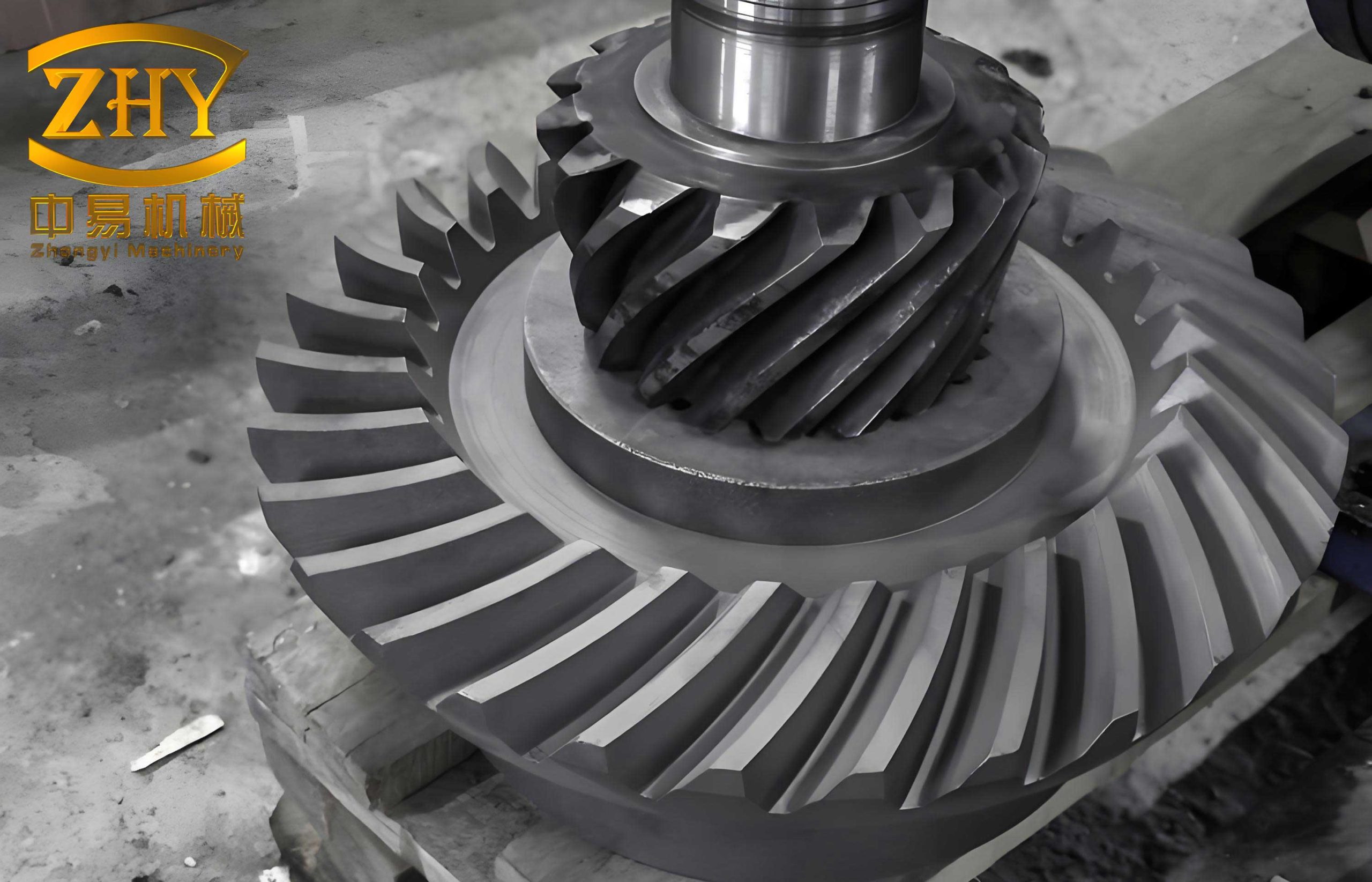
Precision forging of helical bevel gears involves deforming a billet into the desired shape using dies under high pressure. Key process parameters, such as initial forging temperature, friction coefficient, and press speed, significantly influence the outcome. For instance, a higher temperature improves material flow but may degrade microstructural properties, while excessive friction increases loads and wear on tools. Therefore, optimizing these parameters is crucial for achieving a balance between formability and equipment constraints. In this work, I develop a quadratic polynomial response surface model that correlates these variables with objective functions—namely, maximum forming load and final filling ratio. Through finite element analysis and optimization algorithms, I determine the optimal settings that enhance the forging process for helical bevel gears.
To begin, I establish a finite element model for the helical bevel gear forging process. The gear geometry, based on a typical automotive transmission component, is designed with a central hole to accommodate post-forging machining. The billet material is selected as AISI-4120 steel, known for its good forgeability and strength. In the simulation, the billet is treated as a plastic body, while the dies are considered rigid to simplify calculations. The mesh is refined with 200,000 elements, particularly around the tooth regions, to capture detailed deformation behavior. The friction condition is modeled using a shear friction model, and heat transfer coefficients are set to account for thermal effects during forging. The initial finite element setup allows me to simulate the forging process and evaluate the impact of various parameters on helical bevel gear quality.
The design variables for optimization are chosen based on their influence on forging outcomes. These include the initial billet temperature (t), friction coefficient (μ), and press speed (v). Their ranges are determined from practical experience and material properties, as summarized in Table 1. The objective functions are defined as the maximum forming load (F) and the filling ratio (η), where η is calculated as the ratio of the forged gear’s surface area to the die cavity’s surface area after final forging. Minimizing F reduces equipment stress and energy consumption, while maximizing η ensures complete tooth formation and dimensional accuracy for the helical bevel gear.
| Variable | Range |
|---|---|
| Initial temperature t (°C) | 900 – 1100 |
| Friction coefficient μ | 0.1 – 0.6 |
| Press speed v (mm/s) | 50 – 300 |
I employ Latin Hypercube Sampling (LHS) to generate 30 representative combinations of the design variables, ensuring a diverse and efficient exploration of the parameter space. Each combination is simulated using finite element analysis to obtain values for F and η. Based on these results, I construct a quadratic polynomial response surface model with radial basis functions (RBF) to approximate the relationships. The general form of the model is given by:
$$(F, \eta) = \beta_0 + \sum_{i=1}^{k} \beta_i G_i + \sum_{i=1}^{k} \beta_{ii} G_i^2 + \sum_{i=1}^{k-1} \sum_{j>1}^{k} \beta_{ij} G_i G_j + \text{RBF}$$
where $$G_i$$ and $$G_j$$ represent the design variables (t, μ, v), k = 3 is the number of variables, $$\beta$$ coefficients are regression parameters, and RBF is a Gaussian function defined as:
$$g_i(\phi) = \frac{1}{1 + \exp(-[1 + \Phi^T] \phi_i)}$$
This model effectively captures the nonlinear interactions between process parameters and forging outcomes for helical bevel gears. To validate its accuracy, I compare predicted values from the response surface with simulation results. For example, the residual errors for maximum forming load predictions are within 5%, indicating a high degree of reliability. Similarly, the filling ratio model shows consistent performance, enabling its use in optimization.
Using the response surface models, I perform multi-objective optimization to find the best parameter settings. The optimization aims to minimize F and maximize η simultaneously. I utilize MATLAB’s optimization toolbox to solve this problem, applying constraints based on practical forging limits. After analysis, the optimal parameters are identified as: initial temperature t = 1000°C, friction coefficient μ = 0.3, and press speed v = 200 mm/s. At these settings, the predicted maximum forming load is 25610 kN, and the filling ratio reaches 1.0, indicating complete die filling for the helical bevel gear. This represents a significant improvement over initial simulations, where underfilling and higher loads were observed.
To verify the optimization results, I conduct a finite element simulation with the optimized parameters. The simulation confirms that the helical bevel gear forms fully, with teeth exhibiting excellent profile accuracy and no visible defects. The maximum forming load is measured at 24900 kN, closely matching the predicted value and demonstrating the model’s precision. This outcome underscores the effectiveness of response surface methodology in refining the forging process for helical bevel gears. Moreover, the reduced load aligns with equipment capabilities, potentially extending tool life and lowering production costs.
The influence of each parameter on forging quality can be further analyzed through sensitivity studies. For instance, increasing the initial temperature generally reduces flow stress and forming loads, but beyond 1100°C, it may cause grain growth or oxidation. The friction coefficient plays a dual role: lower values reduce resistance but may lead to material slippage, while higher values increase loads and improve filling at the expense of tool wear. Press speed affects strain rates and heat generation; moderate speeds like 200 mm/s balance deformation homogeneity and process efficiency. These insights are crucial for tailoring the forging process to specific helical bevel gear designs and material grades.
In addition to numerical validation, practical trials are essential to confirm the feasibility of optimized parameters. Using a J55-2500 friction press, I carry out forging experiments under the recommended conditions. The produced helical bevel gears exhibit full tooth filling, smooth surfaces, and dimensional consistency, as shown in comparative analyses. The forming load during experimentation is within acceptable limits, verifying that the optimization approach is viable for industrial applications. This success highlights the potential of integrating response surface models with simulation tools to enhance manufacturing processes for complex components like helical bevel gears.
The broader implications of this study extend to automotive and aerospace industries, where helical bevel gears are integral to transmission and power systems. By optimizing precision forging, manufacturers can achieve higher production rates, better material utilization, and improved gear performance. Future work could explore advanced materials, such as titanium alloys or composites, for helical bevel gears, or incorporate real-time monitoring and adaptive control into the forging process. Additionally, machine learning techniques could be combined with response surface methodology to handle more variables and objectives, further refining the optimization of helical bevel gear manufacturing.
In conclusion, this research demonstrates a systematic approach to optimizing the precision forging process for helical bevel gears in automotive transmissions. Through response surface modeling, finite element simulation, and experimental validation, I identify optimal parameters that ensure high-quality gear formation with reduced loads. The methodology presented here offers a robust framework for addressing similar challenges in metal forming, contributing to the advancement of near-net-shape manufacturing technologies. As demand for efficient and reliable helical bevel gears grows, such optimization efforts will play a key role in meeting industry standards and driving innovation.