
In my extensive experience with power transmission systems, particularly in locomotive applications, the helical bevel gear plays a critical role in transferring torque between non-parallel shafts, such as in the final drive assemblies of diesel locomotives. These gears are subjected to severe cyclic loading, and their failure, especially premature pitting on the tooth flanks, poses significant operational and maintenance challenges. This article presents a comprehensive analysis, from my first-person perspective as an engineer involved in failure analysis, of the root causes behind the early-stage pitting observed on the tooth surfaces of certain helical bevel gears. The focus is on gears manufactured from specific alloy steels, processed through carburizing, quenching, and electrical discharge running-in, which exhibited pitting after approximately 200,000 kilometers of service.
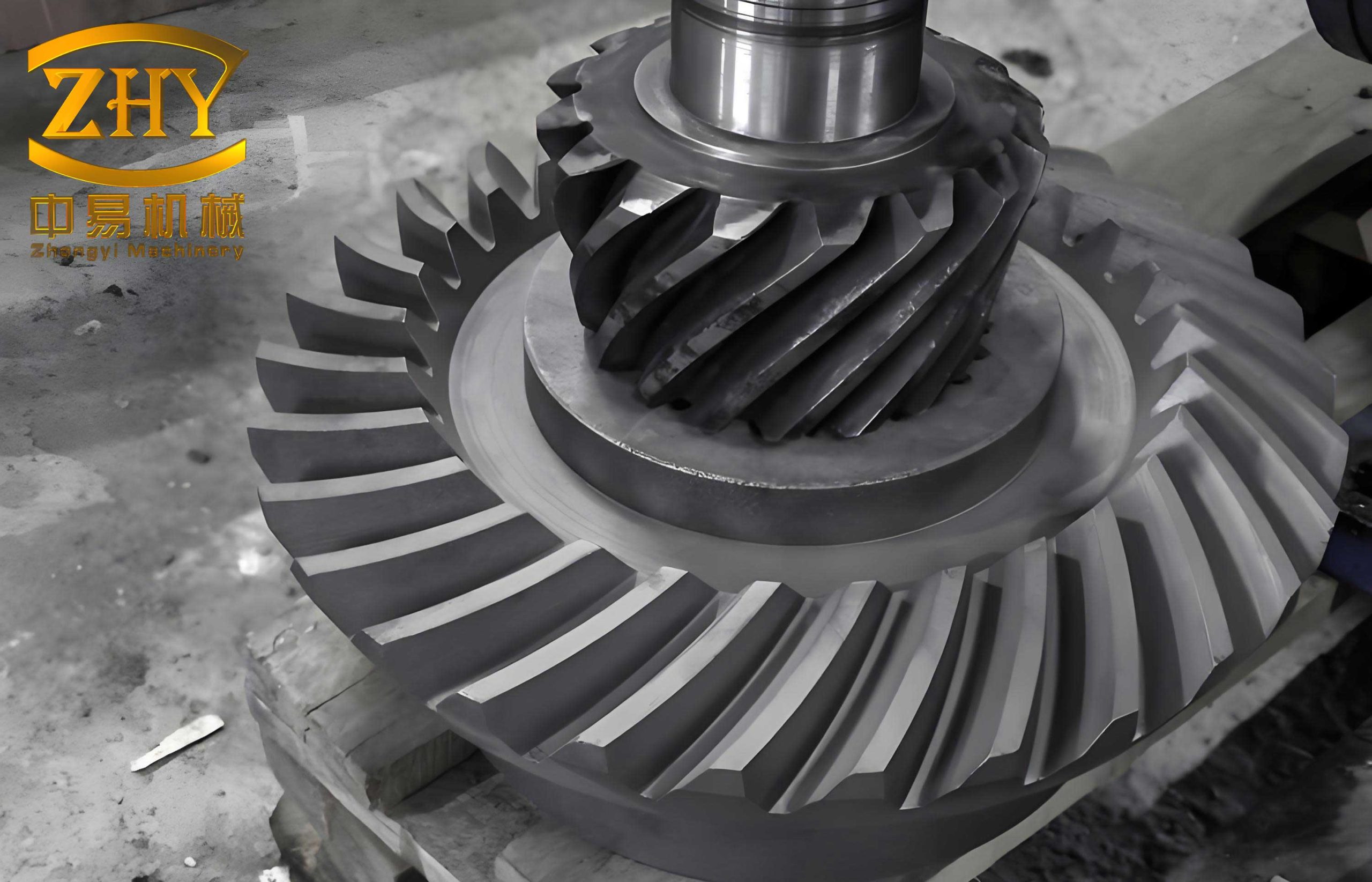
The helical bevel gear, with its curved teeth enabling smooth and high-load capacity operation, is central to this investigation. The premature failure mode under study is contact fatigue pitting, characterized by the formation of small pits or cavities on the active tooth flank. This phenomenon not only reduces the efficiency of the gear transmission but can lead to catastrophic failure if left unchecked. Based on detailed metallurgical examinations and stress analysis, I will delve into the macro-characteristics, microstructural findings, and underlying mechanisms, supported by quantitative data presented in tables and theoretical frameworks expressed through formulas.
Macroscopic Manifestations of Pitting Failure
Upon disassembly and visual inspection of several failed helical bevel gears, distinct patterns of damage were observed. The pitting predominantly appeared as dense clusters of small, crater-like depressions, often aligning into bands. The location varied between the pinion and gear, suggesting complex load distribution. To systematically categorize these observations, the following table summarizes the key macroscopic features from specific gear sets analyzed.
| Gear Component (Forging ID) | Service Distance (km) | Pitting Location on Tooth Flank | Morphology and Severity |
|---|---|---|---|
| Small Helical Bevel Gear (ID: 75209) | ~219,000 | Mostly below the pitch line | Intense, dense point-like pitting, coalescing into banded cavities. |
| Small Helical Bevel Gear (ID: 75210) | ~200,000 | Primarily below pitch line, some near tooth tip | Pronounced point-like pitting on multiple teeth, forming bands. |
| Large Helical Bevel Gear (ID: 1-01-1) | ~200,000 | Predominantly above the pitch line | Severe,密集点状剥离, forming extensive banded凹坑. |
| Large Helical Bevel Gear (ID: 75208) – Matched with 75210 | ~200,000 | No pitting, but severe scoring/grooving | Deep scoring indentations up to ~0.5 mm, no pitting observed. |
The contrast between the pitted gears and the gear with only scoring is particularly instructive. It hints that the presence of pitting is not merely a function of high surface stress but is intimately linked to the material’s subsurface condition. The helical bevel gear with scoring endured similar loads without pitting, prompting a deeper microstructural investigation.
Microstructural and Metallurgical Analysis
To understand the failure mechanisms, I conducted detailed metallographic examinations on sectioned teeth from the affected helical bevel gears. The core of the analysis focused on the microstructure, hardness gradients, and the presence of non-metallic inclusions or undesirable transformation products near the surface. The findings are summarized comprehensively in the table below.
| Gear Sample (Forging ID & Failure Mode) | Surface Microstructure & Case Depth Anomaly | Surface Hardness (HV) | Core Microstructure & Hardness (HV) | Key Observations near Pits/Defects |
|---|---|---|---|---|
| Small Gear 75209 (Pitted) | Uniform layer of troostite (~0.15 mm deep). Carbides scarce. | ~513 at 0.05 mm depth | Lath martensite + proeutectoid ferrite (network), HV ~413 | Plastic deformation layer (~0.05 mm) aligned with sliding direction. Microcracks at ~15° to surface, within troostite layer. |
| Small Gear 75210 (Pitted) | Non-uniform: Troostite + block/network carbides. Depth varies (0.15-0.30 mm). Carbides up to Level 6 locally. | ~538 at 0.05 mm depth (pitch area) | Lath martensite + proeutectoid ferrite, HV ~453 | Similar plastic deformation and microcracks confined to troostite layer. Unpitted teeth showed martensite + carbides at surface. |
| Large Gear 1-01-1 (Pitted) | Bainitic layer (~0.20 mm deep) on flank. Decarburization at tip/root (~0.5 mm). | ~513 at 0.08 mm depth | Lath martensite, HV ~453 | Plastic deformation layer (~0.08 mm) and microcracks within bainite layer. |
| Large Gear 75208 (Scored, not pitted) | Martensite + slight bainite + carbides (block/network, uneven). Carbides up to Level 6 at tip. | Not explicitly given, expected high for martensite | Lath martensite + ferrite, HV ~453 | Scored area: Deep plastic deformation layer (~0.12 mm) with white etching layer (~0.02 mm) and tempered dark layer. Microcracks within deformed layer. |
A critical pattern emerges: every helical bevel gear tooth that exhibited early pitting had a subsurface layer of a soft, non-martensitic transformation product—either troostite or bainite. This layer’s hardness was significantly lower than the expected hardened martensitic case. In contrast, the helical bevel gear with only scoring possessed a predominantly martensitic surface, despite having other issues like carbide heterogeneity. The depth of pitting and the associated microcracks never exceeded the depth of this soft layer. This is a pivotal clue. The contact fatigue strength, $\sigma_{Hlim}$, of a material is strongly correlated with its hardness. For carburized and hardened steels, the relationship can be approximated by empirical formulas. One common relation for the allowable contact stress is:
$$\sigma_{Hlim} = A \cdot HV + B$$
where $A$ and $B$ are material constants. A substantial drop in surface hardness directly reduces $\sigma_{Hlim}$, making the helical bevel gear tooth far more susceptible to pitting under cyclic contact stresses.
Mechanistic Discussion: The Interplay of Material and Load
The failure process is classic contact fatigue pitting. Under repeated rolling and sliding contact, cyclic Hertzian stresses are generated. The maximum shear stress occurs slightly below the surface. The process can be modeled in stages:
- Initial Plastic Deformation: Repeated subsurface shear stresses exceeding the material’s yield strength cause accumulated plastic strain. This is observed as the flow lines or deformation layer parallel to the sliding direction.
- Crack Initiation: After sufficient cycles (“plasticity exhaustion”), microcracks nucleate, typically at inclusions or microstructural inhomogeneities. In these gears, the cracks initiated at the interface between the soft non-martensitic layer and the harder core, or within the soft layer itself, following the direction of plastic flow at an angle of 10°-20° to the surface.
- Crack Propagation: Lubricant is forced into these microcracks under pressure, creating a hydrostatic “oil wedge” effect that wedges the crack open during compressive loading cycles, promoting growth. The crack propagates until a small piece of material detaches, forming a pit.
The fundamental equation for Hertzian contact stress between two curved elastic bodies (simplified for gear teeth contact at the pitch line) is:
$$\sigma_H = \sqrt{ \frac{F_n / b}{\pi \cdot \left( \frac{1-\nu_1^2}{E_1} + \frac{1-\nu_2^2}{E_2} \right) \cdot \frac{1}{\rho_{red}}} }$$
Where:
- $\sigma_H$ = Maximum Hertzian contact stress
- $F_n$ = Normal load per unit face width
- $b$ = Face width
- $E_1, E_2$ = Moduli of elasticity for pinion and gear
- $\nu_1, \nu_2$ = Poisson’s ratios
- $\rho_{red}$ = Reduced radius of curvature, $\frac{1}{\rho_{red}} = \frac{1}{R_1} \pm \frac{1}{R_2}$ (sign depends on contact geometry)
For a helical bevel gear, the calculation is more complex due to the changing curvature across the tooth face and the helical angle, but the principle remains. The safety factor against pitting, $S_H$, is given by:
$$S_H = \frac{\sigma_{Hlim} \cdot Z_{L} \cdot Z_{R} \cdot Z_{V} \cdot Z_{W} \cdot Z_{X}}{\sigma_H} \geq S_{Hmin}$$
Here, $\sigma_{Hlim}$ is the material’s endurance limit, and the $Z$-factors account for life, roughness, speed, hardness ratio, and size effects. A low $\sigma_{Hlim}$ due to a soft surface layer drastically reduces $S_H$.
My analysis, corroborated by comparative design calculations for similar locomotive helical bevel gears, revealed that the specific design in question operated with one of the highest calculated Hertzian stresses and consequently the lowest safety factors against pitting, both for starting and continuous duty. This marginal design, when combined with a compromised material surface, creates a perfect storm for early failure. The following table contrasts key stress parameters for different designs, illustrating the point.
| Locomotive Model / Gear Type | Calculated Max Hertzian Stress $\sigma_H$ (MPa) – Starting | Calculated Max Hertzian Stress $\sigma_H$ (MPa) – Continuous | Relative Pitting Safety Factor $S_H$ (Qualitative) |
|---|---|---|---|
| Model A (Reference) | ~1500 | ~1200 | High |
| Model B (Reference) | ~1600 | ~1250 | Medium | 东方红 [Subject] Helical Bevel Gear | ~1850 | ~1550 | Lowest |
Regarding the influence of the electrical discharge running-in process, my examination of a new, run-in helical bevel gear showed that it primarily improved surface finish (reducing roughness from approximately Ra 3.2µm to Ra 0.8µm) and removed the superficial oxide layer. A very thin white layer and a tempered dark layer were present, but no significant alteration of the subsurface hardness or microstructure was detected that would inherently promote pitting. Therefore, while beneficial for run-in conformity, this process is not a primary root cause of the early pitting observed.
Root Cause Analysis and Contributing Factors
Synthesizing all evidence, the early pitting on these helical bevel gears is predominantly attributed to two interrelated factors:
1. Inadequate Heat Treatment Leading to Subsurface Microstructural Deficiencies: The presence of troostite or bainite layers indicates improper quenching. Based on my own process investigation trials, this can result from:
- Insufficient austenitizing temperature or time.
- Delayed quenching, allowing transformation to begin in the nose of the Time-Temperature-Transformation (TTT) curve.
- Inadequate agitation or quenching medium performance.
The formation kinetics can be described by the Avrami equation for isothermal transformation:
$$f = 1 – \exp(-k t^n)$$
where $f$ is the transformed fraction, $t$ is time, $k$ and $n$ are material- and temperature-dependent constants. If the cooling curve passes through the bainite or pearlite (troostite) nose for a critical duration, a significant volume fraction of soft phase forms. The depth of this layer directly dictates the maximum depth of pitting, as cracks cannot easily propagate into the tougher, harder martensitic core.
2. Inherently High Operational Contact Stresses: The design of this particular helical bevel gear pair results in Hertzian stresses that push the limits of even a perfectly heat-treated material. The combination of high load and a reduced safety margin makes the gear set exceptionally sensitive to any material quality downgrade. The bending stress at the tooth root, while important for bending fatigue, is less relevant here as the failure originated as contact fatigue on the flank.
The interaction can be visualized as a failure boundary condition. For a helical bevel gear to survive its design life, the applied stress must remain below the material’s endurance limit. The soft layer lowers the endurance limit curve, while the high design stress raises the applied stress curve, causing an early intersection—failure.
Conclusions and Forward Path
In conclusion, my investigation identifies the early point-surface pitting on the subject helical bevel gears as a contact fatigue failure. The primary enabling cause is the formation of a soft, non-martensitic subsurface layer (troostite/bainite) due to heat treatment deficiencies, which severely compromises the contact fatigue resistance of the gear tooth surface. A significant contributing factor is the relatively high operational contact stresses inherent in the gear design, which offers a low safety factor against pitting even for a material with optimal properties.
To enhance the durability and reliability of such helical bevel gears, a dual approach is necessary. First, stringent control and potential optimization of the heat treatment process—particularly austenitizing parameters, quenching speed, and transfer times—are imperative to ensure a fully martensitic case of appropriate depth and hardness. Second, a redesign review to lower the maximum contact stresses, possibly through geometry optimization (increased radius of curvature, profile modification) or material upgrade, should be considered to provide a more robust design margin. Continuous monitoring and non-destructive testing of critical helical bevel gears in service can also help in early detection of subsurface anomalies before they lead to catastrophic failure.