
In my years of practical experience within gear manufacturing, addressing the post-heat-treatment distortion of helical bevel gears, often referred to as disc gears, has been a persistent and critical challenge. These components, ubiquitous in automotive, tractor, and forklift drivetrains, are typically fabricated from low-alloy carburizing steels like 20CrMnTi. Following the standard carburizing and direct quenching process, the most prevalent and problematic form of distortion is the planar warping or dishing of the gear’s bottom face. While dedicated quenching presses are the standard industrial solution for controlling this deformation, their high cost and specialization render them inaccessible for small to medium-scale production batches. Therefore, developing and refining a methodology to significantly reduce this planar翘曲变形 (warpage) without reliance on press quenching equipment has been a vital pursuit. This article consolidates the effective control methods we have successfully implemented, forming a comprehensive, multi-faceted strategy.
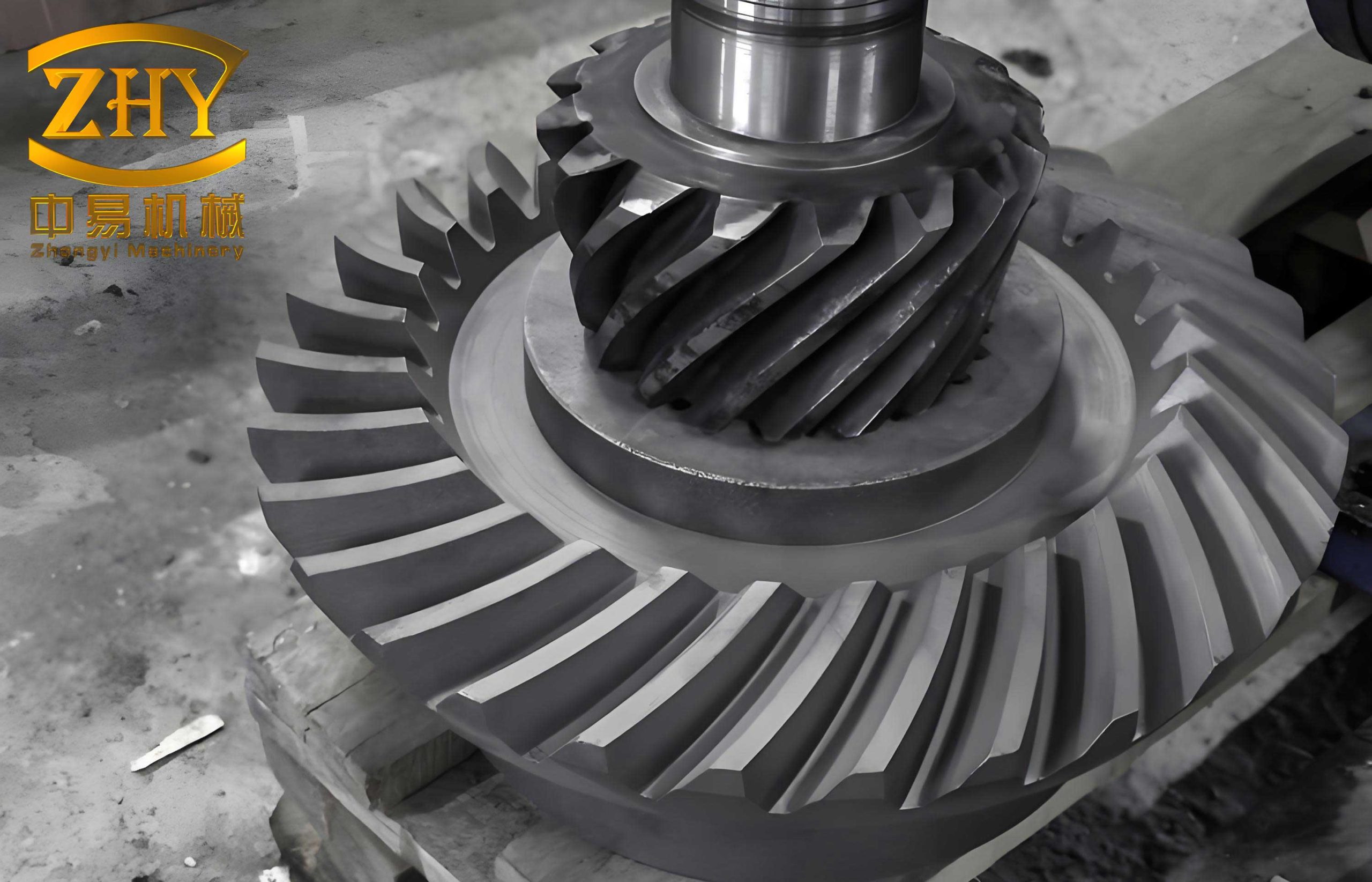
The geometry of a typical helical bevel gear is characterized by a conical shape with helical teeth. After carburizing and quenching, irrespective of the gear’s thickness, diameter, or furnace loading orientation (horizontal or vertical), the bottom face consistently exhibits a concave dishing distortion. In our predominant vertical hanging method, the inner annular region of the bottom face consistently shows more severe distortion than the outer annular region. The magnitude of warpage is directly correlated to the part’s diameter-to-thickness ratio; larger diameter and thinner gears present the greatest challenge. For instance, one of our most distortion-prone models is a specific large-diameter, thin-web helical bevel gear. Statistical analysis of sample batches reveals a clear pattern: while outer face distortion often remains within tolerance, inner face distortion frequently exceeds acceptable limits, indicating an imbalance in the quenching stresses that must be addressed.
The root causes of distortion in helical bevel gears are multifaceted and interconnected. They can be summarized by the following contributing factors:
- Thermal Plastic Deformation: At elevated carburizing temperatures (typically 900-930°C), the yield strength of the steel drops significantly. The weight of the helical bevel gear itself can cause creep and sagging, especially when hung vertically.
- Handling and Agitation: Non-uniform movement or shaking during transfer from the furnace to the quench tank induces mechanical distortion.
- Thermal and Transformation Stresses: This is the core of quenching distortion. Rapid cooling creates steep temperature gradients (thermal stress). Simultaneously, the austenite-to-martensite transformation, with its associated volume expansion, occurs non-uniformly from surface to core (transformation stress). The interplay of these stresses, particularly when asymmetric due to geometry, causes warping.
- Residual Machining Stresses: Stresses imparted during prior cutting and shaping operations can be relieved or redistributed during heating, contributing to final distortion.
For a helical bevel gear, the non-uniform cross-section—thicker at the outer rim and thinner near the inner bore or web—creates an inherent condition for non-uniform cooling and stress generation, explaining why the inner area warps more severely.
Our strategy to control distortion hinges on systematically mitigating each contributing factor through a combination of process modification, medium selection, and fixture design.
1. Medium-Temperature Rare-Earth Assisted Carburizing and Carbonitriding
Conventional gas carburizing for helical bevel gears is performed at 920-930°C. A fundamental principle is that lower quenching temperatures generally reduce distortion. Therefore, lowering the carburizing temperature is desirable. However, this drastically reduces carburizing kinetics. Our solution is the use of rare-earth (RE) elements as catalysts to enhance diffusion rates at lower temperatures.
The RE additive is dissolved in methanol and combined with carriers like triethanolamine and urea to form a proprietary mixture. This mixture is dripped into the furnace alongside other agents (e.g., methanol, kerosene) during the process. The typical process for a helical bevel gear requiring a case depth of 0.8-1.2mm is outlined below and summarized in Table 1.
| Stage | Exhaust | Boost (Strong Infiltration) | Diffusion | Temperature Drop |
|---|---|---|---|---|
| Temperature (°C) | 860-880 | 860-880 | 860-880 | 820-840 |
| Methanol (drops/min) | 120-140 | – | 50-60 | 50-60 |
| Kerosene (drops/min) | – | 80-100 | 30-40 | – |
| RE-Mixture (drops/min) | – | 80-100 | 30-40 | – |
| Time (min) | ~30 | 90-150 | 30-60 | ~30 |
| Furnace Pressure (mm H₂O) | 150-250 | |||
The process can be visualized as:
$$
T(t) = \begin{cases}
860 \rightarrow 880^\circ C & 0 \leq t < t_{\text{exhaust}} \\
860 \rightarrow 880^\circ C & t_{\text{exhaust}} \leq t < t_{\text{boost}} \\
860 \rightarrow 880^\circ C & t_{\text{boost}} \leq t < t_{\text{diffusion}} \\
820 \rightarrow 840^\circ C & t_{\text{diffusion}} \leq t \leq t_{\text{drop}}
\end{cases}
$$
The exact temperature within the 860-880°C range is selected based on the helical bevel gear’s module and required case depth, as per Table 2.
| Gear Type Identifier | Module (mm) | Case Depth (mm) | Process Temperature (°C) |
|---|---|---|---|
| Type A | 6-8 | 1.0-1.3 | 870-880 |
| Type B | 4-6 | 0.8-1.1 | 860-870 |
| Type C | 8-10 | 1.2-1.5 | 875-880 |
2. Optimized Quenching Parameters: Temperature and Medium
The quenching operation is where the final distortion is locked in. Our approach focuses on minimizing harmful thermal gradients while ensuring sufficient hardness.
Lower Quenching Temperature: We quench directly from the diffusion/drop temperature (820-840°C). This lower temperature reduces the initial temperature difference between the helical bevel gear and the quenchant ($\Delta T = T_{\text{gear}} – T_{\text{oil}}$), thereby lowering the severity of thermal shock and thermal stress. The selected temperature must still ensure full hardening of the core to meet mechanical specifications. For larger module gears, we use ~840°C; for smaller modules, ~820°C is sufficient.
Hot-Oil Quenching with Air Cooling Delay: The choice of quenchant is critical. Contrary to the general guideline of fast cooling in the pearlite “nose” region, research on gear distortion suggests that to minimize distortion dominated by thermal stress, a medium with lower cooling capacity in the high-temperature region (>600°C) but adequate speed in the low-temperature martensite formation region (300°C and below) is beneficial. Therefore, we use a higher viscosity mechanical oil (e.g., ISO VG 100 or 150). To improve uniformity and flow, and to further reduce $\Delta T$, the oil is heated and maintained at 100-120°C. The quenching sequence is crucial: after the helical bevel gear is lowered into the hot oil, it is held stationary for a period to allow temperature equalization and partial cooling, then removed for final air cooling to room temperature. This “hot-oil – air delay” sequence reduces the violent boiling stage and promotes more uniform heat extraction.
The cooling rate $v(T)$ can be conceptually modeled in three stages:
$$
v(T) \approx \begin{cases}
v_{\text{low}} & T > 600^\circ C \quad \text{(Vapor blanket stage, slowed by hot, viscous oil)} \\
v_{\text{moderate}} & 600^\circ C > T > M_s \quad \text{(Convective cooling)} \\
v_{\text{moderate}} & T \approx M_s \quad \text{(Air cooling, slowing transformation)}
\end{cases}
$$
where $M_s$ is the martensite start temperature.
3. Specialized Fixture and Compensation Washer Design
Fixture design is paramount for achieving uniform heating and cooling. A poorly designed hanger introduces points of stress concentration and causes non-uniform fluid flow during quenching.
Our designed fixture for hanging helical bevel gears features a square frame with multiple curved support posts. The advantages are multifold:
- Stability: The gear is securely cradled within the frame, minimizing swinging or agitation during transfer.
- Uniform Support: The curved posts match the gear’s back face contour, distributing the weight over a larger area and preventing localized stress points.
- Representative Cooling: Small test coupons (齿块) can be attached to the fixture in a location that experiences a cooling cycle representative of the actual gear teeth, providing accurate hardness verification.
The Compensation Washer – A Key Innovation: To directly combat the disproportionate inner-rim warping, we introduced a simple yet highly effective mechanical compensation technique. A flat, circular washer (compensation ring) is placed against the inner portion of the gear’s bottom face before it is mounted on the fixture post. This washer, typically made of a heat-resistant material, acts as a thermal mass and a physical constraint. During quenching, it slightly retards the cooling of the thin inner web area, bringing its cooling curve closer to that of the thicker outer rim. This reduces the thermal gradient across the face, thereby leveling the differential contraction and minimizing dishing. The effect can be conceptualized by modifying the heat transfer boundary condition locally:
$$
-k \left. \frac{\partial T}{\partial n} \right|_{\text{inner face with washer}} < -k \left. \frac{\partial T}{\partial n} \right|_{\text{inner face without washer}}
$$
where $k$ is thermal conductivity and $\frac{\partial T}{\partial n}$ is the temperature gradient normal to the surface. The washer reduces the effective heat flux ($q”$) from that area.
The size and thickness of the compensation washer are empirically determined based on the specific geometry of the helical bevel gear. The assembly—gear, washer, post, and frame—must be handled with utmost care: smooth furnace entry/exit, rapid immersion into the quenchant, and absolutely no movement in the tank.
4. Results and Integrated System View
The implementation of this combined strategy has yielded consistent and significant improvements. For most standard helical bevel gears, the post-quench planar distortion is controlled within the following typical limits:
- Inner Bottom Face Flatness: ≤ 0.15 mm
- Outer Bottom Face Flatness: ≤ 0.10 mm
This translates to a first-pass qualification rate exceeding 95% for common designs. Even for the most challenging, large-diameter thin-web helical bevel gears, the distortion is dramatically reduced, achieving qualification rates above 85%, which is a substantial improvement over uncontrolled processes.
The success of this methodology underscores a critical principle: controlling distortion in complex components like the helical bevel gear is not achievable through a single “silver bullet.” It requires a synergistic, system-level approach. The workflow can be summarized by the following integrated equation, representing the overall distortion $D$ as a function of multiple controlled variables:
$$
D_{\text{helical bevel gear}} = f(T_{\text{carb}}, t_{\text{carb}}, \text{RE}, T_{\text{quench}}, \eta_{\text{oil}}, T_{\text{oil}}, F_{\text{fixture}}, C_{\text{washer}}, O_{\text{ops}})
$$
Where:
- $T_{\text{carb}}, t_{\text{carb}}$: Carburizing temperature and time.
- $\text{RE}$: Rare-earth catalytic effect.
- $T_{\text{quench}}$: Quenching temperature.
- $\eta_{\text{oil}}, T_{\text{oil}}$: Quenchant viscosity and temperature.
- $F_{\text{fixture}}$: Fixture design factor.
- $C_{\text{washer}}$: Compensation washer effect.
- $O_{\text{ops}}$: Operational discipline factor.
Only by optimizing all these variables in concert can the distortion of a helical bevel gear be minimized effectively without the need for capital-intensive press quenching equipment. This holistic strategy provides a viable and robust solution for manufacturers engaged in small-to-medium batch production of these critical power transmission components.