
In modern manufacturing, the production of components such as helical bevel gears often involves complex design and forging processes. These gears, characterized by their curved teeth and conical shape, are critical in automotive and machinery applications for transmitting power between intersecting shafts. Precision forging of helical bevel gears offers advantages like improved material strength, reduced waste, and enhanced dimensional accuracy. However, the design phase, particularly for preform billets, is tedious and error-prone when done manually. To address this, I have developed a comprehensive CAD system tailored for the precision forging of helical bevel gears. This system integrates computational design with automated drafting, streamlining the entire process from initial parameters to final forging drawings. The core of this work revolves around the helical bevel gear, a component that, despite variations in models, shares similar geometric features, making it ideal for parametric CAD approaches.
The CAD system I created focuses on the precision forging of helical bevel gears, enabling rapid generation of cold forging drawings, hot forging drawings, and preform billet drawings. It leverages the Gleason system for geometric calculations, ensuring that the helical bevel gear design meets theoretical and practical requirements for smooth operation and tooth strength. By automating repetitive tasks, the system reduces human error and significantly cuts down design time. In this article, I will detail the system’s architecture, its interface technology, and the key design steps, emphasizing the use of tables and formulas to encapsulate critical data. Throughout, the term helical bevel gear will be frequently highlighted to underscore its centrality in this research.
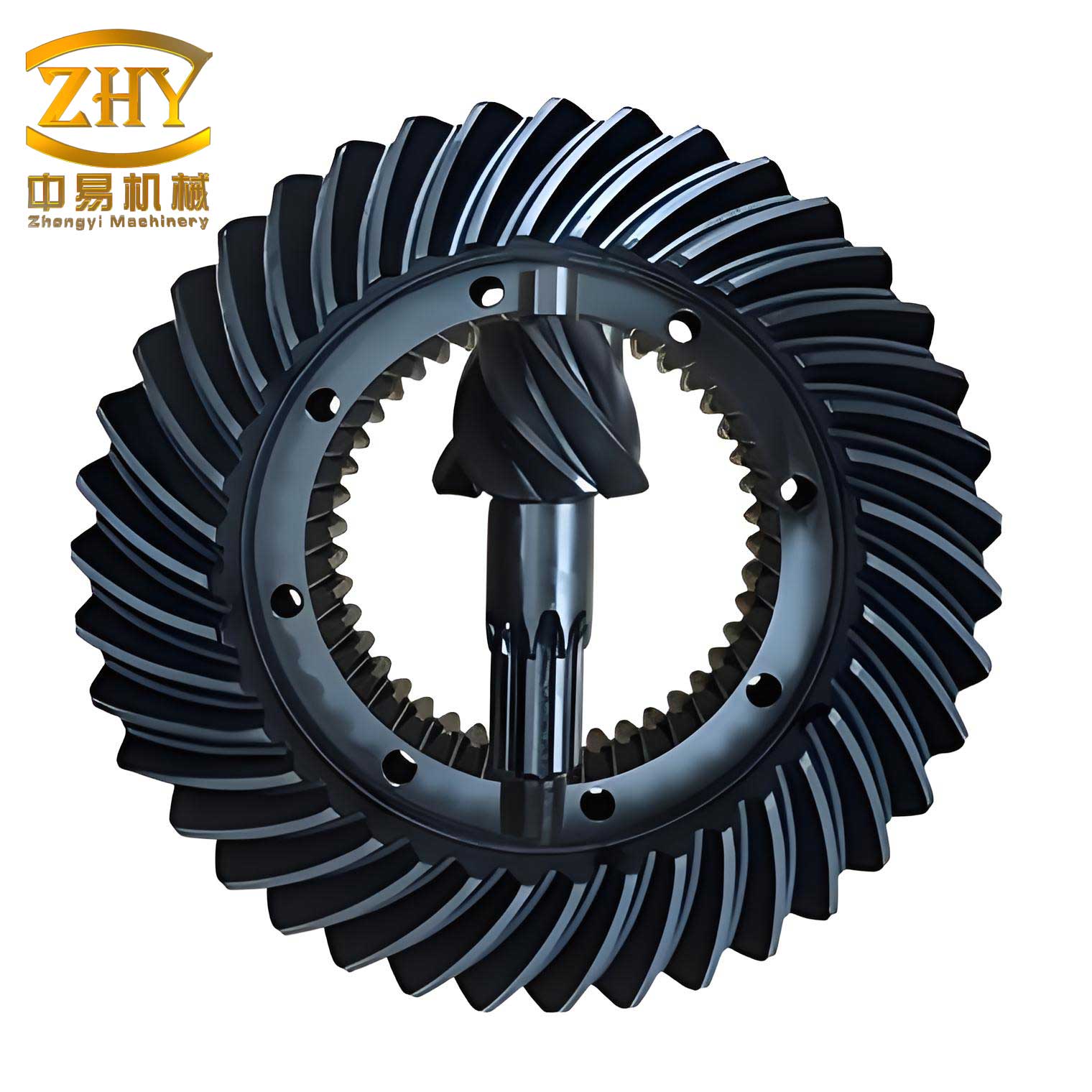
At the heart of the CAD system is the integration between high-level programming languages and AutoCAD, facilitated through script files (*.SCR). This interface allows for seamless data exchange, where design calculations performed in Visual Basic are converted into AutoCAD commands for automatic drawing generation. The workflow begins with inputting the basic parameters of the helical bevel gear, such as module, number of teeth, pressure angle, and spiral angle. These parameters drive the geometric computations, which are based on established formulas. For instance, the pitch cone angle $\phi$ for a helical bevel gear can be derived from the gear ratio and shaft angle, but in the Gleason system, it is calculated using specific coefficients. The general formula for the pitch diameter $d$ of a helical bevel gear is given by:
$$d = m_t \cdot z$$
where $m_t$ is the transverse module and $z$ is the number of teeth. However, for helical bevel gears, additional factors like spiral angle $\beta$ and pressure angle $\alpha$ come into play. The system incorporates these into a comprehensive set of equations, summarized in Table 1 below, which outlines the key geometric parameters for a typical helical bevel gear.
| Parameter | Symbol | Formula or Value |
|---|---|---|
| Transverse Module | $m_t$ | Derived from axial module $m_a$ and spiral angle $\beta$: $m_t = m_a / \cos \beta$ |
| Number of Teeth | $z$ | Input parameter |
| Pressure Angle (Normal) | $\alpha_n$ | Typically 20° for standard helical bevel gears |
| Spiral Angle | $\beta$ | Input parameter, often between 25° and 45° |
| Pitch Cone Angle | $\phi$ | Calculated based on gear pair geometry |
| Radial Displacement Coefficient | $\xi$ | From Gleason system to avoid undercutting |
| Tangential Displacement Coefficient | $\tau$ | Optimized for load distribution |
| Addendum Coefficient | $f_0$ | Typically 0.85 for balanced strength |
The CAD system processes these parameters to generate the cold forging drawing, which represents the final forged component after cooling but before any machining. The design of the cold forging drawing for a helical bevel gear involves determining the parting line, machining allowances, tolerances, draft angles, and fillet radii. The parting line is crucial for mold release and filling efficiency. For helical bevel gears, due to the curved tooth profile and steep back cone, the parting line is set at the tooth tip on the large end, as illustrated in the image above. This placement enhances mold life and gear accuracy by reducing stress concentrations. Machining allowances are applied to surfaces that require post-forging processing, while the tooth surfaces, being precision-forged, are left without additional material. Table 2 provides standard values used in the system for these design elements, tailored for helical bevel gears.
| Design Element | Typical Value | Notes |
|---|---|---|
| Machining Allowance | 1.0 mm to 2.0 mm | Uniform across non-tooth surfaces |
| Forging Tolerance | ±0.3 mm on dimensions | Depends on gear size and complexity |
| Draft Angle | 3° to 5° | Facilitates ejection from die |
| Fillet Radius | 3 mm to 5 mm | Reduces stress and improves flow |
| Flash Land Width | 4 mm to 6 mm | Standardized for helical bevel gear forging |
Transitioning to the hot forging drawing, the system accounts for thermal expansion during the forging process. The hot forging drawing is derived from the cold forging drawing by applying a shrinkage factor $\delta$, which compensates for material contraction upon cooling. The formula used is:
$$L = l(1 + \delta)$$
where $L$ is the hot forging dimension, $l$ is the cold forging dimension, and $\delta$ is the shrinkage rate, typically set at 1.5% for steel alloys used in helical bevel gears. This adjustment ensures that the forged gear, after cooling, matches the desired cold dimensions. Additionally, the flash gutter design is incorporated to manage excess material. The flash gutter dimensions are standardized based on empirical data from helical bevel gear forging trials. The volume of flash $V_f$ can be estimated using:
$$V_f = A_f \cdot t_f$$
where $A_f$ is the cross-sectional area of the flash gutter and $t_f$ is the flash thickness. The system automates these calculations, ensuring consistency across different helical bevel gear models.
The most critical aspect of the CAD system is the preform billet design, which directly influences the success of precision forging for helical bevel gears. The preform billet must be shaped to ensure proper metal flow, minimize forging defects, and reduce flash waste. The system employs the concept of an “equivalent billet,” a mathematical model that simplifies the complex geometry of the helical bevel gear into a form amenable to forging analysis. The equivalent billet is defined by parameters such as volume, weight, and shape factors. The design process, as implemented in the system, involves iterative calculations to optimize the billet geometry. The flowchart in the original text outlines this process, but here I will elaborate with formulas. The mass of the preform billet $m_p$ is given by:
$$m_p = m_h + m_f + \Delta m$$
where $m_h$ is the mass of the hot forging, $m_f$ is the mass of the flash, and $\Delta m$ is an allowance for process variations. The volume $V_p$ is calculated from the density $\rho$ of the material:
$$V_p = \frac{m_p}{\rho}$$
For a helical bevel gear, the preform billet often resembles a truncated cone or a disk with specific contours to match the gear’s tooth profile. The system uses parametric equations to define this shape. For instance, the radial profile $r(z)$ along the axis can be modeled as:
$$r(z) = R_0 – k \cdot z^2$$
where $R_0$ is the maximum radius, $k$ is a curvature constant derived from the gear geometry, and $z$ is the axial coordinate. This allows for automatic generation of the billet drawing in AutoCAD. Table 3 summarizes key parameters in preform billet design for helical bevel gears.
| Parameter | Symbol | Determination Method |
|---|---|---|
| Billet Mass | $m_p$ | Sum of hot forging mass, flash mass, and allowance |
| Billet Volume | $V_p$ | Calculated from mass and material density |
| Shape Factor | $S_f$ | Ratio of surface area to volume, optimized for flow |
| Forging Force Estimate | $F$ | Based on billet projected area and material yield strength |
The interface technology between Visual Basic and AutoCAD is pivotal to the system’s functionality. By generating *.SCR files, the system translates design data into a series of AutoCAD commands that execute in batch mode. This approach minimizes memory usage and simplifies debugging. The script file contains commands for drawing lines, circles, arcs, and dimensions, all parameterized based on the helical bevel gear inputs. For example, to draw a tooth profile, the script might include:
LINE x1,y1 x2,y2
ARC x3,y3 x4,y4 radius
where coordinates are computed from gear geometry formulas. This seamless integration enables the system to produce accurate drawings without manual intervention, a significant advancement for helical bevel gear manufacturing.
To validate the system, I applied it to a case study involving a helical bevel gear similar to those used in automotive rear axles. The gear parameters, anonymized for confidentiality, include a module of 9 mm, 25 teeth, a spiral angle of 35°, and a pressure angle of 20°. The system computed all geometric dimensions and generated the cold forging, hot forging, and preform billet drawings automatically. The results aligned with industrial standards, demonstrating the system’s practicality. For instance, the cold forging drawing showed a parting line at the tooth tip, machining allowances on non-tooth surfaces, and appropriate draft angles. The hot forging drawing incorporated the 1.5% shrinkage factor, and the preform billet design achieved a balance between metal flow and minimal flash. This application highlights the system’s ability to handle diverse helical bevel gear configurations efficiently.
In terms of economic impact, the CAD system reduces design time for helical bevel gears by over 70%, cuts material waste through optimized preform billets, and enhances forging quality by ensuring precise dimensions. The use of standardized templates and automated calculations minimizes errors, leading to higher模具 life and lower rejection rates. Moreover, the system’s user-friendly interface, built with object-oriented programming in Visual Basic, makes it accessible to engineers without extensive CAD expertise. Future enhancements could include integration with finite element analysis for simulating metal flow during forging, further refining the preform billet design for helical bevel gears.
In conclusion, the development of this CAD system represents a significant step forward in the precision forging of helical bevel gears. By combining advanced programming with established forging principles, the system automates the entire design process, from parameter input to drawing generation. The extensive use of tables and formulas, as presented herein, encapsulates the critical data and computations required for helical bevel gear manufacturing. The helical bevel gear, with its complex geometry, benefits immensely from such automated solutions, leading to improved productivity and cost savings in industrial applications. As manufacturing evolves, systems like this will become indispensable for producing high-quality helical bevel gears with precision and efficiency.