
The manufacturing of high-precision helical bevel gear components is a cornerstone of modern power transmission systems, particularly in demanding applications such as automotive differentials, aerospace actuators, and heavy industrial machinery. Among the various production techniques, precision hot forging stands out for its ability to produce near-net-shape parts with excellent mechanical properties, material yield, and production efficiency. However, the process subjects the forging dies to extreme conditions of high pressure, elevated temperature, and severe frictional sliding, leading to wear as a primary failure mode. The economic viability of precision forging is directly tied to die life; therefore, a profound understanding and accurate prediction of die wear are critical for process optimization and cost reduction. This study delves into the wear mechanisms of dies used in the precision forging of a helical bevel gear, employing numerical simulation based on the fundamental Archard wear theory and rigid-plastic finite element analysis (FEA). The core objective is to quantify and analyze the influence of critical process parameters—specifically, die preheating temperature and forging speed—on the wear distribution and magnitude across the complex die cavity.
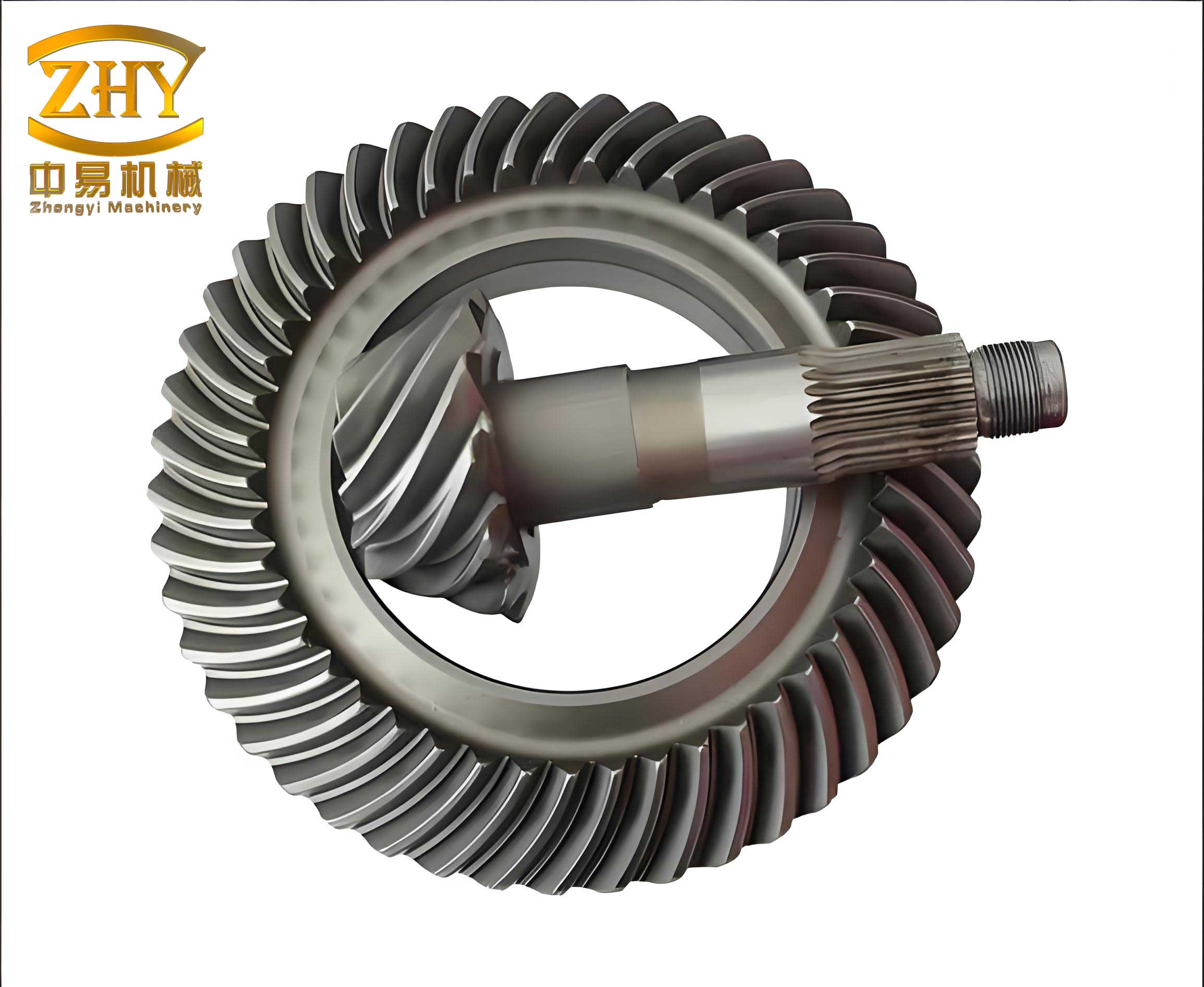
The wear of hot forging dies is a complex thermo-mechanical phenomenon. During the forging cycle, the die surface undergoes cyclic heating from contact with the hot billet and cooling from lubricant application and exposure to the environment. This thermal cycling can induce softening (tempering) of the die surface layer, reducing its hardness and, consequently, its wear resistance. Simultaneously, the high contact pressures and significant relative sliding velocities between the deforming material and the die surface cause abrasive and adhesive wear. The Archard wear model provides a robust theoretical framework to integrate these mechanical factors. The generalized Archard equation for volumetric wear is given by:
$$ V = K \frac{F_N s}{H} $$
Where \( V \) is the wear volume, \( K \) is a dimensionless wear coefficient, \( F_N \) is the normal load, \( s \) is the sliding distance, and \( H \) is the hardness of the softer material (typically the die surface after thermal softening). For application in metal forming simulations, this model is often adapted to calculate local wear depth \( \omega \) over time. The differential form and its integrated version used for incremental FEA are expressed as:
$$ d\omega = k \frac{P}{H} v_r dt $$
$$ \omega = \int_{t} k \frac{P(t)}{H(T)} v_r(t) dt $$
Here, \( \omega \) is the accumulated wear depth at a point on the die, \( k \) is a material-dependent wear factor (\( \approx 2 \times 10^{-6} \) for steel-on-steel), \( P(t) \) is the instantaneous contact pressure (normal stress), \( H(T) \) is the surface hardness which is a function of temperature \( T \), \( v_r(t) \) is the instantaneous relative sliding velocity, and \( t \) is time. The model clearly shows that wear depth is promoted by high pressure, high sliding speed, and prolonged contact time, but is inhibited by high surface hardness.
To simulate the precision forging process of the specific helical bevel gear, a three-dimensional finite element model was established. The key parameters of the studied helical bevel gear are summarized in Table 1.
| Parameter | Symbol | Value | Unit |
|---|---|---|---|
| Number of Teeth | z | 39 | – |
| Module | m | 4 | mm |
| Pressure Angle | α | 20 | ° |
| Spiral Angle | β | 35 (Right Hand) | ° |
| Face Width | – | 23 | mm |
| Addendum | – | 2.24 | mm |
| Whole Depth | – | 7.55 | mm |
In the simulation setup, the billet material was defined as 40Cr steel, modeled as a rigid-plastic body with an initial forging temperature of 1100°C. The upper and lower dies were modeled as rigid bodies made of H13 hot-work tool steel. The initial hardness of the die material was set to 52 HRC. A critical aspect of the model is the definition of temperature-dependent hardness for the die surface. A representative relationship used in such analyses can be approximated by:
$$ H(T) = H_0 \cdot \exp(-\lambda (T – T_{ref})) $$
Where \( H_0 \) is the initial hardness at reference temperature \( T_{ref} \), and \( \lambda \) is a temperature softening coefficient. This function is integrated into the wear calculation, making the wear rate highly sensitive to the local die surface temperature. The thermal boundary conditions included heat convection with the environment and thermal conduction at the die-billet interface. The friction at the contact interface was modeled using the shear friction model with a coefficient of 0.3. Two distinct parametric study plans were executed, as outlined in Table 2, to isolate the effects of die preheating temperature and forging speed.
| Study Variable | Level 1 | Level 2 | Level 3 | Level 4 | Level 5 |
|---|---|---|---|---|---|
| Die Preheating Temperature, \( T_p \) (°C) | 200 | 250 | 300 | 350 | – |
| Forging Speed, \( v_f \) (mm/s) | 5 | 8 | 10 | 12 | 15 |
The simulation results for die wear were post-processed to generate wear depth contour plots on the upper die surface and to extract maximum wear values. The analysis of the effect of die preheating temperature revealed a consistent wear pattern but with varying intensity. The region of maximum wear was consistently located not on the intricate tooth profiles themselves, but on the transition surface between the central hub and the root of the tooth cavity. This area experiences severe metal flow and high relative sliding as the material is forced radially outward into the spiral tooth cavities of the helical bevel gear. The wear on the actual tooth flanks was significantly lower, generally below 0.0007 mm per forging stroke, indicating that the primary wear mechanism is associated with bulk material flow rather than final calibration of the gear teeth.
The quantitative maximum wear depths for different preheating temperatures are presented in Table 3. A clear trend is observable: as the die preheating temperature increases from 200°C to 350°C, the maximum wear depth decreases. This inverse relationship can be explained by the reduction in thermal shock and thermal gradient. When a cold die (200°C) contacts the 1100°C billet, a steep temperature gradient is created at the surface, inducing high thermal stresses and rapid surface tempering, drastically lowering \( H(T) \) in Equation (2). Preheating the die to 300°C or 350°C minimizes this initial thermal shock, maintains a more uniform temperature gradient through the die wall, and helps preserve the surface hardness for a longer duration during the contact period. The retained higher hardness directly reduces the wear rate factor \( kP/H \). A polynomial fit to the data in the 200-300°C range yields the following empirical correlation:
$$ \omega_{max}(T_p) = -1.2 \times 10^{-7} T_p^3 + 9.8 \times 10^{-5} T_p^2 – 0.0292 T_p + 4.48 $$
Where \( \omega_{max} \) is in micrometers and \( T_p \) is in °C. This highlights the non-linear but beneficial effect of increasing preheat temperature on die wear resistance for the helical bevel gear forging process.
| Die Preheating Temperature, \( T_p \) (°C) | 200 | 250 | 300 | 350 |
|---|---|---|---|---|
| Max. Wear Depth on Upper Die, \( \omega_{max} \) (×10⁻³ mm) | 1.60 | 1.43 | 1.30 | 1.12 |
The influence of forging speed presents a more complex interplay of factors. On one hand, a higher forging speed \( v_f \) increases the strain rate in the billet and, more importantly for wear, the relative sliding velocity \( v_r \) at the die interface. According to the Archard model (Equation 2), this should linearly increase the wear rate \( d\omega/dt \). On the other hand, a faster forging stroke reduces the total contact time \( t_c \) between the hot billet and the die surface. This shorter exposure time limits the total heat transfer into the die, potentially reducing the depth and degree of surface tempering, thereby maintaining a higher average \( H(T) \) during the process. The net effect is determined by which factor dominates: the increased sliding velocity or the reduced thermal exposure.
The simulation results, summarized in Table 4, demonstrate that the velocity effect dominates for the forging of this helical bevel gear. As the forging speed increases from 5 mm/s to 15 mm/s, the maximum wear depth increases by a factor of over three. The wear pattern remains similar, but the intensity escalates significantly with speed. This indicates that the proportional increase in the \( P \cdot v_r \) product (the mechanical work of friction) outweighs any mitigating effect from reduced thermal softening. The relationship between maximum wear depth and forging speed can be approximated by the following fitted equation:
$$ \omega_{max}(v_f) = 5.7143 \times 10^{-7} v_f^3 – 1.82 \times 10^{-5} v_f^2 + 3.2029 \times 10^{-4} v_f – 6.1402 \times 10^{-4} $$
Where \( v_f \) is in mm/s and \( \omega_{max} \) is in mm. The cubic term suggests a strongly non-linear increase in wear at higher speeds, which could be related to changes in friction conditions or heat generation at the interface.
| Forging Speed, \( v_f \) (mm/s) | 5 | 8 | 10 | 12 | 15 |
|---|---|---|---|---|---|
| Max. Wear Depth on Upper Die, \( \omega_{max} \) (×10⁻³ mm) | 0.625 | 1.10 | 1.30 | 1.62 | 2.02 |
To synthesize the findings, a comparative analysis underscores the primary wear zones and the quantitative impact of parameters. The most critical area for wear is consistently the transitional region feeding the tooth cavities of the helical bevel gear, not the precision tooth flanks. This has practical implications for die design and maintenance; reinforcement or localized surface treatment (e.g., nitriding) could be strategically applied to these high-wear zones to extend overall die life. Furthermore, the study demonstrates that process windows can be optimized. For instance, operating with a die preheat temperature of 300-350°C and a moderate forging speed of 5-10 mm/s for this specific component would balance productivity with die longevity. The use of the Archard-based FEA model provides a predictive tool to scale these findings. By integrating the local pressure \( P \), sliding velocity \( v_r \), and temperature-dependent hardness \( H(T) \) histories from the forging simulation into the wear integral, the model can predict the wear profile after a simulated number of forging cycles \( N \):
$$ \omega_{total}(x,y) = N \cdot \int_{t_c} k \frac{P(x,y,t)}{H(T(x,y,t))} v_r(x,y,t) dt $$
This allows for the virtual estimation of die life and the identification of the exact number of cycles after which the wear on the critical helical bevel gear tooth profile or the feed region exceeds permissible tolerances.
In conclusion, the precision forging of helical bevel gear components presents significant challenges in terms of die wear, which is primarily governed by the thermo-mechanical conditions at the die-workpiece interface. This numerical investigation, grounded in the Archard wear theory, has successfully simulated and quantified the wear behavior. The key findings are that increasing the die preheating temperature within a practical range (200-350°C) significantly enhances die wear resistance by mitigating thermal shock and preserving surface hardness. Conversely, increasing the forging speed markedly accelerates wear, as the detrimental effect of increased frictional sliding work surpasses the benefit of reduced thermal exposure time. The derived empirical correlations offer a guide for selecting process parameters to maximize the service life of expensive forging dies used in the manufacture of high-quality helical bevel gear sets. The methodology established here serves as a powerful tool for the virtual prototyping and optimization of precision forging processes for complex components like the helical bevel gear, ultimately aiming to reduce manufacturing costs and improve product consistency.