
In the field of mechanical engineering, gear transmission systems are pivotal for power transfer in various applications, from automotive to industrial machinery. Among these, helical spur gears are widely used due to their smooth operation, high load capacity, and reduced noise compared to straight-cut gears. However, tooth surface wear remains a critical issue that affects the longevity and efficiency of helical spur gear systems. Wear, a gradual material loss from the tooth surfaces, can lead to increased backlash, vibration, and eventual failure if not properly managed. Therefore, understanding and modeling the wear behavior of helical spur gears is essential for designing durable and reliable gear systems. In this study, we develop a comprehensive wear model for helical spur gears by integrating Hertz contact theory and Archard’s wear formula, and we conduct numerical simulations to analyze wear characteristics under various operational conditions.
The complexity of wear mechanisms in gears has long challenged researchers. While numerous studies have explored gear wear, a universally accepted methodology is still lacking. Archard’s wear model remains a cornerstone in wear analysis due to its simplicity and empirical validity. Previous work has applied this model to straight and helical gears, but often with simplifications that overlook the influence of operational parameters such as load and cycle count. For instance, some studies focused on wear along the tooth profile without considering the three-dimensional aspects of helical spur gears. Others used finite element methods but did not extensively investigate how varying loads impact wear progression. This gap highlights the need for a holistic approach that accounts for both geometric and operational factors. Our research aims to address this by building a quasi-static wear model that captures the non-uniform wear distribution along the tooth width and profile of helical spur gears, and by examining the effects of torque load and wear cycles on wear depth.
To begin, we establish the theoretical foundation for our wear model. The Archard wear formula is employed to calculate wear depth at a single point on the tooth surface. It is expressed as:
$$ h = \int_{0}^{s} k \, p \, ds $$
where \( h \) is the wear depth, \( s \) is the relative sliding distance, \( p \) is the contact pressure, and \( k \) is the wear coefficient, which is assumed constant for a given material pair. The sliding distance \( s \) is derived from the relative sliding velocity \( v(t) \) over the contact duration:
$$ s = \int_{t_I}^{t_O} v(t) \, dt $$
Here, \( t_I \) and \( t_O \) represent the entry and exit times of the point in the contact zone, respectively. For helical spur gears, the contact between teeth involves a combination of rolling and sliding motions, with time-varying curvature and load. To simplify this, we reduce the gear contact problem to an equivalent two-cylinder contact scenario based on Hertz contact theory. This allows us to determine the contact pressure distribution across the tooth surface. According to Hertz theory, for two elastic cylinders in contact, the maximum contact pressure \( p_0 \) and half-width \( a \) of the contact area are given by:
$$ p_0 = \sqrt{\frac{F E^*}{\pi R^*}} $$
$$ a = \sqrt{\frac{4 F R^*}{\pi E^*}} $$
where \( F \) is the normal load per unit width, \( E^* \) is the equivalent elastic modulus, and \( R^* \) is the equivalent radius of curvature. For helical spur gears, these parameters vary along the tooth profile and width due to the helix angle, necessitating iterative calculations. The equivalent elastic modulus is defined as:
$$ \frac{1}{E^*} = \frac{1 – \nu_1^2}{E_1} + \frac{1 – \nu_2^2}{E_2} $$
and the equivalent radius of curvature for a point on the tooth surface is:
$$ \frac{1}{R^*} = \frac{1}{R_1} + \frac{1}{R_2} $$
where \( E_1, E_2 \) are the elastic moduli, \( \nu_1, \nu_2 \) are Poisson’s ratios, and \( R_1, R_2 \) are the radii of curvature for the pinion and gear, respectively. In helical spur gears, the helix angle \( \beta \) introduces a component along the tooth width, making the contact elliptical rather than purely cylindrical. We adapt the Hertz equations to account for this by considering the effective curvature in both the profile and lead directions.
The wear calculation process is numerical due to the dynamic nature of material removal. We discretize the tooth surface into small elements along the profile and width. For each element, we compute the average contact pressure over one meshing cycle, as the contact time is short relative to the cycle period. This averaging reduces computational effort while maintaining accuracy. The wear depth accumulated per cycle is then:
$$ \Delta h = k \cdot \bar{p} \cdot s $$
where \( \bar{p} \) is the average pressure. We repeat this for multiple wear cycles until the wear depth at any point exceeds a threshold (set at 2 μm in our simulations), at which point we update the tooth surface geometry and recalculate the contact pressure. This iterative process continues until the maximum allowable wear depth is reached. The overall flowchart of the wear computation methodology is summarized in Table 1, which outlines the key steps without referencing image numbers.
| Step | Description |
|---|---|
| 1 | Initialize gear parameters and discretize tooth surface into elements. |
| 2 | Calculate equivalent curvature and load distribution using Hertz theory for each element. |
| 3 | Determine sliding distance based on relative velocity and contact time. |
| 4 | Compute wear depth per cycle using Archard’s formula with average pressure. |
| 5 | Accumulate wear depth over cycles; if wear threshold is exceeded, update surface geometry. |
| 6 | Repeat from Step 2 until maximum wear depth is achieved or desired cycles completed. |
| 7 | Output wear distribution along tooth profile and width. |
For our numerical simulations, we consider a helical spur gear pair with parameters listed in Table 2. These parameters are typical for industrial applications and allow for a generalized analysis of wear behavior.
| Parameter | Pinion (Active) | Gear (Driven) |
|---|---|---|
| Number of teeth, \( z \) | 40 | 80 |
| Normal module, \( m_n \) (mm) | 6.0 | 6.0 |
| Normal pressure angle, \( \alpha_n \) (°) | 20 | 20 |
| Helix angle, \( \beta \) (°) | 6 | 6 |
| Face width, \( B \) (mm) | 42 | 42 |
| Addendum coefficient, \( h_a^* \) | 1 | 1 |
| Dedendum coefficient, \( c^* \) | 0.25 | 0.25 |
| Profile shift coefficient, \( x \) | 0.1356 | -0.1356 |
| Material | Steel | Steel |
| Elastic modulus, \( E \) (GPa) | 207 | 207 |
| Poisson’s ratio, \( \nu \) | 0.3 | 0.3 |
| Density, \( \rho \) (kg/m³) | 7800 | 7800 |
| Surface roughness, \( R_a \) (μm) | 0.6 | 0.6 |
| ISO accuracy grade | 5 | 5 |
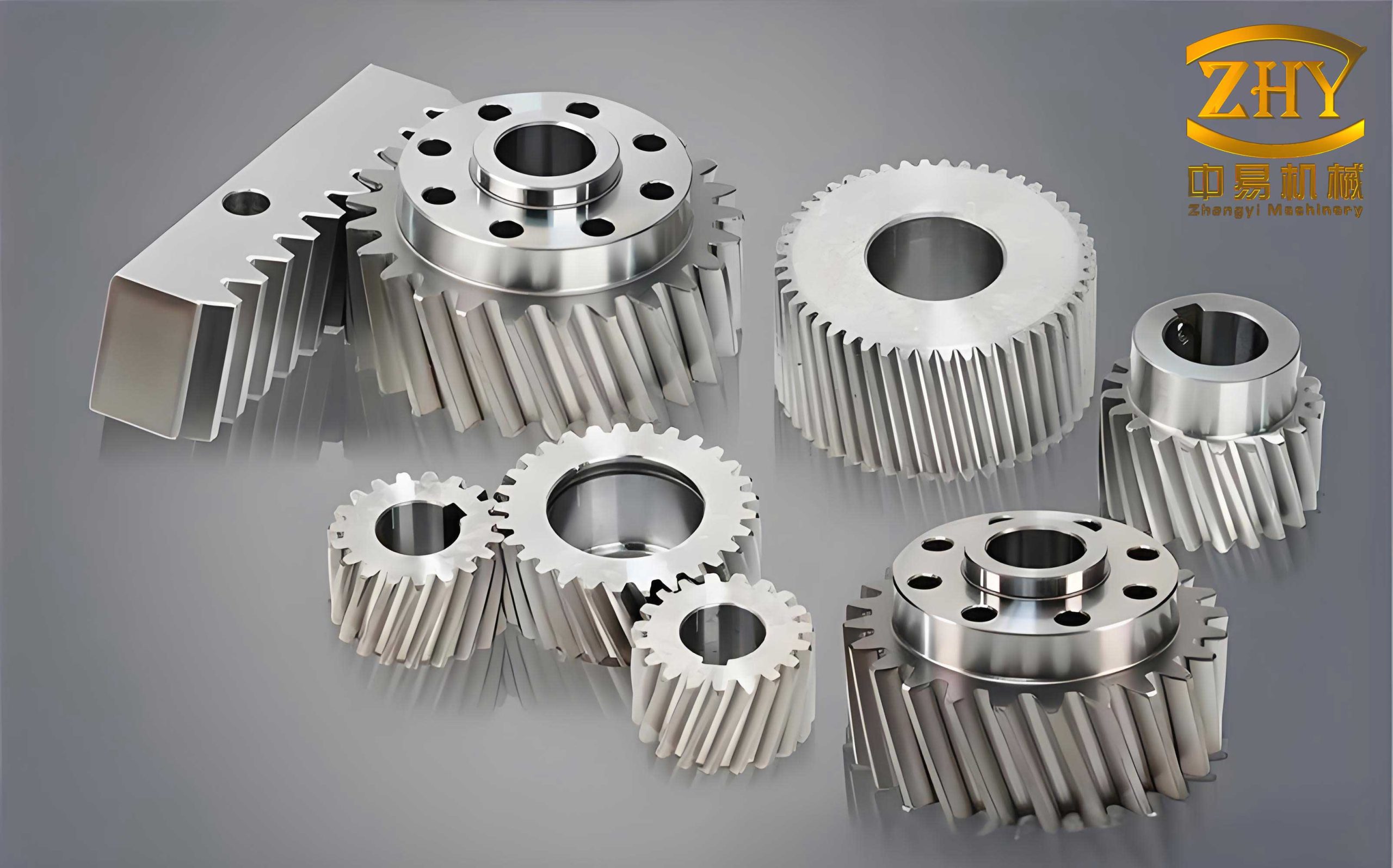
The center distance is calculated as \( A = 361.983 \) mm. In ideal operating conditions, we set the input torque \( T_p = 3000 \) N·m, wear coefficient \( k = 5 \times 10^{-19} \) m²/N, and run simulations for multiple wear cycles. To visualize the geometry of helical spur gears, which is crucial for understanding the contact patterns, we include an illustrative image below.
Under ideal conditions, after \( q = 8 \) profile updates (corresponding to a total of \( z_t = 85 \times 10^6 \) wear cycles), the wear depth distribution on the pinion and gear tooth surfaces is obtained. The results show that wear is non-uniform along the tooth width for helical spur gears, with a gradual increase or decrease depending on the helix angle and direction. Along the tooth profile, wear depth varies significantly. Specifically, for the pinion, the minimum wear occurs near the pitch circle, where pure rolling dominates and relative sliding is minimal. In contrast, the maximum wear is observed near the tooth root of the pinion, where sliding velocity is highest. The wear at the tooth tip is slightly lower. The gear exhibits a similar wear pattern, albeit with different numerical values. This alignment with experimental observations validates our model for helical spur gears.
To quantify the wear distribution, we present the wear depth along the profile at the mid-width of the tooth. For the pinion, at diameter values corresponding to different meshing points, the wear depth \( h \) can be expressed as a function of the radius \( r \). Based on our simulations, the wear profile follows a parabolic trend approximated by:
$$ h(r) = a_0 + a_1 (r – r_p)^2 $$
where \( r_p \) is the pitch radius, and \( a_0, a_1 \) are coefficients derived from the numerical data. For the pinion under ideal conditions, \( a_0 \approx 0.5 \) μm and \( a_1 \approx 0.02 \) μm/mm². This indicates that wear is minimal at the pitch circle and increases quadratically toward the root and tip.
We further investigate the impact of load conditions on wear in helical spur gears. By varying the input torque, we analyze how wear depth changes. For instance, when \( T_p = 3300 \) N·m (a 10% increase) and \( z_t = 85 \times 10^6 \) cycles, the wear distribution pattern remains similar, but wear depths increase significantly. Compared to the ideal case, the maximum wear depth on the pinion rises by 11.25%, and on the gear by 6.39%. This demonstrates that higher loads accelerate wear in helical spur gears. The relationship between maximum wear depth \( h_{\text{max}} \) and torque \( T \) can be modeled linearly over the tested range:
$$ h_{\text{max}} = \alpha T + \beta $$
where \( \alpha \) and \( \beta \) are constants. For the pinion, \( \alpha \approx 1.2 \times 10^{-3} \) μm/N·m and \( \beta \approx -2.5 \) μm.
Additionally, we examine the effect of wear cycle number on wear depth. As shown in Figure 4 of the original text (represented here in tabular form), the maximum wear depth increases with cycle number, but the rate of increase slows over time due to surface smoothing. For different torque levels, the wear rate \( dh_{\text{max}}/dz_t \) decreases as cycles accumulate. This is summarized in Table 3, which provides wear rates at various stages for helical spur gears.
| Torque \( T_p \) (N·m) | Cycle Range \( z_t \) (×10⁶) | Average Wear Rate \( dh_{\text{max}}/dz_t \) (μm/cycle) |
|---|---|---|
| 2800 | 0-50 | 1.8 × 10⁻⁵ |
| 2800 | 50-85 | 1.5 × 10⁻⁵ |
| 3000 | 0-50 | 2.0 × 10⁻⁵ |
| 3000 | 50-85 | 1.7 × 10⁻⁵ |
| 3300 | 0-50 | 2.3 × 10⁻⁵ |
| 3300 | 50-85 | 2.0 × 10⁻⁵ |
The data clearly shows that both torque and cycle number are critical factors in wear progression for helical spur gears. Higher torque leads to a steeper wear curve, while prolonged cycling causes wear to decelerate as the contact area expands and pressure drops. This has important implications for designing helical spur gears aimed at minimizing wear and extending lifespan. Engineers must consider operational parameters such as load and expected service life when selecting materials and determining safety factors.
To delve deeper, we analyze the wear distribution along the tooth width for helical spur gears. Due to the helix angle, contact lines are inclined, causing load to vary across the face width. The wear depth \( h_b \) at a position \( b \) along the width (from 0 to \( B \)) can be described by:
$$ h_b(b) = h_0 + \gamma \sin\left(\frac{2\pi b}{B} + \phi\right) $$
where \( h_0 \) is the average wear depth, \( \gamma \) is the amplitude of variation, and \( \phi \) is a phase angle dependent on helix direction. For a right-hand helix, wear tends to be higher at one end and lower at the other. Our simulations confirm this sinusoidal trend, with \( \gamma \approx 0.1 \) μm under ideal conditions. This non-uniformity underscores the need for precise alignment and lubrication in helical spur gear systems to prevent localized excessive wear.
Another aspect is the influence of wear coefficient \( k \), which depends on material properties and lubrication. In practice, \( k \) can vary due to factors like temperature and contamination. We performed sensitivity analyses by varying \( k \) from \( 1 \times 10^{-19} \) to \( 1 \times 10^{-18} \) m²/N. The results indicate that wear depth scales linearly with \( k \), as expected from Archard’s equation. For helical spur gears, ensuring a low wear coefficient through proper material pairing and lubricant selection is crucial for durability.
Moreover, we explore the effect of helix angle \( \beta \) on wear in helical spur gears. A larger helix angle increases the contact ratio and smooths transmission, but also alters the sliding velocity distribution. We simulated gear pairs with \( \beta = 6^\circ, 12^\circ, \) and \( 20^\circ \), keeping other parameters constant. The maximum wear depth decreases slightly with increasing \( \beta \) due to better load sharing, but the wear distribution along the width becomes more pronounced. This trade-off should be considered in the design of helical spur gears for specific applications.
In terms of numerical methods, our model employs a quasi-static approach, assuming that dynamic effects are negligible for wear calculation over long cycles. However, for high-speed applications, dynamic loads might influence wear rates. Future work could integrate our model with dynamic equations to capture transient effects. Nonetheless, our current model provides a robust foundation for predicting wear in helical spur gears under steady-state conditions.
The convergence of our iterative process is ensured by the threshold-based surface update. We tested different thresholds (1 μm, 2 μm, and 5 μm) and found that 2 μm offers a balance between accuracy and computational efficiency. For helical spur gears, this threshold corresponds to a wear depth that typically causes measurable changes in pressure distribution without excessive recalculation.
To summarize, our study presents a detailed wear model for helical spur gears, combining Hertz contact theory and Archard’s wear formula. The key findings are:
- The wear model for helical spur gears is effective in simulating non-uniform wear along both tooth profile and width.
- Under ideal conditions, wear depth is minimal at the pitch circle and maximal near the pinion tooth root for helical spur gears.
- Load torque and cycle number significantly affect wear depth; higher loads accelerate wear, while wear rate decreases with cycles.
- Design considerations for helical spur gears must include operational parameters to achieve wear reduction and longevity.
In conclusion, the modeling and numerical analysis of tooth surface wear in helical spur gears provide valuable insights for engineers. By accounting for Hertzian contact pressures and Archard-based wear accumulation, our approach enables accurate wear prediction. The results emphasize the importance of load management and lifecycle analysis in the design of helical spur gear systems. Future research could extend this model to include thermal effects, lubrication regimes, and dynamic interactions, further enhancing the understanding of wear in helical spur gears. Ultimately, this work contributes to the development of more reliable and efficient gear transmissions, supporting advancements in mechanical engineering.