
In this comprehensive study, I explore the innovative concept of helical spur gears with asymmetric involute profiles, focusing on their parametric design and bending stress analysis. The helical spur gear represents a significant advancement in gear technology, combining the benefits of helical gears—such as smooth operation and high load capacity—with the performance enhancements offered by asymmetric tooth profiles. Traditional symmetric helical spur gears have been widely used in various industrial applications, but as demands for higher speeds and heavier loads increase, there is a growing need for improved gear designs. Asymmetric helical spur gears, where the drive and coast sides of the tooth have different pressure angles, offer potential advantages in terms of strength and efficiency. However, detailed research on these gears remains limited. In this paper, I aim to address this gap by developing a thorough methodology for designing and analyzing asymmetric helical spur gears, using parametric modeling and finite element analysis (FEA) tools.
The motivation for this work stems from the success of asymmetric involute spur gears in prior studies, which have demonstrated superior bending strength and contact performance compared to symmetric counterparts. By extending this concept to helical spur gears, we can potentially achieve even better performance in applications requiring high torque and reduced noise. My approach begins with deriving the mathematical equations for the tooth profile of an asymmetric helical spur gear, based on the gear generation method using a rack cutter. This foundation allows for the creation of a parametric 3D model in Pro/ENGINEER (Pro/E), enabling rapid design iterations. Subsequently, I conduct FEA to evaluate the bending stress at critical meshing positions, comparing symmetric and asymmetric helical spur gears. Throughout this paper, I will emphasize the importance of the helical spur gear in modern mechanical systems and highlight how parametric design can streamline development processes.
To ensure clarity and depth, I will structure this paper as follows: First, I present the theoretical background and derivation of tooth profile equations for the asymmetric helical spur gear. Next, I detail the parametric modeling process in Pro/E, including key steps and relationships. Then, I describe the FEA setup and results for bending stress analysis. Finally, I discuss the implications and future directions for helical spur gear research. Along the way, I will incorporate tables and equations to summarize critical data and formulas, reinforcing the analytical rigor of this study. The helical spur gear, with its unique geometry, poses both challenges and opportunities for optimization, and this work aims to provide a robust framework for engineers and researchers.
The core of designing an asymmetric helical spur gear lies in understanding the relationship between the rack cutter profile and the generated gear tooth profile. In gear manufacturing, the generation method—using a rack-type cutter—is common for producing involute gears. For an asymmetric helical spur gear, the rack cutter has distinct profiles for the drive side (with a larger pressure angle) and the coast side (with a smaller pressure angle). I consider a dual-fillet rack cutter, as it provides a more accurate representation of the tooth root geometry. The parameters of the rack cutter, such as the addendum coefficient, dedendum coefficient, and fillet radius, directly influence the gear tooth shape. Let me define the key symbols used in the derivations:
- $m$: Module (mm)
- $z$: Number of teeth
- $\alpha_d$: Pressure angle on the drive side (°)
- $\alpha_c$: Pressure angle on the coast side (°)
- $\beta$: Helix angle (°)
- $h^*_{ad}$: Addendum coefficient on the drive side
- $h^*_{ac}$: Addendum coefficient on the coast side
- $c^*_d$: Dedendum coefficient on the drive side
- $c^*_c$: Dedendum coefficient on the coast side
- $r_\rho$: Fillet radius of the rack cutter (mm)
- $a$: Distance from the rack cutter pitch line to the fillet center (mm)
Based on the geometry of the dual-fillet rack cutter, I derive the following equations for the fillet radius and distance $a$:
$$r_\rho = \frac{c^*_d m}{1 – \sin \alpha_d}$$
$$a = (h^*_{ad} + c^*_d) m – r_\rho$$
These equations ensure that the rack cutter produces the desired tooth root shape for the helical spur gear. The rack cutter profile consists of straight line segments that generate the involute portions and circular arcs that generate the fillet curves. During the generation process, the rack cutter moves relative to the gear blank, enveloping the tooth profile. For the asymmetric helical spur gear, I establish a coordinate system on the transverse plane (perpendicular to the gear axis). Let the gear center be the origin $O$, with the $Y$-axis passing through the midpoint of the tooth space on the pitch circle. The tooth profile on the transverse plane includes involute curves and fillet curves for both the drive and coast sides.
For any point $M(x, y)$ on the drive-side involute, the parametric equations are derived as follows:
$$
\begin{bmatrix}
x_M \\
y_M
\end{bmatrix}
=
\begin{bmatrix}
\cos \gamma_d & -\sin \gamma_d \\
\sin \gamma_d & \cos \gamma_d
\end{bmatrix}
\times
\begin{bmatrix}
\frac{m z \cos \alpha_d \sin(\text{inv} \alpha_{Md})}{2 \cos \alpha_{Md}} \\
\frac{m z \cos \alpha_d \cos(\text{inv} \alpha_{Md})}{2 \cos \alpha_{Md}}
\end{bmatrix}
$$
where $\gamma_d = \frac{\pi}{2z} + \text{inv} \alpha_d$, and $\alpha_{Md}$ is the pressure angle at any point on the drive-side involute. The function $\text{inv} \alpha$ represents the involute function, defined as $\text{inv} \alpha = \tan \alpha – \alpha$ in radians. Similarly, for the drive-side fillet curve, which is an extended involute, the equations are:
$$
\begin{bmatrix}
x_M \\
y_M
\end{bmatrix}
=
\begin{bmatrix}
-\sin \phi_d & -\cos (\sigma_d – \phi_d) \\
\cos \phi_d & -\sin (\sigma_d – \phi_d)
\end{bmatrix}
\begin{bmatrix}
r \\
\frac{a}{\sin \sigma_d} + r_\rho
\end{bmatrix}
$$
Here, $\phi_d$ and $\sigma_d$ are angular parameters related to the rack cutter geometry. For the coast side, the involute equations for a point $N(x, y)$ are:
$$
\begin{bmatrix}
x_N \\
y_N
\end{bmatrix}
=
\begin{bmatrix}
-\cos \gamma_c & \sin \gamma_c \\
\sin \gamma_c & \cos \gamma_c
\end{bmatrix}
\times
\begin{bmatrix}
\frac{m z \cos \alpha_c \sin(\text{inv} \alpha_{Nc})}{2 \cos \alpha_{Nc}} \\
\frac{m z \cos \alpha_c \cos(\text{inv} \alpha_{Nc})}{2 \cos \alpha_{Nc}}
\end{bmatrix}
$$
with $\gamma_c = \frac{\pi}{2z} + \text{inv} \alpha_c$, and $\alpha_{Nc}$ as the pressure angle on the coast-side involute. The coast-side fillet curve equations are:
$$
\begin{bmatrix}
x_N \\
y_N
\end{bmatrix}
=
\begin{bmatrix}
\sin \phi_c & -\cos (\sigma_c – \phi_c) \\
\cos \phi_c & -\sin (\sigma_c – \phi_c)
\end{bmatrix}
\times
\begin{bmatrix}
r \\
\frac{a}{\sin \sigma_c} + r_\rho
\end{bmatrix}
$$
To avoid undercutting or interference in the helical spur gear, the pressure angle at the connection point between the involute and fillet must satisfy certain conditions. For the drive side:
$$\alpha_{Md} \geq \arctan \left[ \tan \alpha_d – \frac{4 h^*_{ad}}{z \sin (2 \alpha_d)} \right]$$
For the coast side:
$$\alpha_{Nc} \geq \arctan \left[ \tan \alpha_c – \frac{4 h^*_{ac}}{z \sin (2 \alpha_c)} \right]$$
These inequalities ensure a smooth transition and proper meshing for the helical spur gear. Once the transverse tooth profile is defined, it is extruded along a helical path to form the 3D geometry of the helical spur gear. The helix is defined by the helix angle $\beta$. For a point $(x_0, y_0)$ on the transverse profile, after rotating by an angle $\theta$ (positive for right-hand helix, negative for left-hand helix), the 3D coordinates $(X, Y, Z)$ are given by:
$$
\begin{bmatrix}
X \\
Y \\
Z
\end{bmatrix}
=
\begin{bmatrix}
\cos \theta & -\sin \theta & 0 \\
\sin \theta & \cos \theta & 0 \\
0 & 0 & \theta
\end{bmatrix}
\begin{bmatrix}
x_0 \\
y_0 \\
\frac{m z}{2 \tan \beta}
\end{bmatrix}
$$
This equation accounts for the helical motion, where the $Z$-coordinate varies linearly with $\theta$ to create the helix. With these mathematical foundations, I can proceed to the parametric modeling of the helical spur gear.
The parametric design of the helical spur gear using Pro/ENGINEER involves creating a 3D model that can be easily modified by changing basic parameters. This approach is crucial for optimizing the helical spur gear for different applications. I start by defining the basic parameters in Pro/E’s toolset, such as module, number of teeth, pressure angles, helix angle, face width, and coefficients. These are stored as parameters with initial values. Then, I establish relations to compute derived parameters, like pitch diameter, base diameter, addendum diameter, and dedendum diameter. For example, the pitch diameter $d$ is calculated as $d = m z / \cos \beta$, and the base diameter for the drive side is $d_{bd} = d \cos \alpha_d$. These relations ensure that the model updates automatically when basic parameters change.
Next, I create a cylindrical gear blank with a diameter equal to the addendum diameter and a height equal to the face width. On one end face of the blank, I sketch the transverse tooth profile. This involves drawing circles for the dedendum, base, and pitch diameters, and then using the derived equations to create the involute and fillet curves. In Pro/E, I use the “From Equation” feature to generate these curves based on the parametric equations. Since the tooth profile is asymmetric, I create separate curves for the drive and coast sides, ensuring they connect smoothly at the root and tip. After sketching the profile for one tooth space, I trim it to form a closed loop.
To extrude this profile into a helical shape, I define a helical trajectory. In Pro/E, this can be done using a helical sweep feature. I set the profile to be constant along the helix, with the pitch determined by the helix angle. The tooth space is then cut from the gear blank along this helix, creating a single tooth gap. This process is repeated for all teeth by using a pattern feature, which arrays the tooth gap around the gear axis based on the number of teeth. The result is a complete 3D model of the asymmetric helical spur gear. Additional features, such as hubs, keyways, or lightening holes, can be added as needed. The parametric nature of this model allows for quick regeneration of new gear designs by simply updating the basic parameters, making it highly efficient for iterative design and analysis.
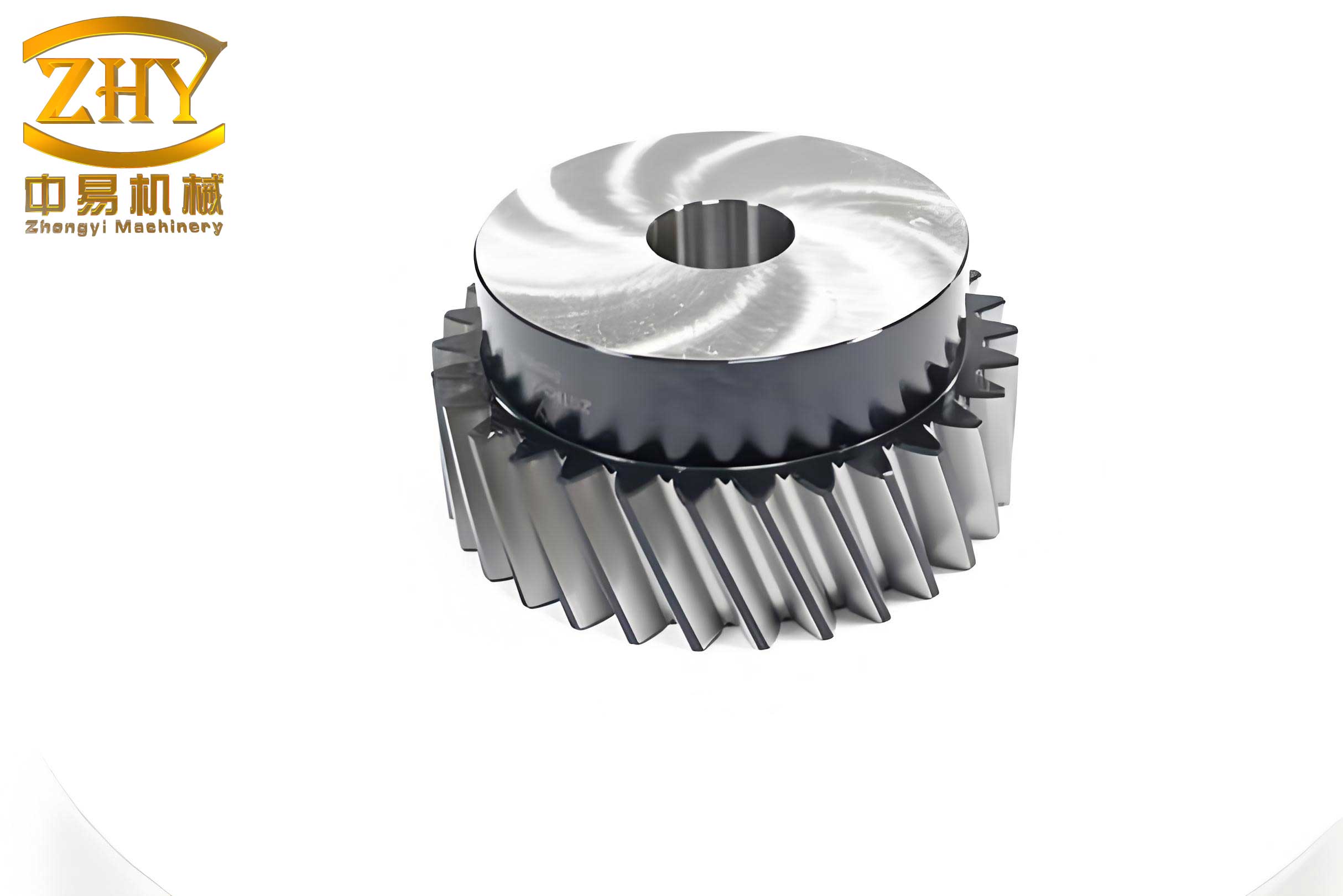
This image illustrates a typical helical spur gear, highlighting its helical teeth and asymmetric profile potential. The parametric modeling process ensures that such gears can be customized for various engineering requirements, emphasizing the versatility of the helical spur gear in transmission systems.
To validate the performance of the asymmetric helical spur gear, I conduct a bending stress analysis using finite element analysis (FEA). Bending stress at the tooth root is a critical factor in gear design, as it affects fatigue life and failure modes. I compare symmetric and asymmetric helical spur gears under identical loading conditions to assess the benefits of asymmetry. For this analysis, I use the 3D models generated in Pro/E and import them into an FEA software, such as ANSYS or Abaqus. The gears are meshed with fine elements near the tooth root to capture stress concentrations accurately. I apply boundary conditions and loads to simulate real-world meshing scenarios.
I define two specific meshing positions for analysis: Position A, where the transverse plane is at the highest point of single-tooth contact (HPSTC), and Position B, where the transverse plane is at the pitch point. These positions are chosen because they often correspond to high bending stresses in gear teeth. For both positions, I model a gear pair consisting of a driver and a driven gear. The driver gear is the focus of stress evaluation. I apply a torque corresponding to a power transmission of 30 kW and a speed of 1000 rpm. The contact between teeth is modeled using surface-to-surface contact elements with friction considered. To reduce computational cost, I model only a segment of the gear, typically five teeth, with appropriate symmetry conditions.
The material properties are assumed to be steel with a Young’s modulus of 210 GPa and a Poisson’s ratio of 0.3. After solving the FEA model, I extract the maximum bending stress at the tooth root for both symmetric and asymmetric helical spur gears. The results are summarized in the table below, which includes key parameters and stress values.
| Parameter | Symmetric Helical Spur Gear | Asymmetric Helical Spur Gear |
|---|---|---|
| Module $m$ (mm) | 5 | 5 |
| Number of Teeth $z_1$ / $z_2$ | 30 / 60 | 30 / 60 |
| Drive Side Pressure Angle $\alpha_d$ (°) | 20 | 25 |
| Coast Side Pressure Angle $\alpha_c$ (°) | 20 | 15 |
| Helix Angle $\beta$ (°) | 30 | 30 |
| Face Width $b$ (mm) | 20 | 20 |
| Addendum Coefficient $h^*_{ad}$ / $h^*_{ac}$ | 1.0 / 1.0 | 1.0 / 1.0 |
| Dedendum Coefficient $c^*_d$ / $c^*_c$ | 0.25 / 0.25 | 0.25 / 0.25 |
| Max Bending Stress at Position A (MPa) | 38.413 | 36.044 |
| Max Bending Stress at Position B (MPa) | 37.251 | 34.887 |
| Stress Reduction Percentage | – | 6.17% (A) and 6.34% (B) |
From the table, it is evident that the asymmetric helical spur gear exhibits lower bending stresses at both meshing positions compared to the symmetric helical spur gear. This reduction, approximately 6%, indicates a potential improvement in bending strength and durability. The stress distribution contours from FEA show that the maximum stress occurs at the root fillet on the drive side, as expected. The asymmetric design redistributes the load more evenly, reducing stress concentrations. I also analyze cases with different fillet geometries, such as circular arcs versus extended involutes, to see their impact on stress. For instance, when using a circular fillet, the bending stress increases slightly, highlighting the importance of fillet design in helical spur gear optimization.
The bending stress $\sigma_b$ in a gear tooth can be estimated using the Lewis formula, modified for helical gears. For a helical spur gear, the bending stress is given by:
$$\sigma_b = \frac{F_t}{b m_n} \cdot \frac{1}{Y} \cdot K_a K_v K_m$$
where $F_t$ is the tangential force, $b$ is the face width, $m_n$ is the normal module ($m_n = m \cos \beta$), $Y$ is the Lewis form factor, and $K_a$, $K_v$, and $K_m$ are application, velocity, and load distribution factors, respectively. For asymmetric teeth, the form factor $Y$ differs between the drive and coast sides, affecting the stress calculation. The FEA results align with these theoretical predictions, confirming the validity of the model.
In addition to bending stress, I briefly consider contact stress analysis for the helical spur gear, as it is crucial for pitting resistance. The contact stress $\sigma_H$ can be calculated using the Hertzian contact theory, adapted for gear teeth:
$$\sigma_H = \sqrt{\frac{F_t}{b d_1} \cdot \frac{u \pm 1}{u} \cdot \frac{E}{\pi (1 – \nu^2)} \cdot \frac{1}{\cos^2 \beta} \cdot Z_I}$$
where $d_1$ is the pitch diameter of the driver gear, $u$ is the gear ratio, $E$ is the equivalent Young’s modulus, $\nu$ is Poisson’s ratio, and $Z_I$ is the geometry factor. For asymmetric helical spur gears, the pressure angle asymmetry influences the geometry factor, potentially reducing contact stress. However, a detailed contact analysis is beyond the scope of this paper and can be explored in future work.
The parametric design and stress analysis presented here demonstrate the feasibility and advantages of asymmetric helical spur gears. By leveraging modern CAD and FEA tools, engineers can efficiently design and optimize these gears for specific applications. The helical spur gear, with its helical teeth, offers inherent benefits like smooth engagement and higher load capacity, and when combined with an asymmetric profile, it can achieve even better performance. In industries such as automotive, aerospace, and heavy machinery, where gear reliability is paramount, the asymmetric helical spur gear could become a valuable innovation.
To further illustrate the design variations, I provide a summary of key parameter ranges for helical spur gears in the table below. This can serve as a reference for designers seeking to implement asymmetric profiles.
| Design Parameter | Typical Range for Helical Spur Gears | Recommended Range for Asymmetric Designs |
|---|---|---|
| Module $m$ (mm) | 1–20 | 2–10 |
| Pressure Angle $\alpha$ (°) | 14.5–25 | Drive: 22–30, Coast: 14–20 |
| Helix Angle $\beta$ (°) | 10–45 | 15–30 |
| Face Width $b$ (mm) | 10–200 | 20–100 |
| Addendum Coefficient | 0.8–1.2 | 1.0–1.1 (drive), 0.9–1.0 (coast) |
| Dedendum Coefficient | 0.25–0.35 | 0.25–0.3 |
In conclusion, this study has successfully developed a comprehensive methodology for the parametric design and stress analysis of helical spur gears with asymmetric involute profiles. I have derived the mathematical equations for the tooth profile, implemented a parametric 3D model in Pro/E, and conducted FEA to evaluate bending stresses. The results show that asymmetric helical spur gears can reduce bending stress by approximately 6% compared to symmetric designs, indicating improved strength and potential for longer service life. The parametric approach allows for rapid customization and optimization, making it a powerful tool for gear design. Future work could expand on this by exploring dynamic analysis, noise reduction, and multi-objective optimization for helical spur gears. As industries continue to push the boundaries of mechanical performance, the asymmetric helical spur gear stands out as a promising solution for high-demand applications.
Throughout this paper, the helical spur gear has been emphasized as a key component in modern engineering, and its asymmetric variant offers a path to enhanced performance. By integrating advanced modeling and analysis techniques, we can unlock new possibilities in gear technology. I hope this research provides a solid foundation for further investigations and practical implementations of helical spur gears in various mechanical systems.