
In the field of mechanical transmission systems, helical spur gears play a critical role due to their high load-bearing capacity, smooth operation, and efficiency. However, manufacturing imperfections, such as helix errors and tooth profile errors, significantly impact their meshing performance. In this study, I investigate the design methodology for helical spur gears across various precision grades, focusing on how these errors influence gear behavior. By establishing mathematical models that incorporate helix and tooth profile errors, constructing three-dimensional geometric models, and performing finite element analysis (FEA), I aim to reveal the effects of different error combinations and precision levels on gear transmission characteristics. This work provides insights into optimizing helical spur gear design for enhanced reliability and performance in practical applications.
The helical spur gear is characterized by its involute profile in the transverse section and a helical tooth alignment along the axis. The basic geometry of a perfect helical spur gear can be described mathematically. Let the base circle radius be \(r_b\), and the starting point of the involute be E. The angle between OE and the Y-axis is \(\theta_0\). For any point C on the involute EF, which is tangent to the base circle at B, the angle between OB and OE is \(\theta_1\). The parametric equations for the involute EF are given by:
$$x(\theta_1) = r_b \sin(\theta_0 + \theta_1) – \theta_1 r_b \cos(\theta_0 + \theta_1)$$
$$y(\theta_1) = r_b \cos(\theta_0 + \theta_1) + \theta_1 r_b \sin(\theta_0 + \theta_1)$$
$$z(\theta_1) = 0$$
By rotating this involute around the Z-axis with a helical motion, the left tooth surface of the helical spur gear is formed. The tooth surface equation becomes:
$$
\begin{bmatrix}
x(\theta_1, \gamma) \\
y(\theta_1, \gamma) \\
z(\theta_1, \gamma) \\
1
\end{bmatrix}
=
\begin{bmatrix}
\cos(\gamma) & -\sin(\gamma) & 0 & 0 \\
\sin(\gamma) & \cos(\gamma) & 0 & 0 \\
0 & 0 & 1 & -p\gamma \\
0 & 0 & 0 & 1
\end{bmatrix}
\begin{bmatrix}
x(\theta_1) \\
y(\theta_1) \\
z(\theta_1) \\
1
\end{bmatrix}
=
\begin{bmatrix}
r_b \sin(\theta_0 + \theta_1 – \gamma) – \theta_1 r_b \cos(\theta_0 + \theta_1 – \gamma) \\
r_b \cos(\theta_0 + \theta_1 – \gamma) + \theta_1 r_b \sin(\theta_0 + \theta_1 – \gamma) \\
-p\gamma \\
1
\end{bmatrix}
$$
Here, \(\gamma\) is a parameter representing the rotation angle around the Z-axis, and \(p\) is the helical parameter, defined as \(p = p_z / 2\pi\), where \(p_z\) is the axial displacement per revolution. This equation describes the ideal tooth surface of a helical spur gear without any errors.
To account for manufacturing inaccuracies, I incorporate helix errors and tooth profile errors based on gear precision standards. The helix error is defined as the deviation between the designed helix and the theoretical helix, measured along the direction tangential to the base circle in the transverse plane. When unfolded on a cylindrical surface, this error manifests as a variation in the helix angle. The incremental mathematical model for helix error is expressed as:
$$
\begin{bmatrix}
\Delta_1 X(\theta_1, \gamma) \\
\Delta_1 Y(\theta_1, \gamma) \\
\Delta_1 Z(\theta_1, \gamma)
\end{bmatrix}
=
\begin{bmatrix}
r_b \Delta(\theta) \cos(\theta_0 + \theta_1 – \gamma) \\
-r_b \Delta(\theta) \sin(\theta_0 + \theta_1 – \gamma) \\
0
\end{bmatrix}
$$
Similarly, the tooth profile error is measured along the normal direction to the involute, which corresponds to the tangential direction of the base circle. The incremental model for tooth profile error is:
$$
\begin{bmatrix}
\Delta_2 X(\theta_1, \gamma) \\
\Delta_2 Y(\theta_1, \gamma) \\
\Delta_2 Z(\theta_1, \gamma)
\end{bmatrix}
=
\begin{bmatrix}
\Delta(f) \cos(\theta_0 + \theta_1 – \gamma) \\
\Delta(f) \sin(\theta_0 + \theta_1 – \gamma) \\
0
\end{bmatrix}
$$
By superimposing these error components onto the ideal tooth surface, the combined mathematical model for a helical spur gear with both helix and tooth profile errors becomes:
$$
\begin{bmatrix}
X(\theta_1, \gamma) \\
Y(\theta_1, \gamma) \\
Z(\theta_1, \gamma)
\end{bmatrix}
=
\begin{bmatrix}
r_b \sin(\theta_0 + \theta_1 – \gamma) – \left[ r_b (\theta_1 – \Delta(\theta)) + \Delta(f) \right] \cos(\theta_0 + \theta_1 – \gamma) \\
r_b \cos(\theta_0 + \theta_1 – \gamma) + \left[ r_b (\theta_1 – \Delta(\theta)) + \Delta(f) \right] \sin(\theta_0 + \theta_1 – \gamma) \\
-p\gamma
\end{bmatrix}
$$
In this study, I define three types of helix error functions \(\Delta(\theta)\) to represent common manufacturing deviations: linear increasing type, parabolic concave type, and parabolic convex type. These are formulated as follows:
For linear increasing type:
$$\Delta(\theta) = a x, \quad a = \frac{\Delta}{r_b}, \quad x = \frac{\gamma b}{p}$$
For parabolic concave type:
$$\Delta(\theta) = a \left( x – \frac{1}{2} \right)^2, \quad a = \frac{4\Delta}{r_b}, \quad x = \frac{\gamma b}{p}$$
For parabolic convex type:
$$\Delta(\theta) = a \left( x – \frac{1}{2} \right)^2 + c, \quad a = -\frac{4\Delta}{r_b}, \quad c = \frac{\Delta}{r_b}, \quad x = \frac{\gamma b}{p}$$
Here, \(\Delta\) is the maximum error value, \(r_b\) is the base radius, \(\gamma\) is the rotation parameter, \(b\) is the face width, and \(p\) is the helical parameter. The tooth profile error function is defined as a parabolic concave shape:
When \(f \leq g_p\):
$$\Delta(f) = a_1 (f – g_p)^2, \quad f = \theta_1 r_b, \quad a_1 = -\frac{\Delta}{g_p^2}$$
When \(f > g_p\):
$$\Delta(f) = a_2 (f – g_p)^2, \quad f = \theta_1 r_b, \quad a_2 = -\frac{\Delta}{(g_l – g_p)^2}$$
In these equations, \(g_p\) is the length of the involute generating line at the pitch circle, and \(g_l\) is the maximum length of the generating line. These error functions allow me to model helical spur gears with varying precision grades by adjusting the \(\Delta\) values according to standard tolerance tables for grades 5, 7, and 10.
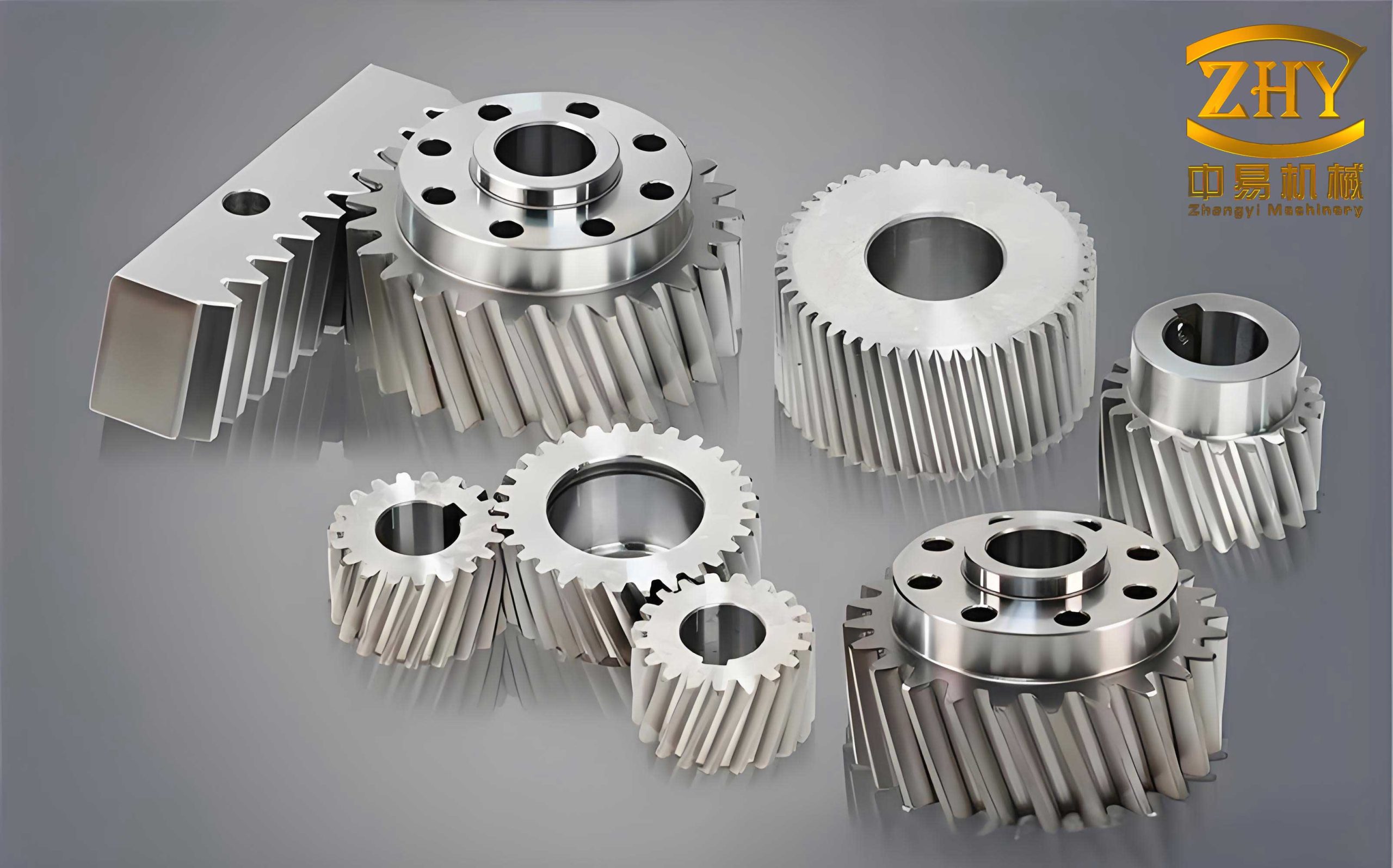
To visualize the geometry of helical spur gears, consider the following representation, which illustrates the typical appearance of these components in engineering applications:
The three-dimensional geometric model of the helical spur gear is constructed using computational tools. I employ MATLAB to calculate the tooth surface data points based on the mathematical model with errors. These data points are then processed and imported into Pro/ENGINEER (Pro/E), where they are fitted into surfaces using boundary-fitting commands. The tooth surfaces are combined with the tip cylinder and root cylinder to form a solid tooth space. By performing Boolean subtraction operations with the gear blank, the complete 3D model of the helical spur gear is generated. This process is repeated for different error combinations and precision grades to create a series of models for analysis.
The basic parameters of the helical spur gear pair used in this study are summarized in the table below. These parameters are essential for ensuring consistency across all models and simulations.
| Parameter | Symbol | Value for Pinion | Value for Gear |
|---|---|---|---|
| Normal Module | \(m_n\) | 0.8 mm | 0.8 mm |
| Number of Teeth | \(z\) | 16 | 39 |
| Normal Pressure Angle | \(\alpha_n\) | 20° | 20° |
| Helix Angle | \(\beta\) | 12° | 12° |
| Face Width | \(b\) | 6 mm | 6 mm |
For finite element analysis (FEA), the 3D geometric models are exported as IGES files and imported into ANSYS. To balance computational efficiency and accuracy, I select six pairs of teeth from the gear pair for meshing analysis. The material properties are set to 40Cr steel with an elastic modulus of \(2.1 \times 10^6\) MPa and a Poisson’s ratio of 0.6. The SOLID185 hexahedral element type is used for discretization. The model is partitioned into blocks to achieve a suitable mesh density, resulting in a refined finite element mesh that captures the contact behavior accurately.
The error combinations analyzed are denoted as A-B, where A represents the helix error type and B represents the tooth profile error type. The three primary combinations are: parabolic concave – parabolic concave (PC-PC), parabolic convex – parabolic concave (PV-PC), and linear increasing – parabolic concave (LI-PC). For each combination, I evaluate precision grades 5, 7, and 10 by adjusting the error magnitudes according to standard limits. The FEA simulations compute key performance metrics: maximum equivalent stress, maximum bending stress, transmission error, and maximum contact pressure over a full meshing cycle.
The results from the finite element simulations provide comprehensive insights into how errors and precision grades affect the performance of helical spur gears. Below, I summarize the findings using tables and formulas to highlight the trends.
Impact on Maximum Equivalent Stress: The maximum equivalent stress varies during meshing due to factors like edge contact and load distribution. For the PC-PC error combination, stress peaks at the initial engagement phase, decreases as full-face contact is achieved, and rises again near disengagement. Lower precision grades exacerbate the stress at engagement. For the PV-PC combination, a severe stress concentration occurs when the rear face enters meshing, leading to a sharp increase in stress. This is attributed to the reduced effective contact area caused by the error profile. The LI-PC combination shows relatively lower stress fluctuations, with reduced stress during engagement as precision improves.
To quantify these effects, the maximum equivalent stress \(\sigma_{eq}\) can be expressed as a function of rotation angle \(\phi\) and error magnitude \(\Delta\). For instance, for the PC-PC case, a simplified model yields:
$$\sigma_{eq}(\phi) = \sigma_0 + k_1 \Delta \cdot e^{-k_2 \phi} \quad \text{for } \phi < \phi_c$$
$$\sigma_{eq}(\phi) = \sigma_0 \quad \text{for } \phi_c \leq \phi \leq \phi_d$$
$$\sigma_{eq}(\phi) = \sigma_0 + k_3 \Delta \cdot (\phi – \phi_d) \quad \text{for } \phi > \phi_d$$
Here, \(\sigma_0\) is the stress under ideal conditions, \(k_1, k_2, k_3\) are coefficients, \(\phi_c\) is the angle at which full contact begins, and \(\phi_d\) is the angle at which disengagement starts. The table below summarizes the peak stress values for different precision grades and error combinations.
| Error Combination | Precision Grade 5 | Precision Grade 7 | Precision Grade 10 |
|---|---|---|---|
| PC-PC | 450 MPa | 420 MPa | 500 MPa |
| PV-PC | 600 MPa | 550 MPa | 700 MPa |
| LI-PC | 400 MPa | 380 MPa | 450 MPa |
Impact on Maximum Bending Stress: The bending stress patterns closely follow those of equivalent stress, indicating a strong correlation. For PC-PC errors, bending stress is highest during engagement and disengagement, with lower precision grades increasing the stress. For PV-PC errors, the stress concentration at rear-face engagement leads to critical bending stresses that may risk tooth failure. The LI-PC combination shows minimal bending stress variations except at the entry and exit points. The bending stress \(\sigma_b\) can be modeled similarly:
$$\sigma_b(\phi) = \frac{M(\phi)}{S} + \alpha \Delta(\theta)$$
where \(M(\phi)\) is the bending moment, \(S\) is the section modulus, and \(\alpha\) is a sensitivity coefficient. The table below presents the maximum bending stress values.
| Error Combination | Precision Grade 5 | Precision Grade 7 | Precision Grade 10 |
|---|---|---|---|
| PC-PC | 300 MPa | 280 MPa | 350 MPa |
| PV-PC | 450 MPa | 400 MPa | 520 MPa |
| LI-PC | 250 MPa | 230 MPa | 300 MPa |
Impact on Transmission Error: Transmission error (TE) is defined as the deviation from ideal angular position during meshing. It exhibits oscillatory behavior with peaks and valleys corresponding to tooth engagements and disengagements. For PC-PC errors, TE shows three peaks and two valleys per cycle, with lower precision grades reducing the amplitude of fluctuations. For PV-PC errors, the TE pattern shifts, and at lower grades, the phase reverses with increased amplitude. For LI-PC errors, the peaks remain stable, but valleys deepen with decreasing precision. The transmission error \(TE(\phi)\) can be expressed as:
$$TE(\phi) = \sum_{i=1}^{n} A_i \sin(\omega_i \phi + \phi_i) + \beta \Delta(f)$$
where \(A_i\) are amplitudes, \(\omega_i\) are frequencies, \(\phi_i\) are phase shifts, and \(\beta\) is a coupling coefficient. The table below shows the peak-to-peak TE values.
| Error Combination | Precision Grade 5 | Precision Grade 7 | Precision Grade 10 |
|---|---|---|---|
| PC-PC | 0.02 mm | 0.015 mm | 0.025 mm |
| PV-PC | 0.03 mm | 0.022 mm | 0.035 mm |
| LI-PC | 0.01 mm | 0.008 mm | 0.012 mm |
Impact on Maximum Contact Pressure: Contact pressure is critical for surface durability. For PC-PC errors, pressure spikes at engagement and disengagement, with lower grades delaying the peak. For PV-PC errors, pressure fluctuates severely at key meshing points, worsening with lower precision. For LI-PC errors, pressure trends align with ideal gears but at higher magnitudes. The contact pressure \(P_c\) can be estimated using Hertzian theory modified for errors:
$$P_c = \sqrt{\frac{F E^*}{\pi R}} + \gamma \Delta(\theta)$$
where \(F\) is the load, \(E^*\) is the effective elastic modulus, \(R\) is the effective radius, and \(\gamma\) is a factor. The table below lists the maximum contact pressures.
| Error Combination | Precision Grade 5 | Precision Grade 7 | Precision Grade 10 |
|---|---|---|---|
| PC-PC | 1.5 GPa | 1.3 GPa | 1.8 GPa |
| PV-PC | 2.0 GPa | 1.7 GPa | 2.3 GPa |
| LI-PC | 1.2 GPa | 1.1 GPa | 1.5 GPa |
To further analyze the effects, I compare the three error combinations at a fixed precision grade (grade 7). The results indicate that the PV-PC combination has the most detrimental impact on all performance metrics, causing significant stress concentrations and TE variations. The PC-PC combination shows moderate effects, while the LI-PC combination is relatively benign. This suggests that in the design of helical spur gears, error types must be carefully considered alongside precision grades.
The mathematical models and FEA results underscore the importance of precision in helical spur gear manufacturing. Lower precision grades generally degrade performance, but the extent depends on the error profile. For instance, parabolic convex helix errors combined with parabolic concave tooth profile errors create localized high-stress zones that can lead to premature failure. In contrast, linear increasing helix errors with parabolic concave tooth profile errors distribute loads more evenly, mitigating adverse effects. These insights can guide tolerance allocation and quality control processes for helical spur gears in industries such as automotive and aerospace.
In conclusion, this study presents a comprehensive design method for helical spur gears with different precision grades. By developing mathematical models that incorporate helix and tooth profile errors, constructing 3D geometric models, and performing detailed finite element analyses, I have revealed how error combinations and precision levels influence meshing performance. The findings highlight that precision grade reduction exacerbates stresses, transmission error, and contact pressure, with the parabolic convex – parabolic concave error combination being the most critical. The linear increasing – parabolic concave combination shows the least impact. These results provide valuable guidelines for optimizing helical spur gear design, ensuring reliability and efficiency in mechanical transmission systems. Future work could explore additional error types, dynamic loading conditions, and experimental validation to further enhance the understanding of helical spur gear behavior.