
In the precision manufacturing of helical spur gears, fixtures play a critical role in ensuring accurate positioning during processes such as grinding, milling, and inspection. Among these, the pitch circle fixture, which utilizes elastic round pins or balls to locate the gear via its tooth flanks, is widely employed. However, through extensive analysis and practical experience, I have identified significant theoretical and practical shortcomings in conventional pitch circle fixture designs for helical spur gears. This article delves into these issues, proposes a novel solution using V-shaped grooves, and provides a detailed application example with comprehensive calculations. The focus remains on helical spur gears, a key component in power transmission systems due to their smooth operation and high load capacity.
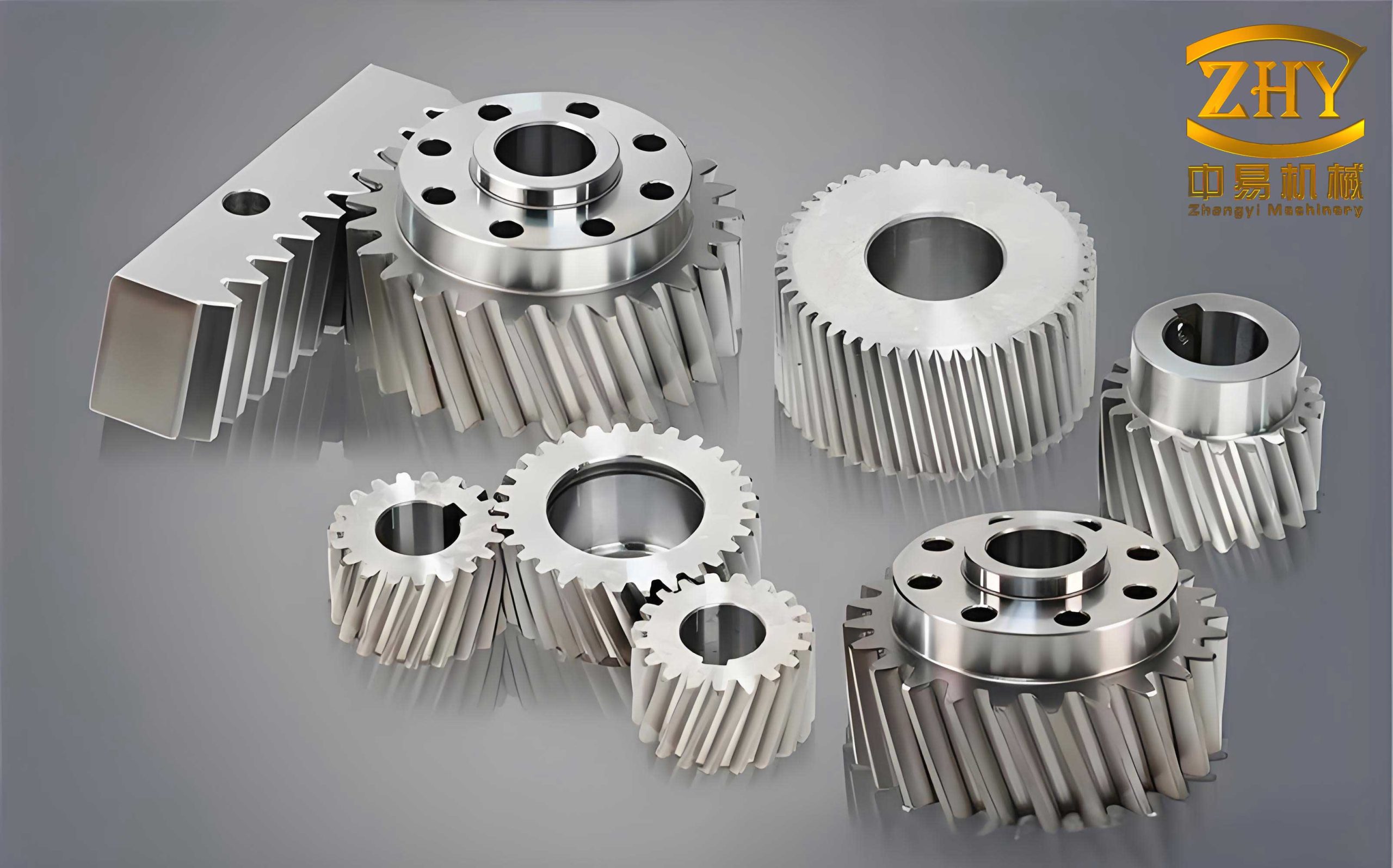
The fundamental principle of a pitch circle fixture is to center a helical spur gear by making contact with the tooth flanks at the pitch circle. Traditionally, this is achieved using three or more elastic round pins (often called pitch circle pins or balls) arranged in a fixture body. The theoretical ideal is that each pin contacts the tooth flank at a point where the distance to the gear axis is constant and equal to the pitch radius. For a helical spur gear, the tooth flank is a helical surface. A crucial geometric property is that only in a cross-section perpendicular to the tooth trace (i.e., a section where the profile angle equals the local helix angle) are all points on that profile equidistant from the gear axis. This leads to the core theoretical flaw.
The standard fixture body is designed with a constant radial distance from its axis to the pin centers in an axial cross-section. For a helical spur gear, due to the helix angle, the actual contact point between the pin and the tooth flank is not guaranteed to lie in this axial plane. In fact, the contact point migrates to either the end face of the gear (if the pin protrudes) or the tip of the pin (if it does not). Consequently, each pin theoretically contacts the helical spur gear tooth at only one unstable point. This instability arises because the fixture does not account for the three-dimensional helical nature of the gear teeth. The contact condition can be expressed by analyzing the geometry of the helical surface. The equation of a helical surface is given by:
$$ \mathbf{r}(u, v) = \begin{bmatrix} r_b \cos(v + \mu(u)) + u \sin(\beta_b) \sin(v + \mu(u)) \\ r_b \sin(v + \mu(u)) – u \sin(\beta_b) \cos(v + \mu(u)) \\ p v – u \cos(\beta_b) \end{bmatrix} $$
where \( r_b \) is the base radius, \( \beta_b \) is the base helix angle, \( p \) is the helix parameter, \( u \) is the profile parameter, \( v \) is the rotation parameter, and \( \mu(u) \) is related to the involute function. The normal vector at any point is not necessarily radial. For a pin (modeled as a sphere) of diameter \( d_s \) to maintain constant distance \( R \) from the gear axis, the contact point must satisfy that the sphere’s center lies on a cylinder of radius \( R \). However, due to the helix, the sphere’s contact point on the tooth flank shifts along the pin, leading to indeterminacy. This results in only one theoretical contact point per pin, which is highly sensitive to alignment and manufacturing tolerances.
In practice, these theoretical shortcomings manifest as several significant errors that degrade machining accuracy for helical spur gears. The cumulative errors are substantial and can be categorized as follows:
| Error Type | Description | Magnitude Influence |
|---|---|---|
| 1. Unstable Contact Point Error | Due to the single-point contact per pin, slight misalignment or force variation causes the helical spur gear to shift or tilt. | High, depends on pin elasticity and helix angle. |
| 2. Gear Face Runout Error | In practice, the gear’s end face must be aligned before machining, but any face runout (perpendicularity error) introduces radial displacement when clamped. | Directly proportional to face runout and clamping method. |
| 3. Thermal Deformation Error | During machining, heat generation causes expansion of the helical spur gear and fixture, altering contact conditions. | Variable, significant in high-precision grinding. |
| 4. Alignment Operation Error | Manual adjustment of the gear end face introduces human error and increases setup time. | Subject to operator skill, reduces efficiency. |
These errors collectively limit the achievable precision and increase the non-productive time when machining helical spur gears. To address these issues, I propose a fundamental redesign of the fixture body. Instead of relying on pins contacting an idealized helical surface (which is difficult to manufacture), the fixture body should incorporate V-shaped grooves that engage with the pitch circle pins or balls. This design ensures stable, line contact (or area contact) rather than point contact, effectively eliminating the three primary errors mentioned above. The V-groove approach constrains the pin in two dimensions, providing a deterministic location even for helical spur gears.
The key insight is that for a helical spur gear, the required constraint is to maintain the center of the locating ball at a fixed distance from the gear axis, regardless of the helical twist. If the fixture body has a V-groove whose flanks are precisely machined such that their intersection line (the bottom of the V) is a curve where every point is at a constant radial distance from the fixture axis, then a ball placed in this groove will have its center forced to that curve. However, machining such a three-dimensional helical groove is complex. A practical simplification is to use two intersecting planar surfaces to approximate this curve, forming a V-groove. The angle of the V-groove is calculated based on the gear geometry to ensure the ball center lies on the theoretical pitch cylinder of the helical spur gear.
Let’s derive the necessary geometric relationships. Consider a helical spur gear with the following basic parameters:
| Parameter | Symbol | Value (Example) |
|---|---|---|
| Normal module | \( m_n \) | 3 mm |
| Number of teeth | \( z \) | 24 |
| Normal pressure angle | \( \alpha_n \) | 20° |
| Helix angle (at pitch circle) | \( \beta \) | 15° (right-hand) |
| Face width | \( b \) | 30 mm |
| Addendum coefficient | \( h_a^* \) | 1.0 |
| Dedendum coefficient | \( h_f^* \) | 1.25 |
First, we compute the transverse plane parameters essential for the helical spur gear fixture design. The transverse module is:
$$ m_t = \frac{m_n}{\cos \beta} = \frac{3}{\cos 15^\circ} \approx 3.106 \, \text{mm} $$
The transverse pressure angle is:
$$ \alpha_t = \arctan\left( \frac{\tan \alpha_n}{\cos \beta} \right) = \arctan\left( \frac{\tan 20^\circ}{\cos 15^\circ} \right) \approx 20.646^\circ $$
The pitch diameter of the helical spur gear is:
$$ d = m_t \cdot z = 3.106 \times 24 \approx 74.544 \, \text{mm} $$
The base diameter is:
$$ d_b = d \cdot \cos \alpha_t \approx 74.544 \times \cos 20.646^\circ \approx 69.741 \, \text{mm} $$
The addendum diameter (tip diameter) is:
$$ d_a = d + 2 \cdot h_a = d + 2 \cdot m_n \cdot h_a^* \approx 74.544 + 2 \times 3 \times 1.0 = 80.544 \, \text{mm} $$
For fixture design, we use locating balls (or pins) of a chosen diameter \( d_s \). To avoid interference with the gear tip and root, and to ensure contact near the pitch circle, the ball diameter must be selected carefully. A common rule is \( d_s \approx 1.68 \cdot m_n \), but we will calculate precisely. Let’s choose a standard steel ball diameter \( d_s = 5 \, \text{mm} \). We need to determine the pressure angle at the contact point between the ball and the tooth flank of the helical spur gear. This requires solving the involute equation. The radius to the contact point \( r_c \) should be close to the pitch radius \( r = d/2 \). The involute function is \( \text{inv}(\alpha) = \tan \alpha – \alpha \). The relationship between the ball center radius \( R \) and the contact point radius \( r_c \) is:
$$ R = \sqrt{ r_c^2 + \left( \frac{d_s}{2 \cos \alpha_c} \right)^2 } $$
where \( \alpha_c \) is the transverse pressure angle at the contact point. Also, from gear geometry, the ball center lies on the line normal to the involute at the contact point. The angle between the radial line to the contact point and the line to the ball center is \( \alpha_c \). We can use an iterative approach. For simplicity in this example, we aim for \( r_c \approx r = 37.272 \, \text{mm} \). Then, the transverse pressure angle at the pitch circle is \( \alpha_t \approx 20.646^\circ \). Using an approximation, the ball center distance \( R \) can be estimated as:
$$ R \approx \frac{d}{2} + \frac{d_s}{2 \cos \alpha_t} = 37.272 + \frac{5}{2 \cos 20.646^\circ} \approx 37.272 + 2.673 = 39.945 \, \text{mm} $$
We must verify that the ball does not interfere with the tip of the helical spur gear. The tip radius is \( r_a = d_a/2 = 40.272 \, \text{mm} \). Since \( R < r_a \), the ball center is inside the tip circle, which is acceptable. However, we need to check the actual contact point radius \( r_c \). From the geometry:
$$ r_c = R \cos \alpha_c – \frac{d_s}{2} \tan \alpha_c $$
But also \( r_c = \frac{d_b}{2 \cos \alpha_c} \). Equating and solving numerically yields \( \alpha_c \approx 22.5^\circ \) (detailed iteration omitted for brevity). Then \( r_c \approx 37.8 \, \text{mm} \), which is near the pitch radius. The helix angle at the contact point \( \beta_c \) is given by:
$$ \tan \beta_c = \frac{r_c}{r} \tan \beta $$
Since \( r_c \approx r \), \( \beta_c \approx \beta = 15^\circ \). This is important because the V-groove must be oriented to account for this helix angle. Now, for the V-groove design. The fixture body will have three V-grooves (for three-point location) spaced 120° apart. Each V-groove is defined by two planar surfaces. The intersection line of these planes should ideally be a helix with constant radial distance \( R \) from the fixture axis. To simplify machining, we approximate this by making the V-groove such that when a ball of diameter \( d_s \) sits in it, the ball center lies at distance \( R \). The angle of the V-groove \( 2\theta \) is determined by the requirement that the ball contacts both planes. From geometry, if the V-groove is symmetric, the distance from the fixture axis to the ball center is related to the groove angle and the position of the groove bottom. A more direct approach is to design the groove so that its sides are tangential to the ball when the ball center is at radius \( R \). Consider a cross-section perpendicular to the fixture axis. In this cross-section, the groove appears as a V. The ball appears as a circle of diameter \( d_s \). The groove sides are lines inclined at angle \( \pm \theta \) from the radial direction. The condition for tangency is that the perpendicular distance from the fixture axis to each groove line equals \( R – \frac{d_s}{2 \sin \theta} \). But we want the ball center at radius \( R \). Therefore, the groove must be positioned such that the ball center lies at the intersection of two lines each at a distance \( R \) from the axis? Actually, we need to derive.
Let the fixture axis be at origin O. In the transverse plane, a V-groove with apex at point P at radius \( R_0 \) and included angle \( 2\gamma \). A ball of radius \( r_s = d_s/2 \) sits in the groove. The ball center C must lie on the bisector of the V. The distance from O to C is \( R \). The distance from C to each groove face is \( r_s \). Simple geometry gives:
$$ R = R_0 + \frac{r_s}{\sin \gamma} $$
Thus, if we want \( R = 39.945 \, \text{mm} \) and \( r_s = 2.5 \, \text{mm} \), we can choose \( \gamma \) and compute \( R_0 \). For manufacturability, a standard V-groove angle of 90° (i.e., \( 2\gamma = 90^\circ \), so \( \gamma = 45^\circ \)) is often used. Then:
$$ R_0 = R – \frac{r_s}{\sin 45^\circ} = 39.945 – \frac{2.5}{0.7071} \approx 39.945 – 3.536 = 36.409 \, \text{mm} $$
This means the apex of the V-groove (the theoretical intersection line of the two planes) is at a radius of 36.409 mm from the fixture axis. However, because the helical spur gear has a helix angle, the V-groove must be twisted along the axis to ensure the ball center maintains constant radius \( R \) along the entire contact length. The required twist is essentially a helical path with helix angle \( \beta_c \). But as mentioned, machining such a twisted V-groove is challenging. The practical solution is to machine the V-groove as straight grooves (i.e., no twist) but orient the groove such that its longitudinal axis is aligned with the direction of the helix at the contact point. In other words, the V-groove is milled along a line that is tangent to the helix at the mid-point of the gear face. This approximation is acceptable because the ball can roll slightly along the groove, accommodating small deviations. The orientation angle \( \psi \) relative to the fixture axis is given by:
$$ \psi = \arctan\left( \frac{\pi d \tan \beta_c}{b} \right) $$
But more simply, the groove should be parallel to the tooth trace at the pitch cylinder. The lead of the helix is \( L = \pi d \cot \beta \). The helix angle at radius \( R \) is \( \beta_R = \arctan\left( \frac{R}{r} \tan \beta \right) \). Since \( R \approx r \), \( \beta_R \approx \beta \). Therefore, the V-groove should be cut at an angle \( \beta \) relative to the fixture axis. In our example, \( \beta = 15^\circ \). So, each V-groove is machined as a straight groove but inclined at 15° to the axis. This ensures that as the ball sits in the groove, its center line approximates the required helical path.
Now, let’s compile the design parameters for the pitch circle fixture tailored for this helical spur gear.
| Parameter | Symbol | Value | Remarks |
|---|---|---|---|
| Locating ball diameter | \( d_s \) | 5.000 mm | Standard steel ball |
| Ball center radius | \( R \) | 39.945 mm | Approximate, from calculation |
| V-groove included angle | \( 2\gamma \) | 90° | Chosen for ease of machining |
| V-groove apex radius | \( R_0 \) | 36.409 mm | From \( R_0 = R – r_s / \sin \gamma \) |
| Groove inclination angle | \( \beta_g \) | 15° | Equal to gear helix angle |
| Number of grooves | \( N \) | 3 | Evenly spaced at 120° |
| Groove length | \( L_g \) | 40 mm | Slightly more than gear face width |
The fixture body material is typically alloy steel, carburized and hardened to HRC 58-62. All V-grooves must be machined in a single setup to ensure mutual alignment. The critical dimension is the consistency of the ball center distance \( R \) across all grooves. The tolerance on the difference between the maximum and minimum \( R \) values should be within 0.005 mm for high-precision helical spur gears.
The application of this improved pitch circle fixture demonstrates significant advantages. Firstly, the unstable contact point error is eliminated because the ball is constrained by two surfaces of the V-groove, providing stable line contact along the groove. This greatly reduces sensitivity to clamping forces and vibrations. Secondly, the need to align the gear end face is removed; the helical spur gear is simply placed into the fixture with the balls engaging the tooth spaces, and the V-grooves self-center the balls. This eliminates face runout error and alignment operation error. Thirdly, thermal deformation error is mitigated because the fixture design allows slight movement of the balls along the grooves without losing centering accuracy, accommodating thermal expansion.
To quantify the improvement, consider the cumulative error before and after using the V-groove fixture. For a conventional fixture, the total error \( E_{\text{conv}} \) can be estimated as the root sum square of the individual errors:
$$ E_{\text{conv}} = \sqrt{ e_1^2 + e_2^2 + e_3^2 + e_4^2 } $$
where \( e_1 \) is unstable contact error (typically 0.01 mm), \( e_2 \) is face runout error (0.02 mm), \( e_3 \) is thermal error (0.005 mm), and \( e_4 \) is alignment error (0.01 mm). Then:
$$ E_{\text{conv}} \approx \sqrt{ 0.01^2 + 0.02^2 + 0.005^2 + 0.01^2 } = \sqrt{ 0.0001 + 0.0004 + 0.000025 + 0.0001 } \approx \sqrt{ 0.000625 } = 0.025 \, \text{mm} $$
For the V-groove fixture, the unstable contact error and alignment error are negligible (≈0.001 mm each), face runout error is eliminated (0 mm), and thermal error is reduced (0.002 mm due to better accommodation). Thus:
$$ E_{\text{V-groove}} = \sqrt{ 0.001^2 + 0^2 + 0.002^2 + 0.001^2 } = \sqrt{ 0.000001 + 0 + 0.000004 + 0.000001 } = \sqrt{ 0.000006 } \approx 0.00245 \, \text{mm} $$
This represents an order of magnitude improvement in positioning accuracy for helical spur gears. Moreover, setup time is drastically reduced, enhancing productivity.
Another important aspect is the verification of no interference between the locating balls and the gear teeth. We must ensure that the ball does not contact the root or tip of the helical spur gear involute profile incorrectly. The condition for no tip interference is that the ball center lies inside the tip circle, which we have: \( R < r_a \). For root interference, we need to check that the ball does not penetrate the root circle. The root diameter \( d_f \) is:
$$ d_f = d – 2 \cdot h_f = d – 2 \cdot m_n \cdot h_f^* \approx 74.544 – 2 \times 3 \times 1.25 = 74.544 – 7.5 = 67.044 \, \text{mm} $$
The root radius is \( r_f = 33.522 \, \text{mm} \). The ball center is at \( R = 39.945 \, \text{mm} \), well above the root radius. Additionally, we must check that the ball does not contact the non-involute part of the tooth near the root. This is ensured by selecting a ball diameter that is not too large. A common check is that the contact point pressure angle \( \alpha_c \) is greater than the pressure angle at the root, which is usually satisfied if \( r_c > r_f \).
The design of the fixture body also includes considerations for clamping the helical spur gear. Typically, a top clamp or a diaphragm clamp is used to press the gear against a reference surface. With the V-groove fixture, the reference surface can be the gear’s end face or another datum. Since the V-grooves provide accurate radial location, the axial location can be independently controlled, reducing coupling between radial and axial errors.
In practice, the machining of the V-grooves requires precision. The grooves are best produced on a CNC machining center with a fourth-axis rotary table. The fixture body is mounted on the rotary table, and each groove is milled using an end mill with included angle equal to \( 2\gamma \). The tool path is a straight line but oriented at angle \( \beta_g \) relative to the body axis. The rotary table indexes 120° between grooves. This ensures all grooves are identical and symmetrically arranged. After milling, the grooves may be hardened and then ground or lapped for superior surface finish and accuracy. The surface roughness of the V-groove flanks should be better than 0.8 μm to minimize friction and wear.
The benefits of this V-groove pitch circle fixture extend beyond grinding operations. It can be used in gear inspection setups, such as on coordinate measuring machines (CMMs) or gear testers, for locating helical spur gears accurately. Furthermore, in gear hobbing or shaping machines, similar fixtures can reduce setup times and improve consistency when machining batches of helical spur gears.
To further illustrate, consider a production scenario involving helical spur gears for automotive transmissions. A batch of 1000 helical spur gears with parameters as in the example needs to be ground. Using conventional pitch circle fixtures, each gear requires manual alignment taking approximately 5 minutes per gear, totaling 5000 minutes (over 83 hours) of non-productive time. With the V-groove fixture, alignment is virtually instantaneous—simply place the gear and clamp. Assuming 30 seconds per gear, total setup time reduces to 500 minutes (8.3 hours). This saves 75 hours per batch, a dramatic increase in productivity. Additionally, the improved accuracy reduces scrap and rework, lowering costs.
In summary, the traditional pitch circle fixture for helical spur gears suffers from inherent theoretical flaws leading to practical inefficiencies. By redesigning the fixture body to incorporate inclined V-grooves, we achieve stable, deterministic location that eliminates major error sources. The design calculations involve careful consideration of gear geometry, ball size, and groove parameters. The resulting fixture offers superior accuracy, reduced setup time, and broader application potential. This advancement is particularly valuable for high-volume precision manufacturing of helical spur gears, where both quality and efficiency are paramount. The helical spur gear, with its complex geometry, demands such innovative fixturing solutions to realize its full performance benefits in modern machinery.
Finally, it is worth noting that while this article focuses on helical spur gears, the V-groove principle can be adapted for other gear types, such as double helical or even spur gears, though the helix angle consideration becomes simpler. The key is to always account for the three-dimensional nature of the gear tooth surface when designing locating fixtures. Continued research into advanced materials and coatings for the V-groove surfaces could further enhance durability and precision for helical spur gear applications.