
The manufacturing and precise adjustment of helical bevel gears represent a significant technical challenge within the automotive and general machinery industries. These components are critical for transmitting power between intersecting shafts at high efficiency and with smooth, quiet operation. However, the setup calculations required for their cutting on specialized machine tools are notoriously complex and time-consuming, especially for small-batch or single-piece production scenarios. Errors in manual calculation can lead to costly scrap, machine downtime, and performance issues in the final gear set. My work focuses on developing a robust computerized calculation system to automate this process. By transforming the intricate “Roll Position Correction Method” into a structured computer program, we achieve not only a dramatic increase in workflow efficiency but also a guaranteed level of accuracy and repeatability that is difficult to maintain manually. This digital approach represents a fundamental shift in how setup data for machining helical bevel gears is derived and applied.
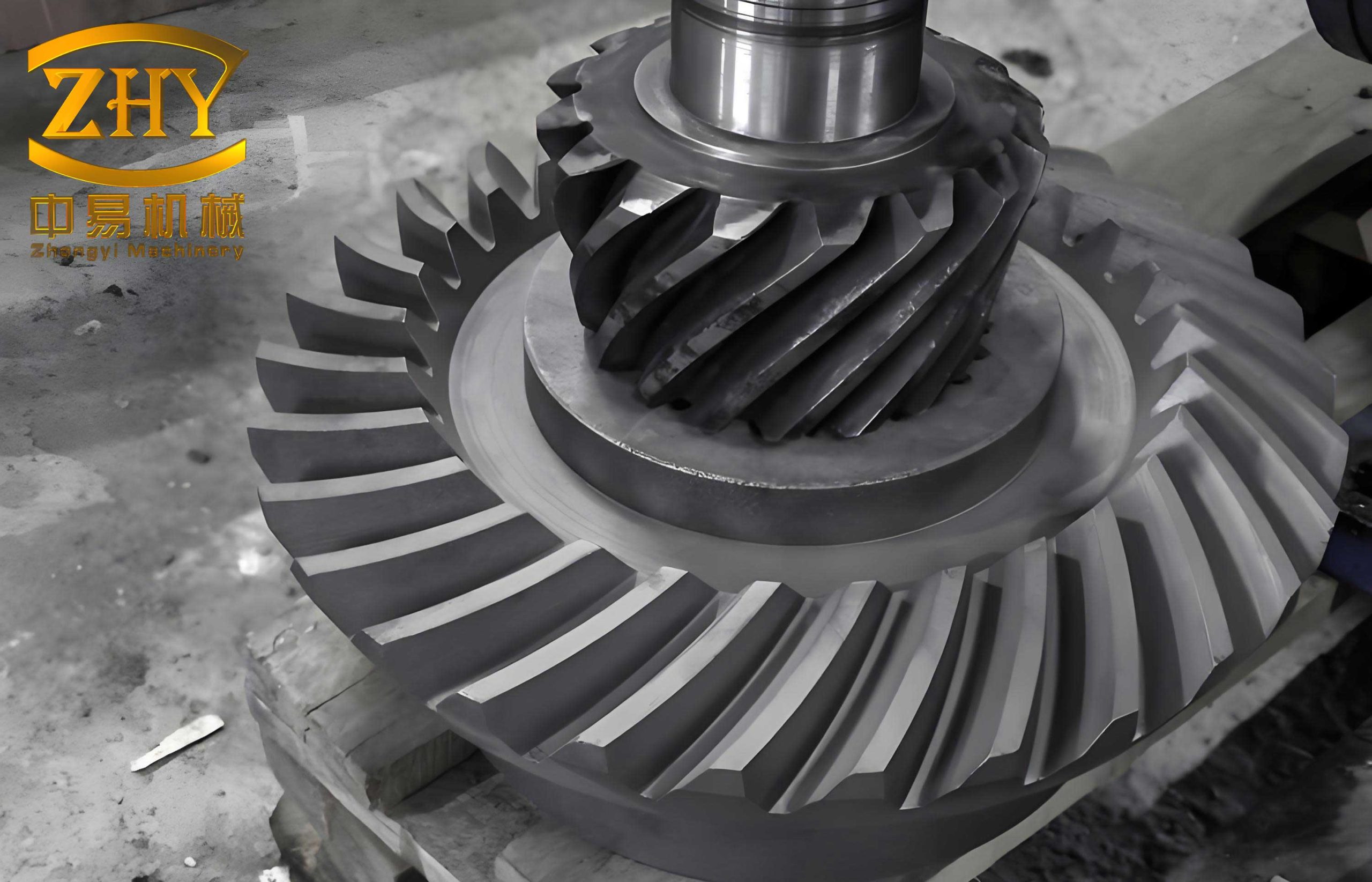
Background and Motivation
The geometry of helical bevel gears is inherently three-dimensional and complex. Their teeth are curved and oblique relative to the gear axis, providing gradual engagement and higher load capacity compared to straight bevel gears. This complexity translates directly to the machining process. Various machine tools and cutting methods exist, such as Formate, Revacycle, or Continuous Indexing (Gleason Phoenix), each suited to different production volumes. For small-lot production, flexibility and quick setup are paramount. The method I have programmed for is specifically designed for single-item or small-batch production on machines analogous to the Gleason No. 116 or similar types. The core challenge lies in calculating dozens of interdependent parameters—from basic gear geometry to specific machine settings like cradle angles, ratio change gears, and tool positioning. Manually performing these calculations is prone to error and can take hours for a single gear pair. Implementing a computer program eliminates arithmetic mistakes, ensures consistency, and reduces calculation time to seconds, freeing skilled technicians to focus on the physical setup and machining operations.
The “Roll Position Correction Method” and Its Formulas
The calculation program is built upon the “Roll Position Correction Method.” This method is particularly well-suited for the single-pass finishing or simplified roughing/finishing cycles used in low-volume production of helical bevel gears. It involves a series of sequential calculations that start with the fundamental gear design parameters and culminate in the specific numerical settings required to adjust the cutting machine. Below are the core formulas and calculation flow. The symbols used are defined in the accompanying table.
| Symbol | Description |
|---|---|
| $m$ | Module |
| $z_1$, $z_2$ | Number of teeth (pinion, gear) |
| $\beta$ | Mean spiral angle |
| $\alpha$ | Pressure angle |
| $F_w$ | Face width |
| $d_1$, $d_2$ | Pitch diameter (pinion, gear) |
| $\delta_1$, $\delta_2$ | Pitch angle (pinion, gear) |
| $R_e$ | Outer cone distance |
| $r_0$ | Cutter radius (blade point radius) |
| $W$, $W_k$ | Machine settings: Cradle angle, etc. |
The calculation sequence begins with the basic geometric dimensions of the gear pair:
1. Pitch Diameters: $$d_1 = m \cdot z_1, \quad d_2 = m \cdot z_2$$
2. Pitch Angles: $$\tan \delta_1 = \frac{z_1}{z_2}, \quad \delta_2 = 90^\circ – \delta_1$$
3. Outer Cone Distance: $$R_e = \frac{d_2}{2 \sin \delta_2}$$
4. Tooth Proportions (Addendum, Dedendum): Based on the specific tooth system used (e.g., Gleason), formulas for working depth $h_k$, addendum $a_{a1}, a_{a2}$, and dedendum $a_{f1}, a_{f2}$ are applied. These often involve factors related to the gear ratio and spiral angle of the helical bevel gears.
5. Cutter Radius Selection: The cutter radius $r_0$ is not arbitrary; it is selected from a standard set based on the outer cone distance $R_e$. The program embeds this selection logic as a lookup rule, typically as follows:
| Range of $R_e$ (mm) | Standard Cutter Radius $r_0$ (mm) |
|---|---|
| $R_e < 80$ | 76.2 (3.0″) |
| $80 \leq R_e < 115$ | 114.3 (4.5″) |
| $115 \leq R_e < 150$ | 152.4 (6.0″) |
| $150 \leq R_e$ | 177.8 (7.0″) or 190.5 (7.5″) |
Once the basic geometry and tool are defined, the core machine adjustment calculations for the gear (larger member) are performed. The formulas for the “Roll Position Correction Method” are implemented sequentially:
6. Gear Cutting Calculations (Gear – Convex Side):
– Gear Ratio Change Gear (Roll): $$i_{rg} = \frac{L \cdot \sin \beta}{r_0 \cdot \cos \alpha}$$ (Where $L$ is a machine constant related to the cradle mechanism).
– Gear Index Change Gear: $$i_{ig} = \frac{K}{z_2}$$ (Where $K$ is a machine-specific indexing constant).
– Gear Cradle Angle: $$W_g = \arcsin\left(\frac{m \cdot z_2}{2 r_0}\right) + \theta_{corr}$$ where $\theta_{corr}$ is an angular correction factor.
7. Pinion Cutting Calculations (Pinion – Concave Side): This involves calculating a correction to the theoretical machine center (Roll Position) to generate the correct pinion tooth flank relative to the gear.
– Pinion Roll Position Correction Value $\Delta X$: $$\Delta X = \frac{r_0 \sin(\psi) – \sqrt{R_e^2 – (r_0 \cos(\psi))^2}}{\cos(\delta_1)}$$ where $\psi$ is a computed angle derived from spiral angle and pressure angle.
– Pinion Ratio Change Gear: $$i_{rp} = i_{rg} \cdot \frac{\cos(\delta_1 + \Delta \phi)}{\cos \delta_1}$$ where $\Delta \phi$ is a small angle correction.
– Pinion Index Change Gear: $$i_{ip} = \frac{K}{z_1}$$
– Pinion Cradle Angle $W_p$: Calculated with a formula similar to the gear’s but incorporating the pinion’s unique geometry and the correction $\Delta X$.
8. Tool Blade Positioning (Blade Point Width): A critical output is the calculated “blade point width” or “tool point distance” $W_f$. This is the effective cutting edge position required to produce the correct tooth thickness. It is calculated considering the circular tooth thickness $S$ at the mean point, the pressure angle, and the cutter radius: $$W_f = r_0 – \sqrt{r_0^2 – \left(\frac{S}{2\cos\alpha}\right)^2 + (r_0 \sin\alpha)^2} – \text{(Finishing Allowance)}$$ The finishing allowance is subtracted to leave stock for a final finishing cut. The resulting $W_f$ value is then compared against a “tool library” of standard blade point widths to select the nearest usable, standard tool. This selection process is a key feature of the program.
Program Design and Implementation
The translation of this mathematical procedure into software requires careful structural design. The program follows a logical, top-down flow, which is best represented by the following algorithmic structure.
The core of the program is written in a structured, procedural language suitable for mathematical computation (such as FORTRAN, C, or advanced BASIC). The flow begins with data input. The operator is prompted to enter the fundamental parameters of the helical bevel gears:
INPUT: Module ($m$), Pinion Teeth ($z_1$), Gear Teeth ($z_2$), Mean Spiral Angle ($\beta$), Pressure Angle ($\alpha$), Face Width ($F_w$). Additionally, specific machine constants (e.g., eccentric cam diameter $L$, indexing constant $K$) and a tooth thickness modification factor are entered.
Following input, the program executes the calculation modules in sequence:
1. Geometry Module: Computes $d_1, d_2, \delta_1, \delta_2, R_e, a_a, a_f$, etc.
2. Cutter Selection Module: Uses the value of $R_e$ and the logic from Table 2 to assign a standard $r_0$. This module acts as an integrated “tool library” for cutter diameter.
3. Gear Machine Setting Module: Executes formulas for $i_{rg}, i_{ig}, W_g$ related to cutting the gear member.
4. Pinion Machine Setting Module: Executes formulas for $\Delta X, i_{rp}, i_{ip}, W_p$ related to cutting the pinion member. This is the heart of the “correction” method.
5. Tool Point Calculation & Selection Module: Calculates the theoretical $W_f$. It then compares this value against an internal array or database of standard, available blade point widths. The program logic selects the standard blade with a point width equal to or slightly less than the calculated $W_f$. This ensures the tool cuts to the correct depth without overloading. The selected tool number and its actual $W_f$ are stored. The difference between the calculated and actual $W_f$ is automatically accounted for in subsequent tolerance calculations.
6. Chordal Dimension Module: Calculates the chordal tooth thickness and chordal addendum at the mean point for both gear and pinion. These are vital for quality control inspection of the cut teeth. The formulas involve the normal chordal thickness: $$S_{n} = S \cdot \cos \beta, \quad h_{cn} = a_a + \frac{S^2 \cos^2 \delta}{4d}$$ where adjustments are made for the spiral angle $\beta$.
7. Output Formatting Module: This is crucial for usability. The program formats all results into a clear, machine-operator-friendly report. Output is grouped logically:
– Gear and Pinion Part Geometry Summary.
– Machine Settings for Gear Cutting (Cradle Angle $W_g$, Ratio Gear $i_{rg}$, Index Gear $i_{ig}$).
– Machine Settings for Pinion Cutting (Cradle Angle $W_p$, Ratio Gear $i_{rp}$, Index Gear $i_{ip}$, Machine Center $\Delta X$).
– Tooling Information (Selected Cutter Radius $r_0$, Selected Blade Point Width/Number, Actual $W_f$).
Error handling is also incorporated. The program checks for logical inconsistencies, such as a face width exceeding the practical limit of $R_e/3$, or a spiral angle outside the typical range for the chosen cutting method. Input validation prevents nonsensical values from causing calculation failures or erroneous outputs.
Practical Application and Benefits
The deployment of this computer-aided calculation program has fundamentally improved the process of manufacturing helical bevel gears in small-batch environments. The advantages are tangible and multi-faceted:
1. Drastic Reduction in Calculation Time and Errors: What was a hours-long, error-prone manual task is now completed in moments with perfect arithmetic accuracy. This eliminates a major bottleneck in the job preparation cycle.
2. Standardization and Consistency: Every gear pair calculated by the program follows the exact same algorithmic logic. This ensures consistency in manufacturing quality, regardless of which technician prepares the job sheet. The “tool library” function standardizes tool selection, preventing ad-hoc choices that could affect tooth form.
3. Support for Process Optimization: The program allows for rapid “what-if” analysis. Engineers can quickly evaluate the impact of slight design modifications or different finishing allowances on the machine settings and tool selection. This aids in optimizing the manufacturing process for cost or performance.
4. Enhanced Knowledge Retention and Training: The program encapsulates specialized knowledge about the “Roll Position Correction Method” and the relationship between gear design and machine kinematics. It serves as a training aid for new technicians, guiding them through the necessary steps and checks.
5. Foundation for Advanced Integration: This standalone calculation program represents the first step towards full Computer-Aided Manufacturing (CAM) for helical bevel gears. The logical structure and output data can be integrated with CNC machine tool controls or used to generate setup instructions automatically.
In conclusion, the computerization of cutting calculations for helical bevel gears via the program described here is not merely a convenience; it is a strategic enhancement of manufacturing capability. It addresses the core challenges of accuracy, efficiency, and repeatability in low-volume production. By reliably transforming design parameters into precise machine instructions, this tool ensures that the complex, high-performance geometry of helical bevel gears is faithfully and efficiently produced on the shop floor. The methodology and program structure are adaptable, providing a solid foundation that can be extended to other gear cutting methods or machine tools as production needs evolve.