
The adoption of precision forging for helical bevel gears presents a highly effective strategy for reducing manufacturing costs and enhancing production efficiency. Compared to traditional gear-cutting methods, the precision forging of helical bevel gears offers distinct advantages, which are summarized in the table below.
| Feature | Advantage of Precision Forging |
|---|---|
| Tooth Strength & Wear Resistance | Improved due to continuous grain flow. |
| Heat Treatment Distortion | Significantly reduced. |
| Meshing Noise | Stable and consistent. |
| Tooth Form Modification | Easier to achieve, e.g., crowned tooth profiles. |
| Material Savings | Substantial reduction in raw material waste. |
| Cost | Approximately 30% reduction. |
| Efficiency | Markedly increased production rate. |
Consequently, since the 1960s, nations such as Germany, the UK, France, the USA, and Japan have progressed from trials to batch production. Domestically, while precision forging for straight bevel gears is well-established, the production of helical bevel gears remains limited to a few organizations engaged in experimental studies or small-batch runs. Key challenges persist, including low mold machining efficiency, insufficient precision, and a low yield rate for qualified forged helical bevel gears. To address these issues, a research project was initiated, leading to the development of a multi-electrode EDM process for machining the cavities of driven helical bevel gear forging dies. This article details this process from a first-person perspective.
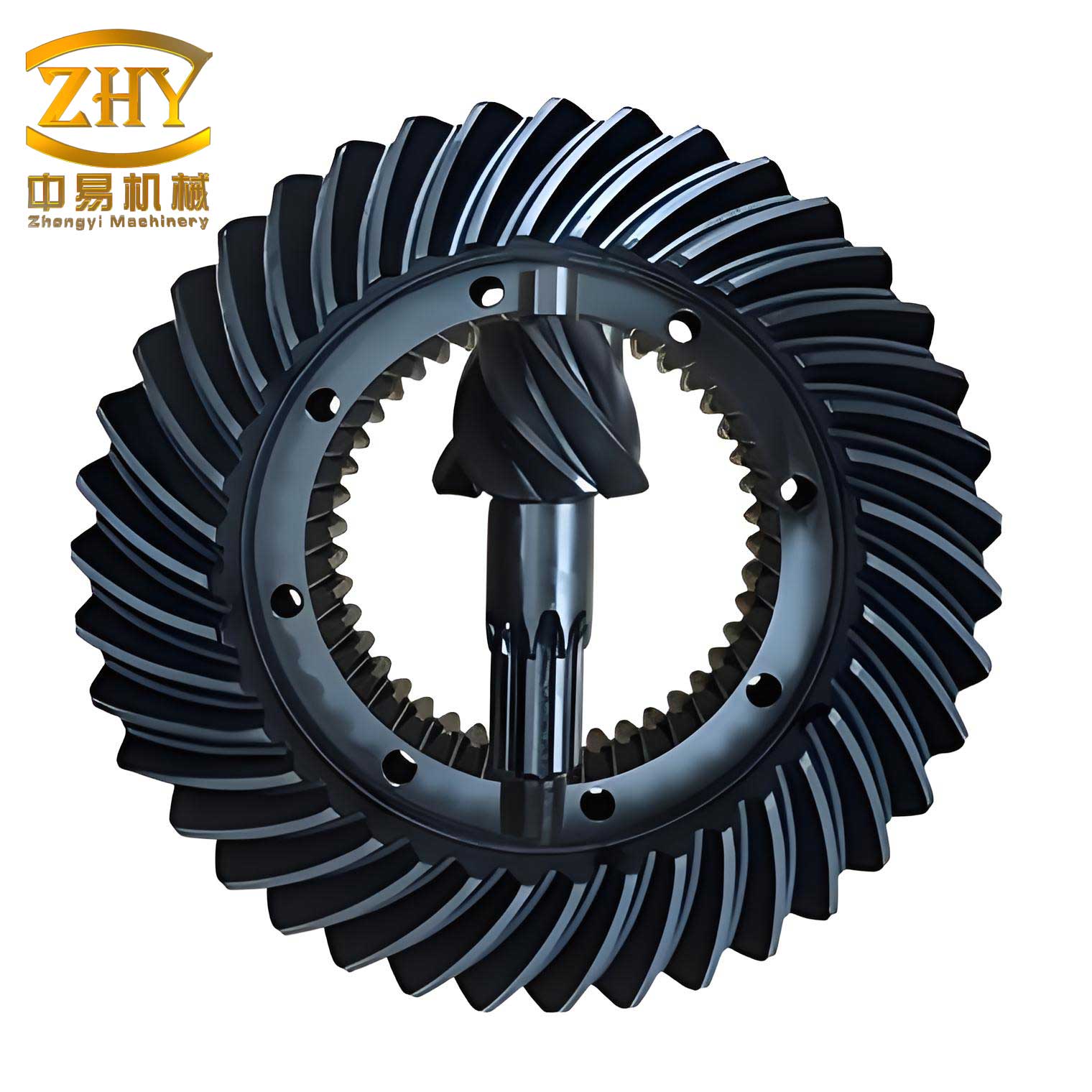
The precision forging process for helical bevel gears typically requires three distinct die cavities: the hot precision forging die, the cold sizing die, and the tooth-form fixture locating plate. The design and manufacturing of the electrode is a critical first step in the EDM process, encompassing material selection, structural design, and dimensional determination.
Electrode Design and Manufacturing
1. Electrode Material Selection
Graphite and oxygen-free copper are the most common materials for cavity EDM. Our comparative tests led to the selection of oxygen-free copper as the preferred material for machining helical bevel gear dies. The key characteristics of both materials are compared below.
| Property | Oxygen-Free Copper | Graphite |
|---|---|---|
| EDM Performance | Stable process, resistant to arcing. Low wear achievable in roughing and semi-finishing with modified parameters. Low wear in finishing possible with specific pulse generators. | High material removal rate, lower relative wear under same settings. More prone to arcing; achieving low wear in finishing is difficult. Wear less sensitive to flushing pressure. |
| Formability | Good ductility, can be forged to be dense. Complex shapes possible but deburring after machining is required. High strength, resists chipping. | Brittle, prone to chipping and corner breakdown. Easy to machine but generates conductive dust harmful to machine tools and health. |
| Other | High density (heavy electrodes). Excellent thermal conductivity, low resistivity. | Low density (light electrodes). Poor thermal conductivity, high resistivity. |
Copper electrodes provide stable machining and can achieve a surface finish of approximately $$Ra \ 1.6 \ \mu m$$. Its poorer machinability is not an issue here, as electrodes can be readily machined on spiral bevel gear generators. Furthermore, graphite dust pollutes these expensive machine tools. Copper’s higher strength also ensures better positioning accuracy in fixtures using cylindrical pins. The primary drawback is its weight, which may affect the dynamic performance of the machine spindle. Graphite may still be considered for roughing electrodes in some scenarios.
2. Electrode Structure
Adopting a multi-electrode strategy necessitates a structure that ensures precise repositioning. The design incorporates two diametrically opposed precision cylindrical pin holes, located at a specific distance from the central axis (e.g., $$65 \pm 0.005 \ mm$$). Corresponding holes are machined in the cutting fixture and the EDM repositioning fixture. Using precision ground dowel pins (e.g., $$\phi 6_{-0.005}^{-0.01} \ mm$$) guarantees the repeatable angular and positional alignment of the electrode’s tooth slots relative to these pins during both gear generation and EDM.
3. Electrode Dimension Determination
The dimensions for the electrodes used for the cold sizing die and the locating plate are derived directly from the master gear, accounting for the uniform finishing discharge gap (taken as $$2\delta_j \approx 0.06 \ mm$$).
For the hot forging die electrode, the dimensions are more complex. The tooth form must incorporate both the cold sizing allowance and the thermal expansion characteristics of the forged gear during cooling. This compensated tooth profile is then uniformly reduced by the finishing discharge gap value $$(\delta_j)$$ along the tooth surface normal to obtain the final electrode dimensions.
When using multiple electrodes (e.g., roughing, semi-finishing, finishing), additional considerations are needed:
- For straight-walled cavities, the outer diameter of the roughing/semi-finishing electrodes is reduced by 0.5-1.0 mm to ensure the final finish of the vertical wall.
- For helical bevel gears with large spiral angles, the tooth thickness on roughing electrodes is uniformly reduced (e.g., 0.3-0.5 mm per side) to provide sufficient stock for the finishing electrode to clean up the profile, especially in the concave region.
The electrode surface finish should be better than $$Ra \ 0.8 \ \mu m$$. To achieve a final forged gear accuracy corresponding to AGMA Class 10, the electrode itself must be manufactured to AGMA Class 12 or higher precision.
4. Electrode Manufacturing
Electrodes are machined from forged oxygen-free copper blanks on spiral bevel gear generators. Forging ensures a dense, uniform structure conducive to low-wear EDM. To achieve the uniform shrinkage required for roughing electrodes, chemical etching can be employed after machining.
Die Cavity EDM Process
1. Die Structure and Pre-Machining
The die blocks are pre-machined by turning to final dimensions everywhere except for the tooth cavity. The EDM process is then dedicated solely to generating the complex tooth form, significantly reducing total machining time.
2. Electrode Alignment and Centering
The electrode’s reference plane must be parallel to the die block surface (or machine table). This is verified using a dial indicator, with a permissible error of less than 0.02 mm over the electrode’s length. Axial alignment (centering) of the electrode to the die cavity is critical. Several methods are used:
- Outer Diameter Positioning: Using the electrode’s OD and the cavity’s pre-machined bore. Concentricity ~ $$\pm 0.05 \ mm$$.
- Positioning Sleeve: Using a precision sleeve. Concentricity ~ $$\pm 0.03 \ mm$$.
- Feeler Gauge Centering: For smaller electrodes. Concentricity ~ $$\pm 0.05 \ mm$$.
- V-Block & Dial Indicator: Concentricity ~ $$\pm 0.03 \ mm$$.
- Dedicated Centering Tool: For high-precision requirements like locating plates. Concentricity ~ $$\pm 0.02 \ mm$$.
3. Comparison of Machining Methods
The complex 3D surface of helical bevel gear cavities precludes the use of single-electrode with orbital motion.
- Multi-Electrode Method: Two or more electrodes are used to machine one cavity. A high-precision repositioning fixture with dowel pins is essential. This method is simple and offers good repeatability. The number of electrodes depends on wear and accuracy requirements; 2-3 electrodes are typically optimal. This is the primary method we employ.
- Multi-Electrode with Orbital Motion: A finishing electrode is given a small orbital motion (e.g., 0.1-0.15 mm). This improves flushing, surface finish uniformity, and reduces machining time, but may increase measured backlash variation.
- Electrode Rotation Method: For helical bevel gears with large spiral angles, a fixture allows the electrode to be rotated by a small angle between roughing and finishing passes. This helps clean the difficult concave flank but can affect form accuracy if wear is significant. It requires a very precise fixture.
- Electrode Screw-Feed Method: The spindle is allowed to rotate freely. As it feeds axially, a mechanical guide (e.g., a master gear, cam, or helical groove) synchronizes the electrode’s rotation with its feed to match the helix. This is suitable for cavities with overlapping projections but risks interference and form error.
4. Electrical Parameter Selection and Transition
Requirements for the power supply are: high material removal rate with low wear for roughing; moderate rate and low wear for semi-finishing; and fine finish ($$Ra \ 1.6 \ \mu m$$) with minimal wear for finishing. After modifying a standard thyristor-based pulse generator, we achieved suitable parameters.
Roughing: Uses a post-peak pulse waveform for stable, high-current, low-wear operation.
Semi-Finishing: Uses a pre-peak waveform for good stability and low wear.
Finishing (Standard): Uses a triangular waveform. It is stable and efficient but exhibits higher electrode wear.
Finishing (Improved): Uses a comb-shaped pulse waveform. This achieves significantly lower electrode wear while maintaining practical productivity, making it superior for helical bevel gear dies.
The transition between parameter sets is governed by the need to progressively remove the roughness from the previous stage while maintaining form accuracy. The side-finishing amount is achieved through axial feed. The relationship is given by:
$$ \Delta L = \frac{(\Delta \delta + \Delta R_{max})}{\sin \beta} $$
where:
- $$\Delta L$$ is the additional axial feed for finishing.
- $$\Delta \delta$$ is the difference in side gap between finishing and previous stage.
- $$\Delta R_{max}$$ is the difference in peak-to-valley roughness.
- $$\beta$$ is the angle between the tooth flank and the electrode feed direction (varies along the tooth, smaller on the concave side).
Since $$\beta$$ is variable, a conservative (smaller) value is used for calculation, verified by practice.
5. Cavity Depth Control
Using a stepping hydraulic head with digital readout, depth is precisely controlled. A calibrated standard block of known thickness ($$H$$) is placed on the die. The electrode is brought into light contact with the block using a finishing spark, and the digital display is set to zero. The total axial feed $$(L_f)$$ for the small-end tooth tip is calculated and input:
$$ L_f = H_{cavity} + H_{block} + C $$
where $$C$$ is a compensation for finishing electrode wear (typically 0.1-0.2 mm). Machining proceeds until the display returns to zero, indicating the final depth is reached, with an error within $$\pm 0.05 \ mm$$.
6. Key Issues and Analysis
Machining Accuracy: The primary concern. Influencing factors include:
- Electrode Accuracy & Wear: Electrode errors are replicated. Finishing wear rounds corners and increases backlash variation. Using low-wear parameters minimizes this.
- Machine & Fixture Rigidity: Poor feed accuracy or flexible fixtures introduce error, especially in deep cavities.
- Alignment Errors: Non-parallelism causes uneven cavity depth and cyclic pitch errors. Poor centering causes eccentricity.
- Parameter Selection: Excessive current density causes arcing and damage.
- Flushing Pressure: Must be steady (e.g., 0.1-0.2 kgf/cm² for roughing, slightly higher for finishing). Fluctuations can shift the electrode.
- Electrode Changing: Careless handling during changeover degrades repositioning accuracy.
Cavity Inspection: Direct measurement is difficult. The multi-electrode method allows for indirect assessment: the finishing electrode and cavity differ only by a uniform spark gap. Therefore, measuring the finished electrode provides a reliable proxy for cavity accuracy. Results for a sample electrode are shown below.
| Item | Master Gear | Hot Forging Electrode (Pre-EDM) | Hot Forging Electrode (Post-EDM) |
|---|---|---|---|
| Tooth-to-Tooth Error | AGMA 12 | AGMA 11-12 | AGMA 10-11 |
| Tooth Alignment | AGMA 11 | AGMA 10-11 | AGMA 9-10 |
| Backlash Variation | AGMA 12 | AGMA 11-12 | AGMA 10-11 |
Surface Finish: A finish of $$Ra \ 3.2 \ \mu m$$ is adequate for hot forging dies, as the micro-craters aid lubrication and the surface polishes during forging. For cold sizing dies and locating plates, a finer finish is desired. Limitations include: the inherent challenge of finishing concave flanks (small $$\beta$$), poor flushing in certain die structures leading to arcing, improper parameter transition leaving or removing too much stock, and operational errors during electrode handling.
Machining Examples
The following helical bevel gear die cavities were successfully machined using the described multi-electrode process on a modified machine.
| Workpiece Description | Electrode (Material, Qty) | Workpiece Material | Max Current (A) | Machining Time | Surface Finish (Ra) |
|---|---|---|---|---|---|
| $$\phi 100$$ mm Motorcycle Driven Helical Bevel Gear Hot Forging Die | Copper (2) | 5CrNiMo | 100 | 15h 30min | ~3.2 μm |
| $$\phi 128$$ mm Tractor Driven Helical Bevel Gear Hot Forging Die | Copper (2) | 5CrNiMo | 100 | 28h | ~3.2 μm |
| $$\phi 128$$ mm Tractor Driven Helical Bevel Gear Locating Plate | Copper (1) | T10A | 40 | 11h 20min | ~1.6 μm |
| $$\phi 210$$ mm Tractor Driven Helical Bevel Gear Hot Forging Die (Prototype) | Copper (3) | 5CrNiMo | 150 | Data Noted | ~3.2 μm |
Technical and Economic Impact and Future Directions
The developed multi-electrode EDM process for helical bevel gear forging dies has proven successful in trial production, offering clear benefits:
- Efficiency: The modified power supply enables low-wear, high-current roughing and semi-finishing for copper electrodes, significantly boosting productivity while maintaining accuracy. Achieved machining times surpass reported benchmarks from international companies for comparable helical bevel gear cavities.
- Accuracy: With electrodes manufactured to AGMA 11-12 standard, the resulting die cavities (indirectly measured) achieve AGMA 10-11 accuracy. Forged gear samples meet AGMA 10 standards, matching the quality of batch-produced cut gears. Batch trials of over a thousand pieces have yielded stable, qualified helical bevel gears.
- Process Robustness: The cylindrical pin repositioning system is simple and reliable. Depth control using a digital readout stepping head is precise and convenient.
This process facilitates the establishment of domestic precision forging lines for helical bevel gears, reducing dependence on imported technology and machinery. While developed for helical bevel gears, the methodology is applicable to straight bevel gears and other complex cavities.
Areas for future development include:
- Enhanced Accuracy and Finish: Further improve cavity finish uniformity and accuracy by advancing low-wear finishing power supplies and developing high-precision, high-finish “skim” EDM techniques.
- Cavity Metrology: Develop reliable direct measurement methods for forged die cavities.
- Specialized EDM Machine: Design and build dedicated EDM machines tailored for helical bevel gear dies to guarantee precision, boost efficiency, and promote widespread adoption of the forging technology.