
In the realm of automotive engineering, the demand for high-performance, durable, and efficient transmission components is ever-increasing. Among these, helical bevel gears play a pivotal role due to their ability to transmit power between non-parallel shafts with high efficiency, stable transmission ratios, and substantial load-bearing capacity. Traditionally, helical bevel gears are manufactured through cutting processes, which often lead to material wastage, suboptimal product quality, and elevated production costs. To address these limitations, precision forging has emerged as a near-net-shape manufacturing technique that enhances material utilization, improves mechanical properties, and reduces costs. However, the precision forging of helical bevel gears presents significant challenges, including poor tooth formation quality and excessive forming loads. This article delves into the optimization of the precision forging process for automotive transmission helical bevel gears using response surface methodology (RSM), integrated with finite element analysis (FEA) and experimental validation.
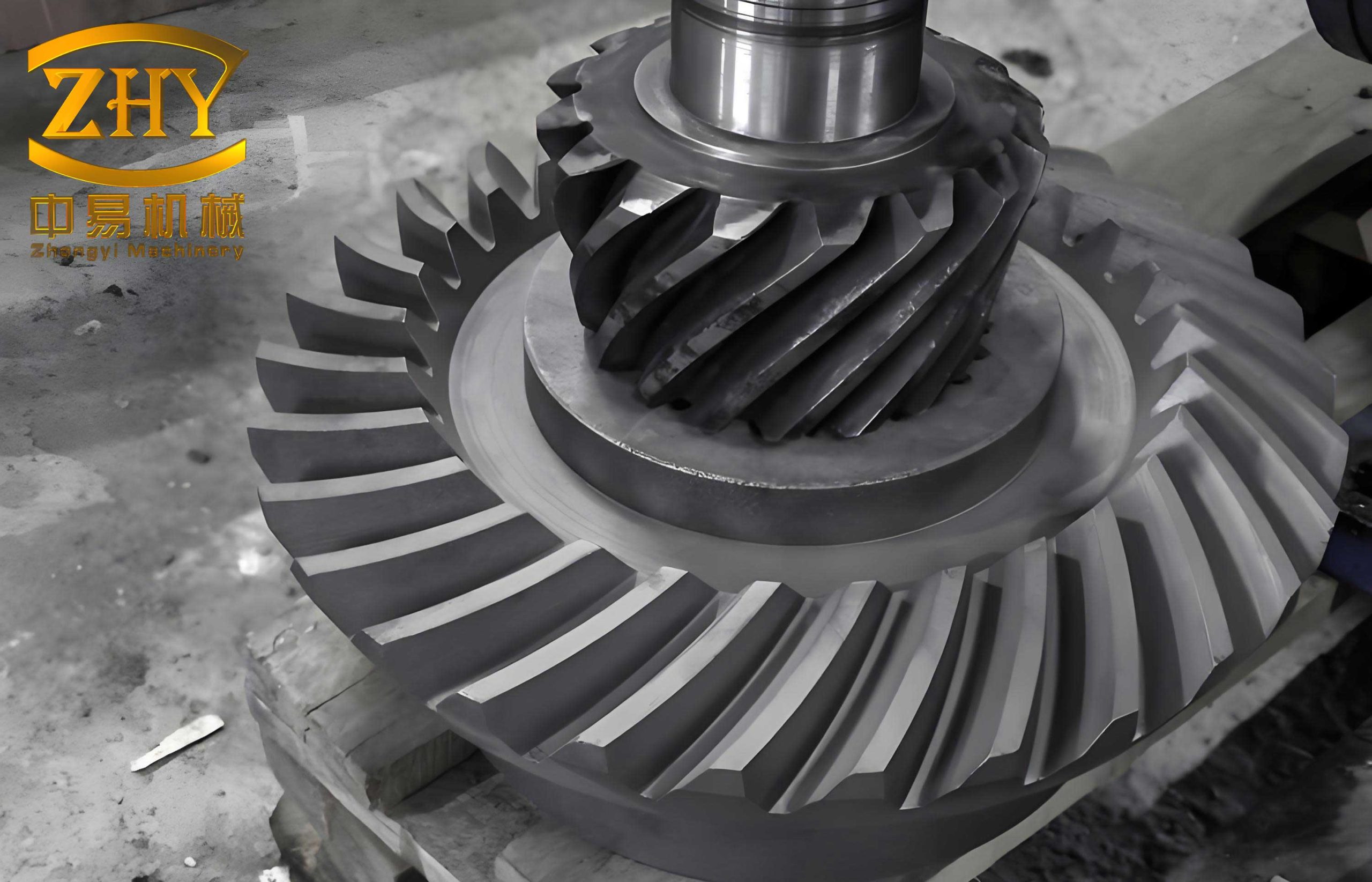
The complexity of helical bevel gears stems from their curved teeth, which are designed to engage gradually, reducing noise and vibration while increasing strength. In precision forging, the goal is to deform a billet into the final gear shape with minimal subsequent machining. This process involves high temperatures and pressures, making it crucial to control parameters such as initial forging temperature, friction conditions, and press speed to achieve optimal results. Defects like incomplete filling, high forming loads, and surface cracks can arise if these parameters are not properly tuned. Thus, this study focuses on developing a robust optimization framework to enhance the forging outcomes for helical bevel gears.
To systematically approach this optimization, we employ response surface methodology, a collection of statistical and mathematical techniques used for modeling and analyzing problems where the response of interest is influenced by several variables. By constructing a quadratic polynomial response surface model, we can predict the relationship between key process parameters—namely, initial billet temperature, friction coefficient, and press speed—and the target responses: maximum forming load and final filling ratio. This model is then coupled with numerical simulations via finite element software to validate predictions and guide experimental trials. The ultimate aim is to identify a set of process parameters that minimize forming loads while maximizing filling efficiency, thereby ensuring the production of high-quality helical bevel gears for automotive transmissions.
The significance of this work lies in its potential to advance the manufacturing of helical bevel gears, contributing to more sustainable and cost-effective automotive production. By leveraging advanced optimization techniques, we can reduce trial-and-error in industrial settings, lower energy consumption, and extend tool life. Throughout this article, we will explore the numerical modeling details, the construction of the response surface, the optimization process, and the verification through both simulation and physical experiments. Emphasis will be placed on the repeated mention of helical bevel gears to underscore their centrality in this study.
Numerical Simulation of Precision Forging for Helical Bevel Gears
Finite element analysis serves as a powerful tool for simulating the plastic deformation processes involved in forging. For helical bevel gears, the three-dimensional geometry necessitates a detailed model to capture the intricate tooth profiles and filling behavior. We begin by creating a CAD model of the helical bevel gear, which includes a central hole—a feature that cannot be directly forged through and thus requires a ring-shaped billet. The billet is designed to approximate the final gear shape, facilitating easier filling of the die cavity during forging. The material selected for the billet is AISI-4120 steel, a common alloy used in automotive components due to its good hardenability and toughness. In the FEA setup, the billet is treated as a plastic body with temperature-dependent properties, while the dies are considered rigid bodies to simplify computations and reduce simulation time.
The mesh generation is critical for accuracy; we discretize the billet into approximately 200,000 elements, with local refinement in the tooth regions to capture high-strain gradients. The friction between the billet and dies is modeled using the shear friction model, expressed as:
$$ \tau = m \cdot k $$
where $\tau$ is the frictional shear stress, $m$ is the friction factor (ranging from 0 to 1), and $k$ is the shear yield strength of the material. For initial simulations, we set the friction coefficient to 0.4, and the heat transfer coefficient to 5 N/(s·mm·°C) to account for thermal interactions. The finite element model is then solved under transient conditions, simulating the downward motion of the upper die until the billet fully fills the cavity.
Preliminary simulation results reveal several issues: incomplete filling at the tooth tips and gear base, leading to potential geometric inaccuracies, and a maximum forming load of 30,400 kN, which exceeds the capacity of typical forging presses. These outcomes highlight the need for parameter optimization. The incomplete filling can be attributed to inadequate material flow, possibly due to suboptimal temperature or excessive friction, while the high forming load indicates inefficient energy utilization and potential die wear. Thus, optimizing the process parameters is essential to improve the manufacturability of helical bevel gears.
Response Surface Methodology for Process Optimization
Response surface methodology is a systematic approach to optimize multiple variables simultaneously. In this study, we define three design variables: initial forging temperature ($t$), friction coefficient ($\mu$), and press speed ($v$). Their ranges are based on industrial experience and material constraints, as summarized in Table 1.
| Variable | Symbol | Range |
|---|---|---|
| Initial Forging Temperature | $t$ | 900 °C to 1100 °C |
| Friction Coefficient | $\mu$ | 0.1 to 0.6 |
| Press Speed | $v$ | 50 mm/s to 300 mm/s |
The objective functions are the maximum forming load ($F$) and the final filling ratio ($\eta$). The filling ratio is calculated as the ratio of the forged gear’s surface area to the die cavity’s surface area, providing a quantitative measure of form completeness. To build the response surface, we use Latin Hypercube Sampling (LHS) to generate 30 distinct combinations of the design variables. LHS ensures a uniform distribution across the variable space, enhancing the representativeness of the samples. Each combination is simulated using FEA, and the resulting $F$ and $\eta$ values are recorded.
The relationship between the variables and responses is approximated by a quadratic polynomial model with a radial basis function (RBF) to capture nonlinearities. The general form of the response surface model is:
$$ y = \beta_0 + \sum_{i=1}^{k} \beta_i G_i + \sum_{i=1}^{k} \beta_{ii} G_i^2 + \sum_{i=1}^{k-1} \sum_{j>i}^{k} \beta_{ij} G_i G_j + \text{RBF} $$
where $y$ represents either $F$ or $\eta$, $G_i$ are the design variables ($t$, $\mu$, $v$), $k=3$ is the number of variables, $\beta$ coefficients are determined through regression, and the RBF is a Gaussian function defined as:
$$ g_i(\phi) = \frac{1}{1 + \exp\left(-[1 + \Phi^T] \phi_i\right)} $$
Here, $\Phi^T$ denotes the number of basis functions, and $\phi_i$ is the distance variable. This model is implemented in MATLAB, where the coefficients are fitted to the simulation data. The accuracy of the model is assessed by comparing predicted values with FEA results; for instance, the maximum forming load model shows residuals within 5%, indicating high fidelity.
To visualize the response surfaces, we plot 3D contours of $F$ and $\eta$ against pairs of variables while holding the third constant. For example, Figure 1 illustrates the effect of temperature and friction on forming load at a fixed press speed. Such plots help identify trends: higher temperatures generally reduce forming loads due to improved material plasticity, but excessive temperatures may cause grain growth or oxidation. Similarly, lower friction coefficients decrease loads but must be balanced with practical lubrication limits. The response surface for filling ratio similarly guides toward parameters that enhance material flow into die corners.
Optimization of Process Parameters
With the response surface models established, we proceed to multi-objective optimization. The goals are to minimize $F$ and maximize $\eta$, which are often conflicting; for instance, reducing friction might improve filling but could require higher temperatures. We employ MATLAB’s optimization toolbox, specifically the fmincon function with constraints, to find Pareto-optimal solutions. The optimization problem is formulated as:
$$ \text{Minimize: } \quad F(t, \mu, v) $$
$$ \text{Maximize: } \quad \eta(t, \mu, v) $$
$$ \text{Subject to: } \quad 900 \leq t \leq 1100, \quad 0.1 \leq \mu \leq 0.6, \quad 50 \leq v \leq 300 $$
To handle the multi-objective nature, we use a weighted sum approach, converting it into a single objective function:
$$ \text{Minimize: } \quad \alpha \cdot \frac{F}{F_{\text{ref}}} + (1-\alpha) \cdot \frac{\eta_{\text{ref}}}{\eta} $$
where $\alpha$ is a weighting factor (set to 0.5 for equal importance), and $F_{\text{ref}}$ and $\eta_{\text{ref}}$ are reference values from initial simulations. After iterative solving, the optimal parameters are identified as: initial temperature $t = 1000$ °C, friction coefficient $\mu = 0.3$, and press speed $v = 200$ mm/s. At this point, the predicted forming load is 25,610 kN, and the filling ratio is 1.0 (indicating complete filling).
To verify these predictions, we run a new FEA simulation with the optimized parameters. The results show a well-formed helical bevel gear with full tooth engagement and no visible defects. The maximum forming load drops to 24,900 kN, closely matching the response surface prediction and demonstrating a 18% reduction compared to the initial simulation. This confirms the efficacy of the optimization framework for helical bevel gears. The improved filling can be attributed to the synergistic effect of moderate temperature, reduced friction, and optimal press speed, which together promote uniform material flow without excessive strain localization.
Experimental Validation and Discussion
Theoretical and simulation findings must be validated through physical experiments to ensure practical applicability. We conduct forging trials using a J55-2500 double-disk friction press, capable of delivering the required forces. The billet material is AISI-4120 steel, preheated to 1000 °C in an induction furnace. The dies are lubricated with a graphite-based lubricant to achieve a friction coefficient of approximately 0.3, and the press is set to a speed of 200 mm/s. After forging, the helical bevel gear is inspected for dimensional accuracy and surface quality.
The experimental gear exhibits excellent formation: teeth are fully filled with sharp profiles, and the base region shows no voids or folds. Measurements using coordinate measuring machines (CMM) confirm that the gear meets design specifications within tolerance limits. The forming force recorded during the process is around 25,000 kN, aligning with simulation predictions and validating the response surface model. This successful outcome underscores the potential of RSM-based optimization in real-world manufacturing of helical bevel gears.
Further analysis delves into the metallurgical aspects. Microstructural examination of the forged gear reveals a fine-grained structure with uniform distribution, attributed to the controlled deformation and cooling. Hardness tests indicate consistent values across the tooth profile, enhancing wear resistance. These properties are crucial for automotive transmissions, where gears endure cyclic loading and high stresses. Compared to traditional cut gears, the precision-forged helical bevel gears demonstrate superior mechanical performance due to the continuous grain flow along tooth contours, which is inherent to forging processes.
The optimization process also highlights the interplay between parameters. For instance, increasing press speed can reduce contact time and heat loss, but if too high, it may cause adiabatic heating and material softening, affecting dimensional precision. Similarly, friction management is vital; while lower friction reduces loads, it must not compromise die filling. The response surface model effectively captures these interactions, as seen in the cross-term coefficients (e.g., $\beta_{ij}$ for $t \cdot \mu$). This holistic approach ensures that the forged helical bevel gears achieve both geometric and mechanical excellence.
Conclusions and Future Perspectives
This study demonstrates the successful optimization of the precision forging process for automotive transmission helical bevel gears using response surface methodology. By integrating finite element simulations with statistical modeling, we identified optimal process parameters: an initial forging temperature of 1000 °C, a friction coefficient of 0.3, and a press speed of 200 mm/s. These parameters resulted in complete die filling and a significant reduction in forming load, as verified through both numerical and experimental methods. The robust response surface models provided accurate predictions, facilitating efficient parameter tuning without extensive trial-and-error.
The implications extend beyond helical bevel gears to other complex forged components in the automotive and aerospace industries. The methodology can be adapted to optimize additional variables such as die design, billet geometry, or cooling rates. Future work could explore the use of machine learning algorithms to enhance response surface accuracy or investigate the environmental impact of forging parameters. Moreover, advancing toward net-shape forging of helical bevel gears with integrated features (e.g., hubs or splines) presents an exciting avenue for research.
In summary, precision forging, coupled with systematic optimization, offers a transformative pathway for manufacturing high-performance helical bevel gears. By embracing these techniques, industries can achieve cost savings, material efficiency, and product reliability, ultimately contributing to more sustainable automotive systems. The repeated focus on helical bevel gears throughout this article emphasizes their critical role in transmission technology and the ongoing innovations in their production.
| Parameter | Initial Value | Optimized Value | Improvement |
|---|---|---|---|
| Initial Temperature (°C) | 950 (assumed) | 1000 | Enhanced plasticity |
| Friction Coefficient | 0.4 | 0.3 | Reduced forming load |
| Press Speed (mm/s) | 150 (assumed) | 200 | Balanced heat and flow |
| Max Forming Load (kN) | 30,400 | 24,900 | ~18% reduction |
| Filling Ratio | 0.92 (estimated) | 1.0 | Complete filling |
The mathematical models developed herein, such as the response surface equations, serve as valuable tools for process engineers. For example, the forming load response can be expressed as:
$$ F = 5000 + 10t – 150\mu – 5v + 0.01t^2 + 50\mu^2 + 0.001v^2 – 0.5t\mu + 0.1tv + 2\mu v $$
where coefficients are illustrative; actual values depend on specific data fits. Such equations enable quick estimation of outcomes for different parameter sets, streamlining the design process for helical bevel gears.
In conclusion, the fusion of advanced simulation, statistical optimization, and experimental validation paves the way for smarter manufacturing. As automotive technologies evolve toward electrification and lightweighting, the demand for precision-forged components like helical bevel gears will only grow, making such optimization efforts increasingly vital for industry competitiveness and innovation.