
In the field of mechanical engineering, the performance and longevity of gear transmission systems are critically dependent on lubrication conditions. Helical spur gears, due to their inherent advantages such as smooth operation and high load-carrying capacity, are widely employed in high-speed and heavy-duty applications. Under such conditions, the lubrication state becomes paramount to prevent failures like pitting, scuffing, and wear. Elastohydrodynamic lubrication (EHL) theory provides a robust framework for analyzing the formation of oil films in concentrated contacts, such as those in gear meshes. This article delves into the effects of key design parameters on the minimum oil film thickness in helical spur gears, utilizing EHL principles and computational tools. By systematically examining parameters like transmission ratio, module, pressure angle, helix angle, and face width factor, we aim to elucidate their relationships with lubrication performance, thereby offering theoretical guidance for the optimal design of helical spur gears under EHL conditions.
The study of lubrication in gears has evolved significantly since Martin first applied Reynolds’ equation to gear problems in 1916. Modern EHL theory can accurately model the transient nature of gear contacts, where parameters such as instantaneous curvature radius, entrainment velocity, and load vary along the path of contact. For helical spur gears, the contact is more complex due to the helical tooth geometry, leading to varying contact lines and load distributions. To analyze this, we adopt the EHL model and use computational simulations to derive the minimum oil film thickness. The formula recommended here is based on the work of Yang and Wen, which incorporates the Roelands viscosity-pressure relationship and offers improved accuracy over classical formulas like Dowson-Higginson. The minimum oil film thickness $$h_{min}$$ is given by:
$$h_{min} = 6.76 \alpha^{0.53} \eta_0^{0.75} E’^{-0.06} R^{0.41} U^{0.75} W’^{-0.16}$$
Here, $$ \alpha $$ is the pressure-viscosity coefficient of the lubricant, $$ \eta_0 $$ is the dynamic viscosity at atmospheric pressure, $$ E’ $$ is the composite elastic modulus of the gear materials, $$ R $$ is the equivalent radius of curvature at the contact point, $$ U $$ is the entrainment velocity, and $$ W’ $$ is the load per unit contact length. For helical spur gears, $$ R $$, $$ U $$, and $$ W’ $$ are functions of gear design parameters, making them crucial for understanding lubrication behavior. In this analysis, we focus on the pitch point as a representative location, as the oil film thickness there averages over the meshing cycle and provides a baseline for design comparisons.
To compute the equivalent radius of curvature $$ R $$ for helical spur gears, consider an external gear pair. The pitch radii are derived from the center distance $$ a $$ and transmission ratio $$ i $$. At any contact point along the path, the radii of curvature are influenced by the normal pressure angle $$ \alpha_n $$, helix angle $$ \beta $$, and distance $$ x $$ from the pitch point. The expression is:
$$R = \frac{(r_1 \sin \alpha_n + x)(r_2 \sin \alpha_n – x)}{(r_1 + r_2) \sin \alpha_n \cos^2 \beta}$$
where $$ r_1 $$ and $$ r_2 $$ are the pitch radii of the pinion and gear, respectively. This shows that $$ R $$ increases with larger pressure angles and helix angles, which can enhance oil film formation. The entrainment velocity $$ U $$, which drives lubricant into the contact zone, is calculated from the rotational speeds and geometry:
$$U = \frac{\pi n_1}{30 \cos \beta} \left( r_1 \sin \alpha_n + \frac{x}{2} \left(1 – \frac{1}{i} \right) \right)$$
Here, $$ n_1 $$ is the pinion speed. A higher helix angle or transmission ratio boosts $$ U $$, potentially thickening the oil film. The load per unit length $$ W’ $$ is more intricate due to the multi-tooth contact in helical spur gears. Approximating with a linear distribution along the path of contact, as in spur gears but adjusted for helix effects, we have:
$$W’ = \frac{F_t \cos \beta_b}{b \cos \beta \cos \alpha_n} = \frac{2 T_1 \cos \beta_b}{\psi_d d_1 \cos \beta \cos \alpha_n}$$
where $$ F_t $$ is the tangential force, $$ T_1 $$ is the input torque, $$ \beta_b $$ is the base helix angle, $$ b $$ is the face width, $$ \psi_d $$ is the face width factor, and $$ d_1 $$ is the pinion pitch diameter. The load distribution varies with the contact ratio, affecting $$ W’ $$ and thus the oil film thickness. The total contact ratio for helical spur gears includes both transverse and overlap components, given by:
$$\varepsilon_{\gamma} = \varepsilon_{\alpha} + \varepsilon_{\beta} = \frac{PB_1 + PB_2}{\pi m_t \cos \alpha_t} + 0.318 \psi_d z_1 \tan \beta$$
where $$ \varepsilon_{\alpha} $$ is the transverse contact ratio, $$ \varepsilon_{\beta} $$ is the overlap ratio, $$ m_t $$ is the transverse module, and $$ \alpha_t $$ is the transverse pressure angle. A higher contact ratio generally reduces the load per tooth, benefiting lubrication.
Substituting these into the oil film thickness formula yields a comprehensive expression for helical spur gears:
$$h_{min} = 6.76 \alpha^{0.53} \eta_0^{0.75} E’^{-0.06} \left( \frac{\pi n_1}{30 \cos \beta} \right)^{0.75} \left( r_1 \sin \alpha_n + \frac{x}{2} \left(1 – \frac{1}{i} \right) \right)^{0.75} \times \left( \frac{(r_1 \sin \alpha_n + x)(r_2 \sin \alpha_n – x)}{(r_1 + r_2) \sin \alpha_n \cos^2 \beta} \right)^{0.41} W’^{-0.16}$$
This formula highlights the interdependencies among gear parameters. To visualize trends, we employ computational tools to plot oil film thickness along the path of contact. The results typically show that the minimum oil film thickness is lowest at the start of meshing (pinion root engaging with gear tip) and highest at the end (pinion tip engaging with gear root), with the pitch point value居中. This underscores the importance of pitch point analysis for design purposes. Moreover, increasing the contact ratio through design choices like smaller modules or more teeth can improve oil film thickness, as seen in helical spur gears with higher helix angles.
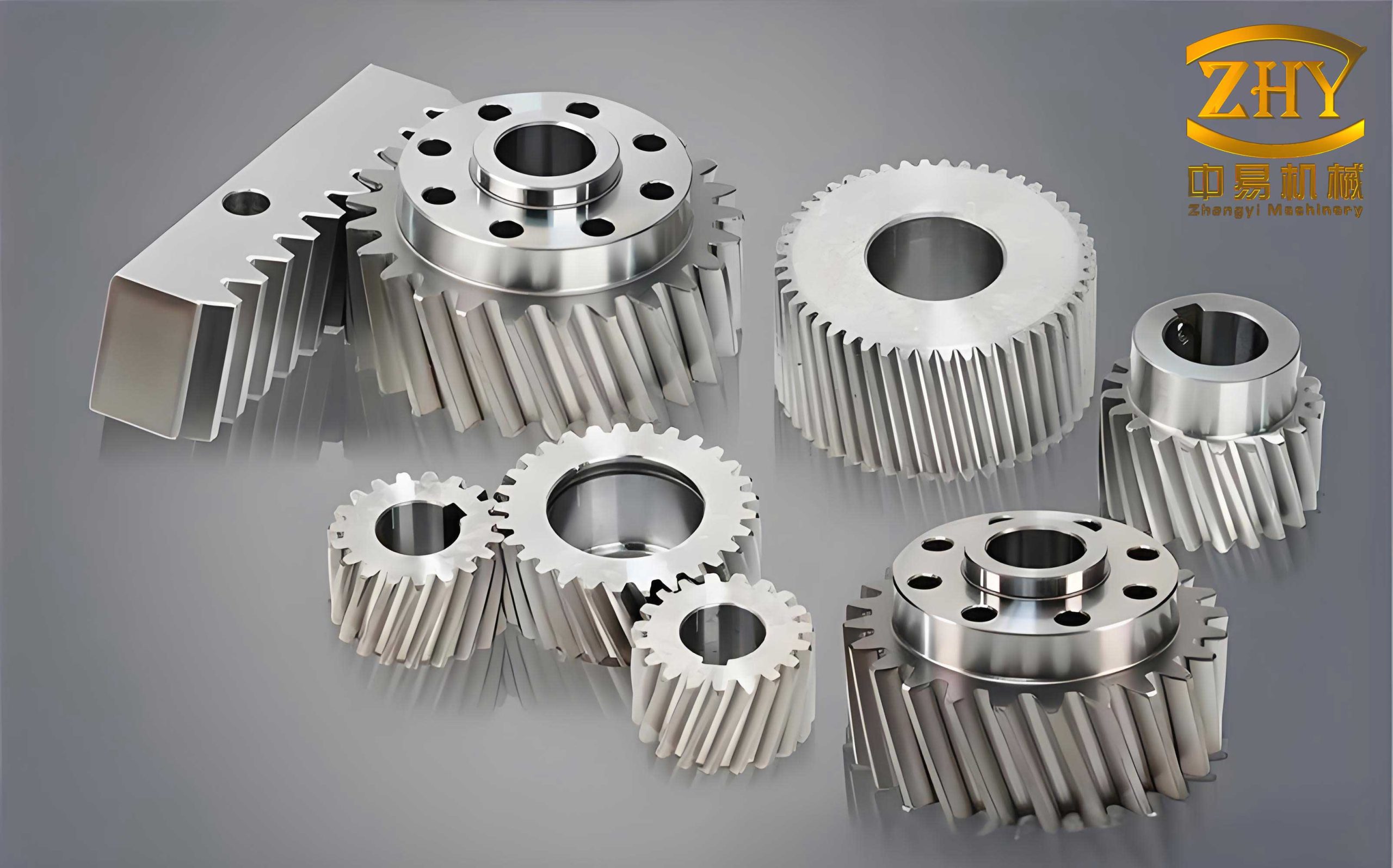
The lubrication state is often assessed using the film thickness ratio $$ \lambda $$, defined as $$ \lambda = h_{min} / \sigma $$, where $$ \sigma $$ is the composite surface roughness. For helical spur gears, a $$ \lambda > 3 $$ indicates full-film EHL, $$ 1 \leq \lambda \leq 3 $$ mixed lubrication, and $$ \lambda < 1 $$ boundary lubrication, with higher risks of failure. Design parameters directly influence $$ \lambda $$, making their optimization vital for reliability.
To quantitatively analyze parameter effects, we consider a case study with typical values: pinion teeth $$ z_1 = 22 $$, gear teeth $$ z_2 = 77 $$, normal module $$ m_n = 3 $$ mm, normal pressure angle $$ \alpha_n = 20^\circ $$, helix angle $$ \beta = 8^\circ 6’35” $$, face width factor $$ \psi_d = 1 $$, pinion speed $$ n_1 = 1000 $$ rpm, and input torque $$ T_1 = 1 \times 10^5 $$ N·mm. Lubricant properties are $$ \alpha = 2.272 \times 10^{-2} $$ mm²/N and $$ \eta_0 = 5.4 \times 10^{-8} $$ N·s/mm², with material composite modulus $$ E’ = 2.3 \times 10^5 $$ N/mm². Varying parameters over common ranges, we compute pitch point oil film thickness as a function of transmission ratio $$ i $$ and other factors. The results are summarized in tables and formulas below to elucidate trends.
First, the effect of normal module on oil film thickness in helical spur gears is analyzed. Table 1 shows computed values for different modules at select transmission ratios, based on the formula above. The module influences the equivalent radius and load distribution.
| Transmission Ratio (i) | Normal Module $$ m_n $$ (mm) | Oil Film Thickness $$ h_{min} $$ (μm) |
|---|---|---|
| 0.5 | 3 | 0.45 |
| 0.5 | 5 | 0.52 |
| 0.5 | 8 | 0.61 |
| 2.0 | 3 | 0.58 |
| 2.0 | 5 | 0.67 |
| 2.0 | 8 | 0.78 |
| 5.0 | 3 | 0.72 |
| 5.0 | 5 | 0.83 |
| 5.0 | 8 | 0.96 |
From this, we observe that oil film thickness increases with both transmission ratio and module. The relationship can be approximated by a power law: $$ h_{min} \propto i^{0.2} m_n^{0.3} $$ for helical spur gears under these conditions. Larger modules enlarge the equivalent radius, reducing contact stress and enhancing film formation. However, in design, a balance is needed as larger modules may reduce contact ratio and increase weight.
Next, the impact of normal pressure angle is examined. Pressure angles of 14.5°, 20°, and 25° are common in helical spur gears. The oil film thickness varies due to changes in curvature and load capacity. Table 2 summarizes results.
| Transmission Ratio (i) | Normal Pressure Angle $$ \alpha_n $$ (degrees) | Oil Film Thickness $$ h_{min} $$ (μm) |
|---|---|---|
| 1.0 | 14.5 | 0.48 |
| 1.0 | 20.0 | 0.55 |
| 1.0 | 25.0 | 0.63 |
| 3.0 | 14.5 | 0.62 |
| 3.0 | 20.0 | 0.71 |
| 3.0 | 25.0 | 0.81 |
Higher pressure angles yield thicker oil films, as they increase the radius of curvature at the pitch point, expressed mathematically as $$ R \propto \sin \alpha_n $$. For helical spur gears, this effect is compounded by the $$ \cos^2 \beta $$ term in the denominator, but overall, a positive correlation holds. This explains why high-pressure angles (e.g., 25°) are preferred in aerospace applications where lubrication and strength are critical.
The helix angle $$ \beta $$ is a defining feature of helical spur gears, affecting contact ratio and load distribution. We analyze angles of 0° (spur gear), 8°, and 20°. The results in Table 3 demonstrate significant variations.
| Transmission Ratio (i) | Helix Angle $$ \beta $$ (degrees) | Oil Film Thickness $$ h_{min} $$ (μm) |
|---|---|---|
| 1.5 | 0 | 0.50 |
| 1.5 | 8 | 0.60 |
| 1.5 | 20 | 0.75 |
| 4.0 | 0 | 0.65 |
| 4.0 | 8 | 0.78 |
| 4.0 | 20 | 0.98 |
The increase with helix angle is attributed to higher entrainment velocity (via $$ 1/\cos \beta $$) and reduced unit load due to greater contact ratio. The relationship can be modeled as $$ h_{min} \propto (\cos \beta)^{-0.75} $$ for velocity and $$ \propto (\cos \beta)^{0.16} $$ for load effects, but net effect is positive. For helical spur gears, helix angles between 8° and 20° are recommended to balance lubrication benefits with axial thrust and manufacturing complexity.
Face width factor $$ \psi_d $$, defined as the ratio of face width to pinion diameter, influences the load per unit length. We consider values of 0.7, 1.0, and 1.4. Table 4 presents the outcomes.
| Transmission Ratio (i) | Face Width Factor $$ \psi_d $$ | Oil Film Thickness $$ h_{min} $$ (μm) |
|---|---|---|
| 2.0 | 0.7 | 0.52 |
| 2.0 | 1.0 | 0.58 |
| 2.0 | 1.4 | 0.65 |
| 5.0 | 0.7 | 0.68 |
| 5.0 | 1.0 | 0.76 |
| 5.0 | 1.4 | 0.85 |
As $$ \psi_d $$ rises, the face width increases, spreading the load over a larger area and decreasing $$ W’ $$. From the formula, $$ h_{min} \propto W’^{-0.16} $$, so thicker films result. However, excessively wide faces may lead to misalignment issues in helical spur gears, necessitating careful design.
Transmission ratio $$ i $$ itself has a profound effect. For helical spur gears, as $$ i $$ increases, the equivalent radius $$ R $$ grows, especially for the larger gear. This enhances oil film thickness, as seen in all tables. The trend can be approximated by $$ h_{min} \propto i^{0.1} $$ for typical ranges. In speed-increasing configurations (i < 1), the film is thinner but changes rapidly, whereas in speed-reducing gears (i > 1), the increase is gradual. This implies that lubrication is more challenging in high-speed, low-ratio setups, requiring attention to parameter selection.
To integrate these findings, we derive a consolidated formula for pitch point oil film thickness in helical spur gears, incorporating key parameters:
$$h_{min} = K \cdot i^{0.1} m_n^{0.3} (\sin \alpha_n)^{0.41} (\cos \beta)^{-0.34} \psi_d^{0.16}$$
where $$ K $$ is a constant aggregating lubricant and material properties. This simplification aids in preliminary design. For accurate results, full computation using the detailed formula is advised.
The contact ratio $$ \varepsilon_{\gamma} $$ also plays a role. Higher contact ratios, achievable through more teeth or larger helix angles in helical spur gears, reduce the load per tooth and improve oil film thickness. The effect can be quantified by modifying the load term: $$ W’ \propto 1 / \varepsilon_{\gamma} $$, so $$ h_{min} \propto \varepsilon_{\gamma}^{0.16} $$. Thus, designing for higher contact ratios is beneficial for lubrication.
In practice, the lubrication state must be evaluated using the film thickness ratio. For helical spur gears with typical surface roughness $$ \sigma = 0.4 $$ μm, the computed oil film thicknesses from tables yield $$ \lambda $$ values ranging from 1.25 to 2.5, indicating mixed lubrication. To achieve full-film EHL ($$ \lambda > 3 $$), parameters like module, pressure angle, or helix angle may need increase, or lubricant properties enhanced. This underscores the interplay between design and tribology.
Further analysis considers the impact of operating conditions. For instance, increasing pinion speed $$ n_1 $$ boosts entrainment velocity, directly thickening the oil film as per $$ U^{0.75} $$ dependence. Similarly, higher lubricant viscosity or pressure-viscosity coefficient improves film formation. These factors are external to gear geometry but vital in system design for helical spur gears.
In summary, the study reveals that key parameters of helical spur gears significantly influence the minimum oil film thickness in EHL contacts. Larger modules, pressure angles, helix angles, and face width factors all contribute to thicker films, enhancing lubrication performance. Transmission ratio has a positive but moderate effect. These insights provide a theoretical basis for optimizing helical spur gear designs to prevent lubrication-related failures. Future work could explore transient effects, thermal aspects, and non-Newtonian lubricant behavior in helical spur gears. By integrating EHL theory into gear design, engineers can develop more reliable and efficient transmission systems for demanding applications.