
In the realm of automotive engineering, the differential system stands as a pivotal component, responsible for transmitting torque to the wheels while allowing them to rotate at different speeds. At the heart of many modern drive axles, particularly in heavy-duty vehicles, lies the hyperboloid gear set. As a seasoned engineer specializing in powertrain systems, I have extensively worked with these gears and can attest to their superior performance over traditional spiral bevel gears. However, this performance comes with stringent requirements in design, lubrication, and adjustment. This article delves deep into the intricacies of hyperboloid gears, exploring their geometric principles, operational challenges, and maintenance protocols, all aimed at maximizing service life and economic efficiency.
The hyperboloid gear, often referred to as a hypoid gear in automotive contexts, is a type of gear where the axes of the driving and driven shafts do not intersect but are offset. This offset allows for a lower propeller shaft placement, contributing to a lower vehicle center of gravity and improved stability. The tooth geometry of a hyperboloid gear is derived from a hyperboloid of revolution, which imparts a curved and elongated contact pattern. This design enables smoother engagement, reduced noise, and enhanced load-bearing capacity compared to spiral bevel gears. The fundamental equation describing the pitch surface of a hyperboloid gear can be expressed in parametric form. For a hyperboloid of one sheet, the surface equation is:
$$ \frac{x^2}{a^2} + \frac{y^2}{b^2} – \frac{z^2}{c^2} = 1 $$
where \(a\), \(b\), and \(c\) are constants defining the hyperboloid’s dimensions. In gear design, this geometry is modified to generate tooth profiles that ensure conjugate action. The kinematics of hyperboloid gear meshing involve complex sliding and rolling motions. The sliding velocity \(V_s\) between mating tooth surfaces is a critical parameter, often reaching extreme values. It can be approximated by:
$$ V_s = \omega_1 \times r_1 – \omega_2 \times r_2 $$
where \(\omega_1\) and \(\omega_2\) are the angular velocities of the pinion and ring gear, respectively, and \(r_1\) and \(r_2\) are the effective contact radii. In practical applications, such as in Dongfeng heavy-duty trucks, the sliding velocity can range from 5 to 15 meters per second, creating conditions of extreme pressure and frictional heat.
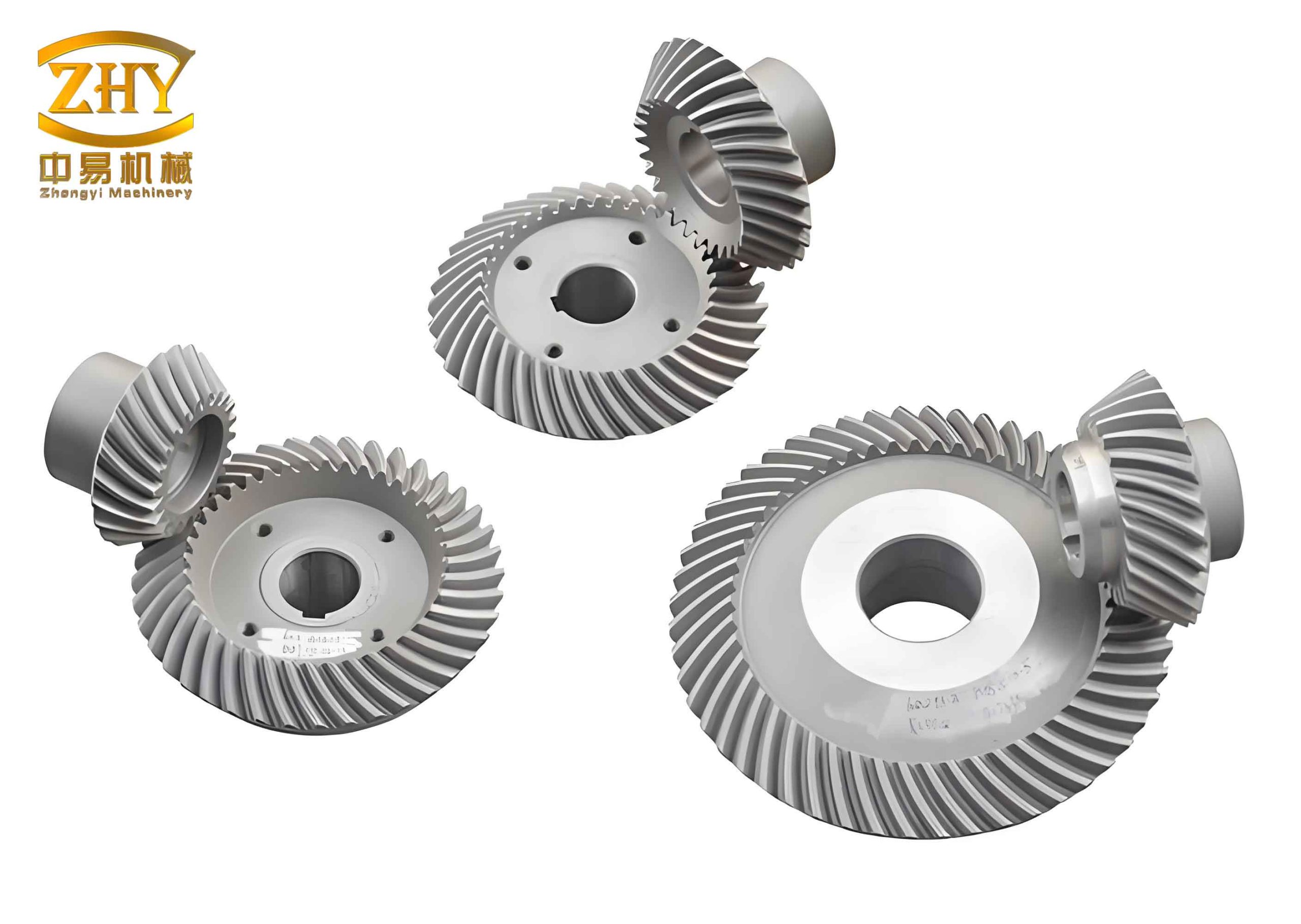
The image above illustrates the intricate geometry of a hyperboloid gear pair, highlighting the offset axes and curved tooth profiles. This visual aids in understanding the complex contact patterns that necessitate precise manufacturing and assembly.
Operating conditions for hyperboloid gears are exceptionally demanding. The combination of high sliding speeds and substantial transmitted loads results in contact pressures that can exceed 2 GPa. The pressure distribution \(P\) at the tooth contact ellipse can be modeled using Hertzian contact theory:
$$ P = \frac{3F}{2\pi ab} $$
where \(F\) is the normal load, and \(a\) and \(b\) are the semi-major and semi-minor axes of the contact ellipse, respectively. These high pressures, coupled with sliding velocities, generate significant frictional heat, leading to localized temperatures that can surpass 200°C. This environment constitutes an extreme pressure (EP) friction regime, where conventional lubrication mechanisms fail. The oil film thickness \(h\) under such conditions, as per elastohydrodynamic lubrication (EHL) theory, becomes exceedingly thin:
$$ h \approx 1.6 \frac{(U \eta)^{0.67} R^{0.464}}{E’^{0.073} W^{0.067}} $$
where \(U\) is the entraining velocity, \(\eta\) is the dynamic viscosity, \(R\) is the effective radius of curvature, \(E’\) is the reduced elastic modulus, and \(W\) is the load per unit width. At these micron-level thicknesses, pure mineral oil films cannot withstand the extreme pressures, leading to film rupture, metal-to-metal contact, and subsequent failure modes like scuffing, pitting, and ultimately, gear seizure.
Therefore, the selection of lubricant is paramount for hyperboloid gear systems. Ordinary gear oils are wholly inadequate. Specifically formulated hypoid gear oils, conforming to standards like API GL-4 or GL-5, are mandatory. These oils contain extreme pressure (EP) additives, primarily sulfur and phosphorus compounds, which form protective sacrificial layers on the gear teeth under high pressure and temperature. The chemical reaction can be simplified as the formation of iron sulfides or phosphides, which have lower shear strength than the base metal, thus preventing adhesion and wear. A key distinguishing feature of these lubricants is their distinctive sulfurous odor. The performance classification is often denoted by viscosity grades and service levels, with higher numbers indicating greater load-carrying capacity. For instance, a GL-5 oil is designed for severe-duty hypoid gears operating under high-speed and/or high-torque conditions.
To quantify the impact of lubrication, consider the following table comparing the performance of different gear oils in a hyperboloid gear application:
| Lubricant Type | EP Additive Package | Expected Service Life (km) | Failure Mode on Hyperboloid Gears |
|---|---|---|---|
| Regular Mineral Gear Oil (GL-1) | None | 1,000 – 5,000 | Rapid scuffing and catastrophic wear |
| Mild EP Oil (GL-4) | Moderate S/P | 50,000 – 100,000 | Moderate pitting under high load |
| Severe EP Hypoid Oil (GL-5) | High S/P, sometimes with borate | >200,000 | Controlled wear, optimal for hyperboloid gears |
This stark contrast underscores the non-negotiable requirement for专用 lubricants. Using general gear oil in a hyperboloid gear differential can lead to failure within a very short mileage, as the thin film breaks down instantly under extreme pressure.
Beyond lubrication, the correct assembly and adjustment of the hyperboloid gear pair are critical determinants of its longevity. The meshing pattern and backlash must be meticulously set according to the manufacturer’s specifications. An incorrect contact pattern, whether too far towards the toe or heel of the tooth, or biased towards the flank or face, drastically reduces load distribution efficiency and accelerates wear. The ideal contact pattern is centrally located on the tooth flank. Backlash, the clearance between mating teeth, is equally crucial. The nominal specification might be around 0.15 to 0.25 mm. However, based on field experience, I have found that adjusting it to a slightly wider range of 0.18 to 0.30 mm often yields better results in real-world operating conditions, accounting for thermal expansion and load deflection.
The relationship between backlash \(B\), gear wear rate \(W_r\), and operational noise \(N\) can be conceptually modeled. Excessive reduction in backlash compromises lubrication flow, increasing wear: \(W_r \propto \frac{1}{B}\) for very small \(B\). Conversely, excessive backlash induces impact loads: \(N \propto B\) for large \(B\). Therefore, an optimal range exists, as shown in the formula for a simplified wear-noise function \(F(B)\):
$$ F(B) = \alpha \cdot \frac{1}{B} + \beta \cdot B $$
where \(\alpha\) and \(\beta\) are constants related to material and operating conditions. The minimum of this function indicates the optimal backlash setting.
Adjustment is typically achieved by shimming the differential bearing preload and adjusting the position of the ring gear relative to the pinion. The pinion depth setting \(D_p\) and the ring gear lateral position \(L_r\) are the primary control variables. Their influence on the contact pattern can be summarized in the following adjustment matrix:
| Adjustment Action | Effect on Contact Pattern (Pinion Tooth) | Effect on Backlash |
|---|---|---|
| Increase Pinion Shim (move pinion in) | Pattern moves towards Toe | Slight Decrease |
| Decrease Pinion Shim (move pinion out) | Pattern moves towards Heel | Slight Increase |
| Increase Side Shim (move ring gear closer to pinion) | Pattern moves towards Root | Decrease |
| Decrease Side Shim (move ring gear away from pinion) | Pattern moves towards Face | Increase |
This table serves as a practical guide for technicians during assembly. A systematic approach involves first setting the pinion depth to achieve the correct pinion bearing preload and approximate pattern, then adjusting the ring gear position to fine-tune the pattern and set the final backlash. Specialized gear marking compound is used to visualize the contact pattern on the tooth flanks.
The material science behind hyperboloid gears is also vital. They are typically forged from case-hardened steels, such as AISI 8620 or 9310, undergoing processes like carburizing and quenching to achieve a hard, wear-resistant surface (typically 58-62 HRC) with a tough, ductile core. The residual stress profile \(\sigma(z)\) as a function of depth \(z\) from the surface is crucial for fatigue resistance, often approximated by:
$$ \sigma(z) = \sigma_0 \cdot e^{-kz} + \sigma_{comp} $$
where \(\sigma_0\) is the surface stress, \(k\) is a decay constant, and \(\sigma_{comp}\) is a beneficial compressive stress induced by shot peening. This compressive layer combats the tensile stresses induced by contact loading, thereby retarding crack initiation and propagation, which are common failure mechanisms in hyperboloid gears subjected to cyclic extreme pressure.
From a thermodynamic perspective, the heat generation \(Q\) in a hyperboloid gear mesh is a function of the friction coefficient \(\mu\), load \(F\), and sliding velocity \(V_s\):
$$ Q = \mu \cdot F \cdot V_s $$
This heat must be effectively dissipated through the gear oil and the housing to prevent thermal runaway and loss of lubricant film integrity. The cooling capacity of the system is thus a design consideration, especially for vehicles operating under continuous heavy load, such as long-haul trucks or construction equipment. The use of synthetic-based hypoid gear oils, which offer superior thermal stability and oxidation resistance compared to mineral oils, is increasingly common in these applications.
Furthermore, the evolution towards electrified vehicles introduces new challenges and considerations for hyperboloid gears. In electric axles, torque delivery is instantaneous and can be extremely high, while operational speeds are also elevated. This places even greater demands on the hyperboloid gear’s ability to handle shock loads and maintain quiet operation. Research is ongoing into advanced surface treatments like diamond-like carbon (DLC) coatings and the development of low-viscosity, high-EP synthetic lubricants to improve efficiency without compromising durability.
In conclusion, the hyperboloid gear is a masterpiece of mechanical design that enables robust and efficient power transfer in automotive axles. Its performance superiority is inextricably linked to a triad of critical factors: precision geometry, specialized extreme-pressure lubrication, and meticulous assembly adjustment. Neglecting any one of these aspects leads to premature failure and significant economic loss. As an engineer, I emphasize that understanding the underlying principles—from the hyperboloid geometry defined by $$ \frac{x^2}{a^2} + \frac{y^2}{b^2} – \frac{z^2}{c^2} = 1 $$ to the extreme-pressure chemistry of sulfur-phosphorus additives—is essential for anyone involved in the design, maintenance, or operation of vehicles employing these sophisticated components. The future will undoubtedly bring advancements in materials and lubricants, but the fundamental importance of the hyperboloid gear in drivetrain technology remains steadfast, demanding continued respect and meticulous care in its application.