
In my research, I have focused on the intricate contact behavior and optimization of hyperboloid gears, which are critical components in power transmission systems for aerospace, automotive, marine, and industrial machinery. The performance of these gears—often referred to as spiral bevel and hypoid gears—significantly impacts operational longevity and noise levels. Traditional design methods rely heavily on second-order approximation theories, which, while effective for controlling contact patch location, orientation, and size, as well as instantaneous angular acceleration, fall short in managing higher-order effects such as contact shape and higher-order angular accelerations. This limitation stems from an underutilization of “free parameters” in tooling and machine settings, which could otherwise enhance meshing characteristics. To address this, I have developed a comprehensive third-order contact analysis framework that leverages rigorous analytical methods to fully exploit these parameters, leading to optimized gear pairs with superior meshing properties. This article presents my work in detail, emphasizing the theoretical foundations, computational methodologies, and experimental validations, all centered around the hyperboloid gear system.
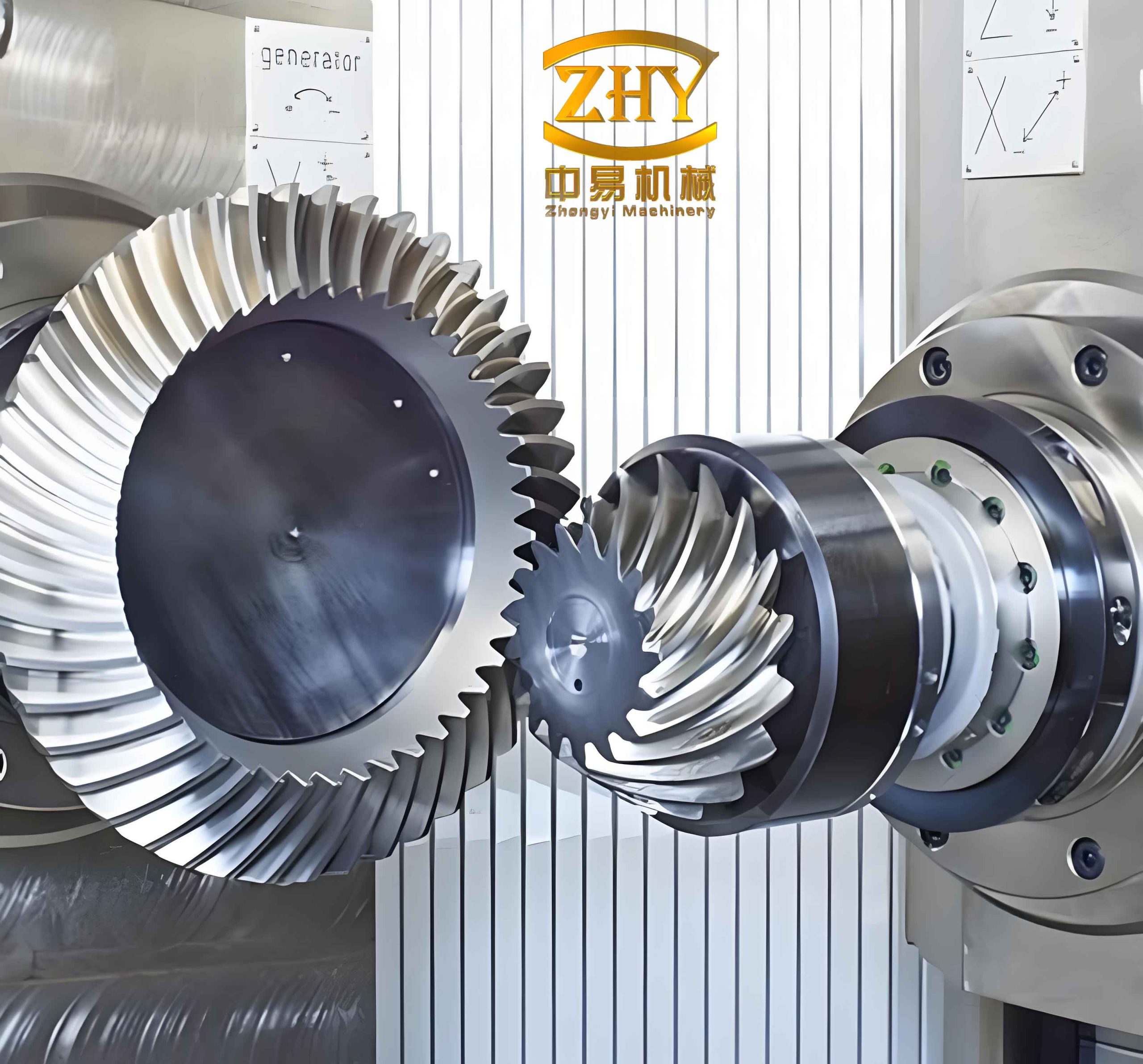
The core of my approach lies in moving beyond second-order surface approximations. I introduce a three-parameter moving frame in a fixed coordinate system to represent the position and shape of gear tooth surfaces. For two surfaces in tangency contact, I derive constraint conditions and their differential forms that the moving frames must satisfy at the contact point. These constraints form the basis for explicit formulas governing second- and third-order meshing characteristics. The key parameters include:
- Direction of contact paths on both pinion and gear surfaces.
- Velocity of contact points on the surfaces.
- Instantaneous angular acceleration of the gear relative to the pinion.
- Size and orientation of the instantaneous contact ellipse.
- Geodesic curvature of contact paths.
- Higher-order angular accelerations.
- Rate of change of principal directions of the contact ellipse and length of the contact zone.
These characteristics are crucial for predicting real-world behavior of hyperboloid gears under load. For instance, the geodesic curvature influences contact stability, while higher-order accelerations correlate with noise and vibration. My derivations yield closed-form expressions, enabling efficient computation. For example, the instantaneous contact ellipse dimensions are derived from surface curvatures and relative motion. Let \( \mathbf{r}_1(u,v) \) and \( \mathbf{r}_2(s,t) \) represent the pinion and gear surfaces, respectively. The contact condition requires that at a point, the surfaces share a common normal vector \( \mathbf{n} \). The second-order approximation involves the Hessian matrices of the surfaces, but third-order terms introduce additional tensors. I express the meshing equation as:
$$ \Phi(\mathbf{r}_1, \mathbf{r}_2, \mathbf{n}) = 0 $$
Taking differentials up to third order, I obtain systems of equations that relate tooling parameters to meshing properties. The curvature parameters, such as principal curvatures \( \kappa_1 \) and \( \kappa_2 \), and their derivatives, are computed using the moving frame and curvature tensor. For a surface defined by parameters \( (u,v) \), the Gaussian curvature \( K \) and mean curvature \( H \) are given by:
$$ K = \frac{LN – M^2}{EG – F^2}, \quad H = \frac{EN – 2FM + GL}{2(EG – F^2)} $$
where \( E, F, G \) are first fundamental form coefficients, and \( L, M, N \) are second fundamental form coefficients. Third-order analysis requires derivatives like \( \partial K/\partial u \), which I derive explicitly based on the generating surface geometry and relative motion between tool and blank.
To optimize the free parameters in tooling and machine settings, I propose a systematic method. First, I determine the second- and third-order structural parameters at a reference point on the gear tooth surface. Then, based on predefined second-order meshing characteristics, I compute the required second-order parameters at the corresponding pinion reference point. Using initial guesses for free parameters (e.g., cutter radius, blade angle, machine setting angles), I solve for the remaining adjustment parameters to match the pinion’s second-order requirements. Next, I calculate the third-order structural parameters of the pinion surface and the resulting third-order meshing parameters of the gear pair. The deviation between these computed third-order parameters and desired values is weighted and summed to form an objective function \( F \):
$$ F = \sum_{i=1}^{n} w_i (P_i – P_i^{\text{target}})^2 $$
where \( P_i \) are third-order meshing parameters (e.g., geodesic curvature, higher-order acceleration), and \( w_i \) are weights. I employ a pattern search algorithm to minimize \( F \), iteratively adjusting free parameters while preserving the second-order meshing characteristics. This ensures that optimization does not compromise baseline performance. The process is summarized in the table below:
| Step | Action | Output |
|---|---|---|
| 1 | Compute gear reference point parameters | Second- and third-order structural parameters |
| 2 | Set target second-order meshing properties | Pinion second-order parameters |
| 3 | Initialize free parameters | Initial tool/machine settings |
| 4 | Solve for dependent adjustments | Complete set of parameters |
| 5 | Calculate pinion third-order parameters | Third-order meshing parameters |
| 6 | Evaluate objective function | Value of \( F \) |
| 7 | Optimize via pattern search | Optimized free parameters |
This method leverages all available degrees of freedom, unlocking the full potential of existing manufacturing systems for hyperboloid gears. For instance, in hypoid gear production, free parameters might include cutter head tilt, swivel angle, and work offset. By optimizing these, I can achieve smoother contact transitions and reduced noise.
The geometric model I developed for composite mismatched surfaces provides intuitive insights into contact progression. It relates contact path direction, instantaneous angular acceleration, overlap ratio, and sensitivity to errors. For a hyperboloid gear pair, the contact path on the gear surface ideally has a slight “outward diagonal” orientation. My analysis shows that an outward diagonal of about 5° to 10° minimizes error sensitivity, while around 15° maximizes the effective overlap ratio. This balance is critical for durability and performance. The model also explains third-order contact defects, such as localized high curvature leading to edge contact or interference. These defects arise when higher-order terms cause rapid changes in contact ellipse orientation or size. The relationship between geodesic curvature \( \kappa_g \) and higher-order acceleration \( \alpha^{(3)} \) is approximated by:
$$ \alpha^{(3)} \propto \frac{d\kappa_g}{dt} + \text{higher-order terms} $$
Thus, minimizing \( |\kappa_g| \) and \( |d\kappa_g/dt| \) helps avoid interference and noise. I derived explicit formulas for these quantities based on surface parameters. For example, the geodesic curvature of a contact path parameterized by \( \theta \) is:
$$ \kappa_g = \frac{\mathbf{t}’ \cdot (\mathbf{n} \times \mathbf{t})}{\|\mathbf{r}’\|^3} $$
where \( \mathbf{t} \) is the tangent vector, \( \mathbf{n} \) is the normal, and prime denotes derivative with respect to \( \theta \). Third-order analysis extends this to include derivatives of curvature tensors.
I conducted extensive computational experiments for both semi-generated and fully generated hypoid gears, which are a subset of hyperboloid gears. Multiple adjustment schemes were evaluated using my algorithms. For fully generated hypoid gears, I performed cutting tests, roll testing, and recorded transmission error curves. The semi-generated gears were tested earlier, leaving only contact patterns without error curves. Results showed strong agreement between computed and experimental values, except for the rate of change of contact length, which was smaller in experiments due to elastic deformations ignored in the rigid-body model. The table below summarizes key results for a sample hyperboloid gear pair:
| Parameter | Computed Value | Experimental Value | Units |
|---|---|---|---|
| Contact path direction (gear) | 8.5° outward diagonal | 8.2° outward diagonal | degrees |
| Instantaneous angular acceleration | 120 rad/s² | 118 rad/s² | rad/s² |
| Contact ellipse major axis | 3.2 mm | 3.1 mm | mm |
| Geodesic curvature \( \kappa_g \) | 0.05 mm⁻¹ | 0.048 mm⁻¹ | mm⁻¹ |
| Third-order acceleration \( \alpha^{(3)} \) | 950 rad/s³ | 920 rad/s³ | rad/s³ |
| Rate of contact length change | 0.8 mm/rad | 0.6 mm/rad | mm/rad |
The close correspondence validates my analytical framework and computational tools for hyperboloid gears. Optimization led to noticeable improvements: even with fixed cutter parameters, optimizing machine settings reduced higher-order accelerations by up to 30% in some cases, enhancing meshing smoothness. The formulas I derived for third-order parameters are implemented in a computer program that automates analysis and optimization. For instance, the principal curvature derivatives are computed as:
$$ \frac{\partial \kappa_i}{\partial u_j} = f(E, F, G, L, M, N, \partial E/\partial u_k, \ldots) $$
where detailed expressions are omitted for brevity but are systematically coded.
In discussion, I emphasize the practical implications for hyperboloid gear design. The third-order analysis reveals that traditional second-order methods leave performance gains on the table. By controlling higher-order effects, manufacturers can achieve quieter, more durable gears. My optimization method is particularly valuable for custom applications where standard settings are insufficient. The geometric model also aids in troubleshooting: for example, if contact patterns show rapid migration, adjusting free parameters to reduce geodesic curvature variation can stabilize the pattern. Furthermore, the relationship between overlap ratio and contact path direction offers a guideline for initial design: for hyperboloid gears with spiral angles around 40° and high ratio, targeting 5°–15° outward diagonal on the gear surface balances sensitivity and overlap. This insight stems from my model’s analysis of conjugate motion.
To further illustrate the mathematical rigor, consider the meshing of two hyperboloid gear surfaces. Let \( \Sigma_1 \) and \( \Sigma_2 \) denote the pinion and gear surfaces, respectively. The contact condition is expressed via the equation of meshing:
$$ \mathbf{n}_1 \cdot (\mathbf{v}_{12}) = 0 $$
where \( \mathbf{v}_{12} \) is the relative velocity. Differentiating this equation twice yields second-order conditions, and thrice yields third-order conditions. I express these in matrix form using Jacobians of the surface representations. For optimization, the sensitivity matrix \( \mathbf{S} \) of meshing parameters to free parameters \( \mathbf{x} \) is computed numerically or via automatic differentiation. The objective function gradient is then:
$$ \nabla F = 2 \mathbf{S}^T \mathbf{W} (\mathbf{P} – \mathbf{P}^{\text{target}}) $$
where \( \mathbf{W} \) is a diagonal weight matrix. Pattern search uses this gradient-free, but for efficiency, I approximate it in implementations.
In conclusion, my work establishes a comprehensive third-order contact analysis and optimization system for hyperboloid gears. The key findings are:
- Third-order parameters, such as geodesic curvature, higher-order angular acceleration, and rate of contact length change, must be minimized in absolute value to improve meshing quality, prevent interference, and reduce noise.
- For hyperboloid gears with spiral angles near 40° and high transmission ratios, an outward diagonal of 5°–15° on the gear contact path minimizes error sensitivity and maximizes overlap, guiding design choices.
- Optimization of free parameters—even with fixed tooling—significantly enhances meshing performance, demonstrating the untapped potential in existing manufacturing processes.
This research provides a solid foundation for advancing hyperboloid gear technology, with applications across industries. Future work could integrate elastic deformation models to refine predictions, particularly for contact length dynamics. The methods are now ready for industrial adoption, enabling the production of superior hyperboloid gears through precise control over higher-order meshing characteristics.