
In the manufacturing of hyperboloid gears, often referred to as hypoid gears, achieving high-quality meshing requires precise calculation of machine tool settings based on the gear pair’s tooth surface geometry. This article, from my perspective as a researcher in gear technology, outlines the fundamental principles and methods for determining the tooth surface structural elements and the corresponding machining adjustment parameters. The focus is on ensuring localized contact patterns and correct tooth root depth across the gear face. The complexity of hyperboloid gears necessitates a deep understanding of their unique geometry, which deviates from conventional bevel or spiral bevel gears due to the offset between axes. I will delve into the mathematical foundations and practical adjustments needed to machine these gears accurately.
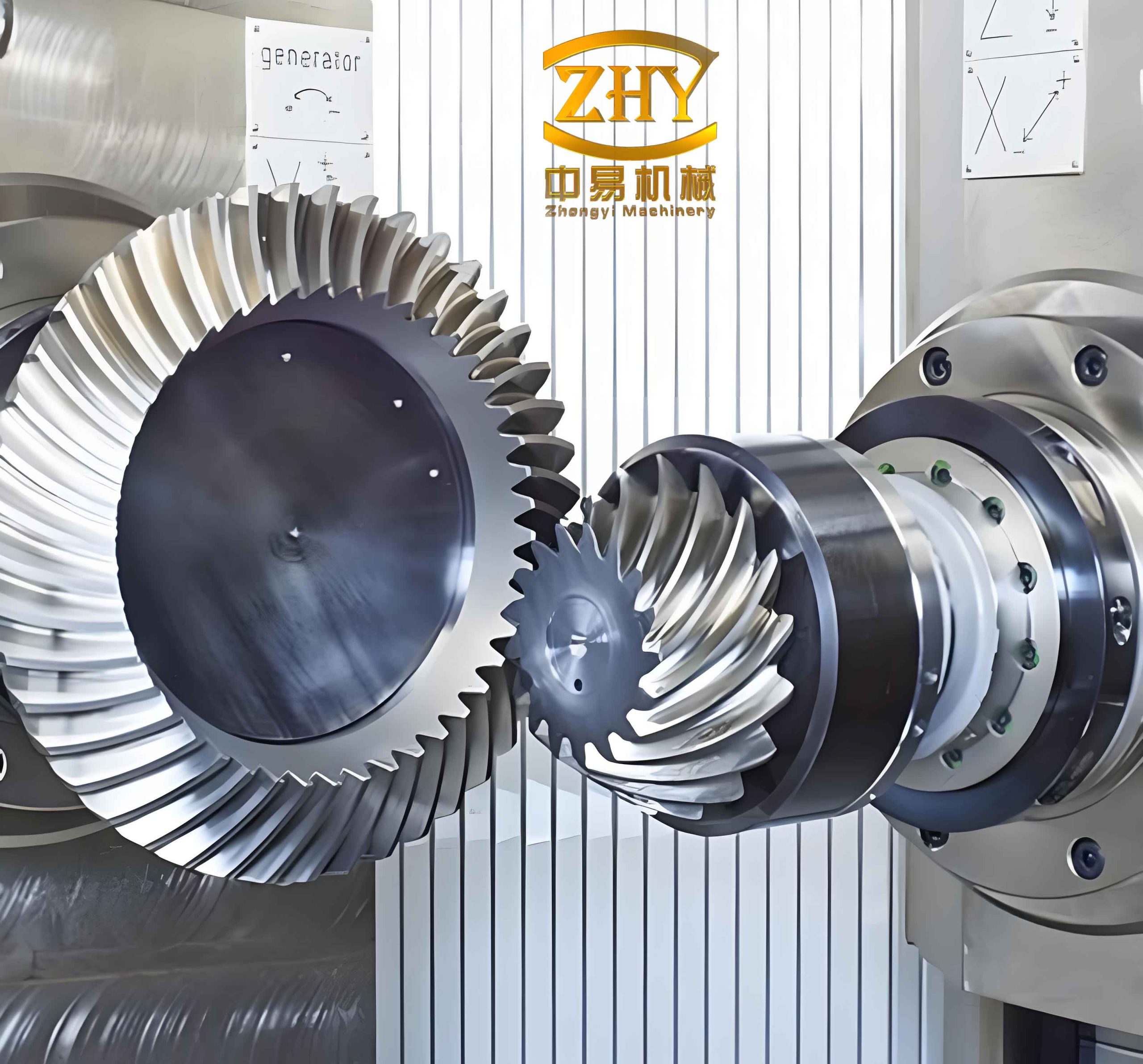
The successful production of hyperboloid gears hinges on controlling the tooth surface form. The tooth surface of the pinion, which is typically the more complex member of the pair, is defined by a set of structural elements at any given point. These elements are derived from the mating conditions with the gear and the manufacturing process of the gear member. In my analysis, I consider a point \( P \) on the pinion tooth surface \(\Sigma\). A coordinate cone is constructed with its axis coincident with the pinion axis and its vertex at the root cone apex \( O_1 \), passing through point \( P \). The cone’s semi-vertex angle is the coordinate cone angle \(\theta\), and the distance from \( P \) to the apex is the coordinate cone distance \( R \). At point \( P \), three mutually orthogonal unit vectors are established: \( \mathbf{e}_R \) along the cone’s generatrix, \( \mathbf{e}_\theta \) along the cone’s circumferential direction, and \( \mathbf{e}_\phi \) determined by the right-hand rule from \( \mathbf{e}_R \) and \( \mathbf{e}_\theta \). The unit normal vector to the surface at \( P \), directed from the tooth material to space, is denoted as \( \mathbf{n} \).
The structural characterization of the pinion tooth surface for hyperboloid gears at point \( P \) is encapsulated by five key elements, which are crucial for defining the contact behavior. These elements are as follows:
| Structural Element | Symbol | Description | Mathematical Expression |
|---|---|---|---|
| Normal Pressure Angle | \(\alpha_n\) | Angle between the surface normal and a plane perpendicular to the coordinate cone’s generatrix. | Defined by projections of \(\mathbf{n}\). |
| Spiral Angle | \(\beta\) | Angle describing the local tooth inclination relative to the generatrix. | Derived from the components of the tangent vector. |
| Tooth Line Curvature | \(K_L\) | Curvature of the tooth trace on the developed coordinate cone. | $$K_L = \frac{1}{R \sin \theta} \left( \pm \frac{\partial \beta}{\partial \phi} – \cos \beta \right)$$ where \(\phi\) is the angular coordinate. |
| Tooth Profile Curvature | \(K_P\) | Geodesic curvature of the intersection line between the tooth surface and a sphere centered at the cone apex. | $$K_P = \frac{1}{R} \left( \frac{\partial \alpha_n}{\partial R} \mp \frac{\sin \alpha_n \cos \beta}{R \tan \theta} \right)$$ |
| Modified Curvatures | \(K_{Lm}, K_{Pm}\) | Corrected curvatures for localized contact, incorporating deviations \(\Delta K_L\) and \(\Delta K_P\). | $$K_{Lm} = K_L \pm \Delta K_L, \quad K_{Pm} = K_P \pm \Delta K_P$$ |
In these expressions for hyperboloid gears, the upper sign typically corresponds to the concave side of the tooth, and the lower sign to the convex side. The normal pressure angle \(\alpha_n\) is related to the transverse pressure angle \(\alpha_t\) by \(\tan \alpha_n = \tan \alpha_t / \cos \beta\). For a specific gear pair, the theoretical values of these five elements at a designated modification center point \( M \) (the target center of the contact pattern) are determined from the gear’s manufacturing data and meshing conditions. To achieve a localized contact ellipse around \( M \), the theoretical tooth line curvature \( K_L \) and tooth profile curvature \( K_P \) are intentionally modified by small deviations \( \Delta K_L \) and \( \Delta K_P \), resulting in the modified curvatures \( K_{Lm} \) and \( K_{Pm} \). The position of \( M \) is defined by its cone distance \( R_M \) and cone angle \( \theta_M \), along with the root angle \( \delta_f \) of the generatrix through \( M \).
Once the structural elements at point \( M \) are established, the next critical step is to determine the machine tool adjustment parameters for cutting the pinion of the hyperboloid gears. These parameters govern the relative motion and orientation between the cutter (usually a face-mill type) and the workpiece. The setup for finish cutting the pinion involves a complex spatial arrangement. I will describe the key adjustment parameters from the viewpoint of the machine operator or process planner.
Let me define the machine coordinate system with origin at the machine center \( O_c \). The plane \( x_c O_c y_c \) is the machine’s central vertical plane, and \( y_c O_c z_c \) is the central horizontal plane. The cradle axis coincides with the \( z_c \)-axis. The pinion axis is set parallel to the central horizontal plane but offset by a distance \( \Delta E \), known as the horizontal offset. The projection of the pinion’s root cone apex onto the central horizontal plane is offset from the machine center by a distance \( \Delta X \) along the direction of the pinion axis. The angle between the pinion’s root generatrix passing through the apex and the cradle axis is denoted as \( \theta_0′ \), often called the initial machine root angle. A pivotal plane is the cutter installation plane, which is defined relative to the pinion. With the pinion apex \( O_1 \) as origin, a coordinate system \( (\xi, \eta, \zeta) \) is established such that the plane \( \xi O_1 \eta \) is perpendicular to the central horizontal plane and makes an angle \( \gamma \) with the pinion’s root generatrix. This angle \( \gamma \) is the cutter installation plane angle.
An important concept in machining hyperboloid gears is the modification center formation position angle \( \varphi_0 \). This is the rotational angle of the pinion from a reference position when point \( M \) is generated by the cutter. Cutter tilt is another essential adjustment, decomposed into horizontal tilt and normal tilt for analytical simplicity. Horizontal tilt involves rotating the cutter axis so that, prior to considering normal tilt, it lies parallel to the machine’s central horizontal plane and perpendicular to the cutter installation plane. The horizontal tilt angle is given by \( \Delta \theta_0 = \theta_0′ – \theta_0 \), where \( \theta_0 \) is the adjusted machine root angle. At the instant of generating point \( M \), the projection of the cutter blade’s cutting edge onto the installation plane forms an angle \( \beta_0 \) with the \( \eta \)-axis, known as the cutter installation spiral angle.
After applying horizontal tilt, normal tilt is introduced by rotating the entire cutter assembly about an axis perpendicular to the cutter installation plane and the cutting edge at the generation point. This rotation angle \( \Delta \gamma’ \) is the normal tilt angle. Due to normal tilt, the angle between the cutter surface normal at the generation point and the installation plane becomes \( \alpha_0 \pm \Delta \gamma’ \), where \( \alpha_0 \) is the cutter blade pressure angle (positive for outer blades, negative for inner blades). The distance from the generation point to the cutter axis during generation is the cutter generating radius \( R_c \). The distance from the cutter tip plane to the generation point is the cutter point height \( h \), which must be set to achieve the specified tooth root depth at both the toe and heel of the gear tooth. The cutter forming radius \( R_0 \) is then \( R_0 = R_c \mp h \) (minus for outer blades, plus for inner blades). The ratio of the pinion rotational angular velocity \( \omega_1 \) to the cradle rotational angular velocity \( \omega_c \) is the machine ratio \( i_c = \omega_1 / \omega_c \).
To summarize, the primary adjustment parameters for machining hyperboloid gears include:
| Parameter Category | Symbols | Description |
|---|---|---|
| Free Selection Parameters | \( \theta_0′, \Delta X, \varphi_0 \) | Initial values chosen with some flexibility, influencing other parameters. |
| Geometric Orientation Parameters | \( \theta_0, \gamma, \Delta \theta_0, \Delta \gamma’ \) | Angles defining cutter and workpiece orientation. |
| Cutter Geometry Parameters | \( \beta_0, R_c, h, R_0, \alpha_0 \) | Parameters related to the cutter setup and dimensions. |
| Kinematic Parameters | \( i_c \) | Machine drive ratio for generating motion. |
The free selection parameters \( \theta_0′, \Delta X, \) and \( \varphi_0 \) are initial choices that can be varied within limits, leading to different combinations of the other parameters. However, any valid set must satisfy three core requirements for hyperboloid gears: first, ensure the modification center \( M \) is generated at the specified location with the prescribed structural elements, thereby controlling contact pattern position, orientation, and size; second, guarantee the tooth root depth is correct at both the toe and heel; and third, keep all parameter values within the allowable adjustment ranges of the machine tool and cutter.
The calculation of the dependent adjustment parameters is rooted in the kinematics of generation and the condition of surface tangency. For an arbitrary point \( P \) on the pinion tooth surface, defined by cone distance \( R \) and cone angle \( \theta \), let its formation position angle be \( \varphi \). Its coordinates at the moment of generation are:
$$x_1 = R \sin \theta \cos \varphi, \quad y_1 = R \sin \theta \sin \varphi, \quad z_1 = R \cos \theta$$
For the modification center \( M \), with known \( R_M \) and \( \theta_M \), the formation position angle \( \varphi_0 \) and the cutter installation spiral angle \( \beta_0 \) are determined from the following equations, which arise from the geometry of the cutter surface relative to the pinion:
$$\tan \beta_0 = \frac{\sin(\theta_M – \theta_0) \mp \sin \delta_f \cos(\theta_M – \theta_0)}{\cos \delta_f}$$
$$\varphi_0 = \arctan\left[ \frac{\sin \delta_f \sin(\theta_M – \theta_0) \pm \cos(\theta_M – \theta_0)}{\cos \delta_f \cos(\theta_M – \theta_0)} \right] \pm \beta_0$$
where the signs depend on the tooth side (concave or convex).
The machine ratio \( i_c \) must be set such that the cutter surface (the generating surface) and the pinion tooth surface are tangent at the generation point. This requires that the normal vector \( \mathbf{n}_c \) of the cutter surface at the contact point is perpendicular to the relative velocity vector \( \mathbf{v}^{(12)} \) between the two surfaces:
$$\mathbf{n}_c \cdot \mathbf{v}^{(12)} = 0$$
From this condition, an expression for \( i_c \) is derived. To establish the full set of equations, consider that as the cradle rotates through an angle \( \psi \), a point \( Q \) on the cutter surface generates a point \( P \) on the pinion surface. The coordinates of \( Q \) in the cutter system are functions of \( \psi \) and the cutter parameters. The contact condition requires that at the generation instant, the coordinates of \( Q \) and \( P \) coincide, and their normal vectors are collinear. This leads to a system of four equations known as the generation motion equations:
$$F_1(R, \theta, \varphi, \psi, \beta_0, R_c, \gamma, \Delta \gamma’, \alpha_0, i_c) = 0$$
$$F_2(R, \theta, \varphi, \psi, \beta_0, R_c, \gamma, \Delta \gamma’, \alpha_0, i_c) = 0$$
$$F_3(R, \theta, \varphi, \psi, \beta_0, R_c, \gamma, \Delta \gamma’, \alpha_0, i_c) = 0$$
$$F_4(R, \theta, \varphi, \psi, \beta_0, R_c, \gamma, \Delta \gamma’, \alpha_0, i_c) = 0$$
These equations are derived by equating the position vectors and enforcing the tangency condition. Through mathematical manipulation, one can obtain expressions for derivatives such as \( \partial R / \partial \varphi \), \( \partial \theta / \partial \varphi \), and \( \partial^2 R / \partial \varphi^2 \), which are related to the surface curvatures.
By substituting the modified curvatures \( K_{Lm} \) and \( K_{Pm} \) (which replace \( K_L \) and \( K_P \)) and the obtained derivatives into the curvature formulas, a system of simultaneous equations is formed involving the adjustment parameters \( \beta_0, R_c, \Delta \gamma’, \) and \( i_c \). Solving this system yields the values for these parameters:
$$\beta_0 = f_1(\theta_M, R_M, \delta_f, \theta_0, \Delta K_L, \Delta K_P)$$
$$R_c = f_2(\theta_M, R_M, \delta_f, \theta_0, \Delta K_L, \Delta K_P, \alpha_0)$$
$$\Delta \gamma’ = f_3(\theta_M, R_M, \delta_f, \theta_0, \Delta K_L, \Delta K_P, \alpha_0)$$
$$i_c = f_4(\theta_M, R_M, \delta_f, \theta_0, \Delta K_L, \Delta K_P, \Delta E, \Delta X)$$
The functions \( f_1, f_2, f_3, f_4 \) are complex and typically solved numerically in practice for hyperboloid gears.
The determination of the cutter installation plane angle \( \gamma \) is based on achieving uniform root depth. For a trial value of \( \gamma \), the required cutter point height \( h_{\text{toe}} \) to cut the correct root depth at the toe is calculated. Similarly, the height \( h_{\text{heel}} \) for the heel is calculated. If \( h_{\text{toe}} = h_{\text{heel}} \), then the chosen \( \gamma \) is correct, and this common value becomes the final cutter point height \( h \). If not, \( \gamma \) is iteratively adjusted until equality is achieved. This ensures that a single cutter setting produces the desired tooth form across the entire face width of the hyperboloid gears.
Finally, if any computed parameter falls outside the machine or cutter’s permissible range, the free selection parameters \( \theta_0′, \Delta X, \) or \( \varphi_0 \) must be revised, and the entire calculation repeated until a feasible set is found. This iterative optimization is a standard part of process planning for hyperboloid gears. The flexibility in choosing free parameters means there are infinitely many valid adjustment combinations, all satisfying the core requirements for contact and geometry. This adaptability is crucial for accommodating different machine tool designs and cutter specifications while maintaining the performance standards of hyperboloid gears.
In conclusion, the machining adjustment for hyperboloid gears is a sophisticated interplay of geometry and kinematics. The five structural elements of the tooth surface dictate the necessary machine settings. Through the generation motion equations and curvature matching, key parameters like cutter orientation, tilt angles, generating radius, and machine ratio are precisely calculated. The iterative determination of the installation plane angle ensures correct tooth depth. Mastery of these principles allows manufacturers to produce hyperboloid gears with optimal contact patterns and durability, essential for high-performance applications in automotive and industrial drives. The mathematical rigor behind these adjustments underscores the precision engineering required for modern hyperboloid gears, making them a fascinating subject in gear manufacturing technology.