
In the realm of automotive drivetrains, hyperboloid gears stand as pivotal components within final drive assemblies, renowned for their ability to transmit power between non-intersecting, offset axes with high efficiency and torque capacity. However, the post-manufacturing heat treatment processes, essential for achieving desired surface hardness and core toughness, often induce uncontrolled dimensional distortions. These distortions manifest as alterations in tooth profile geometry, directly compromising tooth surface accuracy, contact pattern quality, consistency, and ultimately leading to increased noise, reduced lifespan, and higher rejection rates. This work delves into the core mechanisms driving heat treatment distortion in hyperboloid gears, establishes a theoretical framework for predicting contact zone shifts, and validates these predictions through meticulous experimental analysis. The overarching goal is to elucidate the distortion规律 to inform process optimization and enhance the reliability of hyperboloid gear systems.
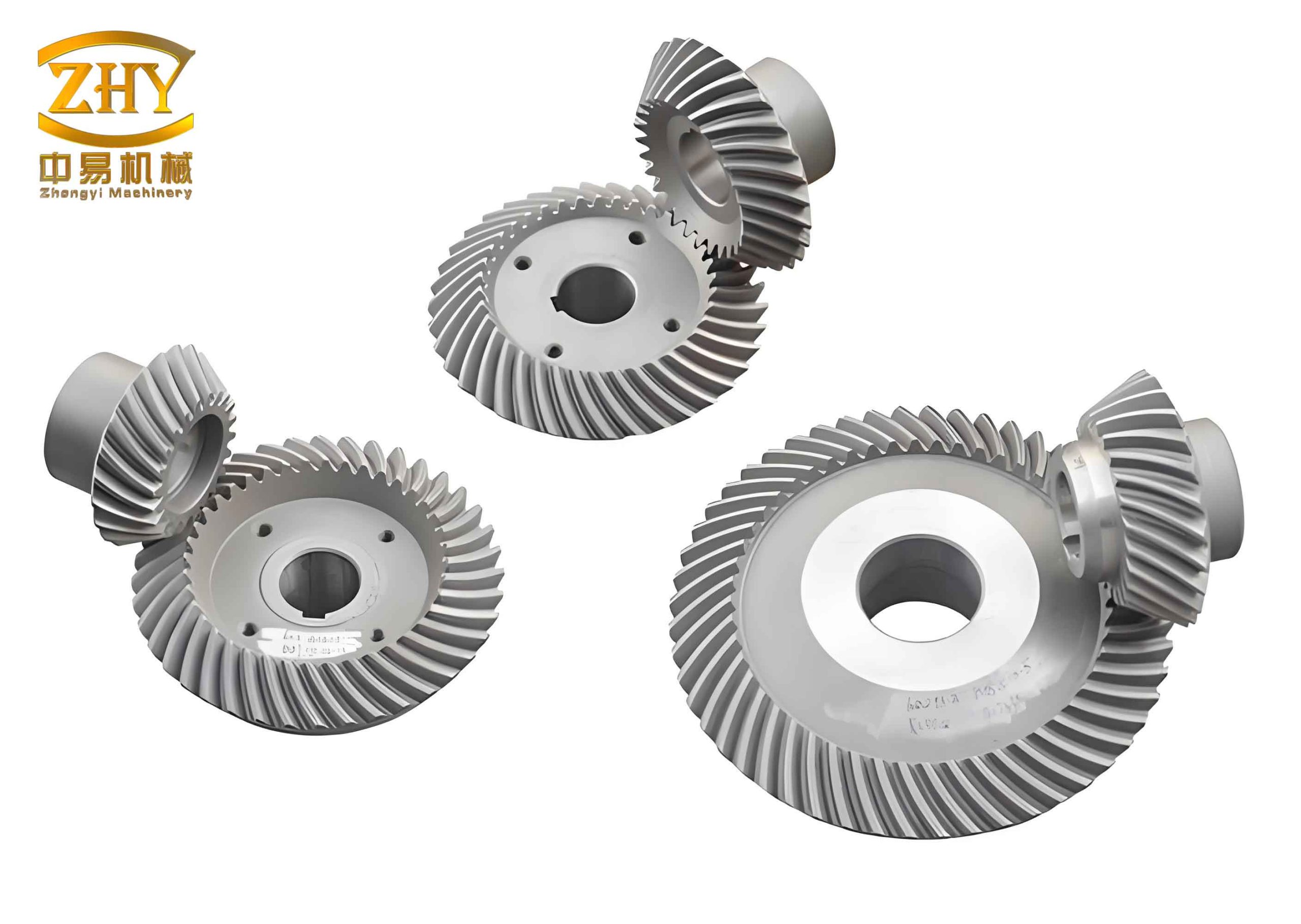
The distortion of hyperboloid gears during carburizing and quenching is a complex thermo-metallurgical phenomenon primarily governed by the interplay of thermal stresses and transformation stresses. During the heating phase, thermal gradients arise due to varying section thicknesses characteristic of hyperboloid gear geometry. The subsequent quenching stage is the most critical, where rapid cooling introduces severe thermal gradients. The surface layers cool and contract faster than the core, generating tensile thermal stresses at the surface and compressive stresses in the core. Concurrently, the austenite-to-martensite transformation, which is accompanied by a volumetric expansion, initiates at the surface. This phase transformation introduces transformation stresses. The resultant stress state, a superposition of thermal and transformation stresses, dictates the final distorted shape. For a ring gear stacked vertically during treatment, non-uniform cooling is pronounced. The central region (B-zone) cools slower than the peripheral edges (A-zone) due to impeded oil flow and greater thermal mass. This leads to a characteristic “dishing” or “cupping” deformation where the gear face becomes convex, often quantified as a “center lift” or “挖心量.” This warpage directly translates to changes in tooth flank topography, affecting pressure angle, spiral angle, and tooth thickness.
The stress evolution can be conceptually modeled. The thermal stress $\sigma_{th}$ during cooling is proportional to the thermal gradient and material properties:
$$\sigma_{th}(t) \propto -E \alpha \frac{\partial T(r,z,t)}{\partial r}$$
where $E$ is Young’s modulus, $\alpha$ is the coefficient of thermal expansion, and $\frac{\partial T}{\partial r}$ is the radial temperature gradient. The transformation stress $\sigma_{tr}$ is related to the volume change $\Delta V$ associated with the martensitic transformation:
$$\sigma_{tr} \propto K \cdot \Delta V \cdot f_m$$
where $K$ is a constraint factor and $f_m$ is the martensite fraction. The total distortion $\delta$ can be seen as an integral of the plastic strain $\epsilon_{pl}$ induced when the combined stress exceeds the yield strength $\sigma_y$:
$$\delta = \int_V \epsilon_{pl} \, dV, \quad \text{where } \epsilon_{pl} \neq 0 \text{ if } |\sigma_{th} + \sigma_{tr}| \geq \sigma_y(T).$$
The following table summarizes key factors influencing distortion in hyperboloid gears:
| Factor Category | Specific Parameters | Influence on Distortion |
|---|---|---|
| Material | Hardenability, Composition (e.g., Cr, Mo, Ni) | Higher hardenability increases transformation stress, potentially increasing distortion. |
| Geometry | Module, Face Width, Offset, Tooth Depth | Asymmetry and varying section thickness promote non-uniform stress. |
| Process – Heating | Heating Rate, Temperature Uniformity | Rapid heating can cause thermal shock and stress. |
| Process – Carburizing | Carbon Potential, Case Depth | Deeper case depth increases gradient and transformation volume. |
| Process – Quenching | Quenchant Type, Agitation, Temperature | Higher cooling severity increases thermal stress; agitation affects uniformity. |
| Fixturing | Stacking Method, Support Points | Improper fixturing can lead to bending and warping under gravity and stress. |
The contact pattern in a paired set of hyperboloid gears is the visible imprint of their conjugated meshing surfaces under load. Any distortion-induced change in flank geometry alters the local normal gap between mating flanks, causing the contact zone to migrate from its intended, optimized position. To theoretically analyze this shift, we employ the 45-point topological grid error method. Modern gear inspection machines, like the Gleason GMM series, measure the deviation of the actual tooth surface from its theoretical design at a predefined grid of 45 points (5 points along the profile height and 9 points along the face width). For a driving pinion concave flank and a driven ring gear convex flank in the “drive” side contact, let $\delta_{z}^{ij}$ represent the surface error at grid point $(i,j)$ on the pinion concave flank (positive for material excess). Similarly, let $\delta_{b}^{ij}$ represent the error on the ring gear convex flank. Due to the meshing kinematics, the theoretical conjugate point on the pinion for a point $(i,j)$ on the ring gear is often at a mirrored index, which we denote as $(6-i, j)$ for a 5×9 grid (indexing from 1). The theoretical normal gap at this pair of points is $L_{0}^{ij}$.
The actual normal gap $L_{a}^{ij}$ between the two flanks at these corresponding points is perturbed by the sum of their errors:
$$L_{a}^{ij} = L_{0}^{ij} – (\delta_{z}^{(6-i)j} + \delta_{b}^{ij})$$
We define the normal gap error $\Delta L^{ij}$ as:
$$\Delta L^{ij} = L_{a}^{ij} – L_{0}^{ij} = – (\delta_{z}^{(6-i)j} + \delta_{b}^{ij})$$
This error dictates contact propensity. Under a loaded condition, the flanks undergo elastic deformation $\tau^{ij}$. For a point pair $k$-$k’$ to be in contact, the displacement compatibility equation must be satisfied:
$$L_{a}^{ij} + \epsilon_k + \epsilon_{k’} = \tau^{ij}$$
where $\epsilon_k$ and $\epsilon_{k’}$ are local elastic deformations at the points. If $\Delta L^{ij} > 0$, the actual gap is larger than theoretical, making it less likely for that point pair to enter contact ($L_{a}^{ij} + \epsilon_k + \epsilon_{k’} > \tau^{ij}$). Conversely, if $\Delta L^{ij} < 0$, the gap is smaller, making contact more probable. Therefore, by mapping the spatial distribution of $\Delta L^{ij}$ across the entire grid, we can predict the contact zone shift. A negative $\Delta L^{ij}$ zone will attract the contact pattern, while a positive zone will repel it. The overall contact ellipse center $(X_c, Y_c)$ can be approximated by a weighted centroid of the negative error field:
$$X_c \approx \frac{\sum_{i,j} w_{ij} \cdot x_{ij} \cdot \max(0, -\Delta L^{ij})}{\sum_{i,j} w_{ij} \cdot \max(0, -\Delta L^{ij})}, \quad Y_c \approx \frac{\sum_{i,j} w_{ij} \cdot y_{ij} \cdot \max(0, -\Delta L^{ij})}{\sum_{i,j} w_{ij} \cdot \max(0, -\Delta L^{ij})}$$
where $w_{ij}$ is a weighting factor potentially related to local contact stiffness.
To validate this theoretical construct and investigate the practical implications of heat treatment on hyperboloid gears, a controlled experimental study was designed and executed. The primary objective was to quantitatively compare tooth flank precision and contact pattern characteristics before and after the standard carburizing and quenching process for a batch of production hyperboloid gears. A secondary objective was to correlate observed flank error changes with the predicted contact zone migration using the 45-point grid analysis.
The experimental setup relied on industry-standard metrology and testing equipment. For flank geometry measurement, a Gleason GMM 350 coordinate measuring machine (CMM) dedicated to bevel and hypoid gears was employed. This device uses a touch-trigger probe to scan the tooth flanks, registering deviations from the nominal design at the standard 45-point grid. For contact pattern assessment, a Gleason 600HTT rolling tester was used. This machine simulates actual operating conditions by mounting the pinion and ring gear in a housing replica, applying a light load, and running them with a marking compound (e.g., Prussian blue) to visualize the contact impression on the tooth flanks. A sample batch of 36 matched hyperboloid gear sets (driving pinion and driven ring gear) from a passenger vehicle rear axle application was selected. All gears were manufactured from a case-hardening steel (e.g., SAE 8620 equivalent). A critical procedure involved marking a specific tooth on both the pinion and ring gear of each set before heat treatment. This allowed for precise pre- and post-treatment measurement of the exact same tooth flank, eliminating random tooth-to-tooth variation from the distortion analysis.
The experimental sequence was as follows: (1) Measure the marked tooth flanks (both concave and convex sides for pinion, convex and concave for ring gear) on the GMM 350 in the “green” state (post-cutting, pre-heat treatment). (2) Subject all gears to the standard industrial gas carburizing and oil quenching process. (3) Re-measure the same marked tooth flanks on the GMM 350 after heat treatment and tempering. (4) Assemble the gears in the 600HTT rolling tester at their theoretical mounting positions and under specified load conditions to obtain contact patterns for both drive and coast sides. The data from the GMM 350 provided the $\delta^{ij}$ error maps. Applying the formula for $\Delta L^{ij}$, we generated pre- and post-heat treatment normal gap error topographies for each gear pair. These topographies are essentially three-dimensional error surfaces plotted over the tooth flank plane.
A representative post-heat treatment error map for a pinion concave flank and its mating ring gear convex flank revealed a distinct pattern. The calculated $\Delta L^{ij}$ surface showed a systematic trend: values tended to be more negative (indicating smaller gaps) in the region towards the toe (inner end) and the mid-profile height. Conversely, areas near the heel (outer end) and the extreme root and tip showed less negative or even positive $\Delta L^{ij}$ values. According to our theoretical displacement compatibility criterion, this predicts that the contact zone would migrate from its nominal position (often optimized to be slightly towards the heel and a bit偏向齿顶 in the design phase) towards the toe and the center of the tooth profile height. This is a critical finding for hyperboloid gears performance prediction.
The rolling test results provided striking visual confirmation. The contact patterns on the ring gear convex flank (drive side) were compared. The pre-heat treatment pattern typically appeared as a well-defined ellipse located slightly towards the heel and slightly偏齿顶, as per design intent. The post-heat treatment pattern for the same gear set, however, consistently showed a distinct shift. The ellipse had moved inward along the face width towards the toe and settled more centrally along the profile height. This observed shift aligned perfectly with the prediction derived from the 45-point topological grid error analysis. The consistency of this shift direction across multiple samples in the batch underscores the systematic nature of the distortion induced by the heat treatment process for these hyperboloid gears.
To quantify the flank geometry changes, statistical analysis was performed on the 36-sample dataset. The following table summarizes the mean change and variation range for key flank error parameters for the driving pinion, calculated as (Post-Treatment Error) – (Pre-Treatment Error):
| Flank Parameter | Pre-Treatment Error Range | Post-Treatment Error Range | Mean Change (Δ) | Physical Interpretation |
|---|---|---|---|---|
| Tooth Thickness (μm) | -18 to -3 (undersize) | +5 to +30 (oversize) | +25 μm | Net expansion due to martensitic transformation. |
| Convex Flank Spiral Angle (arc-min) | +1 to +2 | -2 to +4 | -4 arc-min (decrease) | Tooth tends to “straighten” or unwind. |
| Concave Flank Spiral Angle (arc-min) | -1 to +1 | -6 to +3 | -5 arc-min (decrease) | Greater straightening effect on concave side. |
| Convex Flank Pressure Angle (arc-min) | -2 to +2 | -1 to +3 | +1 arc-min (slight increase) | Minimal systematic change. | Concave Flank Pressure Angle (arc-min) | -1 to +2 | +10 to +14 | +11 arc-min (significant increase) | Substantial increase, affecting mesh geometry. |
The data reveals clear, quantifiable trends. The significant increase in tooth thickness (~25 μm) is a direct consequence of the volumetric expansion during martensite formation. The pronounced decrease in spiral angle, especially on the concave flank, indicates a “toe-in” or “wind-up” relaxation, likely due to the relief of residual machining stresses and the dominant effect of transformation stresses in the tooth geometry. The dramatic increase in the concave flank pressure angle (11 arc-min on average) is a key finding. This suggests that the concave flank profile effectively becomes “steeper” post-heat treatment. When combined with the spiral angle change, it explains the observed contact pattern shift: the effective lead and profile curvatures are altered, changing the conjugate contact path. It is noteworthy that while the absolute magnitude of distortion is considerable, the direction and statistical distribution of the changes are relatively consistent and bounded. This regularity is a positive indicator; it implies that the distortion, though significant, is predictable and potentially compensable. For instance, the pre-grinding or pre-finishing cutting process could be deliberately modified with a “reverse compensation” or “pre-distortion” to anticipate and cancel out the expected heat treatment distortion. This is a common strategy in high-precision gear manufacturing, and our findings provide specific quantitative guidance for hyperboloid gears: cutting the spiral angle slightly larger and the concave pressure angle slightly smaller than nominal to counter the measured post-treatment changes.
The implications extend beyond single-flank analysis. The contact pattern consistency across a batch of hyperboloid gears is vital for noise, vibration, and harshness (NVH) performance. The experimental batch showed increased variation in post-heat treatment contact zone location compared to the pre-heat treatment state. This reduction in consistency stems from minor, uncontrolled variations in the heat treatment process (e.g., temperature uniformity, quenchant flow, positioning within the furnace) interacting with the already complex stress state. Controlling these process parameters with tighter tolerances is essential for improving the consistency of hyperboloid gears performance. Furthermore, the established relationship between flank error and contact shift can be formalized into a predictive model. By characterizing the “distortion signature” of a specific hyperboloid gear design and heat treatment line, one could input pre-treatment measurement data to forecast the post-treatment contact pattern, enabling intelligent sorting or selective assembly to achieve optimal pairings.
In conclusion, this integrated theoretical and experimental investigation has successfully elucidated the mechanistic link between heat treatment distortion and contact zone behavior in hyperboloid gears. The distortion arises from the complex interplay of thermal and transformation stresses during quenching, leading to systematic changes in tooth thickness, spiral angle, and pressure angle. The 45-point topological grid error method provides a robust theoretical framework for analyzing and predicting contact zone shifts based on measured flank deviations. Experimental validation using dedicated gear metrology and testing equipment confirmed the theory: post-heat treatment, the contact pattern on the convex flank of the ring gear consistently migrates from the heel-biased, tip-biased design position towards the toe and the center of the tooth profile. This shift is directly correlated with the calculated normal gap error topography. The quantified distortion patterns, while significant, exhibit a consistent direction and range, highlighting the potential for predictive compensation during the gear cutting phase. Future work should focus on developing finite element models to simulate the multi-physics of the heat treatment process for hyperboloid gears, incorporating phase transformation kinetics and temperature-dependent material properties, to enable virtual prototyping and distortion minimization at the design stage. Additionally, exploring advanced quenching techniques like high-pressure gas quenching or intensive oil agitation could offer better control over cooling uniformity, thereby reducing distortion and improving the consistency of these critical automotive components. The insights gained here form a solid foundation for enhancing the manufacturing precision, performance reliability, and operational quietness of hyperboloid gear drives.