
In the manufacturing of hyperboloid gears, achieving optimal meshing quality is a critical challenge that requires precise control over the gear tooth surfaces. The method of tool tilting, often referred to as the “point contact analytical method,” provides a systematic approach to determine the processing adjustment parameters. This article delves into the fundamental principles behind this method, focusing on the determination of generating motion parameters and the structural elements of tooth surfaces. By applying these principles, computational programs can be developed to calculate adjustment parameters for hyperboloid gear pairs based on given dimensional specifications and transmission requirements, ensuring high-performance meshing.
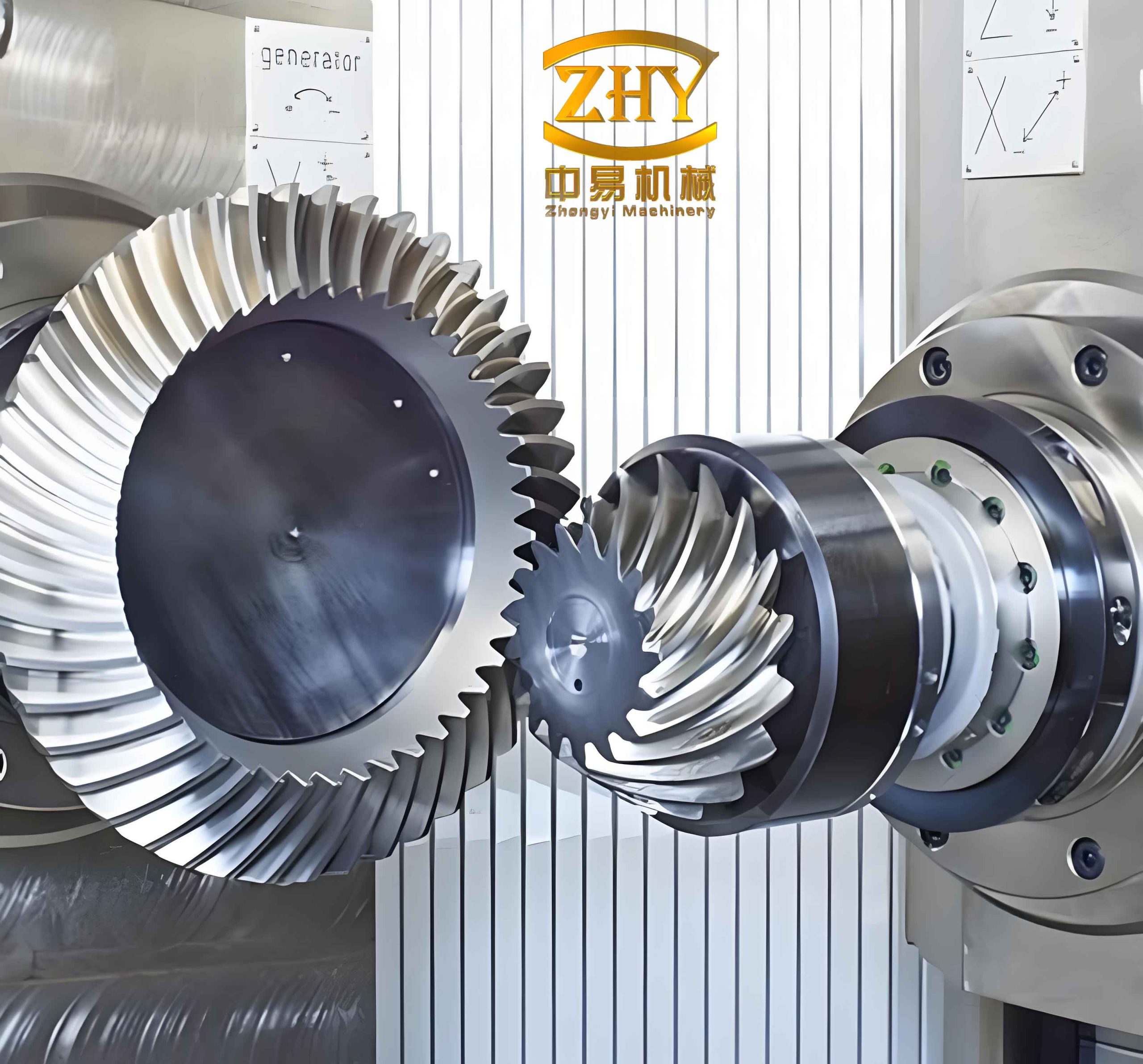
Hyperboloid gears, commonly used in automotive and industrial applications, exhibit complex tooth geometries that necessitate advanced machining techniques. The generating motion parameters play a pivotal role in controlling the shape, size, and position of meshing spots, which directly influence gear noise, efficiency, and durability. These parameters include the cutter diameter, tool tooth profile angle, installation spiral angle of the cutter head, horizontal and vertical displacements of the workpiece and cutter, generating transmission ratio, and the generating gear’s pitch cone angle. Each parameter alteration affects the tooth surface structure of the pinion, thereby impacting meshing quality. The foundation for determining these parameters lies in accurately calculating structural elements such as pressure angle, spiral angle, diagonal coefficient, tooth line curvature, and tooth profile curvature. Proper adjustment ensures that the relationships between these elements on the mating surfaces are optimized for localized contact and improved performance.
The structural elements of the tooth surface are defined at any point on the pinion surface. Let point \( P \) be an arbitrary point on the pinion tooth surface \(\Sigma\). A coordinate cone is constructed with its axis and vertex coinciding with the pinion axis and root cone vertex, respectively, and passing through point \( P \). The cone’s half-angle \(\phi\) is the coordinate cone angle, and the distance \( r \) from \( P \) to the cone vertex is the coordinate cone distance. At point \( P \), three mutually perpendicular unit vectors \( \mathbf{e}_1 \), \( \mathbf{e}_2 \), and \( \mathbf{e}_3 \) are established: \( \mathbf{e}_1 \) along the coordinate cone’s normal direction, \( \mathbf{e}_2 \) along the cone’s generatrix direction, and \( \mathbf{e}_3 \) determined by the right-hand rule from \( \mathbf{e}_1 \), \( \mathbf{e}_2 \), \( \mathbf{e}_3 \). The tooth surface normal unit vector \( \mathbf{n} \) at \( P \) is defined from the tooth material toward the empty space. Decomposing \( \mathbf{n} \) into components along \( \mathbf{e}_1 \), \( \mathbf{e}_2 \), and \( \mathbf{e}_3 \), the tooth surface structure at \( P \) is represented by five elements:
- Normal pressure angle \(\alpha\): The angle between \( \mathbf{n} \) and \( \mathbf{e}_1 \).
- Spiral angle \(\beta\): The angle between the projection of \( \mathbf{n} \) on the plane perpendicular to \( \mathbf{e}_1 \) and \( \mathbf{e}_2 \).
- Diagonal coefficient \(k\): Related to the rate of change of pressure angle along the tooth line.
- Tooth line curvature \(\kappa_l\): The curvature of the tooth line at \( P \) in the developed view of the coordinate cone.
- Tooth profile curvature \(\kappa_p\): The geodesic curvature of the tooth profile curve at \( P \) on a sphere centered at the cone vertex.
These elements are crucial for adjusting meshing spots; changes in pressure angle and spiral angle shift the spot position along the tooth height and length, respectively, while the diagonal coefficient affects the spot’s inclination relative to the tooth line, and curvatures influence the spot’s length and width. The basic formulas for determining these elements are derived from geometric relationships. Let \( n_1 \) and \( n_2 \) be the projections of \( \mathbf{n} \) on \( \mathbf{e}_1 \) and \( \mathbf{e}_2 \), respectively. Then:
$$ \tan \alpha = \frac{n_2}{n_1}, \quad \sin \beta = n_3 $$
where \( n_3 \) is the projection on \( \mathbf{e}_3 \). The end pressure angle \(\alpha’\) at point \( P \) is given by:
$$ \tan \alpha’ = \frac{\tan \alpha}{\cos \beta} $$
The diagonal coefficient \( k \) is expressed as:
$$ k = \frac{d\alpha}{d\phi} = \frac{1}{\cos \alpha} \left( \frac{dn_1}{d\phi} n_2 – \frac{dn_2}{d\phi} n_1 \right) $$
The tooth line curvature \(\kappa_l\) and tooth profile curvature \(\kappa_p\) are derived from differential geometry:
$$ \kappa_l = \frac{d\beta}{d\phi} + \sin \alpha \cdot \frac{d\phi}{ds} $$
where \( s \) is the arc length along the tooth line, and:
$$ \kappa_p = \frac{d\alpha}{d\phi} \cos \beta + \sin \beta \cdot \frac{d\beta}{d\phi} $$
By computing these derivatives based on the tooth surface geometry, the structural elements at any point can be fully determined, forming the basis for processing adjustments in hyperboloid gears.
To achieve ideal meshing for hyperboloid gears, the pinion tooth surface must be derived from the given gear tooth surface. Suppose the gear tooth surface is already machined, either by form cutting or generating methods. The theoretical pinion surface is then determined by meshing the gear and pinion under their working relative position and transmission ratio, resulting in instantaneous line contact. This theoretical surface, while mathematically definable, is impractical to manufacture directly due to tolerances, deformations, and assembly errors. However, it serves as a foundation for modifying the pinion surface. A “modification center point” is selected on the pinion surface, typically away from the tooth root—around the middle of the working height and closer to one end (e.g., the small end)—to ensure full meshing spots. The cone passing through this point and the pinion vertex is called the reference cone, with angle \(\phi_r\) and distance \(r_r\). Based on the gear surface and meshing conditions, the structural elements at this point—\(\alpha_r\), \(\beta_r\), \(k_r\), \(\kappa_{lr}\), and \(\kappa_{pr}\)—are calculated. To promote localized contact, the tooth line and profile curvatures are modified by deviations \(\Delta \kappa_{lr}\) and \(\Delta \kappa_{pr}\), yielding adjusted values \(\kappa_{lr}’ = \kappa_{lr} \pm \Delta \kappa_{lr}\) and \(\kappa_{pr}’ = \kappa_{pr} \pm \Delta \kappa_{pr}\). The modification involves lightly relieving the theoretical surface around the center point, with more material removed farther away, thereby enhancing meshing quality for hyperboloid gears.
The determination of generating motion parameters is central to the machining of hyperboloid gears. Figure 1 illustrates the parameters for finish cutting the pinion. A coordinate system \(O-xyz\) is established with origin at the machine center \(O\); plane \(xOy\) is the vertical center plane, and plane \(xOz\) is the horizontal center plane. The pinion axis is parallel to the horizontal plane at a distance \(E\), and its vertex is offset by distances \(X\) and \(Y\) relative to \(O\). The reference cone’s horizontal generatrix makes an angle \(\phi_0\) with the cutter axis. A local coordinate system \(O’-x’y’z’\) is set at the pinion vertex, where plane \(x’O’y’\) is perpendicular to \(xOz\) and forms an angle \(\eta\) with the reference cone generatrix; this plane is the cutter installation plane, and \(\eta\) is the installation plane angle. The modification center point \(P\) is formed when the axial section through \(P\) on the pinion rotates to an angle \(\theta_0\) relative to the horizontal plane, called the formation position angle. Tool tilting is divided into horizontal and normal components. With horizontal tilting only, the cutter axis is parallel to the horizontal plane and perpendicular to the installation plane, giving a horizontal tilt angle \(\zeta_h = \phi_0 – \eta\). The installation spiral angle \(\psi\) is defined as the angle between the projection of the cutter generatrix on the installation plane and the \(y’\)-axis. Normal tilting then rotates the cutter about an axis through \(P\) perpendicular to the installation plane by an angle \(\zeta_n\), the normal tilt angle. After normal tilting, the angle between the cutter surface normal at \(P\) and the installation plane becomes \(\alpha_0 \pm \zeta_n\), where \(\alpha_0\) is the tool profile angle (inner or outer). The generating radius \(R\) is the perpendicular distance from \(P\) to the cutter axis at formation, and the blade tip height \(h\) ensures proper tooth root depth. The generating transmission ratio \(i_g = \omega_p / \omega_c\) (pinion to cutter angular velocity ratio) is derived from meshing conditions rather than simple geometric angles.
These parameters—\(E\), \(X\), \(Y\), \(\phi_0\), \(\eta\), \(\theta_0\), \(\psi\), \(\zeta_h\), \(\zeta_n\), \(R\), \(h\), and \(i_g\)—are interrelated. The first three (\(E\), \(X\), \(Y\)) are often selectable within limits, \(\eta\) is an initial guess, and the others are computed based on \(\phi_r\), \(\zeta_n\), \(\alpha_0\), and \(R\). Thus, multiple parameter combinations can achieve desired meshing, but any set must satisfy three requirements: (1) realize the specified structural elements at the modification center point, (2) produce correct tooth root depths at both ends, and (3) fall within machine and cutter adjustment limits. The computational principles involve coordinate transformations and contact conditions, as outlined below.
For the pinion, the coordinate cone unit vectors at any point \(P(r, \phi, \theta)\) in system \(O-xyz\) are:
$$ \mathbf{e}_1 = \begin{pmatrix} -\sin \phi \cos \theta \\ -\sin \phi \sin \theta \\ \cos \phi \end{pmatrix}, \quad \mathbf{e}_2 = \begin{pmatrix} \cos \phi \cos \theta \\ \cos \phi \sin \theta \\ \sin \phi \end{pmatrix}, \quad \mathbf{e}_3 = \begin{pmatrix} -\sin \theta \\ \cos \theta \\ 0 \end{pmatrix} $$
The coordinates of \(P\) are:
$$ x = x_0 + r \cos \phi \cos \theta, \quad y = y_0 + r \cos \phi \sin \theta, \quad z = z_0 + r \sin \phi $$
where \(x_0, y_0, z_0\) depend on machine settings. At the modification center point \(P_r(r_r, \phi_r, \theta_0)\), these vectors and coordinates are evaluated. The cutter surface normal at \(P\) in the installation plane coordinates is:
$$ \mathbf{n}_c’ = \begin{pmatrix} \mp \cos \alpha_0 \cos \psi \\ \mp \cos \alpha_0 \sin \psi \\ -\sin \alpha_0 \end{pmatrix} $$
Transforming to \(O-xyz\) and equating to the pinion normal components \(\cos \alpha_r\) and \(\sin \beta_r\) yields equations for \(\theta_0\) and \(\psi\):
$$ \tan \psi = \frac{\sin \beta_r \cos (\phi_r – \eta) \mp \cos \alpha_r \sin (\phi_r – \eta)}{\cos \alpha_r \cos (\phi_r – \eta) \pm \sin \beta_r \sin (\phi_r – \eta)} $$
The critical profile angle \(\alpha_c\), used as a reference for selecting \(\alpha_0\), is found by setting \(\theta_0 = 0\) and \(\zeta_n = 0\):
$$ \tan \alpha_c = \frac{\tan \alpha_r \cos \eta \mp \tan \beta_r \sin \eta}{\cos \phi_r \pm \tan \alpha_r \sin \phi_r} $$
The generating transmission ratio \(i_g\) is derived from the condition that the relative velocity at contact is perpendicular to the common normal:
$$ i_g = \frac{\omega_p}{\omega_c} = \frac{\mathbf{n} \cdot (\mathbf{v}_c – \mathbf{v}_p)}{ \mathbf{n} \cdot \mathbf{v}_c } $$
which simplifies to an expression involving structural elements and machine parameters.
The generating motion equations are established by matching coordinates and enforcing contact between the cutter and pinion surfaces. Let the cutter surface point \(Q(u, v)\) correspond to pinion point \(P(r, \phi, \theta)\) at rotation angle \(\varphi\) of the cutter. After coordinate transformations, the equations are:
$$ x_c(\varphi) = x_p(r, \phi, \theta), \quad y_c(\varphi) = y_p(r, \phi, \theta), \quad z_c(\varphi) = z_p(r, \phi, \theta) $$
and the contact condition:
$$ \mathbf{n} \cdot (\mathbf{v}_c – \mathbf{v}_p) = 0 $$
This leads to a system of four equations in parameters \(r\), \(\phi\), \(\theta\), and \(\varphi\), which are solved numerically. To ensure the modified curvatures \(\kappa_{lr}’\) and \(\kappa_{pr}’\), additional equations involving derivatives of structural elements are derived. For instance, the diagonal coefficient requires computing \(d\alpha/d\phi\) from the generating motion. Using chain rules and the previously mentioned derivatives, we obtain adjustment parameter equations. For example, the tooth line curvature adjustment yields:
$$ \frac{d\beta}{d\phi} \bigg|_{P_r} = \kappa_{lr}’ – \sin \alpha_r \cdot \frac{d\phi}{ds} $$
These equations are solved iteratively to find parameters like \(E\), \(X\), \(Y\), \(R\), and \(h\). A key aspect is ensuring equal root depths at both ends of the tooth. The blade tip height \(h\) is related to the forming radius \(R_f\) by \(R_f = R \mp h \tan \alpha_0\), where the sign depends on inner or outer blades. By solving coordinate conditions for small and large end points, we obtain values \(h_s\) and \(h_l\). If \(h_s \neq h_l\), the installation plane angle \(\eta\) is adjusted until \( |h_s – h_l| \leq 0.01 \, \text{mm} \), ensuring uniform depth. The final \(h\) is taken as the average, and \(R_f\) is computed accordingly.
To summarize the interrelationships, the following table outlines the effects of selectable parameters on adjustment outcomes for hyperboloid gears:
| Parameter | Effect on Pinion Convex Side | Effect on Pinion Concave Side |
|---|---|---|
| \(\phi_0\) increase | Increases \(E\), decreases \(X\), \(Y\) | Decreases \(E\), increases \(X\), \(Y\) |
| \(\zeta_n\) increase | Increases \(R\), decreases \(i_g\) | Decreases \(R\), increases \(i_g\) |
| \(\alpha_0\) increase | Increases \(h\), slight effect on others | Decreases \(h\), slight effect on others |
| \(\eta\) increase | Decreases \(R\), increases \(i_g\) | Increases \(R\), decreases \(i_g\) |
Additionally, the machine constraints must be checked. For instance, on Gleason-type machines, the tilt radius \(R_t\) is typically 114.3 mm, affecting parameter ranges. If computed values exceed limits, selectable parameters are modified based on the table above. This iterative process ensures feasible and optimal settings for hyperboloid gears.
The mathematical formulation relies heavily on coordinate transformations. Let’s denote the transformation from installation coordinates to machine coordinates as a rotation matrix. For normal tilting, the rotation about an axis through \(P\) by angle \(\zeta_n\) is represented by:
$$ \mathbf{R}_n = \begin{pmatrix} \cos \zeta_n & 0 & \sin \zeta_n \\ 0 & 1 & 0 \\ -\sin \zeta_n & 0 & \cos \zeta_n \end{pmatrix} $$
Combining with horizontal tilting and machine rotations, the overall transformation for a cutter point \(Q\) to its position during generation is:
$$ \begin{pmatrix} x \\ y \\ z \end{pmatrix} = \mathbf{T} \cdot \mathbf{R}_h \cdot \mathbf{R}_n \cdot \begin{pmatrix} u \\ v \\ w \end{pmatrix} + \begin{pmatrix} \Delta x \\ \Delta y \\ \Delta z \end{pmatrix} $$
where \(\mathbf{T}\) includes translation offsets, and \(u, v, w\) are local cutter coordinates. The derivatives needed for curvature calculations, such as \(d\mathbf{n}/d\phi\), are obtained by differentiating these transformations. For example, the change in normal vector with respect to cone angle is:
$$ \frac{d\mathbf{n}}{d\phi} = \frac{\partial \mathbf{n}}{\partial \phi} + \frac{\partial \mathbf{n}}{\partial \theta} \frac{d\theta}{d\phi} $$
These derivatives are substituted into the formulas for \(k\), \(\kappa_l\), and \(\kappa_p\), leading to nonlinear equations in the adjustment parameters. Numerical methods, such as Newton-Raphson, are employed to solve these equations efficiently.
In practice, the process for hyperboloid gears involves the following steps: (1) Input gear pair dimensions and meshing requirements. (2) Select initial values for \(\phi_0\), \(\zeta_n\), and \(\alpha_0\). (3) Solve the generating motion equations for \(\theta_0\), \(\psi\), and \(i_g\). (4) Compute structural elements at the modification point. (5) Adjust curvatures via \(\Delta \kappa_{lr}\) and \(\Delta \kappa_{pr}\). (6) Solve adjustment parameter equations for \(E\), \(X\), \(Y\), \(R\), and \(h\). (7) Check tooth root depth equality and iterate on \(\eta\) if needed. (8) Verify machine limits and adjust selectable parameters accordingly. (9) Output final adjustment settings for machining.
This methodology not only ensures precise meshing for hyperboloid gears but also allows for flexibility in manufacturing. By understanding the underlying principles, engineers can optimize gear designs for specific applications, such as high-torque transmissions or noise-sensitive environments. The use of computer algorithms automates these complex calculations, enabling rapid prototyping and production of high-performance hyperboloid gears. Future advancements may integrate real-time monitoring and adaptive control during machining, further enhancing quality and efficiency.
In conclusion, the tool tilting method for hyperboloid gears provides a robust framework for determining processing adjustment parameters. Through analytical modeling of tooth surface structures and generating motions, it achieves localized contact and improved meshing characteristics. The iterative computation of parameters ensures both geometric accuracy and manufacturability. As hyperboloid gears continue to evolve in automotive and industrial sectors, these principles will remain foundational for advancing gear technology and meeting ever-increasing performance demands.