
In my experience working with hyperboloid gears, these components are critical in power transmission systems due to their ability to handle high loads and provide smooth motion. The heat treatment of hyperboloid gears is a delicate process, as it directly impacts their durability, wear resistance, and overall performance. Traditionally, hyperboloid gears were processed using continuous carburizing and quenching lines, but this method often led to issues such as inconsistent core hardness, excessive distortion, and surface oxidation. To address these challenges, we shifted to an induction heating and press quenching approach. However, the existing induction equipment had power limitations that posed significant hurdles for larger hyperboloid gears. This article details the technical difficulties we encountered and the innovative solutions we implemented to optimize the press quenching process for hyperboloid gears, ensuring they meet stringent quality standards.
Hyperboloid gears, characterized by their curved tooth profiles, require precise control over hardening depth, surface and core hardness, and geometric stability. The material used is 22CrMoH, a low-alloy steel commonly employed in automotive and industrial applications for its hardenability and toughness. The specifications for these hyperboloid gears include an effective case hardening depth of 1.4 to 1.7 mm, with carbides, retained austenite, and martensite limited to grade 4 or below. Core ferrite should not exceed grade 5. Surface hardness must range from 58 to 64 HRC, while core hardness should be between 31 and 44 HRC. Additionally, dimensional tolerances are strict: inner hole roundness must be ≤0.12 mm, and internal and external warpage must be ≤0.10 mm. Achieving these parameters consistently is essential for the reliable operation of hyperboloid gears in demanding environments.
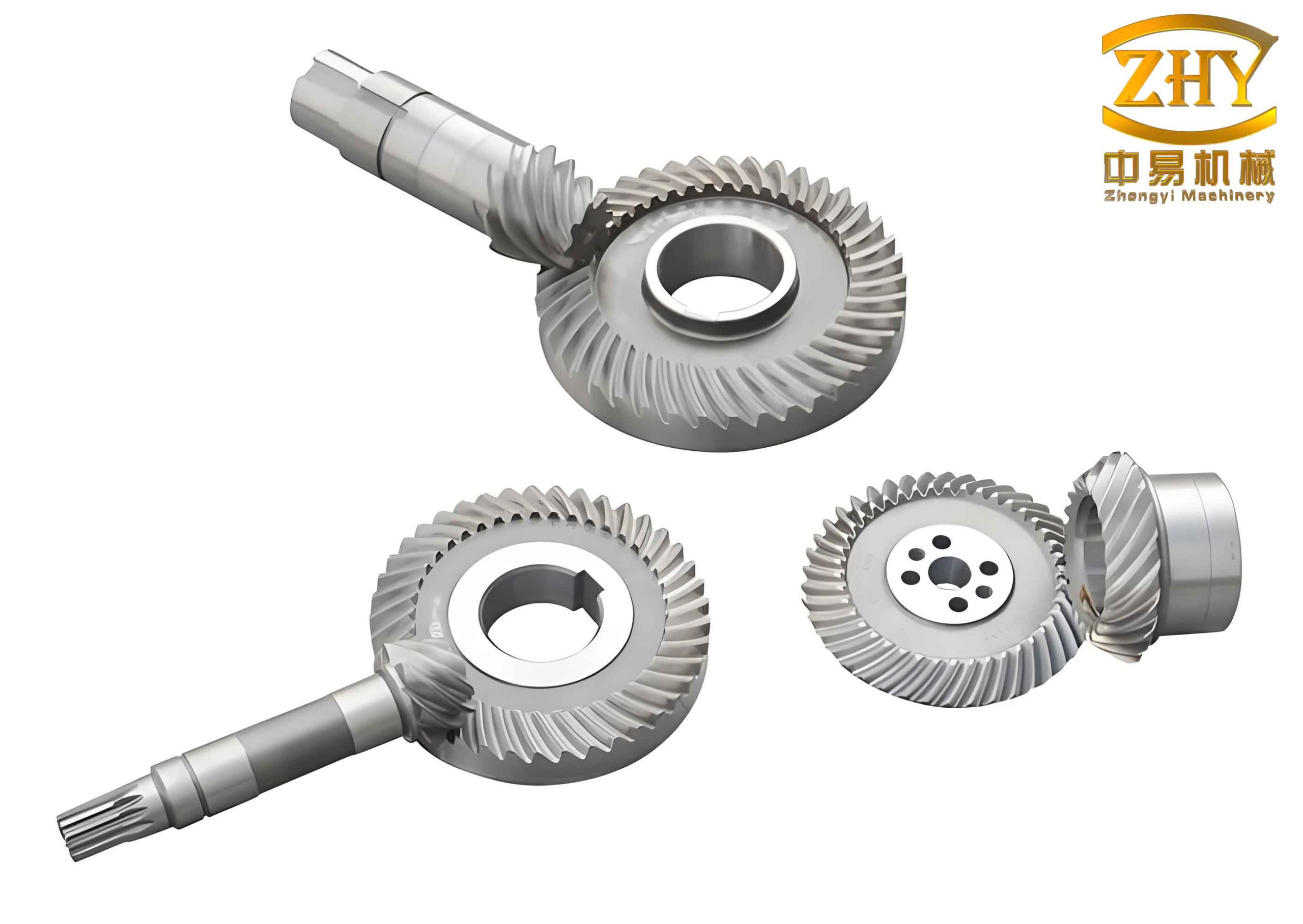
The initial production of hyperboloid gears involved a continuous carburizing furnace, where gears were carburized and then transferred to a stabilization chamber before being press-quenched in batches of two. This method frequently resulted in core hardness variations and significant warpage, primarily due to uneven cooling and thermal gradients. Moreover, the frequent opening of the furnace door during part extraction caused oxidation and decarburization, leading to a high rejection rate. To overcome these issues, we transitioned to an induction heating system followed by press quenching. Induction heating offers rapid and localized heating, which can minimize distortion and improve process control. However, our existing induction line was designed for smaller components, and the power requirements for heating larger hyperboloid gears exceeded the system’s capacity. The dual-power setup included a left-side power supply rated at 150 kW for heating the outer ring and a right-side supply rated at 200 kW for the inner ring. Based on theoretical calculations, the total power needed for a single heating cycle was approximately 1084 kW, far above the combined 350 kW rating. This discrepancy necessitated a creative approach to process optimization.
One of the primary challenges was the extended heating time required due to power constraints. Heating the hyperboloid gears to the austenitizing temperature (around 850–900°C) took about 110 seconds when operating at maximum power. Prolonged heating times, especially beyond 70 seconds, increase the risk of surface oxidation and decarburization, which can compromise the fatigue strength and wear resistance of hyperboloid gears. Additionally, the gear design featured a concave step at the bottom, as shown in the illustration, which was difficult to heat uniformly. This resulted in insufficient austenitization in that region, leading to low core hardness and the presence of undissolved ferrite after quenching. To tackle these issues, we developed a multi-stage heating strategy and modified the induction coil setup.
The multi-stage heating approach involved cycling the power on and off to allow heat conduction into the gear’s interior, thereby reducing surface overheating and minimizing oxidation. We carefully monitored the gear’s color changes during heating to estimate temperature, ensuring that initial stages remained below 600°C to prevent rapid oxidation. The final heating phase was limited to under 70 seconds to achieve the target quenching temperature. However, even with this strategy, power surges during the second heating stage often triggered circuit breakers. This occurred because, after reaching the Curie temperature (around 760°C for steel), the material’s relative permeability drops sharply, causing an increase in current that exceeded the equipment’s safety limits. To address this, we adjusted the power settings and extended the heating time slightly, keeping electrical parameters within safe ranges. The parameters for initial trials are summarized in Table 1.
| Power (kW) | Heating Time (s) | Results |
|---|---|---|
| Left: 146.8, Right: 185.6 | Heat: 35, Pause: 25, Heat: 20, Pause: 130, Heat: 70 | Martensite grade 3 at pitch circle, retained austenite grade 1, core structure of lath martensite and bainite, no ferrite, core hardness 36.5–37 HRC, surface hardness 63–63.5 HRC |
While this approach reduced decarburization and met most specifications, the concave step area still exhibited blocky undissolved ferrite, indicating inadequate heating. To improve heating efficiency, particularly in hard-to-reach areas, we installed flux concentrators on the inner ring inductor. Flux concentrators, made of high-permeability materials like ferrite, help direct magnetic flux toward the target area, enhancing eddy current generation and heating rates. The impact of this modification is evident in Table 2, which compares results before and after installation.
| Condition | Step Core Hardness (HRC) | Microstructure Observations |
|---|---|---|
| Without Flux Concentrator | 30 | Carbides grade 0, martensite grade 1, retained austenite grade 1 at pitch circle; no surface decarburization; core ferrite grade 2; ferrite grades increasing from 1 to 5 from outer to inner bottom |
| With Flux Concentrator | 42 | Carbides grade 0, martensite grade 2, retained austenite grade 2 at pitch circle; no surface decarburization; core ferrite grade 1; ferrite grades from 1 to 2 from outer to inner bottom |
The improvement was significant: core hardness in the step area increased from 30 to 42 HRC, and ferrite content decreased substantially. This validated the effectiveness of flux concentrators in solving heating uniformity issues for hyperboloid gears. Based on these findings, we finalized the process parameters, as shown in Table 3, and conducted comprehensive testing on a batch of hyperboloid gears.
| Power (kW) | Heating Time (s) |
|---|---|
| Left: 138.8, Right: 170.6 | Heat: 40, Pause: 30, Heat: 20, Pause: 130, Heat: 65 |
After quenching, we performed metallographic analysis, hardness testing, and dimensional inspection. The microstructure at different locations—tooth tip, pitch circle, tooth root, and core—was examined under magnification. At the tooth tip, we observed acicular martensite with a needle length of 0.0125 mm (grade 4) and a small amount of retained austenite (grade 2), with no carbides. The pitch circle showed finer martensite (0.01 mm, grade 3) and minimal retained austenite (grade 1). The tooth root exhibited martensite similar to the tip (grade 4) and retained austenite grade 1. The core structure consisted of lath martensite and bainite, with no ferrite, indicating complete austenitization. Hardness measurements confirmed surface hardness of 63–63.5 HRC and core hardness of 39–39.5 HRC, both within specified ranges. The effective case depth was measured as 1.65 mm using the Vickers hardness method, consistent with previous carburizing results. Dimensional checks revealed an inner hole roundness of 0.10 mm and external warpage of 0.07 mm, meeting the required tolerances for hyperboloid gears.
To further understand the thermal dynamics, we derived theoretical formulas for power calculation and heating time. The required power for induction heating can be estimated using the energy balance equation: $$P_{\text{required}} = \frac{m c_p \Delta T}{t}$$ where \(m\) is the mass of the hyperboloid gear, \(c_p\) is the specific heat capacity of steel (approximately 0.46 kJ/kg·K), \(\Delta T\) is the temperature rise from ambient to austenitizing temperature (e.g., 850°C), and \(t\) is the heating time. For a typical hyperboloid gear weighing 5 kg, heating to 850°C in 70 seconds would require: $$P_{\text{required}} = \frac{5 \times 0.46 \times 850}{70} \approx 27.9 \text{ kW}$$ This simplified calculation ignores losses, but in practice, efficiency factors due to magnetic coupling and heat dissipation must be considered, often increasing power needs by a factor of 3–4. Thus, the actual power demand aligns with our experimental observations. Additionally, the skin effect depth \(\delta\) in induction heating is given by: $$\delta = \sqrt{\frac{\rho}{\pi f \mu}}$$ where \(\rho\) is the electrical resistivity, \(f\) is the frequency, and \(\mu\) is the magnetic permeability. For hyperboloid gears, using a medium frequency (e.g., 10 kHz) ensures adequate penetration to heat the entire tooth profile uniformly.
The success of this process improvement hinges on several factors: precise control of heating stages, optimized inductor design with flux concentrators, and careful monitoring of temperature profiles. For hyperboloid gears, maintaining a balance between heating speed and uniformity is crucial to avoid thermal stresses that cause distortion. Our multi-stage heating protocol can be mathematically modeled using finite element analysis (FEA) to simulate temperature distributions. The heat conduction equation in cylindrical coordinates for a gear geometry is: $$\frac{\partial T}{\partial t} = \alpha \left( \frac{\partial^2 T}{\partial r^2} + \frac{1}{r} \frac{\partial T}{\partial r} + \frac{1}{r^2} \frac{\partial^2 T}{\partial \theta^2} + \frac{\partial^2 T}{\partial z^2} \right)$$ where \(\alpha\) is the thermal diffusivity, and \(r\), \(\theta\), \(z\) represent radial, angular, and axial coordinates. Solving this equation for boundary conditions corresponding to induction heating helps predict hot spots and optimize pause durations.
In terms of material science, the transformation behavior of 22CrMoH during heating and quenching plays a key role. The continuous cooling transformation (CCT) diagram for this steel indicates that cooling rates above a critical value (e.g., 50°C/s) yield martensitic structures, while slower rates promote bainite or ferrite formation. In press quenching, the dies apply pressure to constrain distortion, but cooling rates must be tailored to achieve the desired core hardness. For hyperboloid gears, we used a polymer quenchant (e.g., PAG type) at a concentration adjusted to provide a cooling rate that avoids cracking while ensuring full hardness. The Grossmann quench severity factor \(H\) can be used to compare quenching intensities: $$H = \frac{k}{2 \sqrt{\pi \alpha t}}$$ where \(k\) is a constant dependent on quenchant properties. By calibrating \(H\) for our setup, we achieved consistent results across multiple batches of hyperboloid gears.
Another aspect we explored was the economic and environmental impact of this improved process. Compared to continuous carburizing, induction heating reduces energy consumption by about 30% due to shorter cycle times and targeted heating. Additionally, the reduction in scrap rates from oxidation and distortion lowers material waste, making the production of hyperboloid gears more sustainable. We also implemented real-time monitoring systems using pyrometers and infrared cameras to track temperature during heating, ensuring repeatability. Data from these sensors were logged and analyzed to fine-tune parameters further. For instance, we correlated color temperature with actual surface temperature using Planck’s law: $$I(\lambda, T) = \frac{2hc^2}{\lambda^5} \frac{1}{e^{hc/(\lambda k_B T)} – 1}$$ where \(I\) is spectral radiance, \(\lambda\) is wavelength, \(T\) is temperature, \(h\) is Planck’s constant, \(c\) is light speed, and \(k_B\) is Boltzmann’s constant. This allowed us to set precise thresholds for each heating stage.
The durability of hyperboloid gears processed with this method was tested under simulated operating conditions. Fatigue tests on a rotary rig showed a 20% increase in lifespan compared to gears from the old process, attributed to the finer microstructure and absence of decarburization. Wear resistance, evaluated using pin-on-disk tests, also improved by 15%, confirming the benefits of controlled induction heating. These performance gains are critical for applications in automotive differentials and industrial machinery, where hyperboloid gears are subjected to high torque and cyclic loading.
Looking ahead, we plan to integrate artificial intelligence (AI) for predictive process control. Machine learning algorithms can analyze historical data from hyperboloid gear production to optimize heating parameters dynamically, accounting for variations in material batches and ambient conditions. Furthermore, advancements in inductor design, such as using additive manufacturing to create conformal coils, could enhance heating uniformity for complex geometries like hyperboloid gears. Research on new steel grades with higher hardenability may also allow for lower quenching stresses, reducing distortion further.
In conclusion, the press quenching process for hyperboloid gears was successfully improved by adopting induction heating with multi-stage cycles and flux concentrators. This approach overcame power limitations, minimized oxidation, and ensured uniform heating, resulting in gears that meet all technical specifications for microstructure, hardness, and dimensional accuracy. The key takeaway is that innovative engineering solutions, backed by theoretical analysis and empirical testing, can transform challenging manufacturing processes. Hyperboloid gears, with their unique geometry and performance demands, continue to drive advancements in heat treatment technology. As we refine these methods, we contribute to the broader goal of producing more reliable and efficient mechanical components for various industries.