
In modern mechanical engineering, hyperboloidal gears are critical transmission components in automotive and industrial applications due to their ability to transmit motion between non-intersecting axes with high efficiency and load capacity. The complex spatial geometry of hyperboloidal gear tooth surfaces poses significant challenges for precision manufacturing and quality control. Traditional inspection methods, such as contact pattern testing, are insufficient for ensuring geometric consistency between actual and theoretical tooth surfaces, which is paramount for achieving optimal meshing performance and noise reduction. With the advent of digital manufacturing, computer numerical control (CNC) measurement centers have become essential for obtaining detailed tooth surface error data, which guides adjustments in cutting machines. However, the high cost of imported three-dimensional probing systems has limited widespread adoption, particularly in regions developing domestic measurement technologies. This article presents a comprehensive methodology for measuring tooth surface deviations in hyperboloidal gears using a one-dimensional probe, incorporating error compensation techniques to enhance accuracy. The approach is validated through comparative experiments, demonstrating its feasibility and correctness for industrial applications.
The mathematical modeling of hyperboloidal gear tooth surfaces is foundational for generating theoretical data required for measurement. Unlike simple geometric surfaces, hyperboloidal gear tooth surfaces cannot be described by elementary functions; instead, they are derived from the conjugate surface theory based on gear meshing principles and differential geometry. The tooth surface generation process mimics the meshing between the gear and the cutting tool, allowing the surface to be parameterized. For a hyperboloidal gear pair, the tooth surface vector \(\mathbf{r}_i\) and unit normal vector \(\mathbf{n}_i\) are expressed as functions of parameters \(u_i\) and \(\theta_i\):
$$
\mathbf{r}_i = \mathbf{r}_i(u_i, \theta_i), \quad \mathbf{n}_i = \mathbf{n}_i(u_i, \theta_i) \quad \text{for } i = 1, 2
$$
where \(i = 1\) denotes the pinion (small gear) and \(i = 2\) denotes the gear (large gear). In the HFT (Hyperboloidal Formate) cutting method, the parameter \(u_2\) for the gear represents the length variable along the cutter cone generatrix, and \(\theta_2\) is the rotation angle of the cutter head. For the pinion, \(u_1\) corresponds to the cutter cone rotation angle, and \(\theta_1\) is the generating rotation angle of the cradle. These parameters are determined through a series of coordinate transformations based on known cutting machine settings, including tool geometry and kinematic relationships. The derivation involves solving the meshing equation and coordinate mappings from the tool to the workpiece, as detailed in gear theory literature. The resulting parametric equations provide the basis for calculating coordinates and normals at any point on the tooth surface, which are essential for planning measurement points.
To achieve full-tooth-surface coverage, measurement points must be strategically planned in a planar mapping that corresponds one-to-one with the actual tooth surface. A common approach is to use the rotational projection of the tooth surface onto an axial cross-section. In this projection, a planar coordinate system \(OXY\) is established, where \(O\) is the design crossing point of the gear axes. For any measurement point \(M^*\) on the tooth surface, its projected coordinates \((x^*, y^*)\) are related to the actual coordinates in the workpiece coordinate system through nonlinear equations:
$$
x_i = x^*, \quad \sqrt{y_i^2 + z_i^2} = y^*
$$
where \((x_i, y_i, z_i)\) are the components of the tooth surface vector \(\mathbf{r}_i\). Solving these equations yields the corresponding parameters \(u_i\) and \(\theta_i\), which are then substituted into the parametric equations to obtain the exact coordinates and unit normal vectors. Measurement regions are typically limited to areas accessible by the probe, excluding boundary chamfers and root zones. Industry standards, such as those from the American Gear Manufacturers Association (AGMA), recommend grid partitioning where the spacing in the lengthwise direction is less than 10% of the face width, and in the profile direction, less than 5% of the working tooth height or 0.6 mm, whichever is smaller. A standard grid consists of 9 points along the face width and 5 points along the tooth profile, totaling 45 measurement points per tooth flank. This grid ensures dense sampling for accurate deviation analysis. Table 1 summarizes a typical grid configuration for hyperboloidal gears, illustrating the distribution of points across the tooth surface.
| Grid Row | Grid Column | Projected Coordinate X (mm) | Projected Coordinate Y (mm) | Computed Normal Vector (nx, ny, nz) |
|---|---|---|---|---|
| 1 | 1 | -15.2 | 8.5 | (0.12, -0.85, 0.51) |
| 1 | 2 | -12.1 | 8.7 | (0.15, -0.82, 0.55) |
| … | … | … | … | … |
| 5 | 9 | 14.8 | -7.9 | (-0.21, 0.78, -0.59) |
The measurement process using a one-dimensional probe requires precise alignment between the workpiece coordinate system and the measurement coordinate system. In a CNC measurement center like the JD45S, the workpiece is positioned using machining reference surfaces, such as the back face and bore. The transformation matrix \(\mathbf{C}_{cw}\) relates the workpiece coordinate system \(O_w X_w Y_w Z_w\) (right-handed) to the measurement coordinate system \(O_c X_c Y_c Z_c\) (left-handed). Assuming the reference surface is coincident with the rotary table plane, the matrix is given by:
$$
\mathbf{C}_{cw} = \begin{bmatrix}
0 & -1 & 0 & 0 \\
0 & 0 & -1 & 0 \\
-1 & 0 & 0 & a \\
0 & 0 & 0 & 1
\end{bmatrix}
$$
where \(a\) is the installation distance. To locate the tooth surface in the measurement space, a reference point is selected—typically a grid point near the center of the tooth—where the deviation is assumed zero. This reference point, with coordinates \((x_0, y_0, z_0)\) and unit normal \((n_x, 0, n_z)\) in the measurement system after rotation, serves as the datum for all subsequent measurements. The procedure involves: (1) orienting the probe’s sensitive direction to align with the reference point normal; (2) moving the probe to a position above the reference point; (3) rotating the workpiece to allow probe access into the adjacent tooth space; (4) bringing the probe into contact with the tooth surface at the reference point; and (5) recording the rotary table angle \(\beta\). All other measurement points are then transformed by rotating around the \(Z_c\)-axis by \(\beta\), yielding new coordinates and normals in the measurement system. For hyperboloidal gears, this alignment is critical due to their complex curvature, and any misalignment can introduce significant errors.
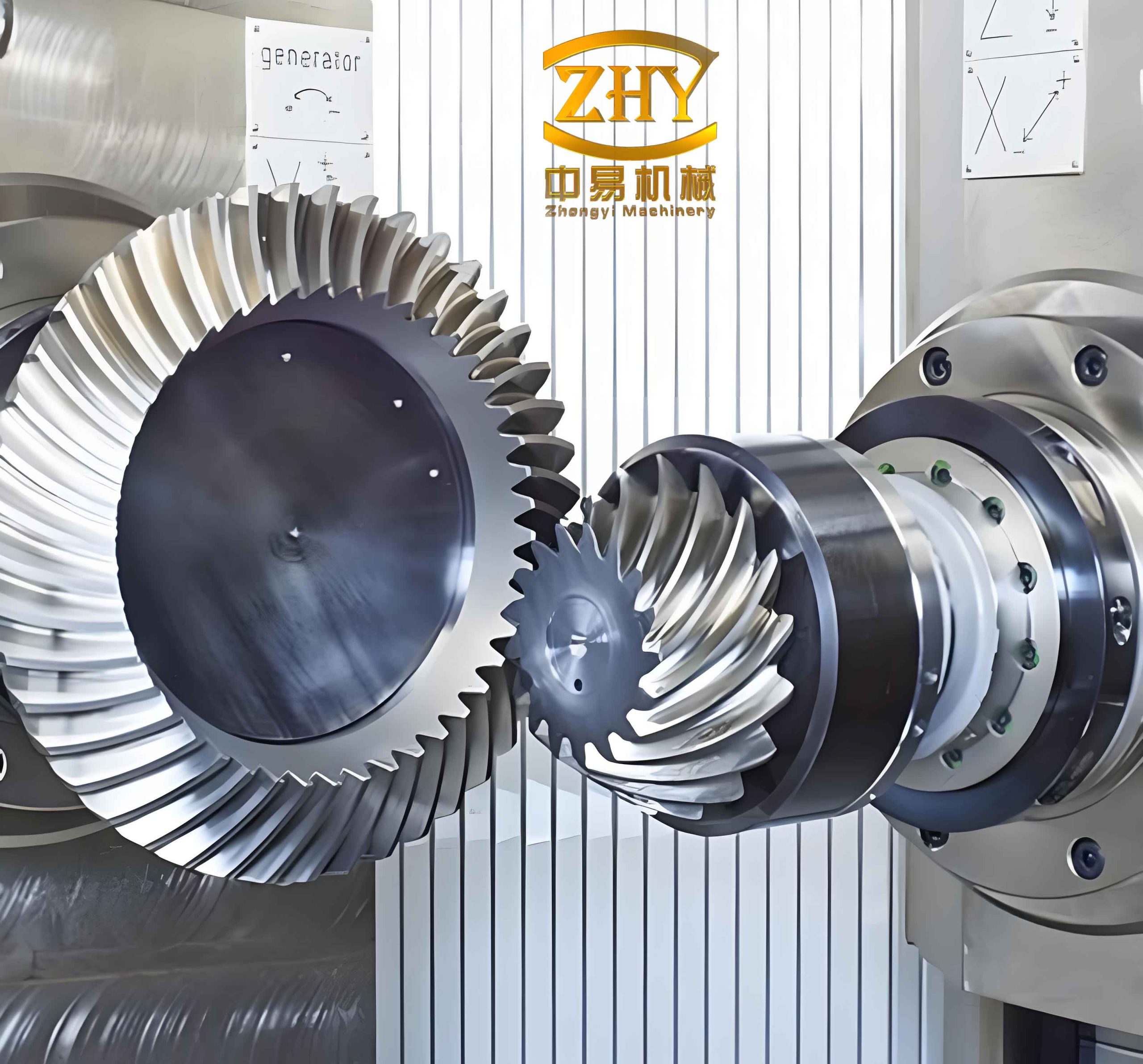
Data processing is a crucial step in compensating for inherent errors when using a one-dimensional probe. Unlike three-dimensional probes that directly capture deviations along the surface normal, one-dimensional probes measure along their sensitive direction, which may not coincide with the normal at each point. After alignment, residual angular differences \(\alpha\) between the probe direction and the surface normal persist in the \(X_c Z_c\) plane. This misalignment causes the actual contact point to shift from the theoretical point, leading to measurement errors. The compensation formula, derived from geometric relations in a micro-scale planar approximation, is:
$$
\delta = r \left( \frac{1}{\cos \alpha} – 1 \right)
$$
where \(\delta\) is the error between the probe reading and the true normal deviation, \(r\) is the probe tip radius, and \(\alpha\) is the angle between the normal and probe directions. This equation shows that larger probe radii or larger angles increase errors. Therefore, selecting a small probe radius (e.g., 1–2 mm) and minimizing \(\alpha\) (ideally within ±10°) are essential. In practice, for hyperboloidal gears, \(\alpha\) is typically less than 5° due to careful alignment, making \(\cos \alpha \approx 1\) and \(\delta\) negligible. However, compensation is still applied to ensure accuracy. Additionally, coordinate adjustments in the \(Z\)-direction are made to ensure the probe contacts the theoretical point. The overall data processing flow includes: (1) applying the rotation transformation based on \(\beta\); (2) computing \(\alpha\) for each point; (3) compensating readings using the above formula; and (4) outputting the true normal deviations. This approach effectively mitigates errors from probe orientation and contact position, yielding reliable deviation maps for hyperboloidal gears.
To validate the methodology, experimental measurements were conducted on a hyperboloidal gear set using a one-dimensional probe on a domestic JD45S measurement center and compared with results from a three-dimensional probe on an M&M 3525 measurement center. The hyperboloidal gears had geometric parameters as listed in Table 2, with pinion cutting parameters provided in Table 3. The gear set was manufactured on a Gleason No. 116 machine using HFT cutting. The measurement grid followed the standard 45-point layout, and deviations were processed with error compensation. Results for the pinion’s convex and concave flanks are shown in deviation plots, indicating trends such as decreasing deviations from toe to heel on convex flanks and increasing deviations on concave flanks. The maximum positive and negative deviations were within expected ranges, demonstrating consistency between one-dimensional and three-dimensional probe measurements. Slight discrepancies (≈0.05 mm) were attributed to factors like machine accuracy, reference distance errors, grid planning variations, and probe ball sphericity. Overall, the comparison confirms the feasibility of using one-dimensional probes for hyperboloidal gear inspection.
| Parameter | Gear (Large) | Pinion (Small) |
|---|---|---|
| Number of Teeth | 35 | 6 |
| Face Width (mm) | 37.00 | 42.56 |
| Root Angle (°) | 72.67 | 10.27 |
| Pitch Angle (°) | 78.60 | 10.97 |
| Face Angle (°) | 79.33 | 16.70 |
| Mounting Distance (mm) | 54.00 | 128.50 |
| Addendum (mm) | 1.21 | 10.04 |
| Dedendum (mm) | 11.18 | 2.61 |
| Offset Distance (mm) | 30.00 | |
| Parameter | Concave Flank | Convex Flank |
|---|---|---|
| Cutter Diameter (mm) | 219.73 | 236.79 |
| Cutter Pressure Angle (°) | 14.00 | 31.00 |
| Workpiece Installation Angle (°) | 354.57 | 353.97 |
| Cradle Angle (°) | 150.33 | 138.42 |
| Eccentric Angle (°) | 52.02 | 58.40 |
| Machine Tool Tilt Angle (°) | 60.62 | 63.90 |
| Machine Tool Swivel Angle (°) | 244.87 | 252.62 |
| Cutting Ratio (Roll) | 5.41 | 6.05 |
The error compensation theory can be extended to analyze sensitivity factors in hyperboloidal gear measurements. For instance, the partial derivatives of \(\delta\) with respect to \(r\) and \(\alpha\) highlight the influence of probe selection and alignment:
$$
\frac{\partial \delta}{\partial r} = \frac{1}{\cos \alpha} – 1, \quad \frac{\partial \delta}{\partial \alpha} = r \cdot \frac{\sin \alpha}{\cos^2 \alpha}
$$
These derivatives show that error sensitivity increases with \(\alpha\), especially near \(\alpha = 90^\circ\), but in practice, \(\alpha\) is small. For hyperboloidal gears with high curvature, maintaining \(\alpha < 5^\circ\) ensures \(\frac{\partial \delta}{\partial \alpha} \approx r \alpha\) (using small-angle approximations), where \(r\) is in mm. Thus, using a 1 mm probe reduces sensitivity by half compared to a 2 mm probe. Additionally, the transformation matrix \(\mathbf{C}_{cw}\) can be generalized for different mounting configurations by incorporating additional rotations and translations, which is vital for hyperboloidal gears due to their offset axes. The general form for coordinate transformation from workpiece to measurement system is:
$$
\begin{bmatrix} X_c \\ Y_c \\ Z_c \\ 1 \end{bmatrix} = \mathbf{T} \cdot \mathbf{R}_z(\gamma) \cdot \mathbf{R}_y(\phi) \cdot \mathbf{R}_x(\psi) \cdot \begin{bmatrix} X_w \\ Y_w \\ Z_w \\ 1 \end{bmatrix}
$$
where \(\mathbf{T}\) is a translation matrix, and \(\mathbf{R}_x, \mathbf{R}_y, \mathbf{R}_z\) are rotation matrices about respective axes. For hyperboloidal gears, the rotation angles \(\gamma, \phi, \psi\) depend on the gear design and setup, and they can be calibrated using reference artifacts. This mathematical framework supports automated measurement routines for hyperboloidal gears in CNC environments.
In terms of measurement uncertainty, various sources contribute to the overall error budget when using one-dimensional probes for hyperboloidal gears. These include probe calibration errors, machine geometric errors, temperature variations, and data processing approximations. A comprehensive uncertainty model can be formulated by combining these factors. For example, the combined standard uncertainty \(u_c\) in the normal deviation measurement is given by:
$$
u_c = \sqrt{u_{\text{probe}}^2 + u_{\text{machine}}^2 + u_{\text{temp}}^2 + u_{\text{comp}}^2}
$$
where \(u_{\text{probe}}\) accounts for probe repeatability and radius error, \(u_{\text{machine}}\) for CNC positioning errors, \(u_{\text{temp}}\) for thermal effects, and \(u_{\text{comp}}\) for compensation formula residuals. For hyperboloidal gears, the complex surface curvature amplifies some errors, so it is recommended to maintain a controlled environment and regular machine calibration. Experimental studies show that with proper procedures, one-dimensional probes can achieve uncertainties below 5 µm for hyperboloidal gear measurements, which is acceptable for most industrial tolerances.
Future advancements in hyperboloidal gear measurement may integrate this methodology with machine learning algorithms for real-time error correction and adaptive grid planning. For instance, neural networks can be trained on simulation data to predict optimal probe paths or compensate for systematic errors based on gear parameters. Additionally, the rise of digital twins for hyperboloidal gear systems could enable virtual measurement simulations, reducing physical inspection time. The use of one-dimensional probes, being cost-effective, aligns with trends toward democratized metrology in gear manufacturing. Further research could explore applications in other complex gear types, such as spiral bevel gears or face gears, extending the principles established here.
In conclusion, the measurement of tooth surface deviations in hyperboloidal gears using a one-dimensional probe is a viable and accurate method when coupled with robust error compensation techniques. This approach addresses the challenges posed by the complex geometry of hyperboloidal gears, leveraging mathematical modeling, coordinate transformations, and geometric corrections. Experimental validation against three-dimensional probe measurements confirms its reliability, with deviations aligning within practical limits. The methodology enables domestic manufacturing of hyperboloidal gears to achieve high precision without reliance on expensive imported equipment, supporting the digital transformation of gear production. As hyperboloidal gears continue to be pivotal in advanced transmissions, this measurement strategy will play a crucial role in quality assurance and performance optimization.