
In the realm of automotive drivetrains, particularly in drive axles, the performance of the final drive unit is paramount. Within this system, the hypoid gear set, often referred to as hyperboloidal gears, plays a critical role. I have spent considerable time studying these components, and in this article, I will delve into the inherent sliding phenomenon in hyperboloidal gears and explore comprehensive process countermeasures to mitigate the associated wear. The Gleason system of hyperboloidal gears dominates the global market due to its superior design for transmission smoothness, compact structure, and low noise. However, the very geometry that grants these advantages also introduces a fundamental challenge: sliding between the tooth surfaces. This sliding is an intrinsic property of hyperboloidal gears, leading to wear and thermal losses if not properly managed. My focus here is to provide a detailed analysis, supported by formulas and tables, on understanding this sliding and the engineering solutions available.
The unique spatial configuration of hyperboloidal gears is the root cause of sliding. Unlike typical bevel gears, the pinion and gear axes in a hyperboloidal set do not intersect; they are offset by a distance known as the hypoid offset. This offset creates a significant difference in the length of individual tooth profiles between the pinion and the gear. To illustrate this without delving into overly complex calculations initially, consider a simplified comparison. For a typical hyperboloidal gear set, if one directly measures the length of a single tooth on the pinion and on the gear, the values are distinctly different. For instance, in a common setup, the pinion tooth length might measure approximately 51 mm, while the gear tooth length is around 30 mm. This discrepancy is a direct consequence of the offset geometry and is visually apparent in the spatial arrangement.
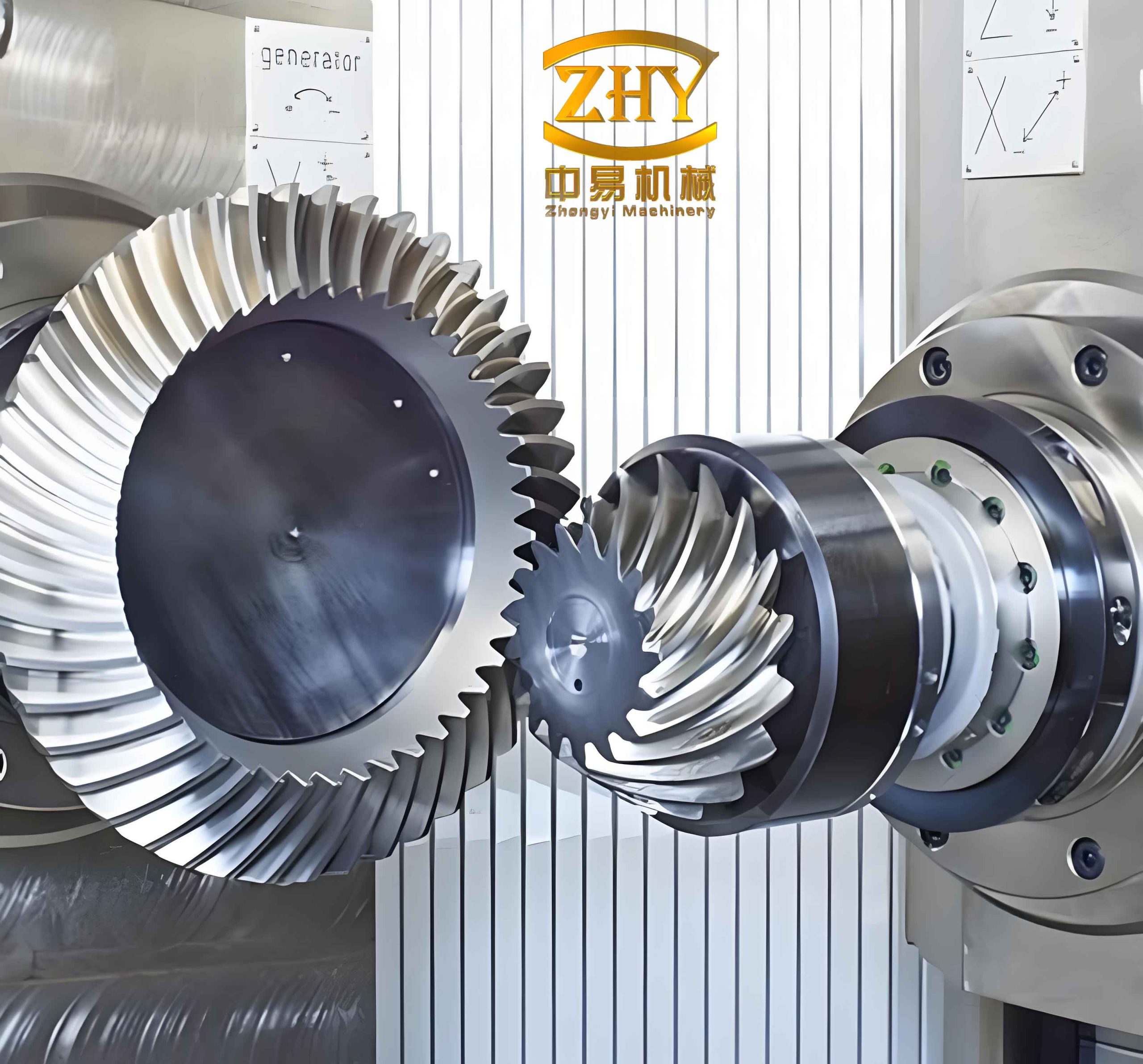
This geometric difference fundamentally dictates the kinematic relationship between the mating surfaces. The contact between the teeth of hyperboloidal gears involves a combination of rolling and sliding motions. The sliding velocity component is substantial and cannot be eliminated. The sliding ratio, a key parameter, can be defined for a point on the tooth surface. For hyperboloidal gears, the sliding velocity $v_s$ at a contact point is the difference between the tangential velocities of the pinion and gear at that point, while the rolling velocity $v_r$ is related to their relative angular velocities and the local geometry. A common measure is the specific sliding, often denoted as $\xi$, which can be expressed for the pinion and gear respectively. For the pinion convex side and gear concave side during forward drive, the specific sliding can be approximated by formulas derived from the gear geometry. For instance, one simplified expression for the sliding velocity magnitude is related to the offset E, the shaft angles, and the angular velocities $\omega_p$ and $\omega_g$ of the pinion and gear.
$$ v_s \approx \sqrt{(\omega_p r_p \sin \beta_p – \omega_g r_g \sin \beta_g)^2 + (E (\omega_p – \omega_g \cos \Sigma))^2} $$
where $r_p$ and $r_g$ are pitch radii, $\beta_p$ and $\beta_g$ are spiral angles, and $\Sigma$ is the shaft angle (typically 90°). The sliding ratio $\zeta$ at a point might be defined as the ratio of sliding velocity to the sum of rolling velocities. The high sliding ratio in hyperboloidal gears is an inherent trait. This sliding leads to frictional work, heat generation, and if uncontrolled, to adhesive wear (scuffing) and abrasive wear. The table below summarizes the comparative geometric features that lead to sliding in hyperboloidal gears versus standard bevel gears.
| Feature | Standard Bevel Gears | Hyperboloidal Gears |
|---|---|---|
| Axis Configuration | Intersecting | Non-intersecting, offset (E) |
| Tooth Length Ratio (Pinion/Gear) | ~1:1 (for same module) | >1:1 (Pinion tooth longer) |
| Primary Motion Component | Predominantly Rolling | Substantial Rolling and Sliding |
| Sliding Velocity | Low | High, especially at tooth ends |
| Typical Sliding Ratio Range | 0.1 – 0.3 | 0.5 – 2.0 or higher |
Interestingly, this inherent sliding in hyperboloidal gears has a paradoxical effect on service life. In classical gear theory for parallel axis gears, the pinion (smaller gear) typically experiences more wear cycles per unit time than the gear (larger gear), but its smaller size often leads to better heat dissipation. For hyperboloidal gears, the longer pinion tooth length and the fact that the sliding motion tends to be faster on the pinion surface can provide a cooling advantage to the pinion. This can partially compensate for its higher cycle count. Consequently, with similar heat treatment, hyperboloidal gear sets can be designed to approach the equal-life principle more effectively than one might initially assume. The wear distribution is influenced by the sliding work, which is the product of friction force and sliding distance. For a point on the pinion, the sliding distance per mesh $L_{s,p}$ is different from that on the gear $L_{s,g}$. Approximate relations can be:
$$ L_{s,p} \approx \frac{v_{s,p} \cdot \Delta t}{N_p} \quad \text{and} \quad L_{s,g} \approx \frac{v_{s,g} \cdot \Delta t}{N_g} $$
where $\Delta t$ is contact time, and $N_p$, $N_g$ are number of teeth. However, the key is that the pinion’s longer tooth spreads the sliding work over a larger area, potentially reducing contact pressure and wear rate.
To combat the detrimental effects of sliding wear in hyperboloidal gears, a multi-faceted process approach is essential. The first line of defense is to reduce the coefficient of friction between the mating tooth surfaces. This begins with material selection. It is strongly advisable to avoid using the same material for both the pinion and the gear in a hyperboloidal set. Identical materials, especially under heavy load and high sliding conditions, are prone to adhesive wear or scuffing due to similar metallurgical properties and mutual solubility. Common low-cost steels like 20CrMnTiH have been widely used, but for modern high-speed and high-torque applications, more advanced alloy steels are preferred. These often belong to the Cr-Mo-Ni system, such as SAE 4320, 8620, or higher grades like 9310. These steels offer better hardenability, core strength, and resistance to contact fatigue. The table below compares typical materials for hyperboloidal gears.
| Material Grade | Alloy System | Typical Case Hardness (HRC) | Core Strength (MPa) | Resistance to Scuffing | Application Level |
|---|---|---|---|---|---|
| 20CrMnTiH | Cr-Mn-Ti | 58-62 | ~1000 | Moderate | Light/Medium Duty |
| SAE 8620 | Cr-Ni-Mo | 58-62 | ~1200 | Good | Medium/Heavy Duty |
| SAE 4320 | Ni-Cr-Mo | 58-62 | ~1300 | Very Good | Heavy Duty |
| SAE 9310 | Ni-Cr-Mo | 60-64 | ~1500 | Excellent | Aerospace/Extreme Duty |
Beyond material choice, surface engineering plays a pivotal role. I highly recommend surface treatments like low-temperature ion sulfuration or sulfur-nitrogen co-diffusion after the gears have been hardened (e.g., carburized and quenched). These processes create a thin, porous, and soft layer of iron sulfides (FeS, FeS₂) on the tooth surface. This layer possesses exceptional tribological properties. The sulfide layer has a hexagonal close-packed (HCP) crystal structure, which inherently provides low shear strength and excellent anti-friction characteristics. The porous nature of the layer acts as a reservoir for lubricant, enhancing boundary lubrication. Most importantly, it prevents direct metal-to-metal contact between the hyperboloidal gear teeth, thereby drastically reducing the risk of adhesive wear and scuffing, which are common failure modes in sliding contacts. The layer also smoothens surface asperities, reducing plowing wear and promoting run-in. Furthermore, it acts as a stress buffer, potentially improving contact fatigue life. The effectiveness of such coatings can be quantified by the reduction in the friction coefficient $\mu$. For untreated steel-on-steel contacts under boundary lubrication, $\mu$ might range from 0.1 to 0.15. With a sulfide layer, $\mu$ can drop to 0.05-0.08. The wear rate $W$, often described by Archard’s equation, is proportional to the normal load $F_N$, sliding distance $L$, and inversely proportional to hardness $H$ and a wear coefficient $K$:
$$ W = K \frac{F_N L}{H} $$
The sulfide layer primarily reduces the wear coefficient $K$ by preventing adhesion and reducing friction.
Another critical aspect in the manufacturing and assembly of hyperboloidal gears is the control and adjustment of the tooth contact pattern, or “gear marking.” Due to the need for backlash and to prevent binding, the contact pattern on the drive side (pinion concave face) and coast side (pinion convex face) does not perfectly align along the entire tooth length. Typically, when the vehicle is moving forward, the mesh starts near the pinion’s toe (large end) and progresses to the heel (small end). The opposite occurs in reverse. This, combined with necessary backlash, results in a staggered contact pattern: the pattern on the pinion concave face tends to be biased toward the toe, while on the convex face it shifts toward the heel. The backlash $j$ is usually controlled within a tight range, e.g., 0.08 mm to 0.15 mm, to ensure smooth operation without excessive noise or risk of seizure. The contact pattern location is optimized primarily for the forward drive direction (pinion concave). The relationship between assembly adjustments (like pinion position, gear position) and pattern movement is governed by the hyperboloidal gear geometry. Small changes in the mounting distance $A_p$ of the pinion or $A_g$ of the gear shift the pattern along the tooth length and flank. The sensitivity can be expressed through derivatives based on the machine settings. For instance, a change $\Delta A_p$ causes a pattern shift $\Delta L_{pattern}$ along the pinion tooth:
$$ \Delta L_{pattern} \approx C_{pA} \cdot \Delta A_p $$
where $C_{pA}$ is a sensitivity coefficient determined by the gear design. During lapping or run-in, a reddish lead-based paste or similar compound is used to visualize the contact. The ideal pattern is centered longitudinally but covers a significant portion of the active profile. The apparent centralization in static tests is due to the highest contact pressure occurring in the middle, where the sliding velocity is also often maximal. The actual dynamic contact zone under load is more extensive. Proper pattern adjustment ensures even load distribution and minimizes localized stress concentrations that could exacerbate sliding wear.
To synthesize the strategies for managing sliding wear in hyperboloidal gears, we must consider the entire process chain: design, material selection, heat treatment, surface engineering, and precise manufacturing/assembly. The unique attributes of hyperboloidal gears, such as the offset and resulting sliding, are not merely drawbacks but can be leveraged through clever engineering. The combination of dissimilar materials, advanced heat treatments (like carburizing for deep case hardness), and modern surface coatings (like low-temperature sulfuration) creates a synergistic effect. Furthermore, precise control of tooth geometry through manufacturing processes like face milling or face hobbing, followed by lapping, ensures optimal contact conditions that minimize unfavorable sliding effects. The performance of these gears can be modeled and predicted using advanced simulation tools that incorporate mixed elastohydrodynamic lubrication (EHL) analysis, which accounts for film thickness $h$, pressure $p$, and friction. The central film thickness in an EHL contact for hyperboloidal gears can be estimated using simplified formulas like the Hamrock-Dowson equation, adapted for the specific curvature and sliding conditions:
$$ \frac{h_c}{R_x} = 2.69 \left( \frac{U \eta_0}{E’ R_x} \right)^{0.67} \left( \alpha E’ \right)^{0.53} \left( \frac{F}{E’ R_x^2} \right)^{-0.067} (1 – 0.61 e^{-0.73k}) $$
where $U$ is rolling speed, $\eta_0$ is dynamic viscosity, $\alpha$ is pressure-viscosity coefficient, $E’$ is reduced elastic modulus, $R_x$ is effective radius of curvature, $F$ is load per unit width, and $k$ is ellipticity parameter. For hyperboloidal gears, the sliding component modifies the effective entrainment velocity, affecting film thickness. When the film thickness is too low, boundary lubrication prevails, and the surface treatments discussed become crucial.
In conclusion, the sliding wear in hyperboloidal gears is an inherent consequence of their advantageous offset geometry. However, through a comprehensive understanding of the tribological system and the implementation of targeted process countermeasures, this challenge can be effectively managed. The key lies in reducing friction through material pairing and surface engineering, optimizing the contact pattern through precise manufacturing, and leveraging the unique wear distribution characteristics of hyperboloidal gears. Continued research into advanced coatings, lubricant additives, and real-time condition monitoring will further enhance the durability and efficiency of these critical components in automotive and industrial drivetrains. The successful application of these principles ensures that hyperboloidal gears continue to provide their signature benefits of compact design, smooth power transmission, and high torque capacity reliably over long service lives.
To further elaborate on the mathematical modeling of wear in hyperboloidal gears, we can consider integrating the sliding wear over the entire contact path. The total wear volume $V_w$ on a tooth flank after $N$ cycles can be approximated by integrating the local wear rate over the contact area and time. For a point on the pinion surface with sliding distance per cycle $s_p(x,y)$, contact pressure $p(x,y)$, and a material/coating specific wear coefficient $K_p(x,y)$, the incremental wear depth per cycle $dh_p$ is:
$$ dh_p = K_p \cdot p \cdot s_p $$
The total wear depth at a point after $N$ cycles is then:
$$ h_{p,total}(x,y) = \int_0^N K_p(x,y) \cdot p(x,y,n) \cdot s_p(x,y,n) \, dn $$
In practice, for hyperboloidal gears, $p(x,y)$ and $s_p(x,y)$ vary significantly along the tooth profile and from the root to the tip. Numerical methods like finite element analysis (FEA) combined with multi-body dynamics simulations are used to compute these fields. The table below provides a hypothetical comparison of wear depth after a standard duty cycle for different surface conditions on hyperboloidal gears.
| Surface Condition | Average Wear Coefficient K (10⁻¹⁵ m²/N) | Calculated Max Wear Depth after 10⁶ cycles (µm) | Relative Wear Life Improvement |
|---|---|---|---|
| Carburized Only (No coating) | 5.0 | 25.0 | 1.0 (Baseline) |
| Carburized + Phosphate Coating | 3.0 | 15.0 | ~1.7 |
| Carburized + Ion Sulfuration | 1.5 | 7.5 | ~3.3 |
| Carburized + DLC Coating | 0.8 | 4.0 | ~6.3 |
Note: DLC (Diamond-Like Carbon) is mentioned as an advanced alternative. The values are illustrative. The key takeaway is that surface treatments can reduce the wear coefficient by an order of magnitude, dramatically extending the life of hyperboloidal gears. The choice of treatment depends on cost, process compatibility, and operational environment.
Finally, it is worth reiterating that the design and manufacturing of hyperboloidal gears are highly specialized fields. The Gleason system provides established methodologies for calculating machine settings (root angle, spiral angle, cutter radius, etc.) that define the tooth geometry. These settings directly influence the ease-off topography, which is the deviation of the real tooth surface from a perfect conjugate surface. The ease-off controls the transmission error and the contact pattern under load. Modern software allows for the optimization of ease-off to minimize peak contact pressure and to manage the sliding velocities across the tooth flank. By carefully tailoring the ease-off, engineers can direct the contact to areas more resistant to sliding wear or where lubrication is more effective. This holistic approach—combining geometric design, material science, surface engineering, and precise manufacturing—ensures that hyperboloidal gears meet the ever-increasing demands for performance, efficiency, and durability in modern mechanical systems.