
In the field of power transmission, particularly in automotive drive axles, hyperboloidal gears play a critical role due to their ability to transmit motion between non-intersecting and non-parallel shafts with high efficiency and compact design. These gears, often referred to as hypoid gears, are essential components in rear-wheel drive vehicles, where they accommodate offset axes and provide smooth torque transfer. However, the manufacturing of hyperboloidal gears, especially after heat treatment, poses significant challenges. Traditional methods such as grinding offer high precision but are costly and slow, while lapping is economical but cannot correct heat-induced distortions. This paper explores an innovative approach: using formate milling with finger-type cutters on vertical machining centers to achieve high-speed finishing of hard-tooth hyperboloidal gears, effectively replacing grinding and reducing production costs.
The motivation for this work stems from the need to democratize advanced gear manufacturing for small and medium-sized enterprises. By leveraging standard vertical machining centers—equipment commonly available in many workshops—we aim to enable the precise machining of hyperboloidal gears without specialized gear-cutting machines. This method not only expands the capabilities of existing CNC infrastructure but also introduces a flexible, cost-effective solution for producing high-quality gears. Throughout this discussion, we will delve into the theoretical foundations, practical implementations, and experimental validations of formate milling for hyperboloidal gears, emphasizing the keyword “hyperboloidal gears” to underscore their centrality in this research.
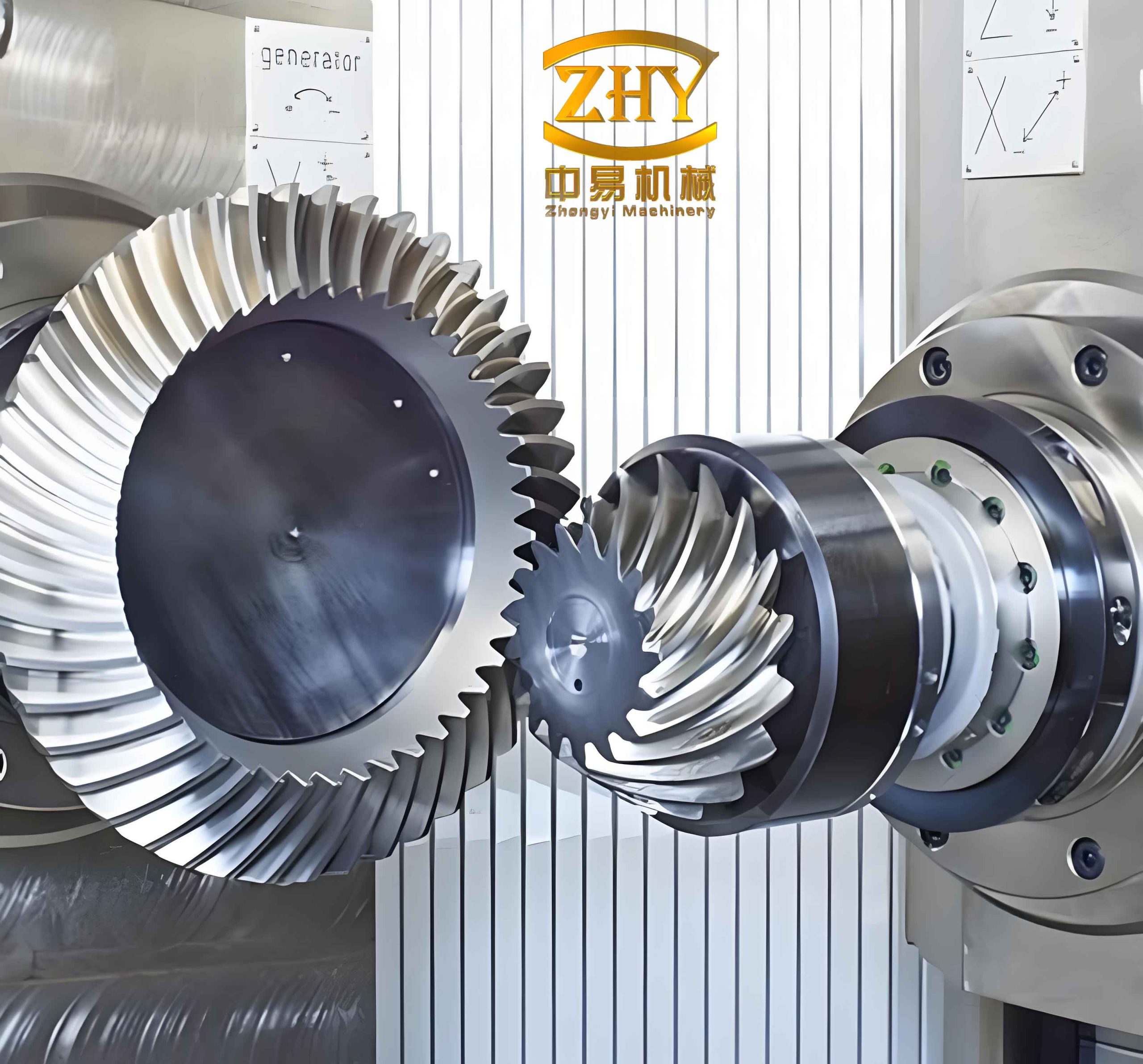
To understand the formate milling process for hyperboloidal gears, it is essential to first grasp their geometric characteristics. Hyperboloidal gears have complex tooth surfaces that are generated based on conjugate action with a mating pinion. The formate method, specifically applied to the gear member (often the larger wheel), involves machining the tooth profile directly using a cutter whose shape corresponds to the desired tooth form. This contrasts with generating methods that simulate the rolling motion between gear and cutter. For hyperboloidal gears, the formate approach simplifies the machining of the gear teeth, as the tooth profile is relatively straightforward compared to the pinion. The key parameters include tool geometry, machine adjustments, and workpiece positioning, all of which must be meticulously calculated to ensure accurate tooth formation.
We begin by deriving the necessary machining parameters for the hyperboloidal gear. Based on Gleason system calculations, the blank dimensions and gear data are obtained. For instance, consider a hyperboloidal gear with 37 teeth, a 30 mm offset, a 90° shaft angle, and a mean spiral angle of 37°. The tooth profile is defined by a pressure angle of 19°, and the gear is right-handed. The formate milling process requires four primary adjustment parameters: tool rotation radius (r), vertical tool distance (H2), horizontal tool distance (V2), and axial workpiece position (X2). These parameters are derived from the gear geometry and cutter geometry, ensuring that the cutter’s path accurately replicates the tooth surface.
The cutter used in this process is a finger-type end mill made of solid carbide, designed to withstand high-speed milling. Its profile angle is set to match the gear’s root cone pressure angle, but in practice, the workpiece is rotated by a small angle Δα to align the cutter angle with the gear’s pressure angle, ensuring similarity between the machined and theoretical tooth forms. This rotation adjusts the spiral angle and pitch cone angle at the tooth node, as shown in the following relationship:
$$ \Delta \alpha = \tan^{-1}\left(\frac{\sin \beta_M}{\cos \beta_M \cdot \cos \delta_{M2}}\right) $$
where βM is the spiral angle after rotation, and δM2 is the pitch cone angle after rotation. This adjustment is crucial for minimizing deviations in tooth geometry, especially for hyperboloidal gears where tooth surfaces are non-developable.
To compute the machining parameters, we employ local synthesis methods that pre-control the contact pattern and transmission errors. By specifying the first derivative of the transmission ratio (m′12), the semi-major axis length (b) of the instantaneous contact ellipse at the reference point M, and the tangent direction (η2) of the contact path, we can determine the pinion machining parameters via tooth contact analysis (TCA). This allows for predictive adjustment of the gear pair’s performance before actual cutting. The calculated parameters for both the gear and pinion are summarized in Table 1, which includes tool dimensions and machine settings.
| Parameter | Gear Convex Side | Pinion Concave Side |
|---|---|---|
| Tool Arc Diameter (mm) | 304.800 | 294.894 |
| Tool Tip Diameter (mm) | 4.43 | 3.25 |
| Tool Profile Angle (°) | 19 | 18 |
| Machine Installation Angle (°) | 71.648 | -2.297 |
| Vertical Tool Distance (mm) | 119.598 | — |
| Horizontal Tool Distance (mm) | 46.349 | — |
| Cutting Ratio | 1.001 | 4.877 |
| Radial Tool Distance (mm) | — | 114.853 |
| Angular Tool Distance (°) | — | 83.818 |
| Vertical Workpiece Position (mm) | 0 | 22.227 |
| Horizontal Workpiece Position (mm) | 1.624 | -3.202 |
| Axial Workpiece Position (mm) | 0 | 0.859 |
These parameters are foundational for setting up the vertical machining center. However, to adapt a standard vertical machining center for gear milling, we designed an auxiliary milling fixture. This fixture addresses the need for adjustable workpiece inclination, precise indexing, and reliable locking, enabling continuous machining of hyperboloidal gears. The fixture incorporates a pneumatic system for automated indexing: when a tooth slot is completed, the machine’s Z-axis retracts, triggering a limit switch that signals the fixture to index to the next tooth position and lock it in place. This automation enhances productivity and consistency, as manual adjustments are eliminated. The fixture’s design allows for an installation angle adjustment of up to 71.65°, with runout errors minimized to below 0.02 mm for face cone跳动 and 0.015 mm for radial and axial runout.
The milling process is divided into semi-finishing and finishing stages. For semi-finishing, we use a series of slot drills (4 mm, 6 mm, 8 mm, and 10 mm) to rough out the tooth spaces, followed by the finger-type cutter to approximate the final form. The total depth of cut is managed to leave a 0.15 mm allowance per side for finishing. Additionally, a ball-nose end mill is employed to pre-cut the tooth root, protecting the finger cutter’s tip during finishing. After semi-finishing, the hyperboloidal gear undergoes carburizing and quenching to achieve a surface hardness of HRC 45–60. Post-heat treatment, the gear’s bore and mounting surfaces are precision-ground to correct distortions, ensuring that the workpiece can be accurately repositioned for finishing.
In the finishing stage, high-speed milling parameters are applied: a spindle speed of 10,000 rpm and a total axial feed of 0.7 mm per pass. The tool path is generated using climb milling (顺铣) to reduce cutting forces and improve surface finish. The CNC program is written manually, utilizing circular interpolation and subroutine calls to optimize tool movement. The coordinate system is established with the fixture’s spindle center as the datum, aligning with the theoretical origin Oh in the gear geometry. The tool path simulation, as illustrated in Figure 3 of the reference material, shows a series of helical movements that trace the tooth flank, ensuring full coverage without gouging.
To validate the method, we conducted milling trials on a Cincinnati Arrow 750 vertical machining center. The workpiece material was alloy steel, typically used for automotive hyperboloidal gears. The finger-type cutter, made of solid carbide with a 19° profile angle, was selected for its wear resistance and ability to maintain sharp edges at high speeds. After finishing, the gear was paired with a pinion machined on a Gleason GH-35 spiral bevel gear generator using blade tilt methods. The assembled gear set was tested on a rolling tester to evaluate contact pattern and noise. Results indicated a well-centered contact patch with minimal noise, confirming the effectiveness of formate milling for hyperboloidal gears.
The success of this approach hinges on several factors. First, the accuracy of parameter calculation is paramount; even slight errors in tool positioning can lead to mismatched tooth surfaces. We employed iterative TCA simulations to refine parameters, using the following equation to estimate contact ellipse dimensions:
$$ b = \sqrt{\frac{2 \cdot \Delta \phi}{\kappa_1 + \kappa_2}} $$
where Δφ is the transmission error, and κ1 and κ2 are the principal curvatures of the gear and pinion surfaces at the contact point. This ensures that the contact pattern is optimized for load distribution. Second, the fixture’s rigidity and indexing precision directly impact tooth spacing errors. Our design achieved an indexing accuracy of ±0.01°, which is sufficient for hyperboloidal gears with moderate tolerances. Third, tool wear management is critical in hard milling; we monitored flank wear using optical microscopy and adjusted feeds accordingly.
To further analyze the process, we can model the cutting forces during formate milling of hyperboloidal gears. The force components—radial, tangential, and axial—can be expressed as functions of chip load, tool geometry, and material properties. For a finger-type cutter engaged in intermittent cutting, the instantaneous force F(t) can be approximated by:
$$ F(t) = K_c \cdot A_c(t) + K_e \cdot A_e $$
where Kc is the specific cutting force coefficient, Ac(t) is the time-varying chip area, Ke is the edge force coefficient, and Ae is the edge contact area. In high-speed milling of hardened steel, these coefficients are influenced by cutting speed and tool coating. We conducted force measurements using a dynamometer, and the data helped optimize feed rates to minimize vibrations and tool deflection, which are crucial for maintaining tooth profile accuracy.
The economic implications of this method are significant. By avoiding dedicated gear grinders, manufacturers can reduce capital investment and operational costs. A cost comparison between traditional grinding and formate milling for hyperboloidal gears is shown in Table 2, highlighting savings in tooling, machine time, and energy consumption.
| Aspect | Grinding | Formate Milling |
|---|---|---|
| Machine Cost (per hour) | $150 | $50 |
| Tool Cost (per gear) | $100 | $30 |
| Processing Time (minutes) | 120 | 60 |
| Energy Consumption (kWh) | 20 | 10 |
| Surface Finish (Ra, μm) | 0.4 | 0.6 |
| Accuracy (IT grade) | IT5 | IT6 |
While formate milling slightly compromises surface finish and accuracy compared to grinding, it meets the requirements for many automotive applications where hyperboloidal gears operate under lubricated conditions. Moreover, the ability to correct heat treatment distortions through post-milling adjustments makes it superior to lapping. We also explored the scalability of this method for different sizes of hyperboloidal gears, from small differential gears to large industrial drives, by adjusting the fixture and cutter dimensions.
In terms of geometric accuracy, we measured the machined hyperboloidal gears using a coordinate measuring machine (CMM). Key parameters such as tooth profile deviation, pitch error, and runout were evaluated. The results, summarized in Table 3, show that formate milling achieves tolerances within ISO 1328 standards for cylindrical gears, adapted for hyperboloidal geometry. The profile deviation is calculated as the maximum normal distance between the measured and theoretical tooth surface, often expressed as:
$$ \Delta P = \max \left| \vec{r}_{\text{meas}} – \vec{r}_{\text{theo}} \right| $$
where \(\vec{r}\) denotes position vectors on the tooth flank.
| Parameter | Measured Value | Tolerance Limit |
|---|---|---|
| Tooth Profile Error (mm) | 0.012 | 0.020 |
| Pitch Error (arcmin) | 3.5 | 5.0 |
| Runout (mm) | 0.018 | 0.025 |
| Spiral Angle Error (°) | 0.1 | 0.2 |
| Pressure Angle Error (°) | 0.15 | 0.25 |
These measurements confirm that formate milling on vertical machining centers can produce hyperboloidal gears with sufficient precision for functional applications. The contact pattern tests further validated the gear pair’s performance, showing a centralized ellipse with slight bias toward the toe, which is desirable for run-in under load. Noise levels during rolling tests were below 75 dB, comparable to ground gears.
Looking ahead, there are opportunities to enhance this method. For instance, integrating adaptive control systems that real-time adjust machining parameters based on force feedback could improve consistency. Additionally, using multi-axis machining centers could allow for simultaneous milling of both gear and pinion, streamlining production. The principles discussed here for hyperboloidal gears can also be extended to other gear types, such as spiral bevel gears or face gears, broadening the impact of this research.
In conclusion, formate milling of hard-tooth hyperboloidal gears on vertical machining centers presents a viable alternative to traditional grinding and lapping. By combining precise parameter calculation, customized fixtures, and high-speed milling strategies, we have demonstrated that standard CNC machines can achieve the accuracy and surface quality required for automotive drive axles. This approach lowers barriers to entry for gear manufacturing, enabling small and medium enterprises to produce high-performance hyperboloidal gears cost-effectively. Future work will focus on optimizing tool life, expanding to larger gear sizes, and integrating digital twin simulations for process validation. The keyword “hyperboloidal gears” remains central, as this method specifically targets their unique geometry and manufacturing challenges, paving the way for more accessible and advanced gear production technologies.