
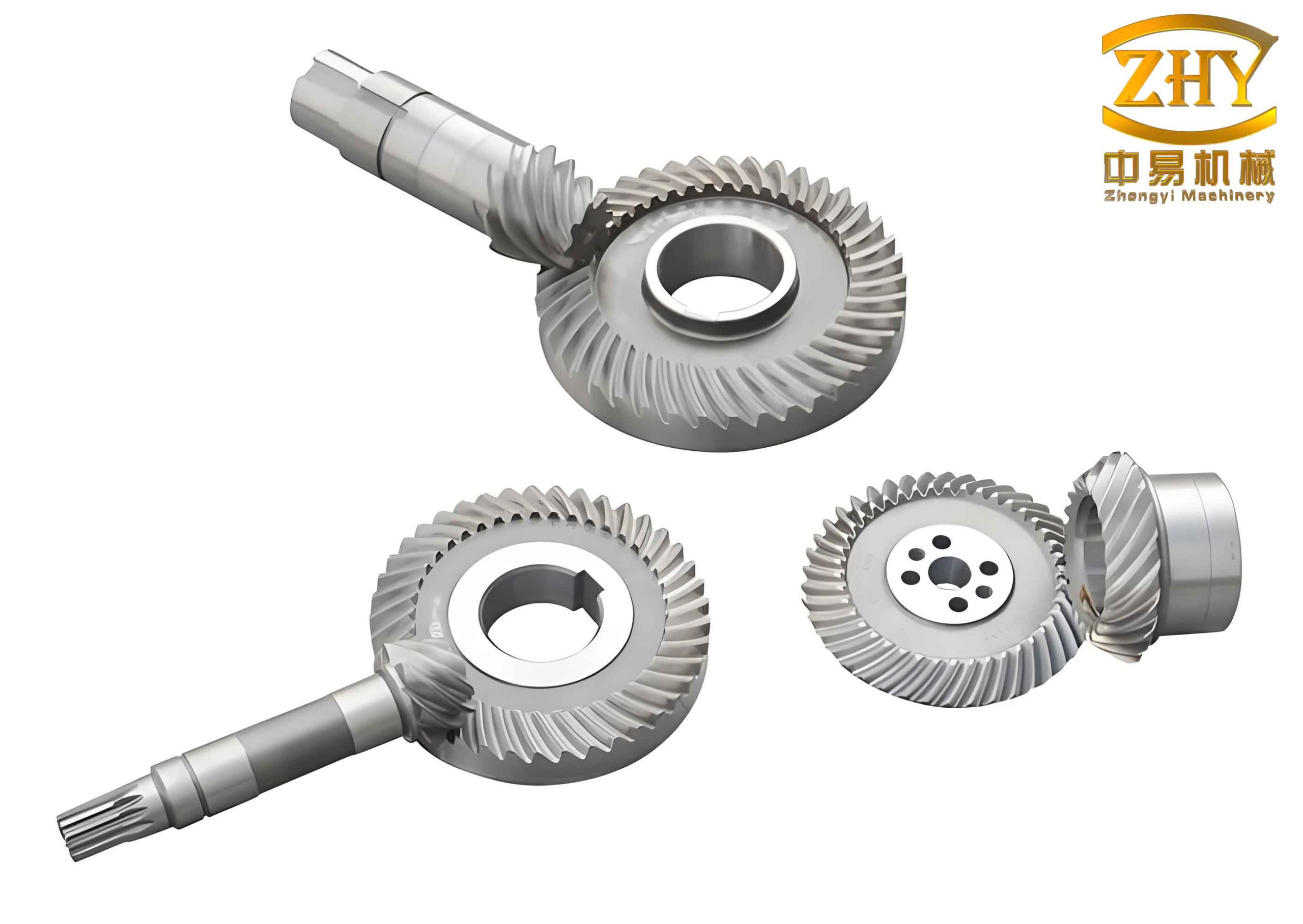
The pursuit of superior performance in automotive drivetrains necessitates continuous refinement of their core components. Among these, hyperboloidal gears, specifically hypoid gears, play a pivotal role in final drive axles, directly influencing vehicle dynamics, noise, vibration, and harshness (NVH) characteristics, and overall efficiency. Traditional gear design often involves trade-offs between competing performance metrics such as transmission error (directly linked to NVH), root stress (related to durability and lifespan), and meshing power loss (affecting fuel economy). This work presents a comprehensive methodology for the concurrent multi-objective optimization of hyperboloidal gears by integrating Ease-off based topological modification, surrogate modeling, and evolutionary algorithms.
The cornerstone of our approach is the Ease-off topography, a powerful and efficient method for defining controlled mismatch between conjugate gear tooth surfaces. For a pinion, the deviation \(\Delta \delta\) between the modified tooth surface \(X_2\) and the theoretical (unmodified) surface \(X_1\) at a given point is defined as the projection onto the unit normal vector \(\mathbf{n}_1\):
$$
\Delta \delta = [ X_2 – X_1 ] \cdot \mathbf{n}_1 (u_1, \theta_1)
$$
This surface deviation can be efficiently parameterized using a second-order Taylor expansion across the tooth face, defined in a local coordinate system where \(x\) is the profile direction (root-to-tip) and \(y\) is the lengthwise direction (toe-to-heel):
$$
\Delta \delta(x, y) = a_0 + a_1 x + a_2 y + a_3 x^2 + a_4 y^2 + a_5 xy
$$
Here, the coefficients \(a_0\) through \(a_5\) serve as the primary design variables for tooth surface modification. Each coefficient governs a specific geometric aspect of the modification: \(a_0\) (spiral angle error), \(a_1\) (pressure angle error), \(a_2\) (lengthwise crown), \(a_3\) (profile curvature), and \(a_4\) (surface twist). By strategically adjusting these six parameters, a vast design space of tooth surface topographies, or “Ease-off maps,” can be generated to tailor the meshing behavior of the hyperboloidal gears.
To realize these virtual Ease-off designs into manufacturable gear models, a critical step is the inverse calculation of corresponding machine tool settings. This is achieved through a sensitivity analysis. The relationship between the change in tooth surface deviation at \(m\) grid points \(\{\Delta \varepsilon_j\}\) and the change in \(n\) machine setting parameters \(\{\Delta \phi_i\}\) can be expressed via a sensitivity matrix \(Y_{ij}\):
$$
\{\Delta \varepsilon_j\} = [Y_{ij}] \{\Delta \phi_i\}
$$
Where the sensitivity coefficient \( \eta_{ij} = \frac{\partial \varepsilon_j}{\partial \phi_i} \). Typically, \(m > n\), making the system over-determined. The optimal set of machine setting adjustments to achieve a desired Ease-off surface \(\{\Delta \varepsilon_j\}\) is found using the least-squares method:
$$
\{\Delta \phi_i\} = \left( Y_{ij}^T Y_{ij} \right)^{-1} Y_{ij}^T \{\Delta \varepsilon_j\}
$$
This formulation allows for the precise translation of our optimization parameters (\(a_0…a_5\)) into practical grinding or cutting machine instructions, enabling the physical production of the optimized hyperboloidal gears.
| Parameter | Pinion | Gear (Wheel) |
|---|---|---|
| Number of Teeth | 10 | 41 |
| Hand of Spiral | Left | Right |
| Shaft Angle | 90° | 90° |
| Mean Spiral Angle | 35° | 35° |
| Mean Normal Pressure Angle | 22.5° | 22.5° |
| Face Width (mm) | 79.02 | 72.00 |
| Whole Depth (mm) | 20.45 | 20.69 |
A detailed drivetrain model is essential for accurate performance evaluation. A full hypoid drive axle model was constructed for this purpose. The gear pair was modeled within specialized gear design software capable of applying Ease-off modifications. The shaft system, including pinion, gear, differential, and axle shafts, was assembled with appropriate bearings. The axle housing was modeled as a flexible component using finite element methods and integrated into the system. This multi-body dynamics model allows for the simulation of loaded tooth contact analysis (LTCA), which is crucial for calculating the three target performance metrics for our hyperboloidal gears.
The first optimization objective is the minimization of Transmission Error (TE). TE is the deviation between the actual angular position of the output gear and its ideal position assuming perfectly conjugate, rigid teeth. It is the primary excitation source for gear whine noise. For a given load, the peak-to-peak value of TE over one mesh cycle is calculated via LTCA. To account for performance across the operating range, the average peak-to-peak TE across multiple load cases (e.g., from 1000 Nm to 5000 Nm input torque) is used.
The second objective is the reduction of Tooth Root Stress. Excessive bending stress at the tooth fillet is a major cause of gear fatigue failure. The maximum Von Mises stress on the loaded (drive) side of the pinion tooth root is extracted from the LTCA results. Again, an average value across the defined load spectrum is computed to ensure robustness.
The third objective is the minimization of Meshing Power Loss \(P_{Mi}\). The power dissipated at the gear mesh interface contributes to reduced drivetrain efficiency and increased thermal loading. For hyperboloidal gears, the meshing loss power can be estimated using empirical and analytical formulas. A common formulation is:
$$
P_{Mi} = \frac{f_m T_1 n_1}{9549 M \cos^2(\beta_m)}
$$
Where \(f_m\) is the mesh friction coefficient, \(T_1\) is the pinion torque (Nm), \(n_1\) is the pinion speed (rpm), \(\beta_m\) is the mean spiral angle, and \(M\) is the mesh mechanical advantage. The friction coefficient itself is often a function of lubricant viscosity, sliding velocity, and load. The mesh mechanical advantage \(M\) is derived from the gear geometry:
$$
M = \frac{2 \cos(\alpha_{tm}) (H_s + H_t)}{H_s^2 + H_t^2}
$$
with \(H_s\) and \(H_t\) defined as:
$$
H_s = (u_v + 1) \left[ \sqrt{ \left( \frac{r_{vem2}}{r_{vm2}} \right)^2 – \cos^2(\alpha_{tm}) } – \sin(\alpha_{tm}) \right]
$$
$$
H_t = \left( \frac{u_v + 1}{u_v} \right) \left[ \sqrt{ \left( \frac{r_{vem1}}{r_{vm1}} \right)^2 – \cos^2(\alpha_{tm}) } – \sin(\alpha_{tm}) \right]
$$
Here, \(u_v\) is the virtual gear ratio, \(r_{vm}\) are the virtual pitch radii, \(r_{vem}\) are the virtual outside radii, and \(\alpha_{tm}\) is the transverse pressure angle. Modifying the Ease-off topography changes the contact pattern and pressure distribution, thereby influencing the effective friction and the load distribution factor implicit in these calculations.
| Parameter | Pinion Value | Gear Value |
|---|---|---|
| Profile Mesh Density | 4 | 4 |
| Face Mesh Count | 8 | 8 |
| Fillet Mesh Count | 8 | 8 |
| Radial Mesh Count | 4 | 4 |
Directly coupling a high-fidelity simulation like LTCA with an optimization algorithm is computationally prohibitive due to the time required for a single analysis. To overcome this, a surrogate model, or metamodel, is constructed. A feedforward Artificial Neural Network (ANN) is an excellent choice for this task due to its ability to model complex, non-linear relationships. The inputs to the ANN are the six Ease-off modification coefficients (\(a_0\) to \(a_5\)). The outputs are the three performance metrics: average TE, average root stress, and meshing power loss at a reference condition.
To train the ANN, a Design of Experiments (DoE) is performed. A sensitivity study is first conducted to understand the influence of each Ease-off coefficient on the outputs. Based on this, levels for each coefficient are chosen to efficiently sample the design space. For example, coefficients with higher sensitivity are sampled with more levels. Combining these levels using a full-factorial or space-filling design generates several hundred distinct Ease-off designs. For each design, the corresponding machine settings are calculated, the modified hyperboloidal gears are modeled, and LTCA simulations are run to obtain the target performance values. This dataset forms the training and validation set for the ANN.
| Input Coefficients (×10⁻⁵) | Simulation Output (MASTA) | Surrogate Model Prediction | Relative Error (%) | ||||||
|---|---|---|---|---|---|---|---|---|---|
| a₀, a₁, a₂, a₃, a₄ | TE (μrad) | Stress (MPa) | Power Loss (W) | TE (μrad) | Stress (MPa) | Power Loss (W) | TE | Stress | Power Loss |
| 10, 10, 5, 5, 5 | 202.49 | 268.01 | 199.56 | 199.76 | 261.97 | 204.97 | -1.35 | -2.25 | 2.71 |
| 5, 5, 15, 15, 15 | 245.92 | 319.35 | 210.82 | 261.18 | 330.65 | 216.81 | 6.21 | 3.54 | 2.84 |
With an accurate and computationally inexpensive surrogate model in place, a multi-objective optimization algorithm can be effectively deployed. The Non-dominated Sorting Genetic Algorithm II (NSGA-II) is particularly well-suited for this task. NSGA-II is a population-based evolutionary algorithm that efficiently finds a set of optimal solutions, known as the Pareto front, where no objective can be improved without worsening another.
The optimization problem is formally defined as:
$$
\begin{aligned}
&\text{Minimize:} \quad F(\mathbf{a}) = [f_1(\mathbf{a}), f_2(\mathbf{a}), f_3(\mathbf{a})] \\
&\text{where:} \quad f_1(\mathbf{a}) = \overline{TE}_{pk-pk}, \quad f_2(\mathbf{a}) = \overline{\sigma}_{root}, \quad f_3(\mathbf{a}) = P_{Mi} \\
&\text{Subject to:} \quad a_i^{lower} \leq a_i \leq a_i^{upper}, \quad i = 0,1,…,5
\end{aligned}
$$
Here, \(\mathbf{a} = [a_0, a_1, a_2, a_3, a_4, a_5]\) is the vector of Ease-off coefficients. The algorithm operates by evolving a population of candidate coefficient sets over many generations. In each generation, individuals are selected based on their Pareto rank (non-domination level) and a crowding distance metric (to promote diversity). Crossover and mutation operators generate new offspring. The surrogate model \(F(\mathbf{a})\) is evaluated thousands of times to guide this evolution towards the Pareto-optimal front.
After running NSGA-II, a set of non-dominated optimal solutions is obtained. An engineer can then select a final design from this Pareto set based on specific project priorities. For instance, if NVH is critical, a solution with minimal TE might be chosen even if it offers slightly higher power loss. To validate the optimization result, the Ease-off coefficients from a selected Pareto-optimal solution are taken, the corresponding machine settings are recalculated, and a final, high-fidelity LTCA simulation is performed on the newly defined hyperboloidal gears model. The agreement between the surrogate model prediction and this final simulation confirms the fidelity of the entire process.
| Performance Metric | Baseline Design | Optimized Design (Selected from Pareto Front) | Improvement |
|---|---|---|---|
| Average Peak-to-Peak TE (μrad) | 178.70 | 107.94 | 39.6% Reduction |
| Average Max Root Stress (MPa) | 387.44 | 300.67 | 22.4% Reduction |
| Meshing Power Loss @ Ref. Condition (W) | 228.77 | 183.10 | 20.0% Reduction |
The results demonstrate the significant potential of this integrated methodology. Compared to the baseline, unmodified gear set, the optimized hyperboloidal gears achieved a substantial reduction in all three targeted performance metrics simultaneously. This is a clear advancement over single-objective optimization, which often leads to compromised performance in other areas. The reduction in transmission error points directly to lower gear noise potential. The decreased root stress implies improved durability and a longer service life for the hyperboloidal gears. The lower meshing power loss translates to higher drivetrain efficiency, contributing to better fuel economy or extended range for electric vehicles.
In conclusion, this work establishes a robust framework for the multi-objective design of high-performance hyperboloidal gears. By leveraging the parametric control of Ease-off topography, the efficiency of neural network surrogate modeling, and the exploratory power of the NSGA-II algorithm, it is possible to navigate the complex design space of hyperboloidal gears and find solutions that offer a superior balance of noise, durability, and efficiency. This methodology is not limited to hypoid gears but can be adapted to other complex gear types like spiral bevel or face gears, providing a valuable tool for advanced drivetrain engineering.