
The study and manufacture of hyperboloidal gears represent a pinnacle in gear technology, driven by their superior performance in demanding applications such as automotive drivetrains. Characterized by an offset between the axes of the pinion and gear, these components offer significant advantages over their spiral bevel counterparts, including higher torque capacity, greater design flexibility for lower vehicle profiles, improved running smoothness, and reduced noise. This offset introduces a complex relative sliding motion along both the tooth length and profile, which, while enhancing lubrication and run-in characteristics, also dramatically increases the geometric and manufacturing complexity of the tooth surfaces.
Traditional machining of hyperboloidal gears relies on specialized, mechanically linked “cradle-type” gear generators. These machines use a combination of rotary and linear motions, governed by complex gear trains, to simulate the relative motion between a cutting tool (cutter head) and a phantom gear (crown gear or generating gear). While effective, this paradigm is inherently rigid; modifications to the tooth contact pattern or corrections for distortion often require physical changes to machine settings or even the design of supplemental correction tools, making the process iterative, time-consuming, and costly.
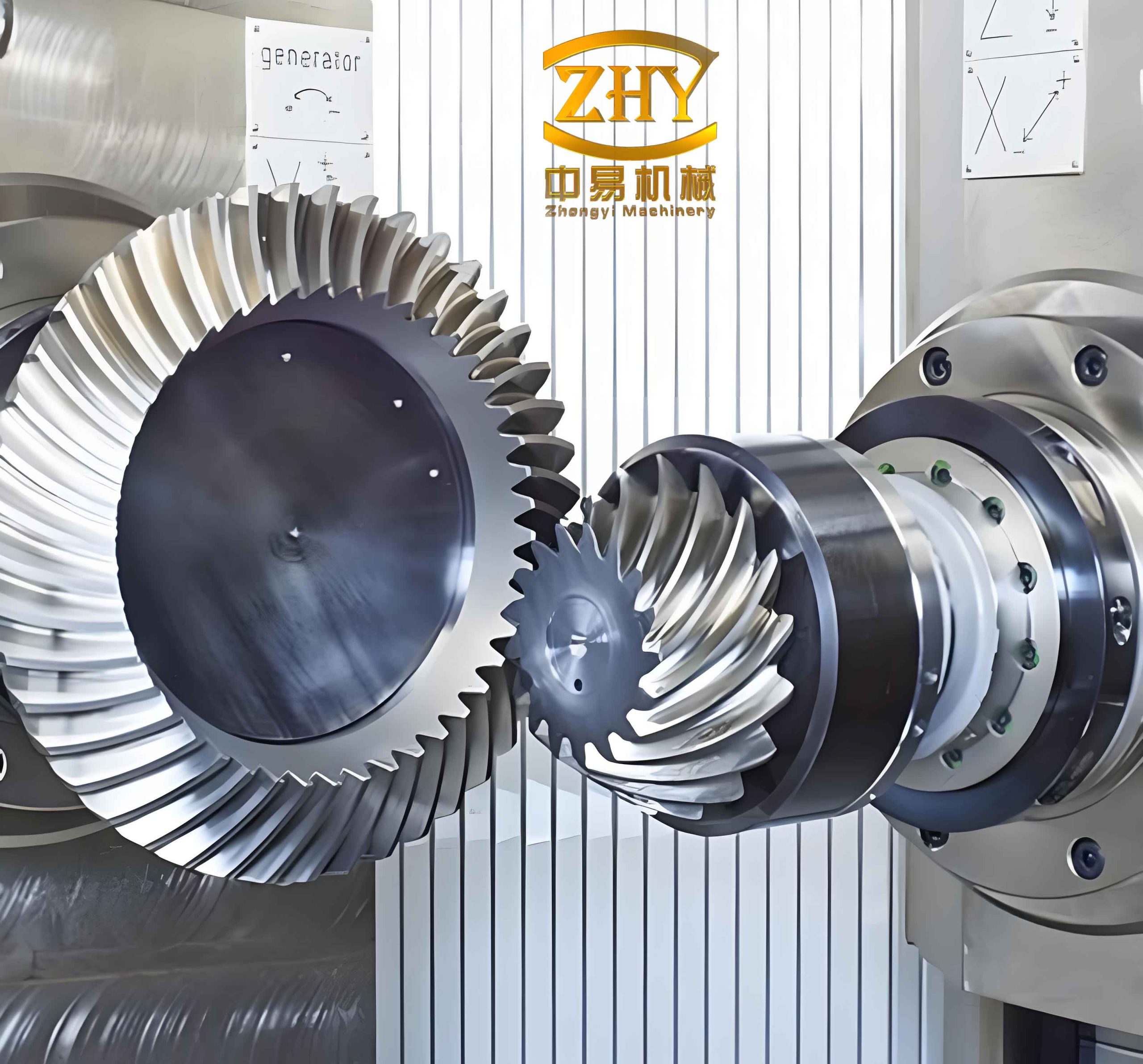
The advent of multi-axis Computer Numerical Control (CNC) machine tools presents a transformative opportunity. By replacing the mechanical generating train with software-controlled, simultaneous multi-axis interpolation, we achieve unprecedented flexibility. This digital paradigm allows for the direct machining of complex theoretical tooth geometries, the implementation of sophisticated ease-off topographies for optimal contact under load, and the rapid compensation for manufacturing errors or heat treatment distortions—all through changes in the machine tool’s program rather than its hardware.
This article details the development of a comprehensive mathematical model to enable the machining of hyperboloidal gears using the Spiroflex (full generating with cutter tilt) method on a modern 6-axis CNC gear hobber. The core challenge lies in mathematically translating the kinematic chain of a universal cradle-type machine into the Cartesian and rotary axes of a contemporary CNC platform. The process involves: 1) defining the cutting tool geometry, 2) modeling the tooth surface generation on the theoretical cradle machine, 3) transforming these cradle settings into equivalent 6-axis CNC coordinates, and 4) validating the model through virtual machining simulation.
Mathematical Foundation of the Face-Hobbing Process on a Cradle-Type Machine
The first step is to establish a precise mathematical model of the tooth flank generation as it occurs on a conventional cradle-type generator. This model serves as the “gold standard,” defining the intended geometry of the hyperboloidal gears.
1. Geometry of the Face-Milling Cutter Head
The cutting tool is a face-milling head equipped with multiple groups of cutter blades (inside, outside, and potentially a middle blade for roughing). For finishing, we consider the inside blade (cutting the convex side of the gear) and the outside blade (cutting the concave side). The cutting edge consists of a straight (primary) part and a tip rounding (fillet).
We define a local coordinate system $S_l$ attached to the cutting edge. The position vector of a point on the straight part of the edge is given by:
$$ \mathbf{r}_l^{(s)}(u) = \begin{bmatrix} \pm u \sin \alpha_F & 0 & u \cos \alpha_F & 1 \end{bmatrix}^T $$
where $u$ is the profile parameter, $\alpha_F$ is the tool pressure angle (blade angle), and the $\pm$ sign corresponds to the outside (+) and inside (-) blades.
The position vector for a point on the tip fillet is:
$$ \mathbf{r}_l^{(f)}(u) = \begin{bmatrix} \pm (x_{cf} – \rho_o \cos u) & 0 & z_{cf} + \rho_o \sin u & 1 \end{bmatrix}^T $$
where $\rho_o$ is the fillet radius, $h_r$ is the reference point height, and $(x_{cf}, z_{cf})$ is the fillet center:
$$ x_{cf} = h_r \tan \alpha_F + \rho_o \tan(0.4\pi – 0.5\alpha_F) $$
$$ z_{cf} = h_r – \rho_o $$
This edge profile must be positioned on the rotating cutter head. We define a cutter coordinate system $S_t$. The transformation from the edge system $S_l$ to the cutter system $S_t$ involves an initial setting angle $\beta_0$, the cutter point radius $r_0$, and the blade direction angle $\delta_0$:
$$ \mathbf{r}_t(u) = \mathbf{M}_{tl}(\delta_0, r_0, \beta_0) \mathbf{r}_l(u) $$
where $\mathbf{M}_{tl}$ is the homogeneous transformation matrix. This matrix positions and orients the cutting edge correctly on the virtual cutter body.
2. Kinematics of Generation: From Cutter to Phantom Gear to Workpiece
On a cradle-type machine, the cutter head and workpiece move relative to each other through a series of rotations and translations that simulate the meshing of the workpiece with a large imaginary crown gear, called the phantom or generating gear.
Step 1: Cutter to Phantom Gear. The cutter head is mounted on a rotating spindle (angle $\beta$) which is itself tilted (swivel angle $\varphi_i$ and orientation angle $\varphi_j$) relative to the cradle axis. The cradle, representing the phantom gear, rotates with an angle $\phi_c$. The coordinate transformation from the cutter system $S_t$ to the phantom gear system $S_d$ is:
$$ \mathbf{r}_d(u, \beta, \phi_c) = \mathbf{M}_{dc}(\theta_c, \phi_c) \mathbf{M}_{cb}(\varphi_j) \mathbf{M}_{ba}(\varphi_i) \mathbf{M}_{at}(\beta) \mathbf{r}_t(u) = \mathbf{M}_{dt} \mathbf{r}_t(u) $$
Here, $\theta_c$ is the initial cradle angle, $S_R$ is the cutter radial distance (machine center to back), and the matrices represent: cradle rotation ($\mathbf{M}_{dc}$), tool swivel orientation ($\mathbf{M}_{cb}$), tool tilt ($\mathbf{M}_{ba}$), and cutter rotation ($\mathbf{M}_{at}$). The surface swept by the cutting edge in $S_d$ defines the tooth flank of the phantom gear.
Step 2: Phantom Gear to Workpiece. The workpiece (gear or pinion) is mounted on its own axis with specific setup parameters. The generating motion is established by a fixed ratio between the cradle rotation $\phi_c$ and the workpiece rotation $\phi_1$. The transformation from the phantom gear system $S_d$ to the workpiece system $S_1$ is:
$$ \mathbf{r}_1(u, \beta, \phi_c) = \mathbf{M}_{1g}(\phi_1) \mathbf{M}_{gf}(\gamma_m) \mathbf{M}_{fe}(E_m, \Delta B) \mathbf{M}_{ed}(\Delta A) \mathbf{M}_{dc}^{-1}(\phi_c) \mathbf{r}_d(u, \beta, \phi_c) = \mathbf{M}_{1d} \mathbf{r}_d $$
The key machine settings in this transformation are:
- $E_m$: Vertical Offset (Sliding Base)
- $\Delta A$: Horizontal Offset (Machine Center to Back)
- $\Delta B$: Blank Offset (or Bed)
- $\gamma_m$: Machine Root Angle
- $\phi_1$: Workpiece Rotation, linked to cradle rotation by the generating ratio: $\phi_1 = R_c \beta + R_a \phi_c$, where $R_c = z_0/z$ (number of cutter groups / workpiece teeth) and $R_a = z_p/z$ (phantom gear teeth / workpiece teeth).
Step 3: The Generated Tooth Surface. The generated tooth surface on the workpiece is the envelope of all successive positions of the cutter edge relative to the workpiece. It is found by solving the equation of meshing, which states that the common normal vector at the contact point between the generating surface (phantom gear tooth) and the generated surface is perpendicular to their relative velocity:
$$ f(u, \beta, \phi_c) = \mathbf{n}_1(u, \beta, \phi_c) \cdot \mathbf{v}_1^{(12)}(u, \beta, \phi_c) = 0 $$
where $\mathbf{n}_1$ is the unit normal to the surface in $S_1$ and $\mathbf{v}_1^{(12)}$ is the relative velocity. Given two constraint equations from the blank geometry (e.g., a point on a grid defined by profile and length coordinates), the system of equations can be solved for the parameters $(u, \beta, \phi_c)$ for each grid point, yielding the exact coordinates $\mathbf{r}_1^{(i,j)}$ and normal vector $\mathbf{n}_1^{(i,j)}$ of the theoretical tooth flank of the hyperboloidal gear.
$$ \begin{cases}
x_1(u, \beta, \phi_c) = X_1^{(i,j)} \\
\sqrt{y_1^2(u, \beta, \phi_c) + z_1^2(u, \beta, \phi_c)} = Y_1^{(i,j)} \\
f(u, \beta, \phi_c) = 0
\end{cases} $$
Kinematic Transformation to a 6-Axis CNC Gear Hobber
The mathematical model derived above is based on a cradle-type kinematic chain. To machine the same theoretical tooth flank on a modern 6-axis CNC machine, we must find an equivalent set of motions. A typical vertical 6-axis CNC gear hobber features the following programmable axes:
- $c_x$: Vertical linear axis of the tool column.
- $c_y, c_z$: Horizontal linear axes of the tool column.
- $\Psi_a$: Rotary axis of the cutter spindle.
- $\Psi_b$: Rotary axis of the workpiece spindle.
- $\Psi_c$: Tilting axis of the workpiece head (often defining the root angle).
The coordinate transformation from the cutter system $S_t$ to the workpiece system $S_1$ on this 6-axis machine is described by a different chain:
$$ \mathbf{M}_{1t}^{CNC} = \mathbf{M}_{1,1′}(\Psi_b) \mathbf{M}_{1′,d}(\Delta\Psi_b) \mathbf{M}_{d,c}(M_d, H_f, k_x, k_z) \mathbf{M}_{c,b}(\Psi_c) \mathbf{M}_{b,a}(c_y, c_z, c_x) \mathbf{M}_{a,t’}(\Delta\Psi_a) \mathbf{M}_{t’,t}(\Psi_a) $$
Here, $M_d$ is the mounting distance, $H_f$ is fixture height, $(k_x, k_z)$ are machine constants, and $\Delta\Psi_a$, $\Delta\Psi_b$ are angular offsets for the tool and workpiece spindles, respectively.
The fundamental requirement for generating the correct hyperboloidal gear tooth flank is that the relative position and orientation between the tool and the workpiece must be identical at every instant in both the virtual cradle machine and the real CNC machine. This is enforced by equating the two transformation matrices:
$$ \mathbf{M}_{1t}^{Cradle}(u, \beta, \phi_c, \text{machine settings}) \equiv \mathbf{M}_{1t}^{CNC}(\Psi_a, \Delta\Psi_a, c_x, c_y, c_z, \Psi_b, \Delta\Psi_b, \Psi_c) $$
By solving this matrix equivalence, we can derive expressions for the 6-axis CNC coordinates as functions of the cradle machine parameters and the motion parameter $\phi_c$ (or $\beta$).
For example, the workpiece tilt angle $\Psi_c$ and the angular offsets can be extracted from elements of the cradle-based matrix $\mathbf{M}_{1t}^{Cradle} = [a_{ij}]$:
$$ \Psi_c = \pm \arccos(a_{13}) $$
$$ \Delta\Psi_a = \arctan\left( \frac{\pm a_{12}}{\pm a_{11}} \right) $$
$$ \Delta\Psi_b = \arctan\left( \frac{\pm a_{23}}{\pm a_{33}} \right) $$
The linear axis positions are then solved from the equality of the translation components:
$$ \begin{aligned}
c_x &= -a_{14}\cos\Psi_c – a_{24}\sin\Delta\Psi_b \sin\Psi_c – a_{34}\cos\Delta\Psi_b \sin\Psi_c – H_f + … \\
c_y &= \sin\Psi_c(-a_{14} + a_{24}\sin\Delta\Psi_b \cot\Psi_c + a_{34}\cos\Delta\Psi_b \cot\Psi_c + H_f + …) \\
c_z &= a_{24}\cos\Delta\Psi_b – a_{34}\sin\Delta\Psi_b
\end{aligned} $$
Finally, the main workpiece rotation angle $\Psi_b$ combines the generating roll $\phi_1$ with the calculated angular offsets and compensates for the tool rotation:
$$ \Psi_b = \phi_1 + \Delta\Psi_b – R_c \Delta\Psi_a $$
By evaluating these equations for every increment of the generating motion (e.g., for small steps of $\phi_c$), we obtain the synchronized 6-axis toolpath required to produce the theoretically exact hyperboloidal gear tooth surface.
Application Example and Virtual Verification
To validate the developed mathematical model and transformation algorithm, a practical example of a pinion-gear pair is analyzed. The basic design parameters are summarized below.
| Parameter | Pinion | Gear |
|---|---|---|
| Number of Teeth, $z$ | 10 | 41 |
| Module (Normal), $m_n$ | 3.33 mm | |
| Shaft Angle, $\Sigma$ | 90° | |
| Offset, $E$ | 20 mm | |
| Spiral Angle at Ref., $\beta_m$ | 50.01° | 37.13° |
| Face Width, $b$ | 32 mm | 30 mm |
The corresponding cradle-type machine settings calculated for the Spiroflex process are shown in the following table. Note the different settings for the convex and concave sides of each member.
| Setting | Pinion Convex | Pinion Concave | Gear Convex | Gear Concave |
|---|---|---|---|---|
| Cutter Tilt, $\varphi_i$ | 2° | 2° | 2° | 2° |
| Tilt Direction, $\varphi_j$ | 7.48° | 168.11° | 168.11° | 7.48° |
| Machine Center to Back, $S_R$ | 96.16 mm | 96.16 mm | 96.15 mm | 96.15 mm |
| Initial Cradle Angle, $\theta_c$ | 67.85° | -55.26° | -55.26° | 67.85° |
| Vertical Offset, $E_m$ | 17.75 mm | 2.16 mm | 2.16 mm | 17.75 mm |
| Machine Root Angle, $\gamma_m$ | 16.43° | 16.43° | 71.30° | 71.30° |
Using the mathematical model, the theoretical tooth flanks for both the pinion and gear are calculated as dense point clouds with associated normal vectors. A 3D solid model of the gear pair is then constructed in CAD software (e.g., SOLIDWORKS) based on this data and assembly parameters.
The core of the validation is the application of the derived kinematic transformation. The cradle settings from Table 2 are converted into time-synchronized coordinates for all six axes $(c_x, c_y, c_z, \Psi_a, \Psi_b, \Psi_c)$ of the CNC machine. This coordinated motion is formatted into a CNC program.
Instead of physical machining, the process is verified using high-fidelity virtual machining software (VERICUT). The CNC program is executed in a simulated environment containing precise models of the 6-axis machine, the cutter head, and the gear blank. The software simulates the material removal process to produce a virtual hyperboloidal gear.
The final, crucial step is error analysis. The tooth surface of the virtually machined gear is compared point-by-point with the original theoretical tooth surface generated by the cradle model. The results are displayed as error contour maps. For the example gear pair, the maximum positional deviation between the simulated and theoretical tooth flanks was found to be approximately 30 μm. Furthermore, the error in tooth thickness was extremely small: +3.8 μm for the pinion and -39.6 μm for the gear. Both error measures are well within the typical acceptance threshold of 50 μm for such simulations, confirming the high accuracy and validity of the developed mathematical model and transformation methodology.
Conclusion
This work successfully establishes a complete mathematical framework for machining high-precision hyperboloidal gears using the Spiroflex method on modern multi-axis CNC platforms. By deriving the tooth surface generation model based on traditional cradle-type kinematics and then performing a rigorous kinematic transformation to a 6-axis CNC coordinate system, we bridge the gap between established design theory and advanced manufacturing technology. The virtual machining verification demonstrates that the model accurately replicates the intended tooth geometry, with errors negligible for industrial purposes.
The significance of this model extends beyond mere reproduction. It unlocks the full potential of CNC flexibility for hyperboloidal gears. Engineers can now directly machine optimized tooth topography designed for low noise and high load capacity, easily correct for heat treatment distortions by modifying the toolpath, and implement advanced grinding or skiving processes for hardened gears—all based on the same fundamental mathematical principle. This digital thread from design to manufacturing is essential for advancing the performance and efficiency of power transmission systems in automotive and aerospace applications.