
In the pursuit of automotive energy efficiency, reducing parasitic losses within transmission systems is paramount. Among these, churning losses—the power dissipated by gears agitating the lubricating oil bath—represent a significant, yet often underexplored, contributor. This is particularly relevant for rear axle assemblies where large-diameter hyperboloidal gears operate partially submerged in oil. My research focuses on the detailed numerical investigation of these churning power losses, specifically within a passenger car rear axle differential assembly. The primary objective is to understand the underlying fluid dynamics, quantify the impact of key operational parameters, and propose a validated structural optimization to mitigate these losses, thereby improving overall driveline efficiency.
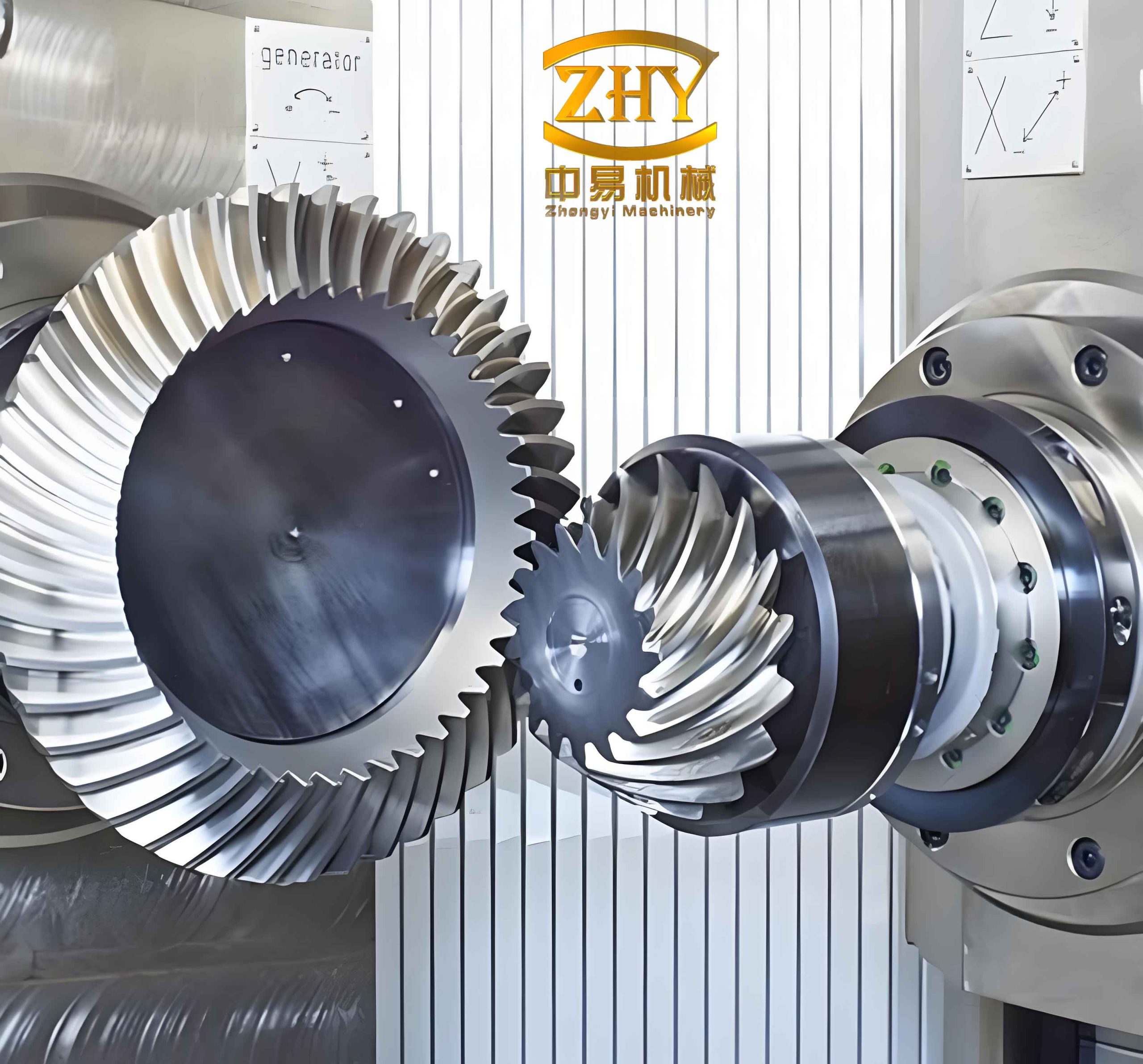
The investigation centers on the ring gear (hyperboloidal gear) and differential housing assembly. In a typical configuration, the ring gear is bolted to the differential housing flange, with bolt heads protruding into the fluid domain. During operation, these bolt heads act like paddles, churning the oil and creating additional resistive torque. To accurately capture this complex, transient, two-phase (oil-air) flow phenomenon, a high-fidelity Computational Fluid Dynamics (CFD) methodology is employed.
1. Mathematical and Numerical Modeling Framework
The flow of incompressible lubricant within the rear axle cavity is governed by the fundamental laws of fluid mechanics. The numerical model solves the three-dimensional, unsteady forms of the continuity and Navier-Stokes (N-S) equations. The governing equations are expressed as follows:
Continuity Equation:
$$ \nabla \cdot \vec{V} = \frac{\partial u}{\partial x} + \frac{\partial v}{\partial y} + \frac{\partial w}{\partial z} = 0 $$
Momentum Equation (Navier-Stokes):
$$ \rho \frac{\partial \vec{V}}{\partial t} + \rho (\vec{V} \cdot \nabla) \vec{V} = -\nabla P + \nabla \cdot \left[ \mu \left( \nabla \vec{V} + \nabla \vec{V}^T \right) \right] + \rho \vec{g} + \vec{F} $$
Where $\vec{V}$ is the velocity vector, $\rho$ is the fluid density, $P$ is the pressure, $\mu$ is the dynamic viscosity, $\vec{g}$ is the gravitational acceleration, and $\vec{F}$ represents other body forces.
To track the sharp interface between the oil and air, the Volume of Fluid (VOF) multiphase model is utilized. In this model, the volume fraction $\alpha_q$ for each phase $q$ (oil or air) is solved. The sum of volume fractions in a cell is unity ($\alpha_{\text{oil}} + \alpha_{\text{air}} = 1$). The tracking of the interface is accomplished by solving a continuity equation for the volume fraction of the primary phase (oil):
$$ \frac{\partial}{\partial t} (\alpha_{\text{oil}} \rho_{\text{oil}}) + \nabla \cdot (\alpha_{\text{oil}} \rho_{\text{oil}} \vec{u}_{\text{oil}}) = S_{\alpha} + (\dot{m}^+ – \dot{m}^-) $$
Here, $\dot{m}^+$ and $\dot{m}^-$ represent mass transfer due to phase change (e.g., cavitation), though for this study focusing on churning, these terms are often negligible. The fluid properties in each cell are calculated as weighted averages based on the volume fraction:
$$ \rho = \alpha_{\text{oil}} \rho_{\text{oil}} + (1 – \alpha_{\text{oil}}) \rho_{\text{air}} $$
$$ \mu = \alpha_{\text{oil}} \mu_{\text{oil}} + (1 – \alpha_{\text{oil}}) \mu_{\text{air}} $$
The high rotational speeds of the hyperboloidal gears induce strong turbulence and vortices. To model this effectively, the RNG $k$-$\varepsilon$ turbulence model is selected. This model offers improved accuracy for flows with high strain rates and streamline curvature—characteristics prevalent in gear churning. The transport equations for turbulent kinetic energy $k$ and its dissipation rate $\varepsilon$ are:
Turbulent Kinetic Energy ($k$) Equation:
$$ \frac{\partial (\rho k)}{\partial t} + \frac{\partial (\rho k u_i)}{\partial x_i} = \frac{\partial}{\partial x_j} \left( \alpha_k \mu_{\text{eff}} \frac{\partial k}{\partial x_j} \right) + G_k – \rho \varepsilon $$
Dissipation Rate ($\varepsilon$) Equation:
$$ \frac{\partial (\rho \varepsilon)}{\partial t} + \frac{\partial (\rho \varepsilon u_i)}{\partial x_i} = \frac{\partial}{\partial x_j} \left( \alpha_{\varepsilon} \mu_{\text{eff}} \frac{\partial \varepsilon}{\partial x_j} \right) + C_{1\varepsilon} \frac{\varepsilon}{k} G_k – C_{2\varepsilon} \rho \frac{\varepsilon^2}{k} – R_{\varepsilon} $$
In these equations, $G_k$ represents the generation of turbulent kinetic energy due to mean velocity gradients, $\mu_{\text{eff}} = \mu + \mu_t$ is the effective viscosity, and $\mu_t = \rho C_{\mu} k^2 / \varepsilon$ is the turbulent viscosity. The term $R_{\varepsilon}$ is the specific additional term in the RNG model that improves accuracy for rapidly strained flows. The model constants are: $C_{1\varepsilon}=1.42$, $C_{2\varepsilon}=1.68$, $\alpha_k = \alpha_{\varepsilon} \approx 1.393$, $C_{\mu}=0.0845$.
2. CFD Model Setup and Analysis Parameters
A three-dimensional fluid domain is created, encompassing the interior volume of the rear axle and differential housing. The model includes the rotating components responsible for churning: the passive hyperboloidal gear (ring gear) and the differential housing. Stationary components like the axle housing and final drive casing form the stationary walls. The domain is discretized using an unstructured tetrahedral mesh, with significant local refinement around the complex gear teeth and bolt heads to resolve the high-velocity gradients and interface dynamics. The mesh independence study was conducted to ensure results were not grid-dependent.
The boundary conditions are defined as follows: the outer housing walls are stationary no-slip walls. The axle shaft openings are defined as pressure outlets at atmospheric pressure. The rotational motion of the ring gear and differential housing is imposed using a sliding mesh or dynamic mesh technique with a user-defined profile file specifying speed and direction. The initial condition sets the oil fill level to a specified height (e.g., 48mm), with the rest of the domain filled with air.
The simulation investigates the influence of two critical operational parameters and one key structural feature:
- Gear Rotational Speed: Varied across a practical operating range.
- Oil Temperature: Affecting the oil’s viscosity and density.
- Bolt Head Geometry: Protruding bolts vs. flush-mounted (countersunk) bolts.
The material properties for the lubricant, typically a gear oil, are defined as temperature-dependent, particularly the dynamic viscosity $\mu_{\text{oil}}(T)$. A representative relation is used, as shown in the table below.
| Parameter | Value / Range | Description |
|---|---|---|
| Oil Density ($\rho_{\text{oil}}$) | ~850 – 900 kg/m³ | Decreases slightly with temperature. |
| Oil Dynamic Viscosity ($\mu_{\text{oil}}$) | See Table 2 | Strong function of temperature. |
| Air Density ($\rho_{\text{air}}$) | 1.225 kg/m³ | Assumed constant. |
| Air Dynamic Viscosity ($\mu_{\text{air}}$) | 1.7894×10⁻⁵ kg/(m·s) | Assumed constant. |
| Rotational Speed ($n$) | 100 – 1100 rpm | Covers idle to high-speed cruise. |
| Oil Temperature ($T$) | 30°C, 60°C, 90°C | Cold, warm, and hot operating conditions. |
| Initial Oil Level | Submerging the ring gear bottom | Typical lubrication level. |
| Temperature, $T$ (°C) | Dynamic Viscosity, $\mu_{\text{oil}}$ (Pa·s) | Kinematic Viscosity, $\nu_{\text{oil}}$ (cSt) |
|---|---|---|
| 30 | ~0.25 – 0.40 | ~280 – 450 |
| 60 | ~0.05 – 0.08 | ~55 – 90 |
| 90 | ~0.012 – 0.020 | ~13 – 22 |
3. Results: Flow Field, Pressure Distribution, and Power Loss
3.1 Transient Oil Flow Patterns
The transient simulation reveals the dynamic process of oil pick-up, transport, and drainage. Initially, the rotating teeth of the hyperboloidal gear dip into the oil sump, adhering oil to their surfaces. This oil is carried upward along the gear’s flank and the differential housing wall. Upon reaching the top region of the cavity, the oil film detaches, forming droplets and streams that fall back under gravity to lubricate other components (e.g., differential gears, bearings) and replenish the sump. A quasi-steady, cyclic pattern is established where the oil distribution fluctuates slightly but maintains a characteristic “wetted” pattern on the rotating parts and a splashed film on the upper stationary walls.
3.2 Dynamic Pressure Distribution on Gear and Bolts
The dynamic pressure field directly relates to the resistive torque acting on the rotating components. The analysis shows that the highest pressures are generated within the gear tooth gaps, especially near the dedendum (root) region, as these cavities act like paddles scooping and pushing against the oil.
| Rotational Speed, $n$ (rpm) | Angular Velocity, $\omega$ (rad/s) | Max Dynamic Pressure, $P_{\text{max}}$ (kPa) | Trend |
|---|---|---|---|
| 133 | 13.9 | ~1.5 | $P_{\text{max}} \propto \omega^2$ Approx. |
| 444 | 46.5 | ~7.5 | |
| 621 | 65.0 | ~14.8 | |
| 888 | 93.0 | ~23.7 |
Critically, the protruding bolt heads create distinct, localized high-pressure zones in their wake (leeward side). This is characterized by flow separation and vortex shedding, leading to significant pressure drag. The pressure on a cross-section through a bolt shows a concentrated region of high pressure gradient immediately behind the bolt, a signature of form drag. As speed increases, this high-pressure region intensifies and expands, confirming that the bolts contribute a non-negligible portion of the total churning loss.
3.3 Quantitative Analysis of Churning Power Loss
The churning power loss $P_{\text{churn}}$ is calculated from the simulation by integrating the viscous and pressure torque acting on the rotating gear and housing surfaces. The analysis of the baseline (protruding bolt) design yields the following key relationships.
Effect of Rotational Speed ($n$): Power loss increases dramatically with speed. The relationship is strongly nonlinear, typically following a power law: $P_{\text{churn}} \propto n^m$, where $m$ is between 2.5 and 3 for gears partially submerged in a baffled environment like a rear axle. This exponent greater than 2 (which would correspond to pure pressure drag) indicates the significant role of viscous shear and the increasing complexity of the turbulent flow field.
Effect of Oil Temperature ($T$): Power loss decreases with increasing temperature. This is primarily due to the exponential reduction in oil viscosity $\mu_{\text{oil}}(T)$. A warmer, thinner oil offers less resistance to shear and generates lower pressure during the “scooping” action of the gear teeth. However, the sensitivity to temperature is less pronounced than the sensitivity to speed.
| Speed, $n$ (rpm) | Churning Power Loss, $P_{\text{churn}}$ (Watts) | ||
|---|---|---|---|
| @ 30°C (High $\mu$) | @ 60°C (Med $\mu$) | @ 90°C (Low $\mu$) | |
| 444 | ~35 | ~28 | ~21 |
| 621 | ~85 | ~70 | ~58 |
| 888 | ~284 | ~235 | ~200 |
| 1065 | ~440 | ~365 | ~254 |
The data clearly shows the dominant effect of speed. For instance, at 90°C, increasing speed from 444 rpm to 1065 rpm causes a ~12x increase in loss. In contrast, at a high speed of 1065 rpm, heating the oil from 30°C to 90°C reduces the loss by only about 42%.
4. Structural Optimization and Drag Reduction
The identification of the bolt heads as significant sources of pressure drag leads to a direct structural optimization hypothesis: By recessing the bolt heads to make them flush with the differential housing flange surface, the form drag can be substantially reduced. This modification changes the design from a protruding bolt connection to a countersunk bolt connection for the hyperboloidal gear.
A new CFD model is created with this “countersunk bolt” geometry, keeping all other parameters (mesh strategy, boundary conditions, operating points) identical to the baseline model. The comparative results are striking:
- Flow Field Simplification: The chaotic vortices and strong flow separation directly behind the bolt heads are eliminated. The flow over the flange becomes smoother.
- Reduction in Dynamic Pressure: The localized high-pressure zones vanish. The overall pressure magnitude on the rotating assembly decreases.
- Reduction in Churning Power: The integrated resistive torque and hence power loss are lower across all tested speeds and temperatures.
| Speed, $n$ (rpm) | Baseline $P_{\text{churn}}$ (W) | Optimized $P_{\text{churn}}$ (W) | Absolute Reduction (W) | Percentage Reduction |
|---|---|---|---|---|
| 133 | ~5.2 | ~4.9 | ~0.3 | ~5.8% |
| 284 | ~13.0 | ~12.0 | ~1.0 | ~7.7% |
| 444 | ~21.0 | ~20.2 | ~0.8 | ~3.7% |
| 621 | ~58.0 | ~53.4 | ~4.6 | ~7.9% |
| 888 | ~200.0 | ~187.8 | ~12.2 | ~6.1% |
| 1065 | ~254.0 | ~233.2 | ~20.8 | ~8.2% |
The percentage reduction varies with speed, but a consistent benefit of approximately 4-8% is achieved. This translates directly into a gain in mechanical efficiency for the rear axle assembly.
5. Experimental Validation via Bench Testing
To conclusively validate the numerical findings and the proposed optimization, a back-to-back efficiency bench test was conducted. Two identical rear axle assemblies were prepared—one with the standard protruding bolt design and one with the modified countersunk bolt design for the hyperboloidal gear.
The test rig consists of a drive motor connected to the pinion flange, torque/speed sensors at the input and both output shafts (connected to the wheel hubs), and load motors at the outputs to apply resistive torque. The overall transmission efficiency $\eta$ is calculated as:
$$ \eta = \frac{P_{\text{out}}}{P_{\text{in}}} \times 100\% = \frac{T_{\text{out,left}} \cdot \omega_{\text{out,left}} + T_{\text{out,right}} \cdot \omega_{\text{out,right}}}{T_{\text{in}} \cdot \omega_{\text{in}}} \times 100\% $$
Tests were run over a matrix of input speeds and torques representative of real-world driving. The results consistently showed that the axle assembly with the countersunk bolt design exhibited higher measured efficiency.
| Input Torque | Design | Peak Efficiency ($\eta_{\text{max}}$) | Efficiency Gain ($\Delta \eta$) |
|---|---|---|---|
| ~81 Nm | Baseline (Protruding) | ~95.9% | +1.0 to +1.1 p.p. |
| Optimized (Countersunk) | ~97.0% | ||
| ~135 Nm | Baseline (Protruding) | ~96.3% | +1.0 to +1.1 p.p. |
| Optimized (Countersunk) | ~97.3% |
The experimental data confirms the simulation’s prediction. The structural optimization yielded a measurable increase in rear axle efficiency of approximately 1.0 to 1.1 percentage points across the tested operating range. This successful validation strengthens confidence in the CFD model as a predictive tool for analyzing parasitic losses in complex gear systems.
6. Conclusions and Implications
My comprehensive numerical and experimental investigation into the churning power loss of automotive rear axle hyperboloidal gears leads to the following conclusions:
- Dominant Parameters: The churning power loss exhibits a very strong, non-linear dependence on the rotational speed of the gears ($P_{\text{churn}} \propto n^{2.5-3.0}$). While increasing oil temperature (reducing viscosity) does lower the loss, its effect is secondary to that of speed.
- Flow Mechanism & Drag Sources: The primary churning action occurs in the tooth gaps of the hyperboloidal gear. Furthermore, protruding bolt heads on the differential housing flange are confirmed to be significant sources of parasitic drag, creating localized high-pressure zones and turbulent wakes.
- Effective Optimization: Recessing the bolt heads to create a flush (countersunk) connection is a simple yet highly effective mechanical optimization. It streamlines the flow over the rotating assembly, reduces form drag, and lowers churning losses by approximately 4-8% in simulation.
- Validated Efficiency Gain: Bench testing under realistic load conditions quantitatively validated the simulation. The optimized design improved the overall rear axle transmission efficiency by about 1.0 to 1.1 percentage points. For a vehicle, this translates directly into reduced fuel consumption and lower CO₂ emissions.
This work underscores the importance of considering secondary details like fastener geometry in high-performance powertrain design. The applied methodology—combining advanced CFD (VOF + RNG $k$-$\varepsilon$) with targeted experimental validation—provides a robust framework for analyzing and minimizing parasitic losses in geared systems, contributing to the development of more efficient automotive drivelines.