
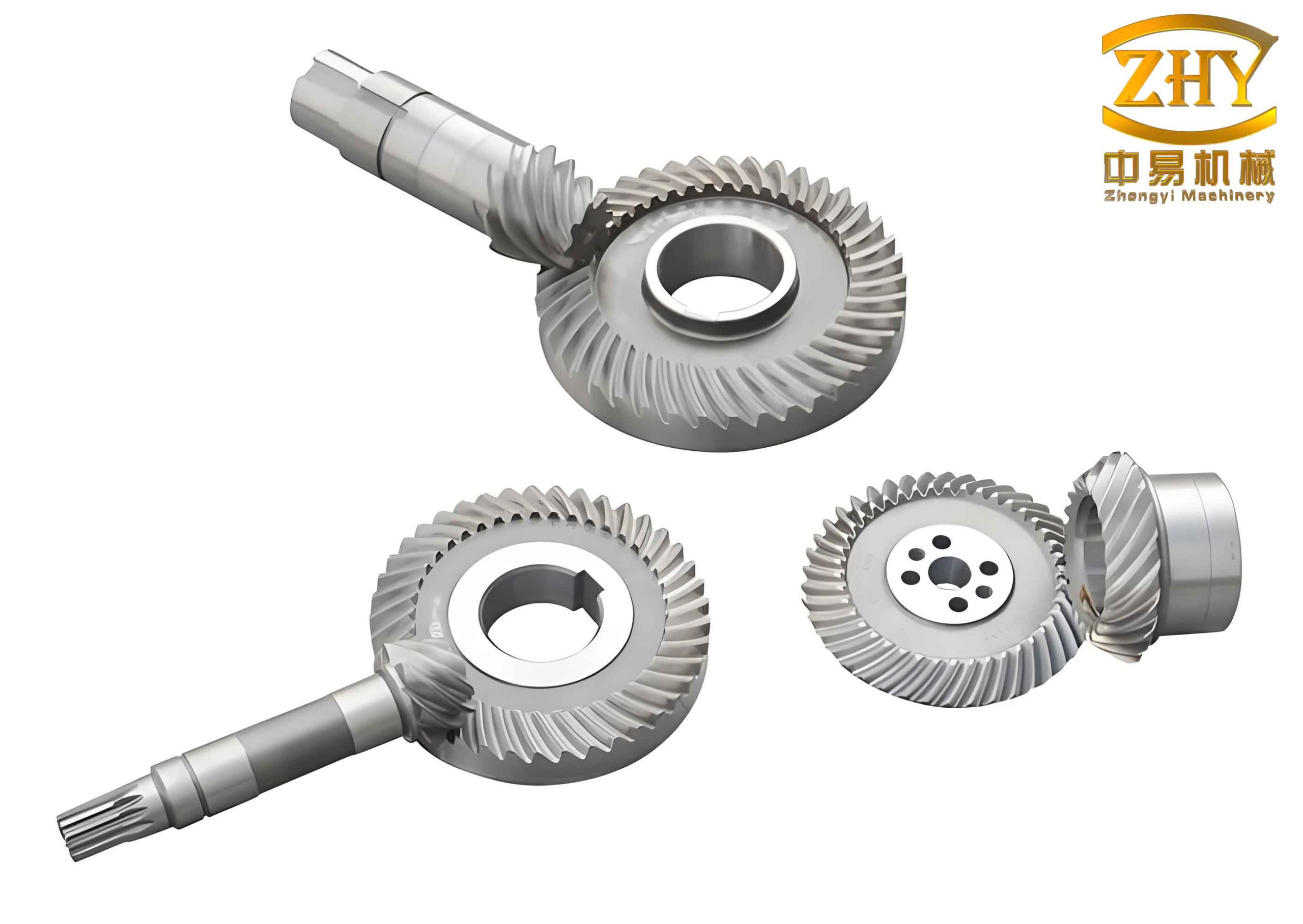
In modern mechanical transmission systems, particularly in automotive drive axles, hyperboloidal gears play a critical role due to their ability to transmit power between non-parallel and non-intersecting shafts with high efficiency and smooth operation. The complex geometry of hyperboloidal gears, characterized by their curved tooth surfaces, presents significant challenges in manufacturing and quality control. One of the most crucial aspects of ensuring optimal performance is the analysis and adjustment of contact patterns on the tooth surfaces. These contact patterns directly influence noise, vibration, and load distribution, making their precise control essential for durable and reliable gear systems. Traditional methods often rely on trial-and-error through rolling tests, which is time-consuming and costly. Therefore, developing a computational approach based on actual tooth surface measurements offers a more efficient and accurate alternative. In this article, we present a comprehensive methodology for reconstructing real tooth surfaces of hyperboloidal gears, performing discrete contact analysis, and calculating adjustment parameters to optimize contact patterns. Our approach leverages advanced numerical techniques, including surface fitting and optimization algorithms, to bridge the gap between design intent and manufactured reality.
The foundation of our analysis lies in the accurate representation of the actual tooth surfaces after manufacturing. Due to inherent machining errors and deviations, the real surfaces of hyperboloidal gears differ from their theoretical counterparts. To capture these deviations, we employ coordinate measuring machines (CMMs) to obtain a grid of points on both the pinion and gear tooth surfaces. Typically, a standard grid of 5 points along the profile direction and 9 points along the lengthwise direction is measured, resulting in 45 data points per tooth flank. Each measured point includes a deviation value \(\delta_{ij}\) from the theoretical surface, which can be expressed as:
$$ \mathbf{R}_{i,j} = \mathbf{r}_{i,j} + \delta_{i,j} \cdot \mathbf{n}_{i,j} $$
Here, \(\mathbf{R}_{i,j}\) denotes the position vector of the actual tooth surface point, \(\mathbf{r}_{i,j}\) is the position vector of the corresponding theoretical point, and \(\mathbf{n}_{i,j}\) is the unit normal vector at the theoretical point. The indices \(i\) and \(j\) refer to the grid points along the tooth height and tooth length directions, respectively. This formulation allows us to construct a point cloud that represents the real tooth surface geometry, accounting for manufacturing inaccuracies.
To facilitate subsequent contact analysis, we need a continuous mathematical representation of the tooth surfaces. We achieve this by fitting a double cubic Non-Uniform Rational B-Spline (NURBS) surface to the measured data points. NURBS surfaces are widely used in computer-aided design due to their flexibility and ability to accurately model complex shapes. The general expression for a NURBS surface is given by:
$$ \mathbf{S}(u,v) = \frac{\sum_{i=0}^{m} \sum_{j=0}^{n} N_{i,3}(u) N_{j,3}(v) w_{i,j} \mathbf{K}_{i,j}}{\sum_{i=0}^{m} \sum_{j=0}^{n} N_{i,3}(u) N_{j,3}(v) w_{i,j}} $$
In this equation, \(\mathbf{K}_{i,j}\) are the control points of the surface, \(w_{i,j}\) are the corresponding weight factors, and \(N_{i,3}(u)\) and \(N_{j,3}(v)\) are the cubic B-spline basis functions in the \(u\) (tooth length) and \(v\) (tooth height) directions, respectively. The fitting process involves calculating the control points iteratively: first along the tooth height direction to generate NURBS curves, and then along the tooth length direction to obtain the complete surface control net. This results in a smooth, differentiable representation of the actual tooth surfaces of both the pinion and gear, which is essential for precise contact analysis. The use of NURBS ensures that the reconstructed surfaces maintain the geometric integrity of the measured data while providing a parametric form suitable for numerical computations.
Once the real tooth surfaces of the hyperboloidal gears are reconstructed, the next step is to analyze their contact behavior under meshing conditions. The contact pattern, which indicates the region of tooth surface interaction during operation, is a key performance indicator. In practice, due to misalignments and errors, the contact pattern may deviate from the ideal location, leading to suboptimal performance such as increased noise, vibration, or premature wear. Therefore, we develop a mathematical model to calculate the adjustments needed to reposition the contact pattern to its desired location. This model focuses on three primary adjustment parameters: the pinion offset \(\Delta V\), the pinion mounting distance \(\Delta H\), and the gear mounting distance \(\Delta J\). These parameters correspond to changes in the relative positioning of the gears during assembly, which can be translated back to corrections in machine tool settings during manufacturing.
The core of the adjustment model is based on the conditions for conjugate meshing between the pinion and gear tooth surfaces. We define coordinate systems attached to the pinion (\(\{O_1: X_1, Y_1, Z_1\}\)) and the gear (\(\{O_2: X_2, Y_2, Z_2\}\)), as well as a fixed reference frame (\(\{O_f: X_f, Y_f, Z_f\}\)). The meshing condition requires that at the point of contact, the position vectors and unit normal vectors of both surfaces coincide in the fixed frame, and the relative velocity at the contact point is orthogonal to the common normal vector. This leads to a system of nonlinear equations:
$$ \begin{align*}
\mathbf{r}_f^{(1)}(u_1, v_1, \phi_1, \Delta V, \Delta H, \Delta J) &= \mathbf{r}_f^{(2)}(u_2, v_2, \phi_2) \\
\mathbf{n}_f^{(1)}(u_1, v_1, \phi_1, \Delta V, \Delta H, \Delta J) &= \mathbf{n}_f^{(2)}(u_2, v_2, \phi_2) \\
\frac{\partial \mathbf{r}_f^{(1)}}{\partial u_1} \cdot \left( \frac{\partial \mathbf{r}_f^{(2)}}{\partial u_2} \times \frac{\partial \mathbf{r}_f^{(2)}}{\partial v_2} \right) &= 0 \\
\frac{\partial \mathbf{r}_f^{(1)}}{\partial v_1} \cdot \left( \frac{\partial \mathbf{r}_f^{(2)}}{\partial u_2} \times \frac{\partial \mathbf{r}_f^{(2)}}{\partial v_2} \right) &= 0 \\
\mathbf{n}_f^{(2)} \cdot \mathbf{v}_f^{(12)} &= f(u_1, v_1, \phi_1, u_2, v_2, \phi_2, \Delta V, \Delta H, \Delta J) = 0
\end{align*} $$
Here, \(u_1, v_1\) and \(u_2, v_2\) are the surface parameters of the pinion and gear, respectively; \(\phi_1\) and \(\phi_2\) are the rotation angles; and \(\mathbf{v}_f^{(12)}\) is the relative velocity vector. Additionally, to maintain a constant backlash during adjustment, the following relationship must hold:
$$ \Delta J + \Delta H \tan \gamma_1 = 0 $$
where \(\gamma_1\) is the pitch cone angle of the pinion. This system of equations is highly nonlinear and involves multiple variables. To solve it efficiently, we employ the Newton-Raphson iterative method. We define the vector of unknowns \(\mathbf{X} = [u_1, v_1, \phi_1, u_2, v_2, \phi_2, \Delta V, \Delta H, \Delta J]^T\) and the system of equations as \(f_d(\mathbf{X}) = 0\) for \(d = 1, 2, \ldots, 9\). The Jacobian matrix \(\mathbf{F}'(\mathbf{X}^k)\) is computed by taking partial derivatives of each equation with respect to each variable. The iteration proceeds as:
$$ \mathbf{X}^{k+1} = \mathbf{X}^k – \left[ \mathbf{F}'(\mathbf{X}^k) \right]^{-1} \mathbf{f}(\mathbf{X}^k) $$
The iteration continues until the norm \(\|\mathbf{X}^{k+1} – \mathbf{X}^k\|\) is less than a specified tolerance \(\sigma\), yielding the solution for the contact point under given adjustment parameters. By varying the gear rotation angle \(\phi_2\) and solving for corresponding pinion angles \(\phi_1\), we can trace the entire path of contact across the tooth surfaces, enabling the prediction of the contact pattern.
However, since the tooth surfaces of hyperboloidal gears are represented discretely via NURBS, directly solving the meshing equations at every point can be computationally intensive. To enhance efficiency and accuracy, we implement a discrete contact analysis approach. The fundamental idea is to approximate the contact by finding the minimum distance between discrete points on the pinion and gear surfaces during meshing. For a given relative position, we compute the distances between all point pairs on the two surfaces. The pair with the smallest distance represents the potential contact point, provided the surfaces are not interfering. The distance between a point \(\mathbf{P}_{ij}^{(2)}\) on the gear surface and a point \(\mathbf{P}_{ij}^{(1)}\) on the pinion surface is given by:
$$ D_{p \times q} = \left\| \mathbf{r}_{f,ij}^{(2)} – \mathbf{r}_{f,ij}^{(1)} \right\| \quad (i = 0,1,\ldots,m; \ j = 0,1,\ldots,n) $$
If the grid of points is sufficiently dense, the minimum distance \(\min(D_{p \times q})\) approximates the surface separation at the contact point. To achieve the required density without excessive initial points, we employ a two-dimensional golden section search method to refine the grid locally around the contact region. The golden section method is a robust optimization technique that converges quickly by recursively partitioning the search interval. In two dimensions, we start with a rectangular domain containing the initial contact point and subdivide it into smaller rectangles using the golden ratio (approximately 0.618 and 0.382). We evaluate the distance function at the center of each sub-rectangle and select the one with the minimum value for further subdivision. This process continues until the rectangle size is smaller than a predefined accuracy threshold. This adaptive refinement ensures that we capture the contact point precisely without uniformly increasing the grid size over the entire surface, thus optimizing computational resources.
Furthermore, to determine whether the surfaces are in proper contact or interference, we check the sign of the dot product between the normal vector at the pinion point and the vector from the pinion point to the gear point. For a point pair, the interference criterion is:
$$ S_{p \times q} = \mathbf{n}_{f,ij}^{(1)} \cdot \left( \mathbf{r}_{f,ij}^{(2)} – \mathbf{r}_{f,ij}^{(1)} \right) $$
If \(\min(S_{p \times q}) < 0\), it indicates that the gear surface penetrates the pinion surface, meaning interference occurs. Otherwise, the surfaces are in proper contact or separated. By combining the distance minimization and interference check, we can accurately simulate the meshing process and identify the contact pattern for hyperboloidal gears under various adjustment settings.
To validate our methodology, we apply it to a practical case involving a hyperboloidal gear set used in an automotive drive axle. The basic geometric parameters of the gear pair are summarized in the table below:
| Parameter | Pinion | Gear |
|---|---|---|
| Number of Teeth | 8 | 39 |
| Module (mm) | 4.611 | – |
| Face Width (mm) | 25 | – |
| Offset Distance (mm) | 25 | – |
| Outer Diameter (mm) | 56.73 | 171.05 |
| Spiral Angle | 50° | – |
| Pitch Cone Angle | 14°11′ | 30°41′ |
| Face Cone Angle | 18°10′ | 76°49′ |
| Root Cone Angle | 11°37′ | 70°48′ |
| Hand of Spiral | Left | Right |
The tooth surfaces of both the pinion and gear are measured using a gear measuring center, and the deviation maps are obtained. The pinion surface deviations range from -10 to +15 micrometers, while the gear surface deviations range from -8 to +12 micrometers, indicating typical manufacturing tolerances. We reconstruct the NURBS surfaces as described earlier. Initial contact analysis without any adjustments reveals that the contact pattern on the gear’s convex side is biased toward the toe (inner end) and slightly toward the top. Specifically, the contact center is offset by approximately \(s = 1\) mm toward the top and \(t = 7\) mm toward the toe from the ideal central location. This misalignment could lead to localized stress concentrations and reduced performance.
Using our adjustment model, we compute the required changes in mounting parameters to center the contact pattern. Solving the system of equations yields the following adjustment values:
| Adjustment Parameter | Value (mm) |
|---|---|
| Pinion Offset (\(\Delta V\)) | +0.312 |
| Pinion Mounting Distance (\(\Delta H\)) | -0.433 |
| Gear Mounting Distance (\(\Delta J\)) | +0.062 |
These adjustments are derived to satisfy both the meshing conditions and the constant backlash requirement. After applying these corrections virtually, we perform the discrete contact analysis again. The resulting contact pattern now appears centered on the tooth flank, with a more favorable shape and distribution. The transmission error curve, which plots the difference between the actual and theoretical rotation angles, also shows reduced amplitude and smoother variation, indicating improved meshing quality.
To verify the accuracy of our computational approach, we compare the predicted contact patterns with physical rolling tests conducted on a computerized gear rolling tester. The gear set is assembled with the original unadjusted settings, and the contact pattern is recorded using marking compound. The experimental pattern closely matches the simulation results, showing a bias toward the toe and top. After adjusting the machine tool settings equivalent to \(\Delta V\), \(\Delta H\), and \(\Delta J\) (through changes in cutter position, workpiece orientation, etc.), the gear is remanufactured and tested again. The new contact pattern from the rolling test is centered, confirming that our adjustment calculations are effective. This consistency between simulation and experiment validates the reliability of our methodology for hyperboloidal gears.
The ability to predict and correct contact patterns based on real tooth surface measurements has profound implications for the manufacturing of hyperboloidal gears. Traditionally, achieving optimal contact requires multiple iterations of trial grinding or lapping, which consumes time and material. Our approach enables a virtual adjustment process, where corrections are computed analytically before physical changes are made to the manufacturing setup. This not only reduces the number of trial runs but also enhances the consistency and quality of the final product. Moreover, the use of NURBS surfaces provides a flexible framework that can accommodate various types of hyperboloidal gears, including those with modified or topologically optimized tooth surfaces.
In addition to contact pattern adjustment, our discrete contact analysis algorithm can be extended to study other performance aspects of hyperboloidal gears. For instance, by incorporating load distribution models, we can estimate contact stresses and bending stresses under operational conditions. The transmission error curves obtained from the analysis can be used to assess vibration excitation and noise potential. Furthermore, the methodology can be integrated into a closed-loop manufacturing system, where measurement data from each production batch is used to automatically update machine tool settings, ensuring consistent quality across multiple units.
It is worth noting that the accuracy of our approach depends on the quality of the initial surface measurements and the fidelity of the NURBS fitting. Higher density measurement grids and advanced fitting techniques, such as adaptive knot placement, can further improve the results. Additionally, the Newton-Raphson solver requires good initial guesses to converge; we typically use the theoretical contact points as starting values. For highly distorted surfaces, global optimization methods might be necessary to avoid local minima. Nevertheless, for typical manufacturing tolerances, our method proves robust and efficient.
In conclusion, we have developed a comprehensive computational framework for the analysis and adjustment of contact patterns on hyperboloidal gears based on real tooth surface data. The key steps involve reconstructing the actual tooth surfaces using NURBS fitting, performing discrete contact analysis with adaptive refinement, and calculating mounting parameter adjustments through numerical solution of meshing equations. The effectiveness of the method is demonstrated through a case study, where simulation results align closely with physical rolling tests. This approach provides a powerful tool for manufacturers to optimize the performance of hyperboloidal gears, reducing development time and improving reliability. Future work may focus on extending the method to dynamic loading conditions, integrating thermal effects, and automating the adjustment process in smart manufacturing environments. As the demand for high-performance gear systems grows, such advanced analysis techniques will become increasingly vital in ensuring the efficiency and durability of hyperboloidal gears in critical applications.
The mathematical models and algorithms presented here are implemented in a custom software tool, which allows for batch processing of gear data and generation of adjustment reports. By adopting this methodology, engineers can shift from experience-based tuning to data-driven optimization, paving the way for more precise and reliable hyperboloidal gear transmissions. The continuous improvement in measurement technologies and computational power will only enhance the applicability and accuracy of such approaches, making them standard practice in the gear industry.