
The precision finishing of hyperboloidal gears is a critical process in automotive and aerospace industries, directly influencing the vibration and noise performance of the final transmission assembly. While traditional lapping remains the predominant method for improving the contact pattern of automotive rear-axle hyperboloidal gears, it possesses inherent limitations. These include low efficiency, inconsistent material removal leading to potential profile degradation, and an inability to favorably modify the surface micro-topography. Ultrasonic Excitation Lapping (UEL) presents a promising alternative, introducing high-frequency, low-amplitude vibrations into the lapping process. This paper details the design, finite element analysis, and experimental verification of a dedicated UEL system for medium-modulus hyperboloidal gears. The objective is to enhance the finishing process, reduce vibrational energy, and improve the functional performance of the gear pair.
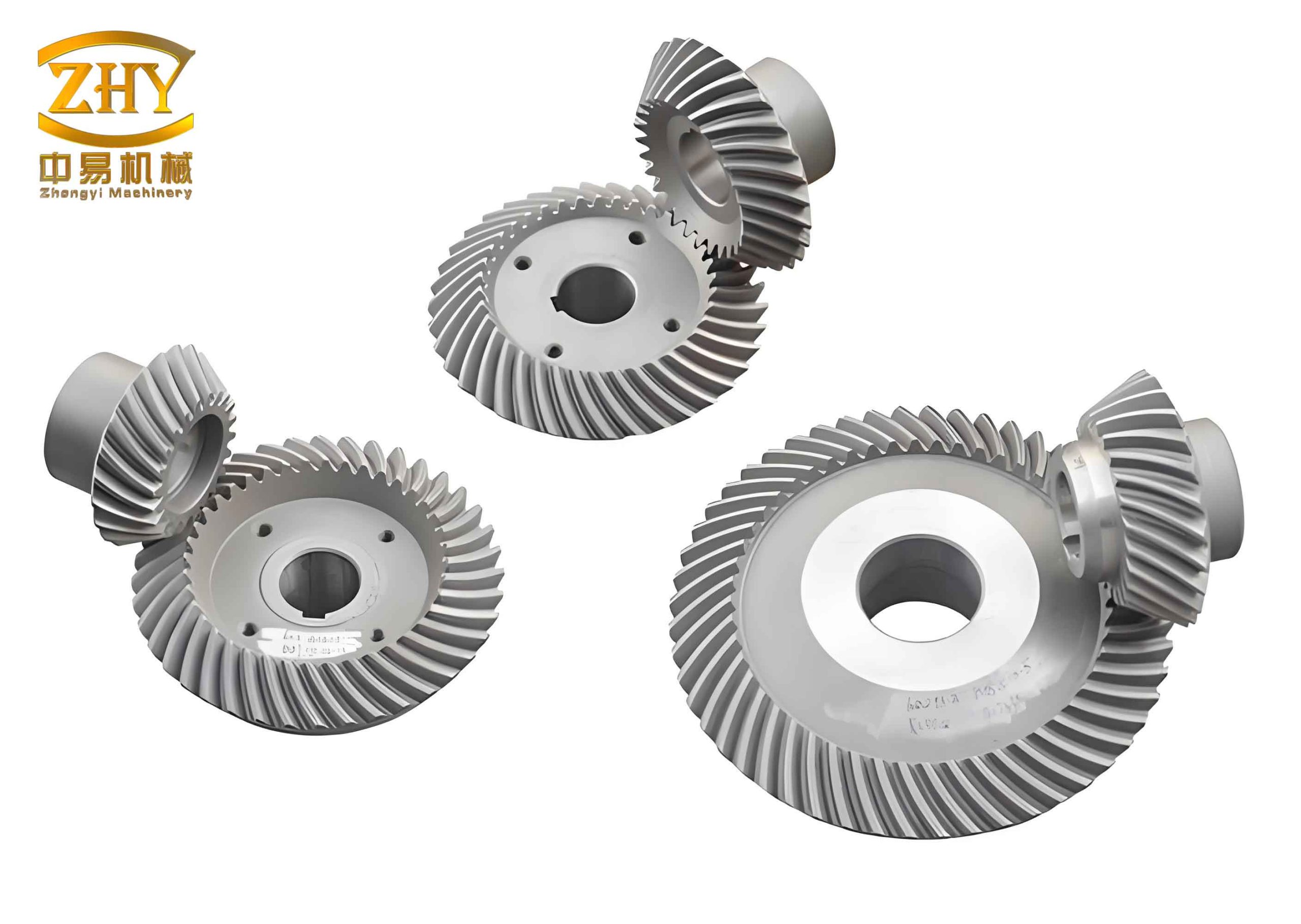
The core of the UEL system comprises three main components: the ultrasonic transducer, the acoustic horn (booster), and the target workpiece—in this case, the pinion of a hyperboloidal gear set. The transducer converts high-frequency electrical signals into mechanical vibrations, typically using the inverse piezoelectric effect of materials like PZT ceramics. For high-power applications, a sandwich (Langevin-type) transducer design is essential to protect the fragile ceramic stacks by placing them under compressive preload. The required maximum preload can be estimated by:
$$F_{max} = S_p \cdot d_{33} \cdot Q_m \cdot E \cdot E_e$$
where $S_p$ is the effective area of the ceramic, $d_{33}$ is the longitudinal piezoelectric constant, $Q_m$ is the mechanical quality factor, $E$ is Young’s modulus, and $E_e$ is the applied electric field strength. The horn then amplifies the vibration amplitude delivered to the gear.
Designing a system for a medium-modulus hyperboloidal gear pinion is complex due to its significant mass and intricate geometry. Simplified mass reciprocity methods used for small gears are inadequate here. Therefore, a comprehensive design strategy employing Finite Element Analysis (FEA) is adopted. The system configuration, as conceptualized, integrates the gear shaft, a stepped horn, and the transducer assembly. The total length is designed for resonance, targeting a specific ultrasonic frequency (e.g., 15-20 kHz). The horn length is crucial for achieving maximum longitudinal vibration amplitude at the gear’s working end.
To accurately model the system, a coupled-field FEA approach is necessary. The piezoelectric ceramics are modeled using elements capable of simulating electromechanical coupling (e.g., SOLID5 in ANSYS), while the metallic components (horn, gear, housing) are modeled with standard structural elements (e.g., SOLID45). A critical aspect often overlooked in analytical models is the effect of the bolt preload on the transducer’s assembly stiffness and resonant frequency. This is meticulously incorporated in the FEA model using pre-tension elements. An initial one-eighth symmetric model is built to reduce computational cost while capturing the essential vibrational modes.
Modal analysis is performed to identify the system’s natural frequencies and mode shapes. The design is iteratively refined, primarily by adjusting the horn’s dimensions, until the first longitudinal resonant mode matches the desired operating frequency and exhibits a clear displacement node suitable for clamping, and an antinode at the gear face. The final simulated design yielded a resonant frequency of approximately 15.6 kHz. Harmonic response analysis over a frequency sweep (e.g., 14-17 kHz) confirms the system’s behavior, showing a sharp peak at the resonant frequency. Key performance metrics from the FEA include the displacement amplification factor (ratio of output to input amplitude) and stress distribution to ensure integrity. The following table summarizes a hypothetical design iteration analysis:
| Design Iteration | Horn Length (mm) | Resonant Freq. (kHz) – FEA | Amplification Factor | Max Stress (MPa) |
|---|---|---|---|---|
| 1 | 340 | 16.45 | 1.8 | 85 |
| 2 | 350 | 15.98 | 2.1 | 78 |
| 3 (Final) | 360 | 15.59 | 2.2 | 75 |
Based on the FEA-optimized design, a physical prototype of the ultrasonic excitation system for hyperboloidal gears is manufactured. The system’s performance is validated experimentally. The actual resonant frequency is measured using an impedance analyzer and compared with the FEA prediction. Vibration amplitude at the free end (gear location) is measured using a laser vibrometer. The close correlation between simulation and experiment validates the design methodology. The table below shows a typical comparison:
| Parameter | FEA Simulation | Experimental Measurement | Deviation |
|---|---|---|---|
| Resonant Frequency | 15.59 kHz | 15.42 kHz | -1.1% |
| Amplitude at Gear End (@1V input) | 4.8 µm | 4.5 µm | -6.3% |
With the validated UEL system, lapping experiments are conducted on a set of case-hardened hyperboloidal gears. The pinion is mounted onto the vibrating horn and meshed with the ring gear under light load in a conventional lapping machine, but with the ultrasonic excitation activated. A specialized abrasive compound is used. The process parameters can be summarized as follows:
| Process Parameter | Setting |
|---|---|
| Ultrasonic Frequency | ~15.4 kHz |
| Vibration Amplitude | 4-5 µm (peak-to-peak) |
| Lapping Speed (Pinion) | ~1420 rpm |
| Lapping Duration | 3-5 minutes (per cycle) |
| Abrasive | Fine-grade silicon carbide in oil |
The effectiveness of ultrasonic excitation for hyperboloidal gears is evaluated by comparing the vibrational characteristics of the gear pair before and after the UEL process. The gear pair is run on a test rig under loaded conditions, and the vibration acceleration is measured using an accelerometer. The frequency spectrum of the vibration signal is analyzed. Post-UEL, a significant reduction in the amplitude of meshing harmonics and sidebands is observed, indicating a smoother interaction between the tooth surfaces. The overall vibration energy, calculated as the RMS of the acceleration signal, shows a measurable decrease. The improvement can be quantified by an Insertion Loss (IL) metric for specific frequency bands:
$$IL(dB) = 10 \cdot \log_{10}\left(\frac{A_{before}}{A_{after}}\right)$$
where $A_{before}$ and $A_{after}$ are the acceleration amplitudes at a target frequency before and after UEL. For the fundamental meshing frequency, improvements of 3-6 dB are commonly achieved.
The benefits of applying ultrasonic excitation to the lapping of hyperboloidal gears are multi-fold. Firstly, the high-frequency micro-impact of the abrasive particles is enhanced, leading to more efficient and uniform material removal. This improves the contact pattern conformity without the risk of over-lapping and profile distortion associated with prolonged conventional lapping. Secondly, the process induces a beneficial micro-dimpled surface texture, which can improve lubrication retention. Thirdly, the high-frequency stress cycles may promote the formation of compressive residual stresses in the near-surface layer of the gear teeth, potentially enhancing fatigue life. The mechanism of material removal transitions from pure abrasive wear to a combination of abrasion and micro-fatigue, governed by the ultrasonic energy input $E_u$ per cycle, which can be approximated by:
$$E_u \propto \frac{1}{2} \rho A^2 \omega^2 V$$
where $\rho$ is the material density, $A$ is the vibration amplitude, $\omega$ is the angular frequency, and $V$ is the active volume of the surface layer.
In conclusion, the design and implementation of an ultrasonic excitation system for hyperboloidal gears, guided by advanced finite element analysis, presents a significant advancement in gear finishing technology. The experimental results confirm that Ultrasonic Excitation Lapping effectively reduces gear mesh vibration and noise by improving surface topography and contact conditions. This process addresses key shortcomings of traditional lapping, offering a path toward higher quality, more durable, and quieter hyperboloidal gear drives for demanding applications in automotive and other precision transmission systems. The successful application to medium-modulus hyperboloidal gears demonstrates the scalability and practical potential of this hybrid finishing methodology.