
In the realm of modern mechanical power transmission, gear drives stand as one of the most critical and widely utilized systems. Among these, the cylindrical gear, characterized by its straight teeth parallel to the axis of rotation, is a fundamental component. This type of gear pair transmits motion and torque through the meshing engagement of its teeth. To meet increasingly demanding performance requirements—such as avoiding tooth undercutting, optimizing structural dimensions, achieving specific center distances, improving wear characteristics, and enhancing load-carrying capacity—gear modification is a standard engineering practice. A specific form of modification is the “high modification” or “addendum modification” of cylindrical gears. In such a pair, the cutting tool is offset away from the gear blank for the pinion and offset toward the gear blank for the larger gear by an equal magnitude. This process results in the working pitch circle coinciding with the standard pitch circle while maintaining the total tooth depth. However, the positions of the tip and root circles relative to the pitch circle are altered. This study focuses on the comprehensive process, from theoretical calculation and three-dimensional modeling to dynamic simulation, for a pair of such high-modified cylindrical gears.
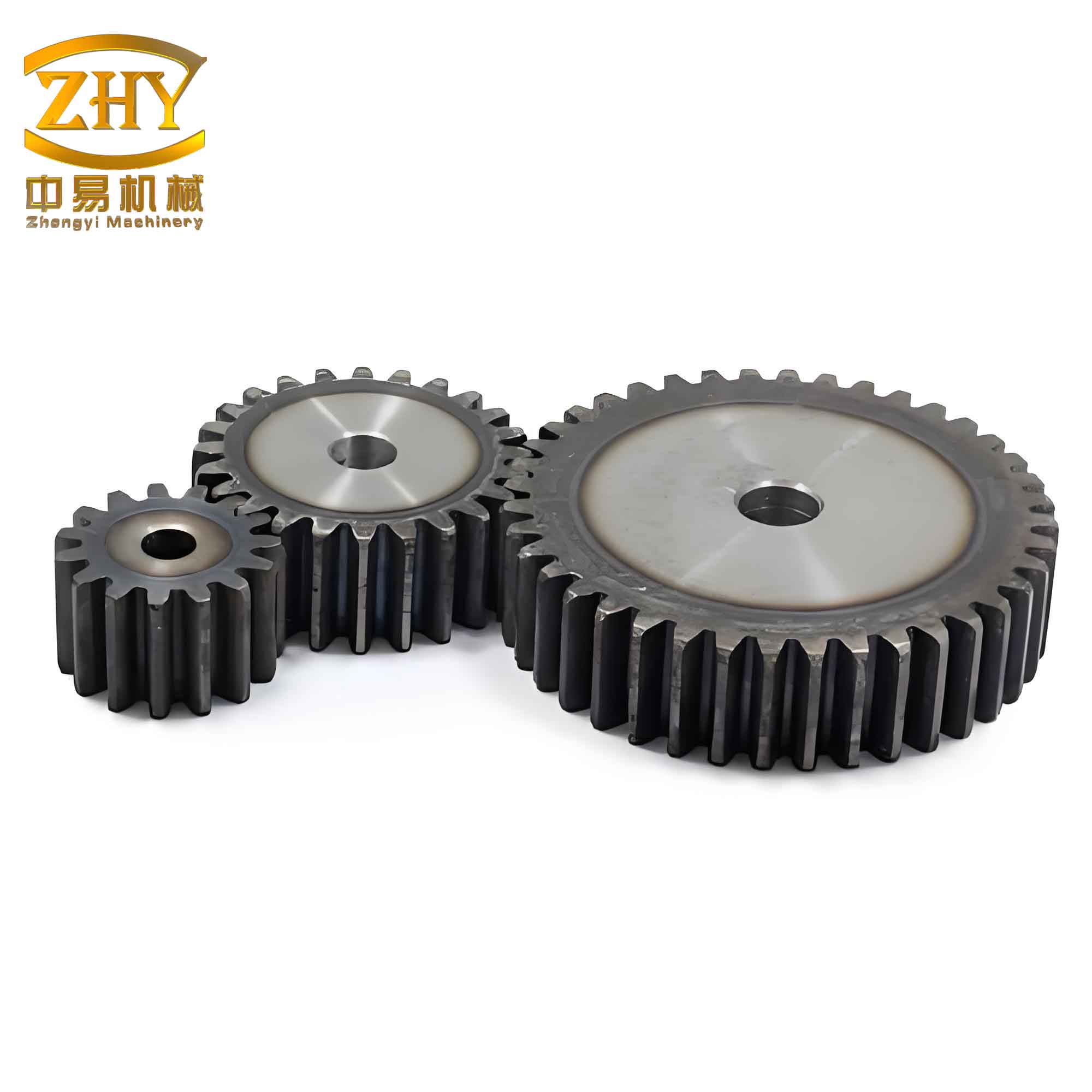
The design and analysis of a modified cylindrical gear pair begin with precise geometric calculations. These calculations define the critical dimensions necessary for both manufacturing and performance evaluation. For a given pair of meshing gears, the fundamental parameters include module (m), number of teeth (Z), pressure angle (α), and modification coefficient (x). Using these, all other geometric features can be derived. The table below summarizes the key formulas and calculated results for an example high-modified cylindrical gear pair. The pinion has a positive modification (x₁ = +0.35), and the gear has an equal but negative modification (x₂ = -0.35), making it a “balanced” or “high” modification where the sum of the coefficients is zero (x₁ + x₂ = 0).
| Parameter | Formula | Pinion (Driver) | Gear (Driven) |
|---|---|---|---|
| Module (m) | Given | 2.5 mm | 2.5 mm |
| Number of Teeth (Z) | Given | 30 | 65 |
| Pressure Angle (α) | Given | 20° | 20° |
| Modification Coefficient (x) | Given | +0.35 | -0.35 |
| Reference Diameter (d) | $$d = m \cdot Z$$ | 75.000 mm | 162.500 mm |
| Base Circle Diameter (d_b) | $$d_b = d \cdot \cos(\alpha)$$ | 70.477 mm | 152.699 mm |
| Addendum (h_a) | $$h_a = m \cdot (1 + x)$$ | 3.375 mm | 1.625 mm |
| Dedendum (h_f) | $$h_f = m \cdot (1.25 – x)$$ | 2.250 mm | 4.000 mm |
| Tip Diameter (d_a) | $$d_a = d + 2 \cdot h_a$$ | 81.750 mm | 165.750 mm |
| Root Diameter (d_f) | $$d_f = d – 2 \cdot h_f$$ | 70.500 mm | 154.500 mm |
| Tooth Height (h) | $$h = h_a + h_f$$ | 5.625 mm | 5.625 mm |
| Center Distance (a) | $$a = m \cdot (Z_1 + Z_2) / 2$$ | 118.750 mm | |
| Transverse Base Pitch (p_t) | $$p_t = \pi \cdot m \cdot \cos(\alpha)$$ | 7.380 mm | |
The accurate three-dimensional modeling of the cylindrical gear pair is a crucial step preceding any advanced engineering analysis. For this task, a parametric CAD environment is indispensable. Siemens NX (formerly Unigraphics or UG) provides a powerful and comprehensive platform for CAD/CAM/CAE integration. Its robust parametric and feature-based modeling capabilities allow for the creation of complex geometries like involute gear teeth with high precision and flexibility. The modeling process for a cylindrical gear within such software typically involves using dedicated gear modeling tools or creating the involute curve profile through parametric equations. The key advantage of parametric modeling is its associativity; a change in a fundamental parameter like the module or number of teeth automatically updates all dependent geometric features, significantly speeding up the design iteration process. For this study, the calculated geometric parameters from the table above were input into the UG modeling environment to generate precise solid models of both the pinion and the gear. Subsequently, these components were virtually assembled at the calculated center distance, ensuring proper meshing engagement for the subsequent dynamic simulation phase. The fidelity of this digital twin of the physical cylindrical gear pair directly impacts the accuracy and reliability of the finite element analysis results.
Before proceeding to complex computer simulations, it is instructive to calculate the theoretical contact stress between the meshing teeth using established mechanical principles. The Hertzian contact theory provides a classical analytical solution for the stress field generated when two elastic bodies are pressed together. For a pair of cylindrical gears, the contact can be approximated by the contact between two equivalent cylinders with radii equal to the radii of curvature of the tooth profiles at the point of contact. The highest contact stress typically occurs near the pitch point, making it a critical location for pitting failure analysis. The simplified Hertzian formula for maximum contact pressure (σ_H) between two parallel cylinders of the same material is given by:
$$ \sigma_H = 0.418 \sqrt{\frac{F_n \cdot E}{L \cdot \rho_{eq}}} $$
Where:
• \( F_n \) is the normal load transmitted between the teeth.
• \( E \) is the Young’s modulus of elasticity for the gear material.
• \( L \) is the effective length of the contact line.
• \( \rho_{eq} \) is the equivalent radius of curvature.
The normal load \( F_n \) is derived from the transmitted torque (T) and the geometry of the cylindrical gear:
$$ F_n = \frac{2T}{d \cdot \cos(\alpha)} $$
For the example cylindrical gear pair, assuming a torque of 500 Nm applied to the pinion (with a reference diameter d₁ = 75 mm = 0.075 m), the calculation proceeds as follows. First, the normal load is computed. The transmitted load acts along the line of action. Using the formula for normal load based on torque and pitch diameter, we get a significant force value that drives the contact stress. This force is distributed along the contact line, which is not constant during meshing due to the changing number of tooth pairs in contact. An approximate length (L) must be calculated considering the face width (b) and the transverse contact ratio (ε_α). For a face width of 40 mm and a calculated transverse contact ratio of approximately 1.68, the effective contact line length L can be estimated using the formula for the average length of lines of contact in a spur gear mesh:
$$ L \approx \frac{b \cdot \epsilon_\alpha}{\cos(\beta_b)} $$
Where \(\beta_b\) is the base helix angle, which is zero for spur cylindrical gears. Thus, \(L \approx b \cdot \epsilon_\alpha = 40 \text{ mm} \times 1.68 = 67.2 \text{ mm}\).
The equivalent radius of curvature \( \rho_{eq} \) at the pitch point for the external gear pair is:
$$ \frac{1}{\rho_{eq}} = \frac{1}{\rho_1} + \frac{1}{\rho_2} $$
with \( \rho_1 = \frac{d_1}{2} \sin(\alpha) \) and \( \rho_2 = \frac{d_2}{2} \sin(\alpha) \).
Substituting the values: \( \rho_1 = (75/2) \times \sin(20°) = 12.83 \text{ mm} \), and \( \rho_2 = (162.5/2) \times \sin(20°) = 27.79 \text{ mm} \). Therefore, \( \rho_{eq} = \frac{\rho_1 \cdot \rho_2}{\rho_1 + \rho_2} = \frac{12.83 \times 27.79}{12.83 + 27.79} = 8.77 \text{ mm} \).
Finally, assuming a common gear steel with Young’s modulus E = 210 GPa (2.1e11 Pa), the theoretical maximum Hertzian contact stress can be estimated. Plugging all calculated values into the Hertz formula provides a benchmark stress value. This calculated stress, typically in the range of several hundred MPa, serves as a critical reference point for validating the subsequent, more detailed finite element analysis of the cylindrical gear contact.
The transient finite element analysis (FEA) represents a powerful numerical method to investigate the dynamic behavior and stress distribution within the cylindrical gear pair under operating conditions. While the Hertz theory offers a simplified analytical solution for contact pressure at a point, FEA can model the entire gear body, capture stress concentrations (e.g., at the tooth root for bending stress), and simulate the time-varying nature of the meshing process. For this analysis, the Ansys Workbench software suite is employed. The process begins by importing the accurately modeled three-dimensional CAD geometry of the cylindrical gear pair from UG. The material properties, typically structural steel (E = 210 GPa, Poisson’s ratio ν = 0.3, density ρ = 7850 kg/m³), are assigned to both gears. The most critical and computationally intensive step is the discretization of the geometry into a finite element mesh. A high-quality, predominantly hexahedral or tetrahedral mesh is generated. To ensure accuracy in the contact region without making the model prohibitively large, local mesh refinement is applied to the tooth flanks and fillets. A typical high-fidelity mesh for a gear pair may consist of several hundred thousand to over a million elements, with smaller element sizes in the contact zones.
Defining the boundary conditions and interactions is paramount for a realistic simulation. A “Frictional” contact formulation is established between the tooth surfaces of the pinion and gear, with the pinion’s teeth typically defined as the contact surface and the gear’s teeth as the target surface. A coefficient of friction, often between 0.05 and 0.15 for lubricated steel contacts, is specified. Kinematic constraints are applied: a “Revolute Joint” is created at the center of the pinion, allowing only rotation about its axis. Another “Revolute Joint” is applied at the center of the gear. To drive the simulation, a rotational velocity (e.g., 1 rad/s or a specified RPM) is applied to the pinion’s joint, simulating the input motion. A moment (torque), opposing the direction of motion, is applied to the gear’s joint, simulating the output load. This setup mimics the real power transmission scenario of a cylindrical gear pair. The analysis is set as “Transient Structural” to solve the system’s response over time, accounting for inertia effects. The solver calculates the displacements, stresses, and strains for each small time increment as the gears rotate through several mesh cycles.
The post-processing of the FEA results yields rich, visual data crucial for evaluating the cylindrical gear pair’s performance. The primary outputs of interest are contour plots (cloud plots) of equivalent (von Mises) stress, contact pressure, and total deformation. The stress contour plot vividly shows the distribution of stress across the gear bodies. High-stress concentrations are expected along the line of contact between meshing teeth, validating the Hertzian contact zone. Another critical area is the tooth root fillet, where maximum bending stress occurs. The deformation plot illustrates the elastic deflection of the teeth under load, which can be important for analyzing transmission error and noise. By extracting the maximum contact pressure value from the FEA results at the pitch point or slightly below it (due to load sharing), a direct comparison can be made with the theoretical Hertzian stress calculated earlier. For a well-constructed and converged finite element model, the two values should be in close agreement, typically within a few percent. This agreement validates the accuracy of the FEA model setup. If the FEA contact stress is significantly higher, it may indicate stress concentrations due to geometric singularities or an insufficiently refined mesh in the contact area. Conversely, a lower FEA stress might suggest an over-constrained model or incorrect load application. This comparative analysis is a fundamental step in building confidence in the simulation results for the cylindrical gear system.
Beyond the basic validation, transient FEA of a cylindrical gear pair offers deep insights that are difficult or impossible to obtain analytically. It allows engineers to trace the path of contact stress and root bending stress on a single tooth as it enters and exits the mesh. This time-history data is essential for fatigue life prediction, as it provides the stress amplitude and mean stress for each loading cycle. Furthermore, the analysis can reveal dynamic effects such as tooth impact at the initial point of contact due to manufacturing errors or deflections, which contribute to vibration and noise. For modified cylindrical gears, FEA is particularly valuable. The effect of the modification coefficient (x) on load distribution along the tooth flank and the consequent shift in the peak contact stress location can be precisely studied. Engineers can use parametric FEA studies to optimize the modification profile—for example, applying tip and/or root relief—to minimize transmission error, reduce peak contact pressure, and lower root bending stress, thereby increasing the durability and efficiency of the gear drive. This iterative simulation-driven design process is far more efficient and cost-effective than building and testing numerous physical prototypes of cylindrical gears.
The integrated methodology—from theoretical geometric calculation and parametric CAD modeling to theoretical Hertzian analysis and advanced transient finite element simulation—forms a complete and robust workflow for the design and analysis of modified cylindrical gears. The parametric CAD model ensures geometric accuracy and enables rapid design changes. The theoretical Hertz calculation provides a quick, first-order estimate of contact stress for preliminary sizing. The detailed transient FEA delivers a comprehensive, dynamic view of the gear pair’s structural behavior under load, identifying critical stress zones and potential failure modes. The close correlation between the analytical Hertzian stress and the numerical FEA contact pressure serves as a critical verification step, confirming the fidelity of the digital model. This holistic approach significantly reduces the reliance on physical prototyping, shortens development cycles, and leads to more reliable and optimized cylindrical gear designs. It empowers engineers to explore a wider design space, confidently select modification coefficients, and ultimately develop cylindrical gear transmissions that meet stringent performance, durability, and efficiency requirements for applications ranging from automotive and aerospace to industrial machinery and robotics. The continuous advancement in computing power and FEA software algorithms promises even more detailed and efficient analyses in the future, further solidifying computer-aided engineering as an indispensable tool in the field of gear technology.