
As a researcher focused on advanced manufacturing techniques, I have long been interested in the precision forging of cylindrical gears, which are essential components in automotive, aerospace, and industrial machinery. The demand for high-quality cylindrical gears with excellent mechanical properties and dimensional accuracy has driven the adoption of closed-die forging, also known as flashless forging. This process offers significant advantages, including high material utilization, improved product quality, and enhanced production efficiency. However, a major challenge in the closed-die forging of cylindrical gears is the excessive mold load, which leads to rapid模具 wear and reduced模具寿命. In this article, I will share my comprehensive analysis of this issue, based on simulations using DEFORM-3D software, and propose two innovative process modifications: the floating die method and the hole split method. These approaches aim to reduce模具载荷 and extend模具寿命, ensuring sustainable production of cylindrical gears. Throughout this discussion, I will emphasize the importance of optimizing cylindrical gear forging processes, and I will use tables and formulas to summarize key findings. The cylindrical gear, with its straightforward design and critical role in power transmission, serves as an ideal case study for exploring these advancements.
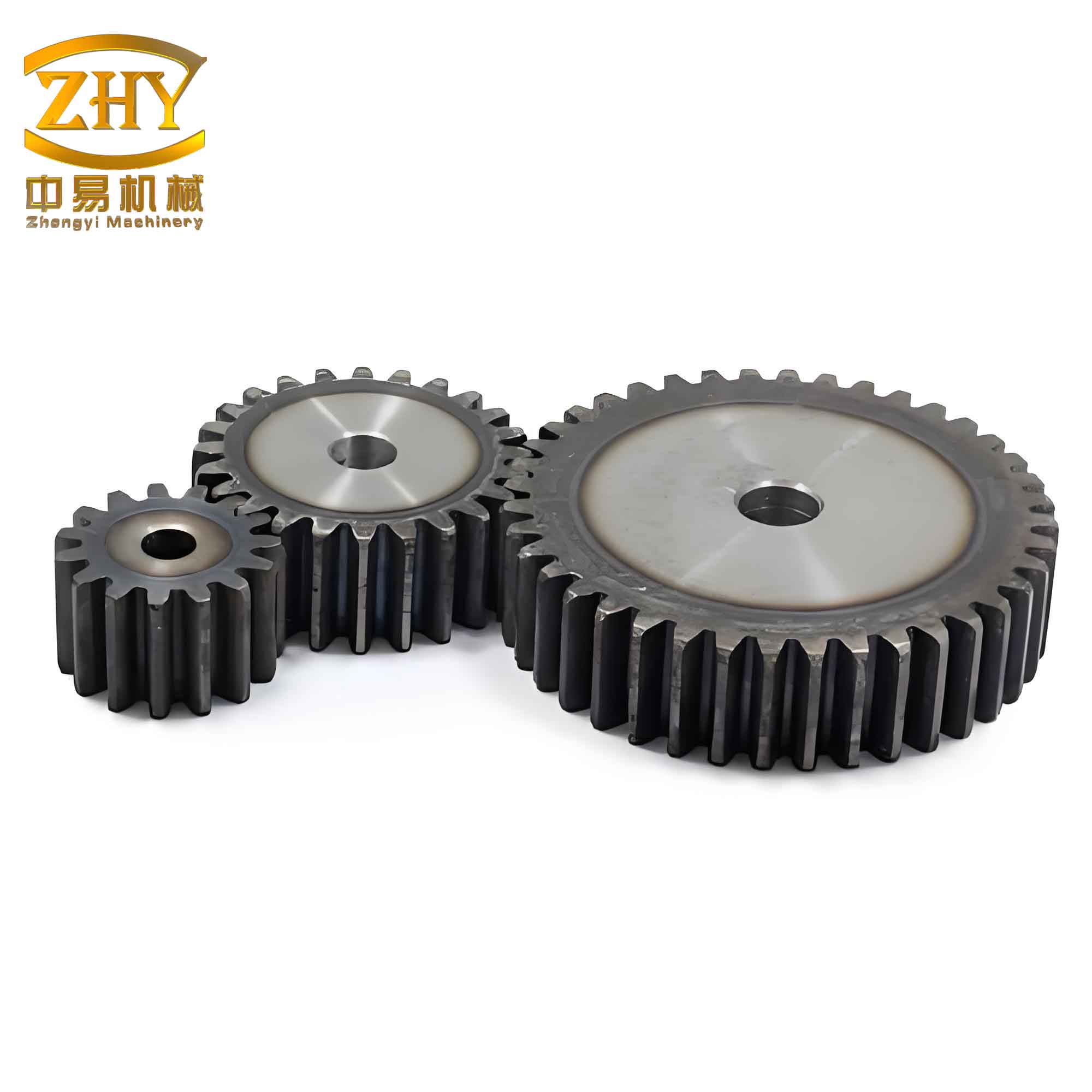
In my research, I focused on a specific cylindrical gear design, commonly used in automotive applications. The cylindrical gear had a pitch diameter of 60 mm, a thickness of 30 mm, a pressure angle of 20°, a module of 3, and 20 teeth. The material selected was 20CrMnMo steel, known for its high strength and toughness, making it suitable for demanding gear applications. The mechanical properties of this steel are crucial for simulating the forging process accurately. I have summarized these properties in Table 1, which includes parameters such as tensile strength, yield strength, elongation, and elastic modulus. Understanding these properties allows for precise modeling of material behavior during deformation, which is essential for predicting模具载荷 and stress distributions in cylindrical gear forging.
| Parameter | Value |
|---|---|
| Tensile Strength | 1250 MPa |
| Yield Strength | 958 MPa |
| Elongation | ≥10% |
| Reduction of Area | ≥45% |
| Impact Energy | ≥55 J |
| Hardness (HB) | ≤217 |
| Poisson’s Ratio | 0.27 |
| Elastic Modulus | 207 GPa |
The closed-die forging process for cylindrical gears involves placing a billet into a confined模具 cavity, where it is compressed by upper and lower punches to form the gear teeth without any flash. While this method is efficient, it results in high模具载荷 due to the constrained metal flow and friction between the billet and模具 surfaces. To quantify these effects, I employed DEFORM-3D, a finite element analysis software widely used for metal forming simulations. The software enables detailed modeling of the forging process, including thermal, mechanical, and tribological aspects. For the cylindrical gear simulation, I created a 3D model of the gear, punches, and die, considering symmetry to reduce computational cost. Only one-fifth of the cylindrical gear was modeled, as it is symmetric, and the mesh was refined in critical areas like the tooth profiles to capture stress concentrations accurately. The simulation parameters are summarized in Table 2, which highlights the settings for friction, material model, and boundary conditions. These parameters are vital for ensuring realistic simulation outcomes, particularly for cylindrical gear forging where precision is paramount.
| Parameter | Setting | |
|---|---|---|
| Material | AISI-4120 (20CrMnMo Steel) | |
| Friction Type | Constant Shear | |
| Friction Coefficient | 0.1 | |
| 模具 Type | Rigid Body | Lower Punch |
| Symmetry Condition | 1/5 Model Applied | |
| Mesh Refinement | Enhanced in Tooth Regions | |
| Simulation Step | Based on Minimum Mesh Size |
In the original closed-die forging process for cylindrical gears, the die is fixed, and the upper punch moves downward to compress the billet. This setup leads to significant friction forces opposing metal flow, especially as the billet fills the tooth cavities. The resulting模具载荷 can be excessively high, jeopardizing模具寿命. To analyze this, I simulated the process and observed the equivalent stress distribution and load-stroke curves. The equivalent stress, often represented by the von Mises criterion, is a key indicator of material deformation and is given by the formula:
$$ \sigma_{eq} = \sqrt{\frac{1}{2}\left[(\sigma_1 – \sigma_2)^2 + (\sigma_2 – \sigma_3)^2 + (\sigma_3 – \sigma_1)^2\right]} $$
where $\sigma_1$, $\sigma_2$, and $\sigma_3$ are the principal stresses. During the forging of cylindrical gears, this stress peaks in areas where metal flow is restricted, such as the tooth roots and tips. My simulation revealed that the original process had a maximum模具载荷 of 778 kN, with high equivalent stresses concentrated in the tooth regions. This underscores the need for process improvements to mitigate these issues in cylindrical gear manufacturing.
To address the high模具载荷 in cylindrical gear forging, I proposed two modified processes: the floating die method and the hole split method. Both aim to reduce friction and facilitate metal flow, thereby lowering the required forming force. In the floating die method, the die is allowed to move downward along with the upper punch, converting the friction force from a resistive to a driving force. This promotes better filling of the tooth cavities, particularly in the lower sections of the cylindrical gear. The mechanics of this method can be described by analyzing the relative velocities between the die and the billet. If the die velocity $v_d$ is greater than the billet velocity $v_b$, the friction force $F_f$ acts downward, aiding deformation. The forming force $F$ can be expressed as:
$$ F = F_0 + \mu \cdot A \cdot p \cdot \text{sgn}(v_d – v_b) $$
where $F_0$ is the base forming force without friction, $\mu$ is the friction coefficient, $A$ is the contact area, $p$ is the contact pressure, and $\text{sgn}$ is the sign function. By optimizing $v_d$, the模具载荷 can be minimized. In my simulation, the floating die method reduced the maximum模具载荷 to 705 kN, a decrease of approximately 10% compared to the original process. This reduction is significant for extending模具寿命 in cylindrical gear production.
The hole split method involves using a billet with a central hole, which acts as a分流 to relieve pressure during forging. This approach reduces the封闭 effect of the die cavity, allowing metal to flow both radially into the tooth profiles and into the central hole. The size of the hole is critical: if too large, it may cause underfilling of the teeth; if too small, it may close prematurely, negating the降载 effect. Through iterative simulations, I determined that a hole diameter between 19 mm and 22 mm is optimal for the cylindrical gear in study. The forming force in this method can be modeled by considering the分流 ratio $R$, defined as the volume of metal flowing into the hole relative to the total volume. The effective forming force $F_{eff}$ is given by:
$$ F_{eff} = F_{total} \cdot (1 – R) $$
where $F_{total}$ is the force required for solid billet forging. My simulations showed that the hole split method achieved a maximum模具载荷 of 589 kN, a reduction of about 25% from the original process. This substantial降载 makes it a promising technique for cylindrical gear forging, especially for high-volume production where模具寿命 is a concern.
To compare the three processes comprehensively, I have summarized the key simulation results in Table 3. This table includes data on maximum equivalent stress,模具载荷, and filling quality for each method. The cylindrical gear’s tooth filling was assessed based on the completeness of the tooth profile, with both modified processes showing improved results over the original. The floating die method enhanced lower tooth filling, while the hole split method maintained good filling with reduced载荷. These findings highlight the effectiveness of process innovations in cylindrical gear forging.
| Process | Maximum Equivalent Stress (MPa) | Maximum模具载荷 (kN) | 载荷 Reduction | Tooth Filling Quality |
|---|---|---|---|---|
| Original Closed-Die | 921 | 778 | 0% | Moderate (Lower teeth may underfill) |
| Floating Die | 902 | 705 | 10% | Good (Improved lower tooth filling) |
| Hole Split | ~900 (estimated) | 589 | 25% | Good (Optimal with hole diameter 19-22 mm) |
In addition to stress and load analysis, I examined the模具载荷-stroke curves for each process, which reveal the forging stages. Typically, cylindrical gear forging involves three stages: upsetting, tooth forming, and final filling. The original process showed a sharp load increase during final filling due to the封闭 cavity, while the modified processes exhibited smoother curves. For instance, in the hole split method, the load remained lower throughout, thanks to the分流 action. This behavior can be described using a piecewise function for load $L$ as a function of stroke $s$:
$$ L(s) = \begin{cases}
L_1(s) & \text{for } 0 \leq s \leq s_1 \text{ (Upsetting)} \\
L_2(s) & \text{for } s_1 < s \leq s_2 \text{ (Tooth Forming)} \\
L_3(s) & \text{for } s_2 < s \leq s_3 \text{ (Final Filling)}
\end{cases} $$
where $L_1$, $L_2$, and $L_3$ are load functions specific to each stage. By optimizing these stages through process modifications, the overall模具载荷 can be reduced, benefiting cylindrical gear manufacturing.
The material behavior during cylindrical gear forging is also influenced by temperature and strain rate, though my simulations assumed isothermal conditions for simplicity. In practice, hot forging of cylindrical gears involves thermal effects that can further affect模具载荷 and wear. The constitutive equation for the steel material can be expressed using the Arrhenius-type model:
$$ \sigma = A \cdot \varepsilon^n \cdot \dot{\varepsilon}^m \cdot \exp\left(\frac{Q}{RT}\right) $$
where $\sigma$ is the flow stress, $\varepsilon$ is the strain, $\dot{\varepsilon}$ is the strain rate, $n$ is the strain hardening exponent, $m$ is the strain rate sensitivity, $Q$ is the activation energy, $R$ is the gas constant, and $T$ is the temperature. For 20CrMnMo steel, these parameters can be determined through experiments, but in my simulation, the software’s built-in material model was used. This highlights the complexity of cylindrical gear forging and the need for advanced simulation tools like DEFORM-3D.
To validate the simulation results, I conducted practical tests on a press machine, producing cylindrical gear samples using both modified processes. The floating die method utilized a cylindrical billet, while the hole split method used a ring-shaped billet with a central hole. The forged cylindrical gears exhibited complete tooth filling and good surface quality, consistent with the simulations. The measured模具载荷 were 658 kN for the floating die method and 534 kN for the hole split method, with errors within 10% of the simulated values. This correlation confirms the reliability of the DEFORM-3D simulations for cylindrical gear forging optimization.
The implications of these findings are significant for the industry. By adopting the floating die or hole split methods, manufacturers can produce cylindrical gears with lower模具载荷, extending模具寿命 and reducing downtime. This translates to cost savings and improved productivity. Moreover, the enhanced filling quality ensures that cylindrical gears meet stringent dimensional tolerances and performance standards. As a researcher, I believe that continuous innovation in forging processes is essential for advancing cylindrical gear technology, particularly in applications like electric vehicles and renewable energy systems, where efficiency and durability are critical.
In conclusion, my study demonstrates that process modifications such as the floating die and hole split methods can effectively reduce模具载荷 in the precision forging of cylindrical gears. Through DEFORM-3D simulations, I showed that these methods lower the maximum load by 10% and 25%, respectively, while maintaining or improving tooth filling. The use of tables and formulas has helped summarize key data, such as material properties and simulation results. The cylindrical gear, as a fundamental mechanical component, benefits greatly from these optimizations, paving the way for more sustainable and efficient manufacturing. Future work could explore hybrid approaches or real-time control systems to further enhance cylindrical gear forging processes. Ultimately, this research contributes to the broader goal of improving metal forming techniques for high-performance cylindrical gears in various engineering applications.
To further elaborate on the mechanics, the reduction in模具载荷 can be quantified using the concept of effective stress and strain energy. The total work done $W$ during forging of a cylindrical gear is given by the integral of stress over volume:
$$ W = \int_V \sigma_{ij} \, d\varepsilon_{ij} \, dV $$
where $\sigma_{ij}$ is the stress tensor and $\varepsilon_{ij}$ is the strain tensor. By reducing friction through the floating die or分流 through the hole split method, the work required decreases, leading to lower模具载荷. This principle applies broadly to cylindrical gear forging and other closed-die processes. Additionally, the wear rate of模具 materials can be estimated using Archard’s wear model:
$$ V = k \cdot \frac{F \cdot s}{H} $$
where $V$ is the wear volume, $k$ is the wear coefficient, $F$ is the normal load, $s$ is the sliding distance, and $H$ is the material hardness. By lowering $F$ through process improvements, the wear volume $V$ is reduced, directly extending模具寿命. This is crucial for cylindrical gear production, where模具 costs are substantial.
In summary, the precision forging of cylindrical gears is a complex but rewarding field. My research highlights the power of simulation-driven optimization to address practical challenges like high模具载荷. By leveraging techniques like the floating die and hole split methods, we can achieve more efficient and durable manufacturing processes for cylindrical gears. I encourage industry practitioners to explore these innovations and adapt them to their specific cylindrical gear applications, ensuring continued advancement in gear technology.