
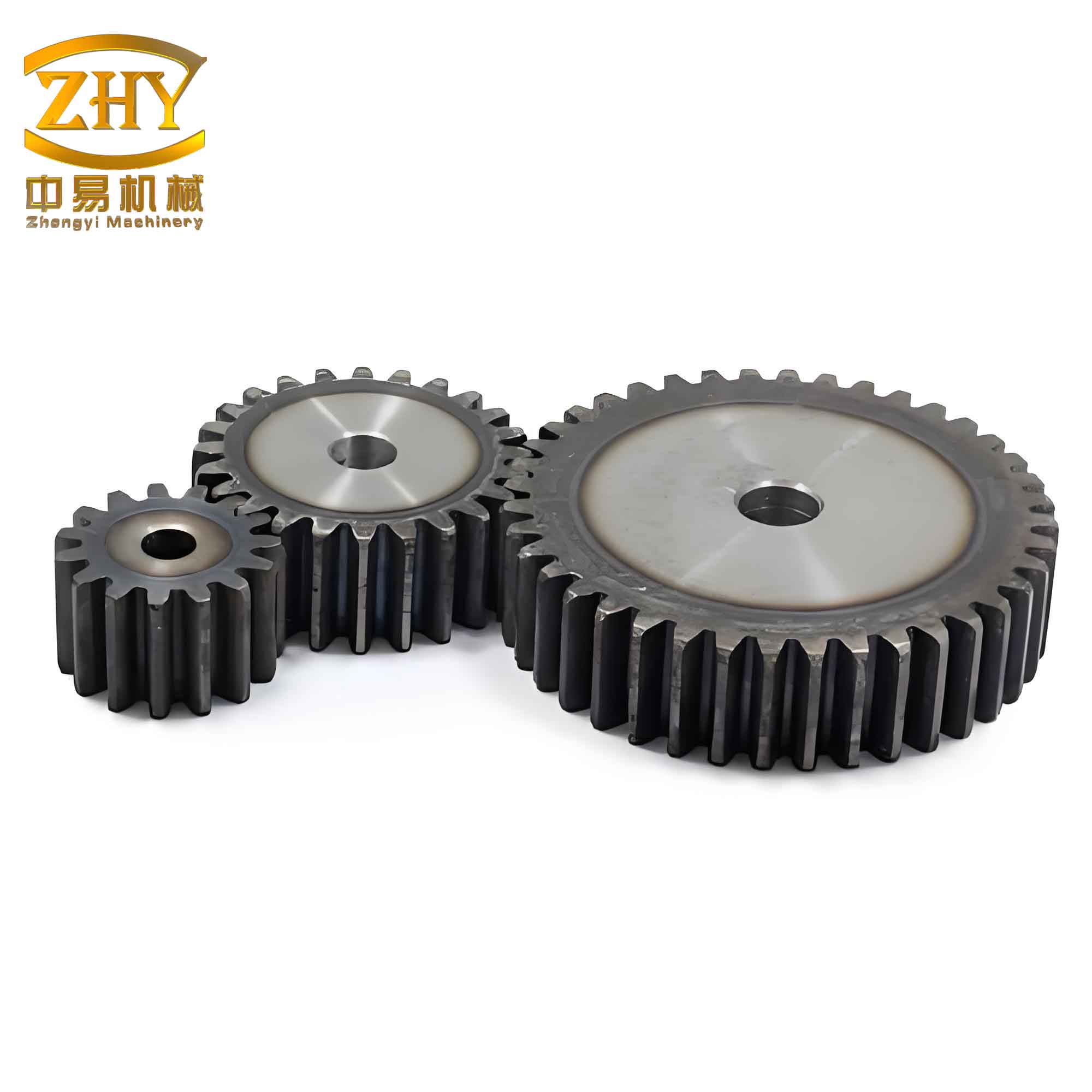
Involute cylindrical gears are fundamental components in mechanical power transmission systems, prized for their high load-bearing capacity, operational efficiency, and cost-effectiveness in manufacturing and maintenance. However, the prolonged service of these cylindrical gear pairs inevitably subjects them to friction and wear at the meshing interfaces. This degradation leads to a decline in transmission accuracy and efficiency, ultimately manifesting as increased vibration and noise. To counteract these effects and restore optimal performance, gear tooth profile modification, or “crowning,” is employed. This process intentionally alters the micro-geometry of the tooth flanks to compensate for errors, deflections, and misalignments, thereby promoting a more favorable contact pattern, reducing stress concentrations, and enhancing the overall durability and reliability of the cylindrical gear transmission.
This study presents a detailed numerical investigation into the effects of drum-type tooth profile modification on the contact stress behavior and bending fatigue lifetime of parallel-axis involute spur cylindrical gears. Utilizing a combined approach of three-dimensional geometric modeling and advanced finite element analysis (FEA), we systematically evaluate how controlled modifications along both the tooth profile (height) and face width (lead) directions influence the gear pair’s performance under ideal and misaligned installation conditions.
Fundamentals of Involute Cylindrical Gear Geometry
The tooth profile of a standard spur cylindrical gear is defined by an involute curve generated from a base circle. The parametric equations for a point \(K\) on this involute in a Cartesian coordinate system are given by:
$$ x_k = r_b \sin u_k – r_b u_k \cos u_k $$
$$ y_k = r_b \cos u_k + r_b u_k \sin u_k $$
where \(r_b\) is the base circle radius, and \(u_k\) is the sum of the roll angle \(\theta_k\) and the pressure angle \(\alpha_k\) at point \(K\). The key dimensional parameters of a standard cylindrical gear are derived from five basic parameters: number of teeth \(z\), module \(m\), pressure angle \(\alpha\), addendum coefficient \(h_a^*\), and dedendum coefficient \(c^*\). For this study, the cylindrical gear pair was designed with symmetric parameters for both pinion and gear, as summarized below.
| Parameter | Symbol | Value | Unit |
|---|---|---|---|
| Number of Teeth | \(z_1, z_2\) | 40 | – |
| Module | \(m\) | 2 | mm |
| Pressure Angle | \(\alpha\) | 20 | ° |
| Addendum Coefficient | \(h_a^*\) | 1.0 | – |
| Dedendum Coefficient | \(c^*\) | 0.25 | – |
| Pitch Diameter | \(d\) | 80 | mm |
| Base Circle Diameter | \(d_b\) | ~75.18 | mm |
| Face Width | \(b\) | 20 | mm |
| Addendum | \(h_a\) | 2.0 | mm |
| Dedendum | \(h_f\) | 2.5 | mm |
Drum Tooth Modification Strategy
To mitigate edge loading and stress peaks caused by misalignment and deformation, a parabolic drum modification was applied to the tooth flanks of the cylindrical gear. This modification involves removing a small amount of material from the theoretical involute profile, creating a slight convex curvature. Two types of crowning were applied simultaneously: profile crowning (along the tooth height) and lead crowning (along the face width).
Establishing a coordinate system with its origin \(O\) at the intersection of the pitch circle and the tooth centerline, the x-axis along the outward tooth normal, the y-axis along the profile direction (positive towards the addendum), and the z-axis along the lead direction, the modification amount \(\Delta x\) is defined by parabolic functions:
Profile Crowning:
$$ \Delta x(y) = C_{\alpha} \left( \frac{ [y + (h_f – c)] – y_0 }{ y_0 } \right)^2, \quad – (h_f – c) \le y \le h_a $$
Lead Crowning:
$$ \Delta x(z) = C_{\beta} \left( \frac{ (z + b_f) – z_0 }{ z_0 } \right)^2, \quad – b_f \le z \le b_r $$
Here, \(C_{\alpha}\) and \(C_{\beta}\) are the maximum profile and lead crowning amounts, respectively. \(y_0\) and \(z_0\) are the symmetry points, typically set at the center of the modification zone (\(y_0 = h_f – c\), \(z_0 = b_f = b/2\)). Six modification cases were studied, ranging from no modification to increasingly significant crowning.
| Modification Case | Max Profile Crowning \(C_{\alpha}\) (µm) | Max Lead Crowning \(C_{\beta}\) (µm) |
|---|---|---|
| Case 1 (Unmodified) | 0 | 0 |
| Case 2 | 2 | 2 |
| Case 3 | 4 | 4 |
| Case 4 | 6 | 6 |
| Case 5 | 8 | 8 |
| Case 6 | 10 | 10 |
Finite Element Modeling and Analysis Methodology
Three-dimensional solid models of the cylindrical gear pairs for all six cases were created. The material assigned was 40Cr alloy steel, with properties essential for structural and fatigue analysis.
| Material Property | Value |
|---|---|
| Density \(\rho\) | 7870 kg/m³ |
| Young’s Modulus \(E\) | 211 GPa |
| Poisson’s Ratio \(\nu\) | 0.277 |
| Yield Strength \(\sigma_{0.2}\) | 785 MPa |
| Tensile Strength \(\sigma_b\) | 980 MPa |
The models were discretized using a 10-node tetrahedral (Tet10) element, with local mesh refinement in the potential contact zones to ensure accuracy in stress resolution. The resulting mesh statistics are shown below.
| Modification Case | Number of Elements | Number of Nodes |
|---|---|---|
| Case 1 | 223,961 | 383,685 |
| Case 2 | 246,221 | 419,235 |
| Case 3 | 246,458 | 419,563 |
| Case 4 | 245,773 | 418,609 |
| Case 5 | 246,392 | 419,390 |
| Case 6 | 246,660 | 419,513 |
A transient dynamic analysis was performed to simulate one complete meshing cycle. The pinion was driven with a constant angular velocity of 2 rad/s, while the gear was subjected to a resisting torque. For the ideal alignment condition, a torque of 15,000 N·mm was applied. A frictional contact formulation (Coulomb friction, \(\mu=0.15\)) was defined between all potential tooth flank surfaces.
Subsequent to the dynamic analysis, a fatigue life assessment was conducted using the stress-life (S-N) approach within the fatigue module. The S-N curve for 40Cr steel was characterized by a three-parameter equation fitted to experimental data:
$$ N_f = C (\sigma_m – \sigma_{ac})^{-m} $$
where \(N_f\) is the fatigue life in cycles, \(\sigma_m\) is the mean stress, and \(\sigma_{ac}\), \(C\), and \(m\) are material constants. The fitted curve for the cylindrical gear material was:
$$ N_f = 1.82524 \times 10^{11} (\sigma_m – 250)^{-2.12613} $$
Results and Discussion: Ideal Alignment Condition
Under perfectly aligned conditions, the transient contact analysis revealed significant differences between the unmodified and modified cylindrical gears.
Contact Stress Analysis: The unmodified cylindrical gear pair (Case 1) exhibited meshing interference, with stress distributed across multiple teeth and pronounced stress concentrations at the pitch line and root fillets. The maximum von Mises stress was 107.37 MPa. Introduction of a small crowning (Case 2, 2 µm) effectively eliminated interference, localizing the contact patch to the central region of the tooth flank. The stress distribution became more uniform from the center towards the edges, and the maximum stress reduced slightly to 103.13 MPa.
As the crowning amount increased further (Cases 3 to 6), the contact area became progressively smaller and more centralized. This led to a general increase in the maximum contact stress: 158.35 MPa (Case 3), 201.54 MPa (Case 4), 165.8 MPa (Case 5), and 247.52 MPa (Case 6). The non-monotonic increase, notably the lower stress in Case 5, was attributed to a broader stress distribution in the root region for that specific geometry. The temporal fluctuation of contact stress also amplified with larger crowning, indicating a more dynamic and potentially more fatiguing load cycle.
Fatigue Life Prediction: The fatigue life calculations under ideal alignment yielded a clear trend. The unmodified cylindrical gear demonstrated the highest predicted life at approximately 23.73 million cycles. Fatigue life decreased with increasing modification: ~19.94 million (Case 2), ~6.10 million (Case 3), ~2.30 million (Case 4), ~2.55 million (Case 5), and plummeted to below 0.05 million cycles for the heavily modified Case 6. This indicates that while minor crowning improves meshing smoothness, any crowning under ideal conditions inherently reduces the contact area, raising stress levels and, consequently, reducing the bending fatigue lifetime of the cylindrical gear teeth.
| Modification Case | Max von Mises Stress (MPa) | Predicted Fatigue Life (Cycles) |
|---|---|---|
| Case 1 | 107.37 | 2.373 × 10⁷ |
| Case 2 | 103.13 | 1.994 × 10⁷ |
| Case 3 | 158.35 | 6.105 × 10⁶ |
| Case 4 | 201.54 | 2.299 × 10⁶ |
| Case 5 | 165.80 | 2.551 × 10⁶ |
| Case 6 | 247.52 | < 5.0 × 10⁴ |
Results and Discussion: Effect of Axis Misalignment
To simulate a practical installation error, analyses were repeated with the gear axis intentionally offset by angles of 0.1°, 0.2°, 0.3°, and 0.4°. The resisting torque was slightly reduced to 14,000 N·mm to aid convergence.
Contact Stress Under Misalignment: For the unmodified cylindrical gear (Case 1), axis misalignment caused severe edge loading. The contact patch shifted to one end of the tooth face, creating a highly localized and intense stress concentration. The maximum stress increased drastically with misalignment angle. Crowning dramatically improved this condition. Even a small 2 µm crowning (Case 2) reduced the stress and began to recenter the contact. For crowning amounts of 4 µm and above (Cases 3-6), the contact patch was successfully maintained near the center of the tooth flank for all misalignment angles studied, demonstrating the robustness of the modification.
The table below exemplifies the stress results for a 0.2° misalignment, showing the corrective effect of increasing crowning on the unmodified gear’s severe edge stress.
| Modification Case | Max von Mises Stress at 0.2° Offset (MPa) |
|---|---|
| Case 1 | 366.98 |
| Case 2 | 283.79 |
| Case 3 | 168.23 |
| Case 4 | 176.56 |
| Case 5 | 190.87 |
| Case 6 | 189.94 |
Fatigue Life Under Misalignment: The fatigue life trends under misalignment were reversed compared to the ideal case. The unmodified cylindrical gear suffered catastrophic life reduction due to edge loading, with life falling below 100,000 cycles for larger misalignments. The modified gears, particularly those with moderate to high crowning (Cases 3-6), exhibited remarkable resilience. Their predicted fatigue lives remained relatively high and stable across the range of misalignment angles, often in the order of millions of cycles. This highlights the critical role of profile modification in ensuring the durability and reliability of cylindrical gear transmissions in real-world applications where perfect alignment cannot be guaranteed.
The following table summarizes the fatigue life for a 0.3° axis offset, illustrating the stability offered by sufficient crowning.
| Modification Case | Predicted Fatigue Life at 0.3° Offset (Cycles) |
|---|---|
| Case 1 | ~1.0 × 10⁵ |
| Case 2 | ~2.5 × 10⁶ |
| Case 3 | ~2.5 × 10⁷ |
| Case 4 | ~1.0 × 10⁸ |
| Case 5 | ~1.0 × 10⁸ |
| Case 6 | ~1.0 × 10⁸ |
Conclusions
This comprehensive numerical study elucidates the complex role of drum tooth profile modification in the performance of parallel-axis involute spur cylindrical gears. The primary conclusions are as follows:
- Under Ideal Alignment: Unmodified cylindrical gears are prone to meshing interference. While even minor crowning eliminates this interference and improves meshing smoothness, it simultaneously reduces the effective contact area. This leads to increased contact stress and a consequent decrease in predicted bending fatigue life compared to the unmodified gear. Excessive crowning can cause severe stress concentration and premature failure.
- Under Axis Misalignment: The unmodified cylindrical gear is highly sensitive to installation errors, developing severe edge loading that drastically shortens its service life. Drum-type modification is essential in this scenario. Adequate crowning amounts successfully re-center the load distribution, mitigate stress peaks, and restore a high and stable fatigue lifetime. The robustness of the cylindrical gear transmission to misalignment is significantly enhanced.
- Design Trade-Off: The selection of an optimal crowning amount for a cylindrical gear pair represents a critical design compromise. For applications where near-perfect alignment can be maintained, minimal or no modification may yield the longest fatigue life. However, for most practical applications where some degree of misalignment is inevitable, a deliberate, optimized level of profile and lead crowning is indispensable. It trades a marginal potential life reduction under perfect conditions for a massive life increase and reliable operation under realistic, imperfect conditions.
The findings provide a quantitative framework and valuable insights for engineers to optimize the micro-geometry of cylindrical gears, balancing meshing quality, load distribution, and fatigue resistance to achieve durable and reliable gear transmission systems.