
In modern manufacturing, cylindrical gears are critical transmission components widely used in automotive and mechanical systems. Their performance and longevity directly impact the efficiency and reliability of high-end equipment. Traditional machining methods, such as hobbing and shaving, often compromise the metal flow lines in the tooth regions, leading to reduced strength and service life. To address these issues, I have designed and investigated a one-step extrusion forming process for spur gears, aiming to enhance production efficiency, material utilization, and mechanical properties. This study encompasses process design, finite element simulation, experimental validation, and optimization of die structures, process parameters, and die materials, with a focus on improving die lifespan and gear quality.
The extrusion forming process involves three stages: blank cutting, heating, and extrusion. A cylindrical blank is prepared and preheated along with the lower die to improve plasticity and prevent thermal shock. The upper die, comprising a tooth section and a cylindrical body, applies vertical force to radially form the gear teeth into the lower die’s cavity. Excess material flows axially upward as flash, reducing forming resistance. Key parameters include blank dimensions, temperatures, friction coefficients, and feed speeds. The finite element model was established using DEFORM-3D, with the blank material as 20CrMnTiH steel and dies as H13 steel. Mesh independence was confirmed with over 100,000 elements, and simulations analyzed metal flow, equivalent strain, and die wear.
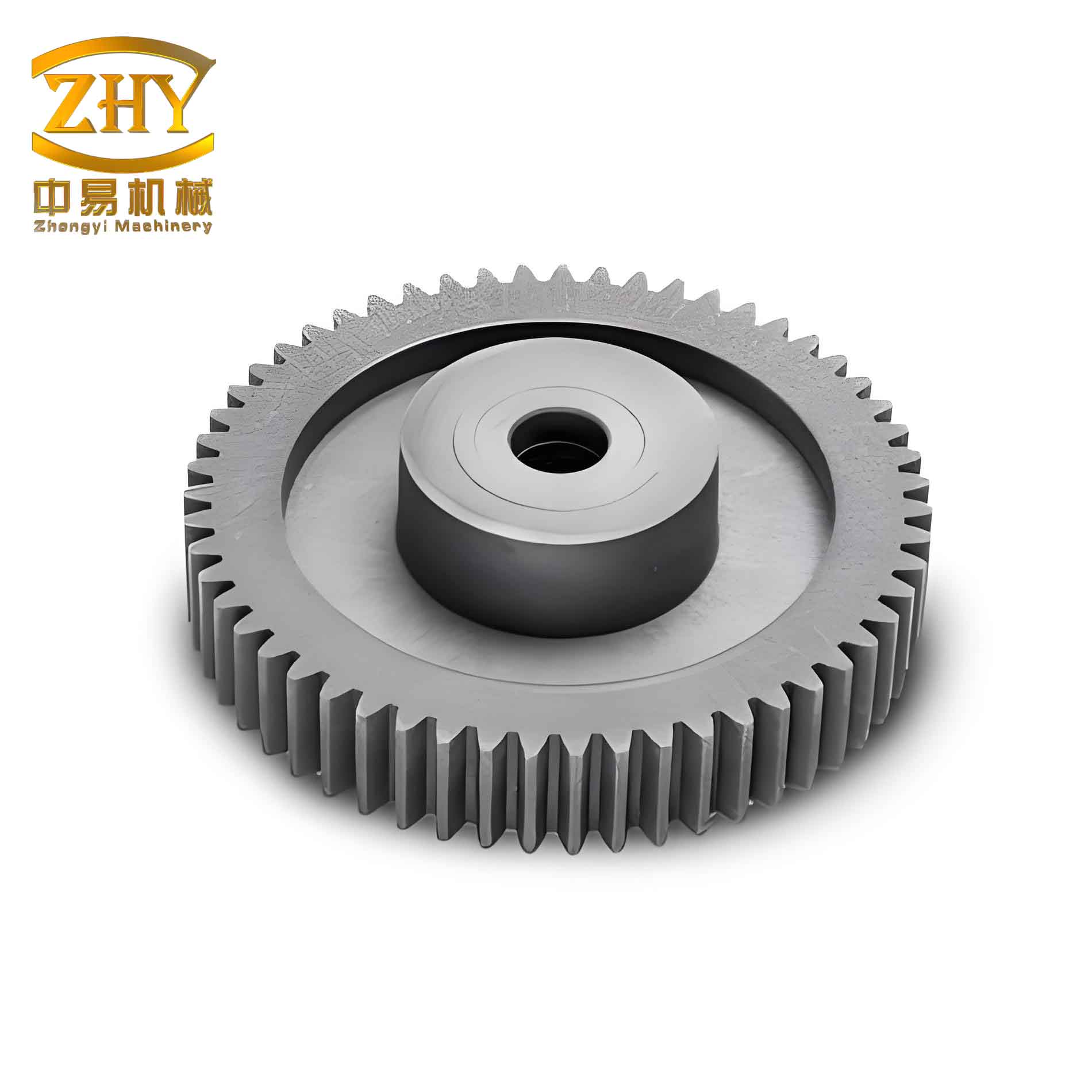
Simulation results revealed that metal flow during extrusion ensured complete filling of the tooth cavities. Radial displacement at the tooth tips was uniform, indicating full formation. The equivalent strain distribution was relatively even across different tooth regions, suggesting homogeneous plastic deformation and high forming quality. This uniformity is crucial for enhancing the strength of cylindrical gears. Experimental validation involved extruding gears under optimized conditions, with blank preheating at 800°C, die preheating at 300°C, and a feed speed of 7.5 mm/s. The formed gears exhibited complete tooth profiles, and metal flow lines observed through etching were continuous and consistent, aligning with simulation predictions. This confirms the feasibility of the extrusion process and its advantage in preserving metal flow integrity.
To optimize die life, the wear of the lower die was analyzed using the Archard wear model, which relates wear depth to contact pressure, sliding distance, and temperature-dependent hardness and wear coefficient. The model is expressed as:
$$ W(T) = K(T) \frac{P L}{H(T)} $$
where \(W(T)\) is the wear depth, \(K(T)\) is the temperature-dependent wear coefficient, \(P\) is the contact pressure, \(L\) is the sliding length, and \(H(T)\) is the temperature-dependent hardness. For H13 steel, empirical relationships were used:
$$ H(T) = 9216.4 \times T^{-0.505} $$
$$ K(T) = (29.29 \times \ln T – 168.73) \times 10^{-6} $$
Wear was most severe during the final extrusion stage due to increased loads and friction. To mitigate this, the upper die structure was modified by adding fillet radii at the tooth base. Different radii (0–10 mm) were tested, and a 6 mm radius was optimal, balancing gear filling and die wear. Additionally, the feed allowance (Δh) was optimized to reduce the extrusion stroke while ensuring gear precision. The relationship between feed allowance and blank volume is summarized in Table 1.
| Feed Allowance (mm) | Blank Height (mm) | Blank Radius (mm) | Die Wear Depth (10⁻⁶ mm) |
|---|---|---|---|
| 0.5 | 65.5 | 32 | 2.21 |
| 1.0 | 65.6 | 32 | 2.02 |
| 1.5 | 65.7 | 32 | 1.83 |
| 2.0 | 66.0 | 33 | 1.85 |
| 2.5 | 66.3 | 33 | 1.89 |
| 3.0 | 67.0 | 33 | 2.01 |
A feed allowance of 1.5 mm with a blank height of 65.7 mm and radius of 32 mm minimized wear. Process parameters were further optimized using response surface methodology (Box-Behnken design) with factors including die preheating temperature, friction coefficient, and feed speed. The quadratic model for wear depth \(W\) was derived as:
$$ W = 52.36975 – 0.01885T – 98.255\mu – 4.0593V + 0.026T\mu – 0.00776TV + 4.3V\mu + 0.000115T^2 + 98.3\mu^2 + 0.30812V^2 $$
where \(T\) is die preheating temperature (°C), \(\mu\) is friction coefficient, and \(V\) is feed speed (mm/s). Optimal parameters were identified as: \(T = 280°C\), \(\mu = 0.27\), and \(V = 8.3\) mm/s, yielding a maximum wear depth of \(1.77 \times 10^{-6}\) mm. Based on cumulative wear data from multiple extrusion simulations, die life was predicted using a fitted polynomial:
$$ W_n = 1.74 – 4.49 \times 10^{-3}n + 4.17 \times 10^{-5}n^2 $$
where \(W_n\) is cumulative wear depth (\(10^{-4}\) mm) after \(n\) extrusions. Assuming a maximum allowable wear of 0.5 mm, the die can produce approximately 11,000 cylindrical gears before failure.
For die material enhancement, (Ti,W)C-based cermet composites with micro/nano Al₂O₃ additions were developed via spark plasma sintering (SPS). Compositions varied in nano-Al₂O₃ content (0–30 wt.%), with fixed micro-Al₂O₃, Ni, Co, and Mo. Sintering was conducted at 1450°C under 30 MPa for 10 minutes. The effects on microstructure and mechanical properties are shown in Table 2.
| Material Code | Nano-Al₂O₃ (wt.%) | Relative Density (%) | Grain Size (μm) | Flexural Strength (MPa) | Vickers Hardness (GPa) | Fracture Toughness (MPa·m¹/²) |
|---|---|---|---|---|---|---|
| nW0 | 0 | 97.2 ± 0.18 | 2.24 ± 0.23 | 820 ± 20 | 18.02 ± 0.63 | 7.5 ± 0.25 |
| nW10 | 10 | 98.1 ± 0.15 | 1.45 ± 0.19 | 890 ± 18 | 18.75 ± 0.40 | 8.3 ± 0.27 |
| nW15 | 15 | 98.8 ± 0.21 | 1.23 ± 0.21 | 940 ± 23 | 19.01 ± 0.35 | 8.9 ± 0.29 |
| nW25 | 25 | 97.5 ± 0.24 | 1.68 ± 0.25 | 860 ± 22 | 18.30 ± 0.42 | 8.1 ± 0.30 |
| nW30 | 30 | 96.8 ± 0.28 | 2.01 ± 0.27 | 800 ± 25 | 17.85 ± 0.50 | 7.8 ± 0.28 |
The nW15 composition (15 wt.% nano-Al₂O₃) exhibited optimal properties, attributed to grain refinement and improved interfacial bonding. Thermal shock resistance was evaluated by quenching pre-cracked samples from various temperatures (200–500°C). Crack extension rates were lower for nW10 and nW15, indicating better resistance. The thermal shock resistance parameter \(R\) is given by:
$$ R = \frac{\sigma_f (1 – \nu)}{E \alpha} $$
where \(\sigma_f\) is tensile strength, \(\nu\) is Poisson’s ratio, \(E\) is elastic modulus, and \(\alpha\) is thermal expansion coefficient. Lower \(E\) and \(\alpha\) enhance resistance, which aligns with the performance of Al₂O₃-added cermets. Friction and wear tests against silicon nitride balls showed that nW15 had the lowest friction coefficient (0.44) and wear rate (\(3.92 \times 10^{-6}\) mm/N·m), due to its high hardness and dense microstructure.
To fabricate the lower die for cylindrical gear extrusion, a reverse forming process was designed. A graphite mold with an internal gear shape was used to sinter the cermet powder via SPS. After sintering, the die was measured using a coordinate measuring machine. Deviations in tooth profile dimensions were less than 1%, meeting precision requirements. This demonstrates the feasibility of powder sintering for producing complex extrusion dies.
In conclusion, the one-step extrusion process for cylindrical gears is viable and offers advantages in metal flow continuity and forming quality. Optimization of die geometry and process parameters significantly reduces wear, extending die life to approximately 11,000 cycles. The development of (Ti,W)C-based cermets with micro/nano Al₂O₃ additions provides a superior die material with enhanced mechanical properties, thermal shock resistance, and wear performance. Future work should focus on experimental validation of optimized parameters and further refinement of cermet compositions for industrial applications. This research contributes to advancing precision forming technologies for cylindrical gears, promoting efficiency and sustainability in manufacturing.