
In modern mechanical transmission systems, the efficiency of gear drives is a critical factor influencing energy consumption, operational costs, and environmental impact. As industries such as automotive, wind energy, and heavy machinery strive for higher performance, minimizing power losses in gears has become a paramount concern. Among various gear types, the cylindrical gear with variable hyperboloid circular-arc-tooth trace (VH-CATT cylindrical gear) presents unique structural and transmission characteristics that offer potential advantages in load distribution and noise reduction. However, its power loss mechanisms, particularly under splash lubrication conditions, require thorough investigation to optimize design and enhance efficiency. This study focuses on analyzing the power loss of VH-CATT cylindrical gears, combining theoretical calculations, numerical simulations using the Smooth Particle Hydrodynamics (SPH) method, and experimental validation with an FZG test bench. The goal is to understand how factors like rotational speed, lubricant viscosity, and oil immersion depth affect power loss, thereby providing insights for improving the transmission efficiency of cylindrical gears in practical applications.
The power loss in gears during operation primarily stems from two sources: churning loss due to lubricant interaction and windage loss from air or oil-air mixture drag. For cylindrical gears, these losses can significantly reduce overall efficiency, especially at high speeds or under specific lubrication conditions. The VH-CATT cylindrical gear, with its curved tooth trace geometry, may exhibit distinct fluid dynamics behavior compared to conventional spur or helical gears. Therefore, a detailed analysis is essential to quantify these losses and develop strategies for mitigation. In this work, we adopt a multidisciplinary approach, integrating fluid mechanics theory, computational simulations, and experimental measurements to explore the power loss characteristics of VH-CATT cylindrical gears. We begin by establishing theoretical models for churning and windage losses, then proceed to create a three-dimensional model based on an FZG gearbox for simulation, followed by validation through physical tests. Throughout this article, we will emphasize the role of cylindrical gears in transmission systems and how their design parameters influence power dissipation.
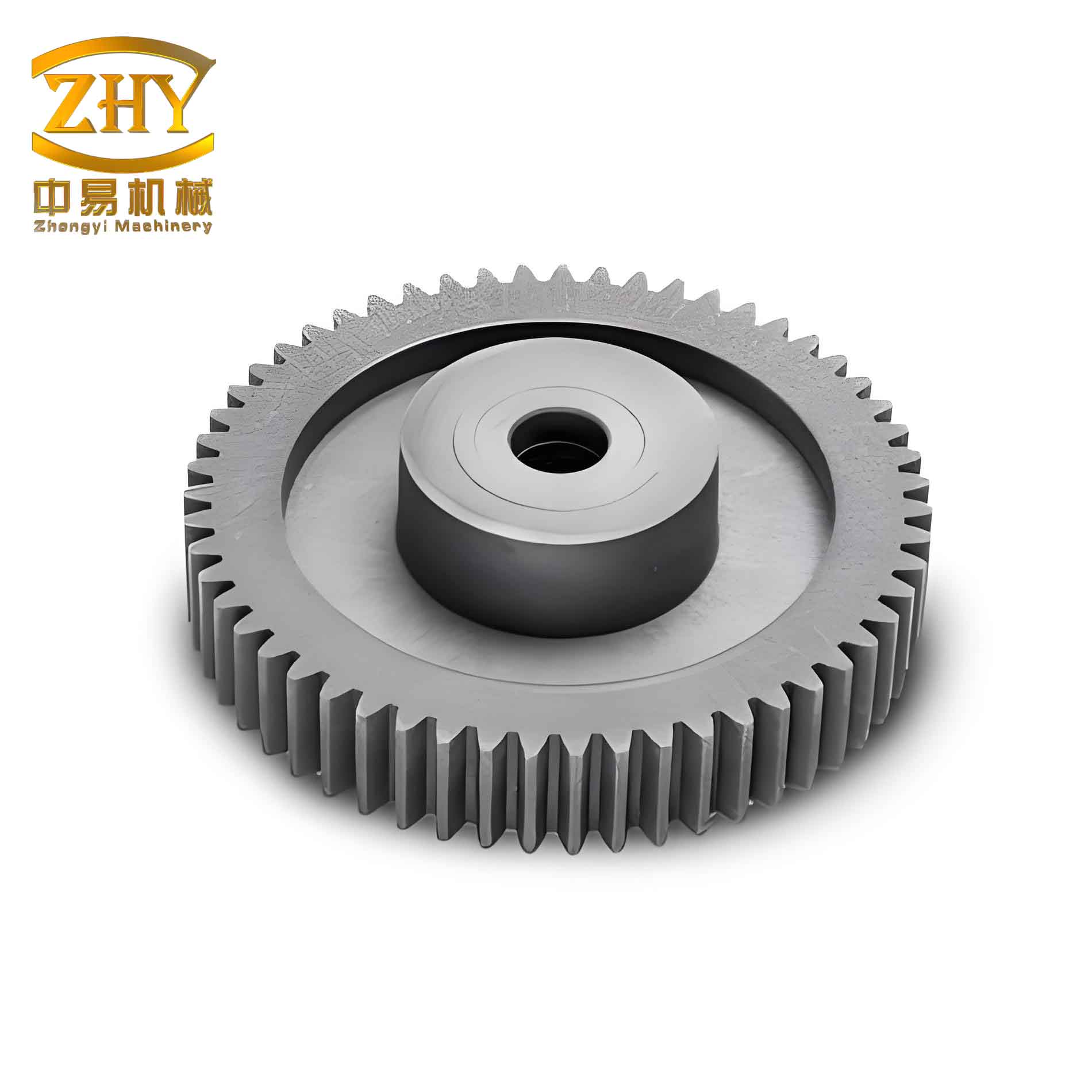
The theoretical calculation of power loss for cylindrical gears involves deriving formulas for both churning and windage losses based on fluid dynamics principles. Churning loss occurs when the gear rotates through a lubricant bath, causing viscous drag and fluid agitation. For a cylindrical gear, this loss can be decomposed into three components: loss due to the gear periphery (related to tooth interaction), loss from the gear side faces, and loss from the squeezing effect in the meshing zone. The total churning power loss, \( P_{\text{churning}} \), is given by the sum of these parts:
$$ P_1 = \frac{7.37 f_g v n^3 d^{4.7} L}{A_g \times 10^{26}} $$
$$ P_2 = \frac{1.474 f_g v n^3 d^{5.7}}{A_g \times 10^{26}} $$
$$ P_3 = \frac{7.37 f_g v n^3 d^{4.7} B R_f / \tan \beta}{A_g \times 10^{26}} $$
$$ P_{\text{churning}} = P_1 + P_2 + P_3 $$
In these equations, \( m_t \) is the module, \( B \) is the face width, \( f_g \) is the gear immersion factor defined as \( f_g = h / d_a \) (where \( h \) is the immersion depth and \( d_a \) is the tip diameter), \( v \) is the kinematic viscosity of the lubricant, \( d \) is the pitch diameter, \( n \) is the rotational speed, \( A_g \) is a gear arrangement constant (taken as 0.2 in this study), \( R_f \) is the surface roughness factor, \( L \) is the shaft length in contact with lubricant, and \( \beta \) is the helix angle. For cylindrical gears, these parameters must be carefully selected to reflect the specific geometry of the VH-CATT design. The churning loss increases with speed and lubricant viscosity, as shown in theoretical curves, highlighting the importance of optimizing these variables for cylindrical gear applications.
Windage loss, on the other hand, arises from the drag between the rotating cylindrical gear and the surrounding air or oil-air mixture. This loss becomes more pronounced at high speeds and can contribute significantly to total power dissipation. Based on Anderson’s model, the windage power loss for a cylindrical gear pair can be expressed as:
$$ P_{\text{driver}} = C \left(1 + 2.3 \frac{B}{R_{\text{driver}}}\right) \rho^{0.8} n^{2.8} R_{\text{driver}}^{4.6} v^{0.2} $$
$$ P_{\text{follower}} = C \left(1 + 2.3 \frac{B}{R_{\text{follower}}}\right) \rho^{0.8} \left(\frac{n}{u}\right)^{2.8} R_{\text{follower}}^{4.6} v^{0.2} $$
$$ P_{\text{windage}} = P_{\text{driver}} + P_{\text{follower}} $$
$$ \rho = \frac{\rho_0 + 34.25 \rho_a}{35.25} $$
$$ v = \frac{v_0 + 34.25 v_a}{35.25} $$
Here, \( C \) is a proportionality constant (2.4 × 10^{-8}), \( \rho \) is the density of the oil-air mixture, \( v \) is its kinematic viscosity, \( \rho_0 \) and \( v_0 \) are the density and viscosity of the lubricant, and \( \rho_a \) and \( v_a \) are those of air. For cylindrical gears, windage loss tends to scale with the fourth power of the pitch radius, making larger gears more susceptible to this type of loss. In high-speed transmissions, minimizing windage is crucial for enhancing the efficiency of cylindrical gear systems.
To complement these theoretical models, we employ numerical simulations using the Smooth Particle Hydrodynamics (SPH) method, which is well-suited for analyzing multiphase flows like those in gearbox splash lubrication. SPH is a meshless Lagrangian technique that represents fluid as discrete particles, allowing for accurate tracking of free surfaces and complex interactions between lubricant and air. This approach avoids issues associated with traditional grid-based CFD methods, such as mesh distortion and convergence difficulties, making it ideal for simulating the dynamic behavior of cylindrical gears in oil baths. The governing equations in SPH for fluid dynamics include the continuity, momentum, and energy equations, discretized into particle-based formulations:
$$ \frac{d\rho_i}{dt} = \sum_j m_j (u_j – u_i) \nabla_i W_{ij} $$
$$ \frac{du_i}{dt} = \sum_j m_j \left( \frac{S_j}{\rho_i^2} – \frac{S_i}{\rho_j^2} \right) \nabla_i W_{ij} + g_i $$
$$ \frac{de_i}{dt} = \frac{1}{2} \sum_j m_j \left( \frac{S_j}{\rho_i^2} – \frac{S_i}{\rho_j^2} \right) : (u_j – u_i) \nabla_i W_{ij} – \sum_j m_j \left( \frac{q_j}{\rho_i^2} – \frac{q_i}{\rho_j^2} \right) \nabla_i W_{ij} $$
In these equations, \( \rho_i \) is the density of particle \( i \), \( u_i \) is its velocity, \( m_j \) is the mass of neighboring particle \( j \), \( W_{ij} \) is the smoothing kernel function, \( S \) is the stress tensor, \( g_i \) is body force, and \( e_i \) is specific internal energy. For simulating cylindrical gear power loss, we apply these SPH formulations to model the two-phase flow of lubricant and air inside a gearbox, capturing effects like oil splash, droplet formation, and air entrainment.
Our simulation model is based on an FZG gearbox, a standard test configuration for gear efficiency studies. We created a three-dimensional geometry of the gearbox using CAD software, focusing on the VH-CATT cylindrical gear pair with parameters as listed in Table 1. The gearbox includes essential components like gears, shafts, and housing, but we simplified the model by removing non-critical parts to reduce computational cost while maintaining accuracy. The SPH particles are set with a diameter of 1 mm, balancing resolution and simulation time. We define various simulation cases to investigate the effects of rotational speed, oil immersion depth, and lubricant viscosity on power loss, as summarized in Table 2. Each case represents a specific operating condition, allowing us to isolate and analyze individual factors influencing the performance of cylindrical gears.
| Parameter | Driver Gear | Follower Gear |
|---|---|---|
| Number of Teeth | 21 | 29 |
| Module | 4 mm | 4 mm |
| Pressure Angle | 20° | 20° |
| Face Width | 80 mm | 80 mm |
| Cutter Radius | 400 mm | 400 mm |
| Young’s Modulus | 203 GPa | 203 GPa |
| Poisson’s Ratio | 0.3 | 0.3 |
| Case | Immersion Depth (mm) | Driver Speed (rpm) | Lubricant Viscosity (m²/s) | Lubricant Density (kg/m³) |
|---|---|---|---|---|
| 1 | 0 | 600 | 7.95 × 10^{-5} | 831.2 |
| 2 | 0 | 1200 | 7.95 × 10^{-5} | 831.2 |
| 3 | 0 | 1800 | 7.95 × 10^{-5} | 831.2 |
| 4 | 0 | 3000 | 7.95 × 10^{-5} | 831.2 |
| 5 | 0 | 1200 | 7.95 × 10^{-5} | 831.2 |
| 6 | -10 | 1200 | 7.95 × 10^{-5} | 831.2 |
| 7 | -20 | 1200 | 7.95 × 10^{-5} | 831.2 |
| 8 | -20 | 200 | 7.95 × 10^{-5} | 831.2 |
| 9 | -20 | 200 | 3.01 × 10^{-5} | 812.1 |
| 10 | -20 | 200 | 1.52 × 10^{-5} | 792.8 |
The simulation results provide detailed insights into the flow field and velocity distribution within the gearbox. For instance, at different time steps, we observe how lubricant particles are agitated by the rotating cylindrical gears, leading to splash patterns that coat the gear teeth and housing walls. The velocity fields show higher speeds near the gear peripheries, decreasing toward the box walls due to viscous effects. In cases with higher rotational speeds, the inertial forces dominate, causing more intense oil splash and increased power loss. This aligns with theoretical predictions, where churning loss scales with \( n^3 \), emphasizing the sensitivity of cylindrical gear efficiency to speed variations. Additionally, the presence of oil-air mixtures and bubble formation in the meshing zone highlights the complex multiphase nature of splash lubrication, which SPH effectively captures.
To quantify power loss, we extract torque data from the simulations, representing the resistance torque experienced by the cylindrical gears due to fluid interactions. The torque trends reveal that power loss increases with rotational speed, as seen in Figure 12 (simulated data). For example, at 600 rpm, the torque fluctuates mildly around a low mean value, while at 3000 rpm, the fluctuations become more pronounced, and the average torque rises significantly. This behavior is attributed to enhanced viscous drag and greater fluid inertia at higher speeds, which are critical considerations for designing high-speed cylindrical gear systems. Moreover, the torque profiles exhibit periodic variations corresponding to gear rotation and tooth engagement, underscoring the dynamic nature of power loss in cylindrical gears.
The effect of oil immersion depth on cylindrical gear power loss is another key aspect. We simulate cases with immersion depths of 0 mm, -10 mm, and -20 mm (relative to the gear centerline), where negative values indicate lower oil levels. The results demonstrate that deeper immersion leads to higher power loss, as more lubricant interacts with the gear surfaces. At -20 mm immersion, the oil level is minimal, reducing drag but also potentially compromising lubrication effectiveness. The torque data in Figure 15 show a clear positive correlation: as immersion depth decreases (more negative), power loss diminishes. This suggests that optimizing oil level can balance lubrication quality and efficiency loss for cylindrical gears, especially in applications where splash lubrication is used.
Lubricant viscosity also plays a crucial role in cylindrical gear power loss. We compare cases with viscosities of 7.95 × 10^{-5} m²/s, 3.01 × 10^{-5} m²/s, and 1.52 × 10^{-5} m²/s, keeping other parameters constant. Higher viscosity lubricants produce greater drag forces, resulting in increased churning loss, as depicted in Figure 18. For instance, at a viscosity of 7.95 × 10^{-5} m²/s, the torque is substantially higher than at lower viscosities. This is because viscous fluids resist shear more strongly, requiring more energy to rotate the cylindrical gear through them. However, higher viscosity may also improve film formation and wear protection, so a trade-off exists. Our simulations help identify optimal viscosity ranges for cylindrical gears based on operating conditions, contributing to better lubricant selection in practice.
To validate our simulation findings, we conducted experiments using an FZG test bench, a standard setup for gear efficiency measurements. The test rig includes a closed-loop power circulation system with a driver motor, torque sensors, and the gearbox housing the VH-CATT cylindrical gear pair. We measure power loss torque under conditions matching the simulations, such as varying rotational speeds and immersion depths. The experimental results, shown in Figure 21(a), confirm that torque increases with speed, consistent with simulation trends. However, measured torques are generally higher than simulated values, which we attribute to additional losses from components like bearings and seals in the actual gearbox. This discrepancy underscores the importance of considering system-level effects when evaluating cylindrical gear efficiency.
Comparisons between simulation and experiment for different immersion depths, as in Figure 22, reveal good agreement in trend but with some quantitative differences. At lower immersion depths, the match is closer, while at higher depths, experimental losses exceed simulations due to factors like oil splashing and air entrainment not fully captured in the model. These validation efforts enhance the credibility of our SPH-based approach for analyzing cylindrical gear power loss, providing a robust tool for future design optimizations.
In conclusion, our study on cylindrical gear power loss, particularly for VH-CATT cylindrical gears, demonstrates that rotational speed, lubricant viscosity, and oil immersion depth are key determinants of efficiency. Higher speeds exacerbate both churning and windage losses, while high-viscosity lubricants increase drag forces. Immersion depth shows a positive correlation with power loss, suggesting that careful oil level management can reduce losses without sacrificing lubrication. The SPH method proves effective in simulating multiphase flows in gearboxes, offering detailed insights into fluid dynamics that complement theoretical models. Experimental validation with an FZG test bench confirms the general trends, though highlighting the need to account for auxiliary components in real systems.
For future work, we plan to extend this research to other cylindrical gear geometries, such as helical or double helical gears, and explore advanced lubrication techniques like jet cooling or minimal quantity lubrication. Additionally, integrating thermal effects into the SPH simulations could provide a more comprehensive understanding of power loss mechanisms in cylindrical gears under varying temperature conditions. By continuing to refine these models, we aim to contribute to the development of more efficient and durable cylindrical gear transmissions, supporting industries in achieving higher energy savings and reduced environmental impact. The insights gained here underscore the importance of holistic design approaches that consider fluid-structure interactions, material properties, and operational parameters for optimizing cylindrical gear performance.
Throughout this article, we have emphasized the significance of cylindrical gears in mechanical systems and how their power loss characteristics can be analyzed and mitigated. From theoretical formulations to numerical simulations and experimental tests, each step contributes to a deeper understanding of the factors influencing cylindrical gear efficiency. As technology advances, further innovations in gear design, lubrication, and simulation methods will undoubtedly enhance the performance of cylindrical gears, making them even more vital in modern engineering applications. We hope this research serves as a foundation for ongoing efforts to improve transmission systems and promote sustainable industrial practices.