
The reliable operation of gear transmission systems is paramount across numerous industries, including aerospace, automotive, and heavy machinery. A critical challenge in predictive maintenance and fault diagnosis is understanding the dynamic response of these systems under various failure modes. Experimentally simulating different types and severities of gear failures, such as cracks or pitting, is often prohibitively expensive and technically difficult. Therefore, developing accurate and efficient computational models to simulate the dynamic behavior of faulty cylindrical gear systems becomes an indispensable tool. These models provide deep insights into fault mechanisms and generate valuable data for building diagnostic databases.
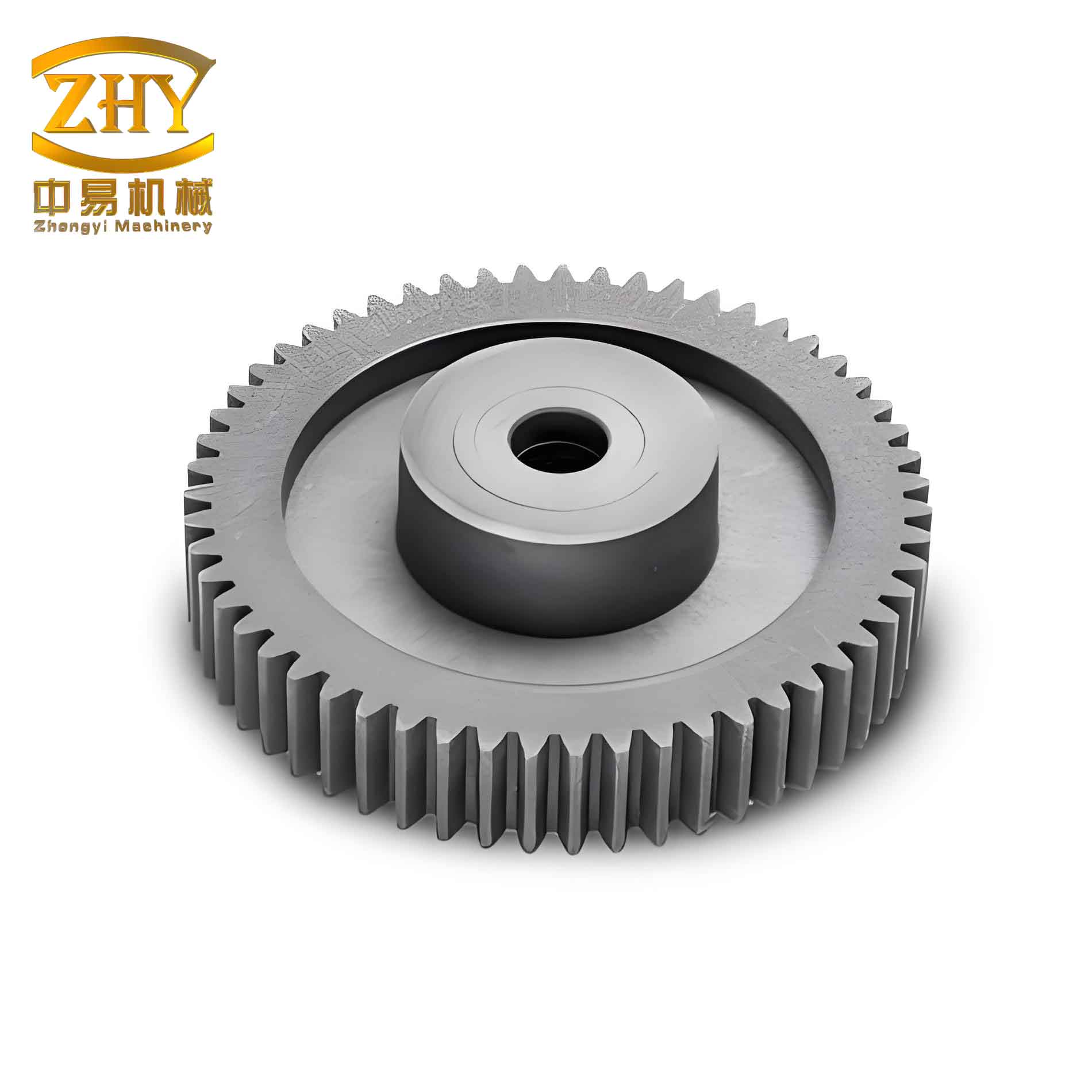
This article presents a comprehensive methodology for the dynamic analysis of spur cylindrical gear pairs with faults. The core approach involves establishing a coupled lateral-torsional vibration model using the lumped parameter method. The time-varying meshing stiffness (TVMS), a primary source of excitation in gear dynamics, is calculated using the potential energy method, incorporating the effects of gear body deflection. The influence of different failure types—specifically root cracks and surface pitting—on the TVMS is investigated in detail. To bridge the gap between simulation and reality, a system model updating technique is employed to calibrate support stiffness and damping parameters against experimental data, ensuring the dynamic model closely matches the physical system. Numerical simulations based on the updated model reveal the characteristic time-domain and frequency-domain response patterns for various fault types and severities. Finally, experimental validation on a cylindrical gear test rig confirms the accuracy of the proposed modeling framework, demonstrating its utility for fault feature analysis and data generation.
1. Dynamic Vibration Analysis Model for Cylindrical Gear Systems
To accurately capture the complex dynamics of a cylindrical gear pair, a six-degree-of-freedom (6-DOF) lumped parameter model is adopted. This model accounts for bending and torsional vibrations, as well as the elasticity of the supporting shafts and bearings. The system is represented in a two-dimensional plane with four translational and two rotational degrees of freedom.
The generalized displacement vector for the system is defined as:
$$ \{\delta\} = \{x_p, y_p, \theta_p, x_g, y_g, \theta_g\}^T $$
where $x_p$, $y_p$, $\theta_p$ are the horizontal, vertical, and rotational displacements of the pinion (driving gear), and $x_g$, $y_g$, $\theta_g$ are the corresponding displacements of the gear (driven gear).
The relative displacement along the line of action $y$ is given by:
$$ y = y_p + R_p\theta_p – y_g + R_g\theta_g $$
where $R_p$ and $R_g$ are the base circle radii of the pinion and gear, respectively.
The dynamic meshing force $F_p$ acting on the pinion and the reaction force $F_g$ on the gear are:
$$ F_p = c_m \dot{y} + k_m y $$
$$ F_g = -F_p = -c_m \dot{y} – k_m y $$
Here, $k_m(t)$ is the time-varying meshing stiffness and $c_m$ is the meshing damping.
The friction force on the tooth surface is approximated as:
$$ F_f = f F_p $$
where $f$ is an equivalent friction coefficient.
The equations of motion for the 6-DOF system are derived as follows:
For the pinion (translational):
$$ m_p \ddot{x}_p + c_{px} \dot{x}_p + k_{px} x_p = F_f $$
$$ m_p \ddot{y}_p + c_{py} \dot{y}_p + k_{py} y_p = F_g $$
For the pinion (rotational):
$$ I_p \ddot{\theta}_p = T_p – F_p R_p + F_f (R_p \tan\beta – H) $$
For the gear (translational):
$$ m_g \ddot{x}_g + c_{gx} \dot{x}_g + k_{gx} x_g = -F_f $$
$$ m_g \ddot{y}_g + c_{gy} \dot{y}_g + k_{gy} y_g = -F_g $$
For the gear (rotational):
$$ I_g \ddot{\theta}_g = -T_g – F_g R_g + F_f (R_g \tan\beta – H) $$
In these equations, $m$, $I$, $c$, and $k$ with appropriate subscripts represent mass, mass moment of inertia, damping, and stiffness, respectively. $T_p$ and $T_g$ are the external torque loads. $\beta$ is the pressure angle, and $H$ is the distance from the mesh point to the pitch point.
These equations can be compactly written in matrix form:
$$ \mathbf{M}\ddot{\{\delta\}} + \mathbf{C}\dot{\{\delta\}} + \mathbf{K}\{\delta\} = \{\mathbf{F}\} $$
where $\mathbf{M}$, $\mathbf{C}$, and $\mathbf{K}$ are the mass, damping, and stiffness matrices, and $\{\mathbf{F}\}$ is the force vector. The stiffness matrix $\mathbf{K}$ is particularly important as it contains the time-varying meshing stiffness $k_m(t)$, which is the primary parameter affected by gear faults in a cylindrical gear system.
2. Calculation of Time-Varying Meshing Stiffness (TVMS)
The time-varying meshing stiffness is the most significant internal excitation in a cylindrical gear pair. The potential energy method, which considers various deformation components, provides a robust analytical approach for its calculation.
2.1 TVMS for Healthy Cylindrical Gears
The total elastic potential energy stored in a deflected gear tooth includes contributions from bending ($U_b$), shear ($U_s$), axial compression ($U_a$), Hertzian contact ($U_h$), and gear body foundation deflection ($U_f$). The corresponding stiffness components are derived from these energies:
Bending stiffness: $$ \frac{1}{K_b} = \int_{0}^{l} \frac{[(l-x)\cos\alpha_p – h\sin\alpha_p]^2}{EI_x} dx $$
Shear stiffness: $$ \frac{1}{K_s} = \int_{0}^{l} \frac{1.2\cos^2\alpha_p}{GA_x} dx $$
Axial compressive stiffness: $$ \frac{1}{K_a} = \int_{0}^{l} \frac{\sin^2\alpha_p}{EA_x} dx $$
Hertzian contact stiffness: $$ \frac{1}{K_h} = \frac{4(1-\nu^2)}{\pi E W} $$
Foundation stiffness: $$ \frac{1}{K_f} = \frac{\cos^2\alpha_p}{WE} \left\{ L^*\left(\frac{u_f}{s_f}\right)^2 + M^*\left(\frac{u_f}{s_f}\right) + P^*(1+Q^*\tan^2\alpha_p) \right\} $$
In these formulas, $E$ is Young’s modulus, $G$ is the shear modulus, $\nu$ is Poisson’s ratio, $I_x$ and $A_x$ are the area moment of inertia and cross-sectional area at distance $x$ from the tooth root, $W$ is the face width, and $\alpha_p$ is the pressure angle at the load application point. The parameters $L^*$, $M^*$, $P^*$, $Q^*$, $u_f$, and $s_f$ are defined according to established formulas for gear body deformation.
The total mesh stiffness for a single tooth pair $K_j^i$ at contact point $j$ is the sum of the compliances (inverse of stiffness) of the pinion and gear teeth for each component:
$$ \frac{1}{K_j^i} = \frac{1}{K_{b,p}} + \frac{1}{K_{s,p}} + \frac{1}{K_{a,p}} + \frac{1}{K_{f,p}} + \frac{1}{K_{b,g}} + \frac{1}{K_{s,g}} + \frac{1}{K_{a,g}} + \frac{1}{K_{f,g}} + \frac{1}{K_h} $$
The total TVMS for the gear pair at any time $t$, considering all $N$ pairs in contact, is:
$$ K_m(t) = \sum_{i=1}^{N} K_j^i $$
2.2 TVMS for Cylindrical Gears with Root Cracks
Root cracks are a common failure mode in cylindrical gear teeth, typically initiating at the fillet due to high bending stress concentration. The crack is modeled as a straight line characterized by its depth $q_0$, angle $\alpha_c$, and starting point height $h_c$.
The presence of a crack reduces the effective area moment of inertia $I_x$ and cross-sectional area $A_x$ of the tooth. For a section at distance $x$ from the root with height $h_x$, the effective parameters become:
$$ I_x = \begin{cases}
\frac{1}{12}(h_x + h_x)^3W & h_x \le h_q \\
\frac{1}{12}(h_x + h_q)^3W & h_x > h_q
\end{cases} $$
$$ A_x = \begin{cases}
(h_x + h_x)W & h_x \le h_q \\
(h_x + h_q)W & h_x > h_q
\end{cases} $$
where $h_q = h_c – q_0 \sin\alpha_c$. These modified $I_x$ and $A_x$ are substituted into the formulas for $K_b$, $K_s$, and $K_a$ to compute the stiffness of the cracked tooth. The foundation stiffness $K_f$ and contact stiffness $K_h$ are assumed unaffected by the crack.
2.3 TVMS for Cylindrical Gears with Surface Pitting
Surface pitting is a contact fatigue failure that manifests as small pits, often near the pitch line. A pit is modeled as a rectangular cavity with length $a_s$, width $w_s$, and depth $h_s$.
Pitting affects the effective face width $\Delta W_x$, cross-sectional area $\Delta A_x$, and area moment of inertia $\Delta I_x$ over the pitted region. If $\mu$ is the distance from the root to the pit’s centerline, the reductions are:
$$ \Delta W_x = \begin{cases} W_s & x \in [\mu – a_s/2, \mu + a_s/2] \\ 0 & \text{otherwise} \end{cases} $$
$$ \Delta A_x = \begin{cases} \Delta W_x \cdot h & x \in [\mu – a_s/2, \mu + a_s/2] \\ 0 & \text{otherwise} \end{cases} $$
$$ \Delta I_x = \begin{cases} \frac{1}{12}\Delta W_x h^3 + \frac{A_x \Delta A_x (h_x – h/2)^2}{A_x – \Delta A_x} & x \in [\mu – a_s/2, \mu + a_s/2] \\ 0 & \text{otherwise} \end{cases} $$
The modified tooth parameters are then $I’_x = I_x – \Delta I_x$, $A’_x = A_x – \Delta A_x$, and $W’ = W – \Delta W_x$. $I’_x$ and $A’_x$ are used in the bending, shear, and axial stiffness calculations, while $W’$ is used in the foundation and Hertzian contact stiffness calculations for the pitted section.
3. Numerical Simulation Analysis
To demonstrate the proposed methodology, a numerical case study of a spur cylindrical gear pair is conducted. The primary parameters of the gear pair are listed in the table below. The pinion is the driving gear, operating at a speed of 1800 rpm. Faults are simulated only on the pinion, as it is typically more susceptible to failure under high-speed conditions.
| Parameter | Pinion | Gear |
|---|---|---|
| Number of Teeth | 23 | 84 |
| Module (mm) | 2 | 2 |
| Pressure Angle (°) | 20 | 20 |
| Face Width (mm) | 20 | 20 |
| Mass (kg) | 0.22 | 1.9 |
| Moment of Inertia (kg·m²) | 4.86e-5 | 3.51e-3 |
3.1 TVMS Results for Different Fault Conditions
Healthy Gear: The TVMS for a healthy cylindrical gear shows a periodic pattern alternating between one and two tooth pairs in contact. The stiffness values in each single and double contact region are consistent.
Gear with Root Crack: Cracks of depth $q_0 = 1$ mm, $1.5$ mm, and $2$ mm were simulated at a $45^\circ$ angle from the root midpoint. The results show that the TVMS decreases, particularly when the cracked tooth is in the meshing zone, and the reduction becomes more pronounced with increasing crack depth.
Gear with Surface Pitting: Two pitting scenarios were analyzed. First, pits of fixed depth ($h_s=1$ mm) and width ($w_s=4$ mm) but varying length ($a_s = 0.5, 0.7, 0.9$ mm) were simulated. Second, pits of fixed depth and length but varying width (20%, 40%, 60% of the face width) were simulated. In both cases, the TVMS exhibits a localized drop when the pitted section passes through the contact zone. The stiffness loss increases with both the length and the width of the pit.
3.2 Dynamic Response from the Faulty Cylindrical Gear Model
The calculated TVMS functions for healthy, cracked, and pitted gears are incorporated into the 6-DOF dynamic model described in Section 1. The equations of motion are solved using a numerical integration method (e.g., Runge-Kutta). The dynamic transmission error or bearing housing acceleration can be derived from the solution. Simulation results indicate that compared to the healthy cylindrical gear, the dynamic response for gears with cracks or pitting shows increased vibration amplitudes and modulated characteristics, providing distinct fault signatures.
4. System Model Updating for Experimental Correlation
Vibration signals are typically measured on the gearbox housing rather than directly on the rotating gears. Therefore, the dynamic model must accurately represent the vibration transmission path from the gear mesh to the measurement point. The support stiffness and damping parameters ($k_{px}, k_{py}, c_{px}, c_{py}, k_{gx}, k_{gy}, c_{gx}, c_{gy}$) are critical in this path and are often not precisely known.
A model updating procedure is employed to calibrate these parameters. The connection between the gear shaft and the housing is simplified as a system with coupled horizontal and vertical stiffness and damping ($k_{ij}, c_{ij}$ where $i,j = x,y$). The frequency response function (FRF) of this 2-DOF system is derived analytically. An impact hammer test is performed on the actual cylindrical gear test rig to obtain the experimental FRF matrix $\mathbf{R}^{e}_{ij}(\omega)$.
An optimization problem is formulated to minimize the error between the simulated FRF $\mathbf{R}^{s}_{ij}(\omega)$ and the experimental FRF:
$$ \varepsilon = \min \sum_{i=x,y} \sum_{j=x,y} \sum_{\omega} \left( |\mathbf{R}^{s}_{ij}(\omega)| – |\mathbf{R}^{e}_{ij}(\omega)| \right) $$
By solving this optimization, the equivalent support stiffness and damping values for the model are identified. These updated parameters ensure that the dynamic model of the cylindrical gear system closely matches the dynamic characteristics of the physical test rig, leading to more realistic simulation of vibration responses measured on the housing.
5. Experimental Validation
A gearbox test rig was constructed, and spur cylindrical gear specimens with seeded cracks and pitting faults were manufactured according to the parameters in Table 1. Vibration acceleration signals were acquired from the housing in the radial direction under a pinion speed of 1800 rpm. The signals were processed using time-synchronous averaging (TSA) to enhance the gear-related components and reduce noise.
The simulated vibration signals from the updated dynamic model were compared with the experimentally measured TSA signals in both the time and frequency domains for three conditions: healthy gear, gear with a root crack, and gear with surface pitting.
Healthy Cylindrical Gear: Both simulated and experimental signals show steady vibration amplitudes without significant impulsive content. The frequency spectrum is dominated by the gear mesh frequency ($f_m$) and its harmonics, with no prominent sidebands around them.
Cylindrical Gear with Root Crack: The signals exhibit periodic impulsive impacts corresponding to the rotation period of the faulty pinion. In the frequency domain, the mesh frequency harmonics ($2f_m$, $3f_m$, etc.) are surrounded by sideband families spaced at the pinion rotational frequency ($f_r$). This modulation is a classic signature of a localized fault like a crack.
Cylindrical Gear with Surface Pitting: Under loaded conditions, the signals show periodic amplitude modulations. The frequency spectrum shows mesh harmonics, with less pronounced but identifiable sidebands, consistent with the distributed nature of pitting damage compared to a single crack.
The strong qualitative agreement between the simulated and experimental fault signatures validates the accuracy of the proposed dynamic modeling approach for faulty cylindrical gear systems.
5.1 Simulation of Fault Severity Progression
With the validated model, it is possible to simulate the dynamic response for progressive levels of fault severity that are difficult or costly to replicate physically. For instance, the model can generate vibration data for a cylindrical gear with crack depths ranging from minor (e.g., 0.5 mm) to severe (e.g., 3 mm), or for pitting with increasing area. The time-domain waveforms show progressively stronger impulse amplitudes, and the frequency-domain spectra show increasing sideband energy. This capability is invaluable for building comprehensive fault databases to train and test data-driven diagnostic algorithms.
6. Conclusion
This article presented an integrated framework for the dynamic modeling and analysis of spur cylindrical gear systems with common faults. The methodology combines a detailed lumped-parameter dynamic model with an analytical potential energy method for calculating time-varying meshing stiffness under healthy, cracked, and pitted conditions. A key contribution is the incorporation of a model updating step to calibrate support parameters against experimental data, ensuring the simulation accurately reflects the vibration transmission path of a real gearbox.
The primary conclusions are:
- The proposed model accurately captures the characteristic vibration signatures of different fault types in a cylindrical gear. The simulated time-domain and frequency-domain responses for healthy, cracked, and pitted gears show strong agreement with experimental measurements.
- The model enables the efficient generation of simulated vibration data for various fault types and, critically, for different levels of fault severity. This provides a rich and controlled data source for developing and validating fault diagnosis algorithms and for building extensive fault libraries.
- By accounting for the system’s support dynamics through model updating, more realistic and accurate dynamic responses can be obtained, moving beyond idealized gear pair models to representations of complete system dynamics.
Future work will focus on refining the model by incorporating more precise damping and friction models, studying the effects of multiple simultaneous faults, and exploring the dynamic stability of the cylindrical gear system as faults propagate. The established framework serves as a powerful tool for understanding fault mechanisms and generating essential data for the advancement of gear condition monitoring technologies.