
The pursuit of enhanced performance in power transmission systems has been a constant driver of innovation in gear design. Among various advanced geometries, the cylindrical gear with a curvilinear tooth line, specifically one based on a hyperbolic circular-arc path, represents a significant advancement over conventional spur and helical cylindrical gears. This type of cylindrical gear offers notable advantages, including increased load-carrying capacity, a larger contact ratio, improved lubrication conditions, and the absence of axial thrust forces. A crucial design aspect for optimizing the performance of any cylindrical gear, including this advanced type, is the application of profile shifting, or addendum modification. Modifying the addendum alters the tooth thickness and root geometry, directly impacting its bending strength. While the fundamental geometry and manufacturing of the hyperbolic circular-arc cylindrical gear have been studied, a comprehensive investigation into how design parameters, particularly under the condition of equal addendum modification, influence the root bending stress is essential for its practical application and optimization. This article aims to address this gap. We will first establish the mathematical model for the tooth surface of a cylindrical gear with a variable hyperbolic circular-arc tooth line incorporating addendum modification. Subsequently, using the finite element method, we will systematically analyze the influence of the modification coefficient and other key design parameters—such as the cutter radius, module, face width, and cutter tip fillet radius—on the root bending stress of this specialized cylindrical gear.
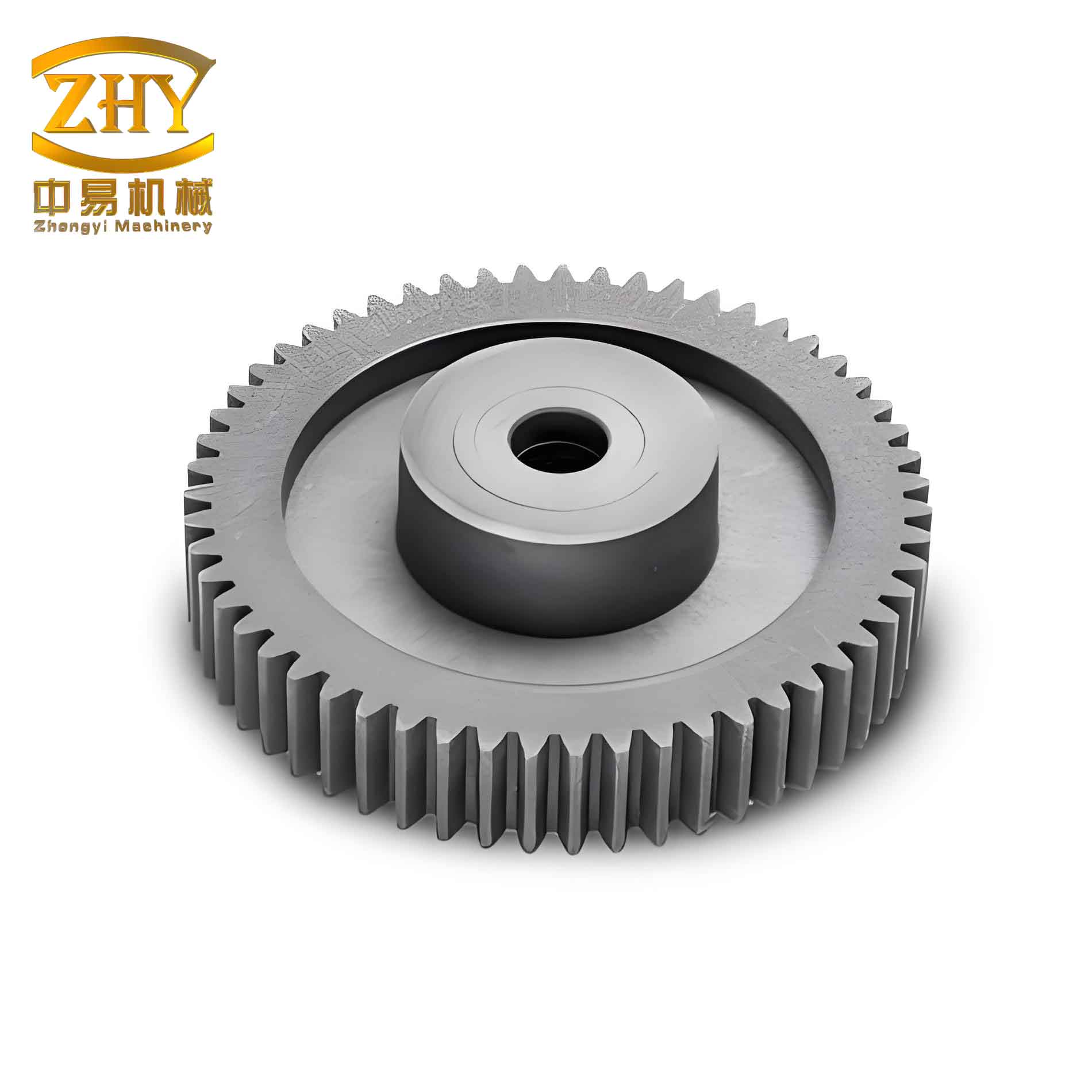
Theoretical Model of the Modified Cylindrical Gear
The manufacturing process for the cylindrical gear with a variable hyperbolic circular-arc tooth line typically involves a dual-blade milling cutter. To incorporate addendum modification, the principle of profile shifting is applied, where the basic rack cutter (or its equivalent in the generating process) is offset from its standard position relative to the gear blank center by a distance defined as \(xm\), where \(x\) is the modification coefficient and \(m\) is the module. This offset, \(xm\), is crucial for avoiding undercutting in gears with low tooth counts and for optimizing the tooth shape for strength.
Establishment of Coordinate Systems
The derivation of the tooth surface equation begins by defining the necessary coordinate systems for the machining process, as conceptualized in the referenced schematic. The following key coordinate frames are established:
- Cutter Fixed Coordinate System \(O_1-x_1y_1z_1\): This system is attached to the milling cutter. The unit vectors are denoted as \((\mathbf{i}, \mathbf{j}, \mathbf{k})\).
- Gear Blank Fixed Coordinate System \(O_2-x_2y_2z_2\): This system is fixed in space relative to the machine. Its unit vectors are \((\mathbf{i}_2, \mathbf{j}_2, \mathbf{k}_2)\).
- Gear Rotating Coordinate System \(O_d-x_dy_dz_d\): This system rotates with the gear blank during the generation process. Its unit vectors are \((\mathbf{i}_d, \mathbf{j}_d, \mathbf{k}_d)\).
Equation of the Cutter Surface
The surface of the dual-blade milling cutter can be represented as a surface of revolution. In the cutter’s fixed coordinate system \(O_1-x_1y_1z_1\), its equation is given by:
$$
\begin{align*}
x_1 &= -\left[ R \mp \frac{\pi}{4}m \pm u \sin \alpha \right] \cos \theta \\
y_1 &= -\left[ R \mp \frac{\pi}{4}m \pm u \sin \alpha \right] \sin \theta \\
z_1 &= u \cos \alpha
\end{align*}
$$
where:
- \(R\) is the nominal radius of the cutter head.
- \(m\) is the module of the cylindrical gear.
- \(\alpha\) is the pressure angle.
- \(u\) and \(\theta\) are the surface parameters of the cutter.
- The upper sign corresponds to the convex side of the gear tooth, and the lower sign corresponds to the concave side.
The unit normal vector \(\mathbf{e}_1\) to the cutter surface is derived from the partial derivatives of the position vector \(\mathbf{r}_1 = [x_1, y_1, z_1]^T\):
$$
\mathbf{e}_1 = \frac{\partial \mathbf{r}_1}{\partial u} \times \frac{\partial \mathbf{r}_1}{\partial \theta} \bigg/ \left\| \frac{\partial \mathbf{r}_1}{\partial u} \times \frac{\partial \mathbf{r}_1}{\partial \theta} \right\| = \cos \theta \cos \alpha \, \mathbf{i} + \sin \theta \cos \alpha \, \mathbf{j} \pm \sin \alpha \, \mathbf{k}
$$
Meshing Condition and Contact Line Equation
According to the theory of gearing, the necessary condition for conjugate contact between the cutter and the gear blank during generation is that their relative velocity is orthogonal to the common normal vector at the point of contact. This meshing condition is expressed as:
$$
\phi = \mathbf{n}_1 \cdot \mathbf{v}^{(12)} = \mathbf{e}_1 \cdot \mathbf{v}^{(12)} = 0
$$
where \(\mathbf{v}^{(12)}\) is the relative velocity of the cutter (body 1) with respect to the gear blank (body 2). The relative velocity can be formulated based on the kinematic relationship between the rotating cutter and the generating gear blank. Solving this equation for the surface parameter \(u\) yields:
$$
u = \frac{\mp \sin \alpha \cos \theta \left( R \mp \frac{\pi}{4}m \right) \pm \sin \alpha (R_1 \psi + R)}{\cos \theta} + x m \cos \alpha
$$
Here, \(R_1\) is the pitch circle radius of the gear, \(\psi\) is the rotational angle parameter of the gear blank, and \(x\) is the addendum modification coefficient. Substituting this expression for \(u\) back into the cutter surface equations gives the family of contact lines in the cutter coordinate system, parameterized by \(\theta\) and \(\psi\).
Tooth Surface Equation of the Modified Cylindrical Gear
The final tooth surface of the manufactured cylindrical gear is obtained by transforming the coordinates of the contact line from the cutter system to the gear’s rotating coordinate system \(O_d-x_dy_dz_d\). This involves two successive coordinate transformations:
- From \(O_1-x_1y_1z_1\) to the intermediate fixed system \(O_2-x_2y_2z_2\) via transformation matrix \(\mathbf{M}_{21}\).
- From \(O_2-x_2y_2z_2\) to the rotating gear system \(O_d-x_dy_dz_d\) via transformation matrix \(\mathbf{M}_{d2}\), which incorporates the gear rotation angle \(\psi\).
The combined transformation is \(\mathbf{r}_d = \mathbf{M}_{d2} \mathbf{M}_{21} \mathbf{r}_1\). Applying this transformation to the contact line equations yields the complete tooth surface equation for the addendum-modified cylindrical gear with a variable hyperbolic circular-arc tooth line:
$$
\begin{align*}
x_d &= \left\{ -\left[ R \mp \frac{\pi}{4}m \pm u \sin \alpha \right] \cos \theta + R + R_1 \psi \right\} \cos \psi + \left( u \cos \alpha – R_1 – x m \right) \sin \psi \\
y_d &= \left\{ \left[ R \mp \frac{\pi}{4}m \pm u \sin \alpha \right] \cos \theta – R – R_1 \psi \right\} \sin \psi + \left( u \cos \alpha – R_1 – x m \right) \cos \psi \\
z_d &= \left[ R \mp \frac{\pi}{4}m \pm u \sin \alpha \right] \sin \theta \\[5pt]
u &= \frac{\mp \sin \alpha \cos \theta \left( R \mp \frac{\pi}{4}m \right) \pm \sin \alpha (R_1 \psi + R)}{\cos \theta} + x m \cos \alpha
\end{align*}
$$
In this final form, \(R\), \(R_1\), \(\alpha\), and \(m\) are fundamental design parameters of the cylindrical gear, while \(\theta\) and \(\psi\) are the independent surface parameters defining the tooth geometry. The equation describes both the convex and concave flanks of the cylindrical gear tooth.
Fillet (Root Transition) Surface Equation
The root fillet is generated by the tip rounded corner of the cutter. Following a similar derivation process, the equation for the root transition surface of the modified cylindrical gear is obtained. Let \(r\) be the cutter tip fillet radius and \(d\) an auxiliary parameter. The fillet surface equation is:
$$
\begin{align*}
x_{dr} &= \left\{ -\left[ A \mp r (\cos \alpha – \cos \beta) \right] \cos \theta + R + R_1 \psi \right\} \cos \psi + \left[ d + r (\sin \beta – \sin \alpha) – R_1 – x m \right] \sin \psi \\
y_{dr} &= \left\{ \left[ A \mp r (\cos \alpha – \cos \beta) \right] \cos \theta – R – R_1 \psi \right\} \sin \psi + \left[ d + r (\sin \beta – \sin \alpha) – R_1 – x m \right] \cos \psi \\
z_{dr} &= \left[ A \mp r (\cos \alpha – \cos \beta) \right] \sin \theta \\[5pt]
\beta &= \arctan \left( \frac{d \cos \theta – r \sin \alpha \cos \theta – x m \cos \theta}{\pm A \cos \theta \mp (R_1 \psi + R) – r \cos \alpha \cos \theta} \right)
\end{align*}
$$
where \(A = R \mp \frac{\pi}{4}m \mp d \tan \alpha\). This fillet surface seamlessly connects the active tooth flank to the root circle of the cylindrical gear.
Finite Element Analysis of the Modified Cylindrical Gear Pair
Model Generation and Basic Parameters
Using the derived mathematical models, point clouds for the tooth surfaces were generated and imported into 3D CAD software to construct solid models of a pinion and gear. These models were then assembled into a gear pair for finite element analysis (FEA). This study focuses on the common and practical case of equal addendum modification (\(x_1 = x_2 = x\)), where the center distance remains unchanged. The primary baseline parameters for the cylindrical gear pair are summarized in Table 1.
| Parameter | Symbol | Value |
|---|---|---|
| Pressure Angle | \(\alpha\) | 20° |
| Module | \(m\) | 3 mm |
| Pinion Tooth Number | \(z_1\) | 21 |
| Gear Tooth Number | \(z_2\) | 37 |
| Addendum Coefficient | \(h_a^*\) | 1.0 |
| Dedendum Coefficient | \(c^*\) | 0.25 |
| Face Width | \(B\) | 45 mm |
| Cutter Radius | \(R\) | 80 mm |
| Cutter Tip Fillet Radius | \(r\) | 0.2 mm |
To balance computational accuracy and efficiency, a seven-tooth segment model for both the pinion and gear was employed for the bending stress analysis. A high-quality hexahedral mesh (C3D8R elements in Abaqus) was generated for this model.
FEA Setup and Procedure
A static implicit contact analysis was performed using commercial FEA software. The key steps in the setup were:
- Material Properties: Both gears were assigned steel properties with an Elastic Modulus of 210 GPa and a Poisson’s ratio of 0.3.
- Contact Definition: Surface-to-surface contact pairs were defined between the mating teeth of the pinion and gear, with the pinion surface as the master and the gear surface as the slave. A finite sliding formulation with a penalty friction coefficient was used.
- Boundary Conditions and Load:
- A reference point was created at the center of each cylindrical gear and coupled to its bore.
- The pinion’s reference point was fixed in all degrees of freedom except for rotation about its axis (\(U_1=U_2=U_3=UR_2=UR_3=0\)).
- The gear’s reference point was fixed in all translational and rotational degrees of freedom (\(U_1=U_2=U_3=UR_1=UR_2=UR_3=0\)).
- A pure torque of 100 N·m was applied to the gear’s reference point, simulating a resistive load. The analysis then solved for the reaction forces and stresses.
- Analysis Steps: Multiple steps were used to ensure stable contact establishment. The final step applied the full load and solved for the stress state at the position of maximum tooth loading within the meshing cycle.
Influence of the Addendum Modification Coefficient on Root Bending Stress
Using the FEA model with the baseline parameters from Table 1, the root bending stress was calculated for a range of equal addendum modification coefficients (\(x\)) from -0.2 to 0.2. The maximum von Mises stress in the root region was extracted for both the pinion and the gear. The results are presented graphically and show a clear and significant trend. For this specific cylindrical gear geometry, as the modification coefficient increases from negative (undercut) to positive values, the root bending stress decreases substantially for both the pinion and the gear. This behavior aligns with the classical effect of profile shifting in standard gears: a positive modification coefficient increases the tooth thickness at the root, thereby increasing the section modulus and reducing the bending stress. The analysis confirms that this fundamental principle holds true for the more complex geometry of the cylindrical gear with a hyperbolic circular-arc tooth line. The beneficial effect on bending strength provides a strong rationale for applying positive addendum modification to this type of cylindrical gear, especially for the pinion which typically experiences higher stress cycles.
Influence of Key Design Parameters on Root Bending Stress
To provide comprehensive design guidance, we extended the analysis to investigate how other critical design parameters interact with the addendum modification coefficient to influence root bending stress. Since the pinion is generally the more critical component, the following analyses focus on the pinion’s maximum root bending stress.
Influence of Cutter Radius (R)
The cutter radius \(R\) is a defining parameter for the hyperbolic circular-arc tooth line of this cylindrical gear. It determines the curvature of the tooth trace. Analyses were conducted for three different cutter radii: 60 mm, 80 mm (baseline), and 100 mm, while keeping all other parameters from Table 1 constant. The relationship between root bending stress and the modification coefficient \(x\) for each cutter radius was plotted. The results indicate that while the general trend of decreasing stress with increasing \(x\) remains consistent, the absolute level of stress is affected by \(R\). For a given modification coefficient, a larger cutter radius results in lower root bending stress. This can be attributed to the change in the load distribution pattern along the tooth trace. A larger \(R\) creates a more gradual curvature, which can lead to a more favorable load distribution and a reduction in stress concentration. Therefore, from a bending strength perspective, selecting a larger cutter radius is advantageous for this cylindrical gear design.
| Design Parameter | Trend of Influence on Bending Stress | Primary Reason / Mechanism |
|---|---|---|
| Addendum Modification Coeff. (\(x\)) | Decreases significantly as \(x\) increases (for \(x > 0\)). | Increased root thickness and section modulus. |
| Cutter Radius (\(R\)) | Decreases as \(R\) increases. | Improved load distribution along the curved tooth line. |
| Module (\(m\)) | Decreases sharply as \(m\) increases. The beneficial effect of \(x\) is more pronounced for larger \(m\). | Larger overall tooth dimensions and greatly increased section modulus. |
| Face Width (\(B\)) | Decreases initially, then stabilizes as \(B\) increases beyond a certain point (e.g., ~\(R\)). | Increased section modulus initially; effective contact width is limited by \(R\), not \(B\). |
| Cutter Tip Fillet Radius (\(r\)) | Decreases initially, then the rate of decrease diminishes. | Reduced stress concentration at the root; excessively large \(r\) may reduce the contact ratio. |
Influence of Module (m)
The module is arguably the most influential parameter on the bending strength of any gear, including this specialized cylindrical gear. Analyses were performed for modules of 3 mm, 5 mm, and 7 mm. The results, plotted as stress versus modification coefficient, reveal a dramatic effect. As the module increases, the root bending stress decreases substantially. For instance, increasing the module from 3 mm to 5 mm can reduce stress by approximately 74% for a given \(x\). Furthermore, the analysis shows that the beneficial stress-reducing effect of a positive modification coefficient becomes more pronounced with larger modules. The relative reduction in stress from \(x = -0.2\) to \(x = 0.2\) was greater for the larger module gears. This underscores the critical role of module selection in the design of a high-strength cylindrical gear and indicates that addendum modification is particularly effective for larger-module gears of this type.
Influence of Face Width (B)
The face width \(B\) directly contributes to the beam strength of a gear tooth. Analyses were conducted for face widths of 30 mm, 45 mm (baseline), and 60 mm. The relationship between stress and modification coefficient was examined for each width. The results show an initial, expected decrease in root bending stress as the face width increases from 30 mm to 45 mm, due to the increased cross-sectional area. However, a further increase in face width to 60 mm yields only a marginal additional reduction in stress. This phenomenon can be explained by the unique geometry of this cylindrical gear. The effective contact zone along the tooth trace is largely governed by the cutter radius \(R\). Once the face width exceeds the effective contact length determined by \(R\), additional material does not significantly contribute to sharing the load. Therefore, increasing face width beyond a certain point (often related to the cutter radius) provides diminishing returns for bending strength and leads to inefficient use of material and increased weight.
Influence of Cutter Tip Fillet Radius (r)
The fillet radius at the root of the cylindrical gear tooth is a critical factor for stress concentration. Analyses were run for fillet radii of 0 mm (sharp corner), 0.2 mm (baseline), and 0.4 mm. The results plotted against the modification coefficient show a clear trend: increasing the fillet radius reduces the maximum root bending stress. A larger, smoother fillet provides a more gradual transition from the tooth flank to the root, thereby reducing the stress concentration factor. The reduction is most significant when moving from a sharp corner (\(r=0\)) to a small radius. However, the rate of stress reduction diminishes as the fillet radius increases further (e.g., from 0.2 mm to 0.4 mm). It is important to note that an excessively large fillet radius could potentially interfere with the meshing action or reduce the effective depth of the tooth, so an optimal value must be chosen considering both bending strength and gear meshing geometry.
Conclusion
This investigation provides a systematic analysis of how key design parameters influence the root bending stress in a cylindrical gear with a variable hyperbolic circular-arc tooth line under the condition of equal addendum modification. The following key conclusions are drawn:
- The derived mathematical model successfully describes the tooth geometry of the addendum-modified cylindrical gear, forming a foundation for its analysis and design.
- The addendum modification coefficient has a pronounced effect. Positive modification (\(x > 0\)) significantly reduces root bending stress for both the pinion and gear of this cylindrical gear pair, validating its use as a strength optimization tool.
- Among the design parameters, the module (\(m\)) has the most dramatic influence on bending stress, with larger modules offering substantially higher bending strength. The beneficial effect of positive addendum modification is amplified for cylindrical gears with larger modules.
- The cutter radius (\(R\)) is a unique and important parameter for this cylindrical gear. A larger cutter radius improves load distribution along the curved tooth line, leading to lower root bending stress.
- The face width (\(B\)) and cutter tip fillet radius (\(r\)) exhibit similar influence patterns: increasing them reduces stress initially, but the effect plateaus. For face width, the plateau is reached when it surpasses the effective contact length governed by \(R\). For the fillet radius, the stress concentration reduction benefit diminishes with larger radii.
The findings offer practical guidance for the design of high-performance cylindrical gears with hyperbolic circular-arc tooth lines. Designers should prioritize selecting an appropriate module and consider applying positive addendum modification, especially for the pinion. The cutter radius should be chosen as large as practical, while the face width and fillet radius should be optimized rather than maximized, considering the trade-offs with size, weight, and other performance metrics. This work establishes a basis for further research into multi-objective optimization of these advanced cylindrical gear systems.