
In modern industrial applications, the cylindrical gear stands as a critical component due to its high transmission efficiency, broad applicability, and strong load-bearing capacity. It is extensively utilized in sectors such as aerospace, automotive, and machine tools. Traditional manufacturing methods for cylindrical gears, including milling, hobbing, and shaping, are predominantly cutting-based. However, with advancements in industrial technology and evolving market demands, issues such as low mechanical performance, significant material waste, and high production costs associated with cut gears have become increasingly prominent. As an advanced near-net-shape forming technology, the cross-rolling forming process for cylindrical gears offers advantages like high production efficiency, reduced material waste, and excellent surface quality, gradually emerging as a vital method in gear processing. The forming force during cross-rolling, influenced by factors such as material properties, roller parameters, and processing conditions, is crucial for workpiece quality and roller lifespan. Accurate calculation of the forming force provides essential guidance for roller design and equipment selection.
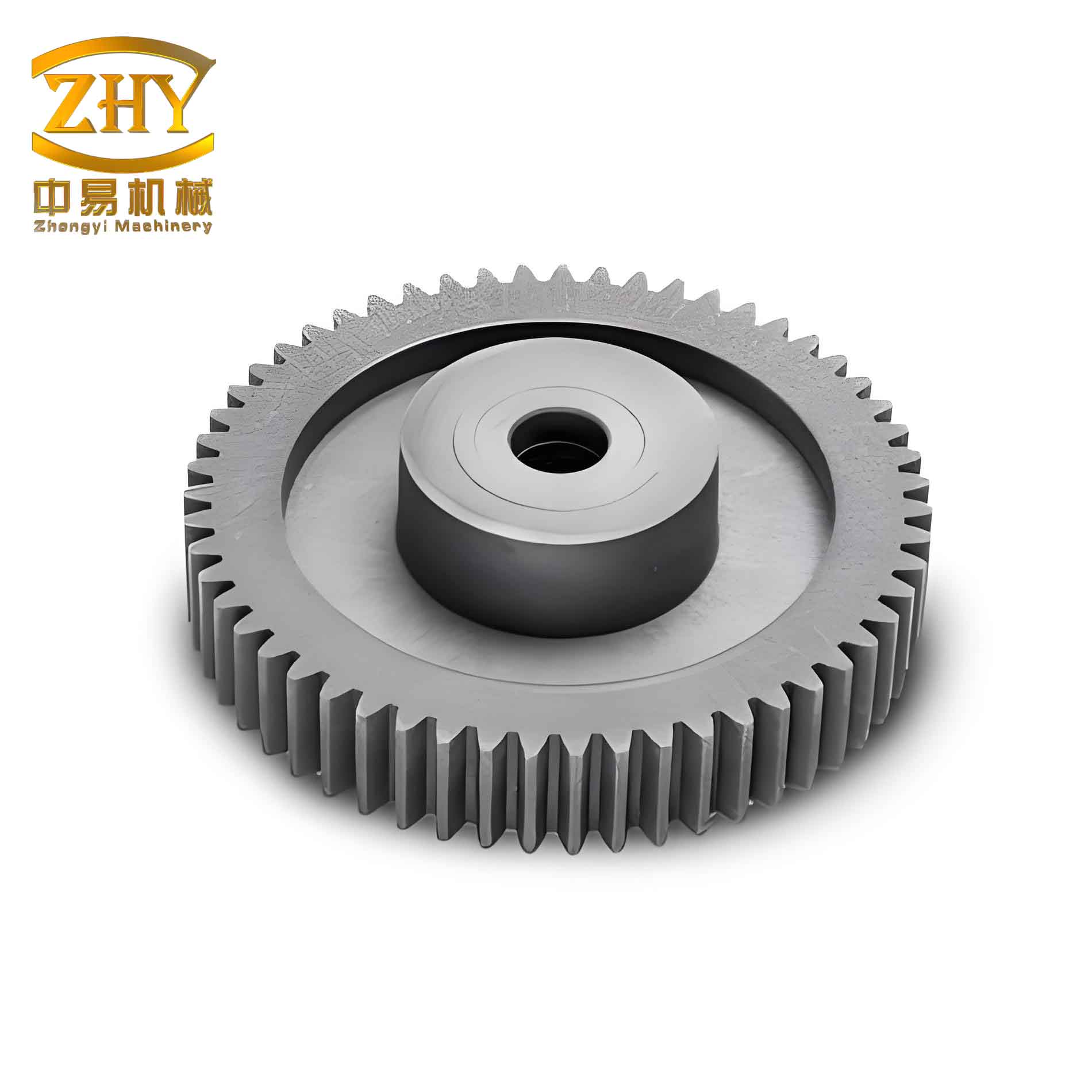
To address this, my research focuses on developing a theoretical model for the forming force in cylindrical gear cross-rolling, supported by experimental validation. The study begins with establishing a constitutive model for the gear steel, followed by deriving contact area formulas and forming force equations, and concludes with finite element simulation and physical testing. This comprehensive approach ensures the model’s accuracy and practicality for industrial applications.
The material under investigation is 40CrNiMo gear steel, known for its high strength and toughness, making it suitable for demanding cylindrical gear applications. Isothermal compression tests were conducted to obtain true stress-true strain curves under various temperatures and strain rates. The tests were performed using a MTS testing machine equipped with a high-low temperature environmental chamber. Specimens with dimensions of Φ8 mm × 12 mm were heated at a rate of 10 °C/min to temperatures of 20 °C, 80 °C, 140 °C, and 200 °C, held for 2 minutes, and then compressed at strain rates of 0.005 s-1, 0.05 s-1, and 0.5 s-1 until 40% reduction in height. The machine automatically collected and converted nominal stress-strain data into true stress-true strain data. The chemical composition of 40CrNiMo steel is detailed in Table 1.
| Element | Ni | Cr | Mn | C | Si | Mo | S | P | Cu | Fe |
|---|---|---|---|---|---|---|---|---|---|---|
| Content | 1.34 | 0.78 | 0.67 | 0.39 | 0.20 | 0.199 | 0.003 | 0.016 | 0.02 | Balance |
Based on the experimental data, the Johnson-Cook (J-C) constitutive model was initially constructed. The standard J-C model is expressed as:
$$ \sigma = (A + B\varepsilon^n)(1 + C\ln\dot{\varepsilon}^*)\left[1 – \left(\frac{T – T_0}{T_m – T_0}\right)^m\right] $$
where $\sigma$ is the equivalent stress, $\varepsilon$ is the equivalent strain, $\dot{\varepsilon}^* = \dot{\varepsilon}/\dot{\varepsilon}_0$ is the dimensionless strain rate, $T$ is the deformation temperature, $T_0$ is the reference temperature, $T_m$ is the melting temperature, and $A$, $B$, $C$, $n$, $m$ are material constants. Using 20 °C and 0.005 s-1 as reference conditions ($T_0 = 20$ °C, $\dot{\varepsilon}_0 = 0.005$ s-1}$), the constants were determined through linear regression from the true stress-true strain curves. The initial yield stress $A$ was identified as 905 MPa (at 0.2% residual plastic strain). The hardening coefficient $B$ and exponent $n$ were found by fitting $\ln(\sigma – A)$ versus $\ln\varepsilon$, giving $B = 1529.93$ and $n = 0.8334$. The strain rate coefficient $C$ was obtained from the relationship between $\sigma/(A + B\varepsilon^n)$ and $\ln\dot{\varepsilon}^*$ at 20 °C, yielding $C = 0.03249$. The temperature softening coefficient $m$ was derived from $\ln[1 – \sigma/(A + B\varepsilon^n)]$ versus $\ln[(T – T_0)/(T_m – T_0)]$ at the reference strain rate, resulting in $m = 0.66$. Thus, the original J-C model for 40CrNiMo steel is:
$$ \sigma = (905 + 1529.93\varepsilon^{0.8334})(1 + 0.03249\ln\dot{\varepsilon}^*)\left[1 – \left(\frac{T – 20}{T_m – 20}\right)^{0.66}\right] $$
However, comparison with experimental data showed deviations, especially at higher temperatures, where the predicted curves shifted upward. To improve accuracy, a modified Johnson-Cook model was adopted, expressed as:
$$ \sigma = (A_1 + B_1\varepsilon + B_2\varepsilon^2 + B_3\varepsilon^3)(1 + C_1 \ln\dot{\varepsilon}^*)\left[1 – \left(\frac{T – T_0}{T_m – T_0}\right)^m\right] $$
where $A_1$, $B_1$, $B_2$, $B_3$, $C_1$, and $m$ are modified constants. Using the reference condition data, a cubic polynomial fit for $A_1 + B_1\varepsilon + B_2\varepsilon^2 + B_3\varepsilon^3$ yielded $A_1 = -221$, $B_1 = 17519$, $B_2 = -64889$, and $B_3 = 82894$. The coefficient $C_1$ was determined as 0.017 from the average slope of $\sigma/(A_1 + B_1\varepsilon + B_2\varepsilon^2 + B_3\varepsilon^3)$ versus $\ln\dot{\varepsilon}^*$ at 20 °C. The modified $m$ value was found to be 0.7744 via linear fitting of $\ln[1 – \sigma/(A_1 + B_1\varepsilon + B_2\varepsilon^2 + B_3\varepsilon^3)]$ versus $\ln[(T – T_0)/(T_m – T_0)]$. Therefore, the revised constitutive model for cylindrical gear steel is:
$$ \sigma = (-221 + 17519\varepsilon – 64889\varepsilon^2 + 82894\varepsilon^3)(1 + 0.017\ln\dot{\varepsilon}^*)\left[1 – \left(\frac{T – 20}{T_m – 20}\right)^{0.7744}\right] $$
The root mean square error ($e_{RMSE}$) for this modified model is 9.575, indicating good predictive capability. The comparison between predicted and experimental true stress-true strain curves across temperatures and strain rates confirms the model’s reliability for subsequent analysis of cylindrical gear forming.
With the material model established, the theoretical framework for the cross-rolling forming force of cylindrical gears is developed. The cross-rolling process involves three directional forces: axial force $F_z$, radial force $F_\tau$, and circumferential force $F_t$. The geometry and kinematics are illustrated in Figure 10 of the original context, where $\omega_r$ is the roller rotational speed, $\omega_g$ is the workpiece rotational speed, and $v_z$ is the workpiece feed velocity. To simplify the complex interaction, the theoretical model focuses on calculating the contact area between the tooth-profile roller and the workpiece, followed by determining the average stress and total forming force.
The first step involves modeling the tooth height evolution during the forming of the cylindrical gear. Based on the gear meshing principle and assuming no axial material flow in the central region (plane strain condition), the workpiece tooth profile is generated by varying the center distance between a rack tool and the workpiece. The roller profile is derived from this process. The coordinate transformations between the rack, workpiece, and roller are essential, as depicted in Figure 11. The roller tooth profile in coordinate system $O_3X_3Y_3$ is given by:
$$ \mathbf{R}_r^i = \begin{bmatrix} x_r^i \\ y_r^i \\ 1 \end{bmatrix} = \begin{bmatrix} x_t^i \cos\varphi + y_t^i \sin\varphi – r_1(\cos\varphi + \varphi \sin\varphi) \\ -x_t^i \sin\varphi + y_t^i \cos\varphi + r_1(\sin\varphi – \varphi \cos\varphi) \\ 1 \end{bmatrix}, \quad i=1,2,3 $$
where $x_t^i$ and $y_t^i$ are coordinates of the rack tool profile (representing tooth top straight line, top transition arc, and tooth flank), $r_1$ is the roller pitch radius, and $\varphi$ is the rotation angle. Similarly, the workpiece tooth profile in coordinate system $O_1X_1Y_1$ is:
$$ \mathbf{G}_1^i = \begin{bmatrix} x_g^i \\ y_g^i \\ 1 \end{bmatrix} = \begin{bmatrix} x_t^i \cos\gamma – y_t^i \sin\gamma + r_2 \cos\gamma + S \sin\gamma \\ x_t^i \sin\gamma + y_t^i \cos\gamma + r_2 \sin\gamma – S \cos\gamma \\ 1 \end{bmatrix}, \quad i=1,2,3 $$
where $r_2$ is the workpiece pitch radius, $\gamma$ is the workpiece rotation angle, and $S$ is the rack displacement. The roller consists of three segments: approach (modification coefficient from -2 to 0), finishing (modification coefficient 0), and exit (modification coefficient from -0.5 to 0).
Using MATLAB, the workpiece tooth profile at different engagement depths is generated. The tooth height growth is analyzed in two stages. In Stage 1, when the roller tooth tip arc and transition arc penetrate the workpiece, the tooth height increase relates to these arcs. Key points like B, C, D, A, E, F are defined (see Figure 13), and coordinates are calculated based on rack geometry and meshing equations. For instance, point D coordinates are $(x_D, y_D)$ with $x_D = 0$, $y_D = r_D = r_0 – H_D$, where $r_0$ is the initial blank radius, and $H_D$ is the penetration depth ($0 \leq H_D \leq M c^*$, with $M$ as module, $c^*$ as clearance coefficient). The roller modification coefficient at point D is $X_D = H_D/(\tan\alpha_0 M) + X_f$, where $\alpha_0$ is the pressure angle and $X_f$ is the initial modification coefficient. The area pressed by the roller, approximated as a polygon, equals the tooth growth area (trapezoidal area), based on volume conservation. This yields equations to solve for tooth height increase $H_1$.
In Stage 2, when the roller tip arc, transition arc, and involute penetrate the workpiece, the tooth height involves these features. Points like N, M, L, K, H are defined (Figure 14). Point N has coordinates $(x_N, y_N)$ with $x_N = 0$, $y_N = r_N = r_0 – H_N$, where $c^* M \leq H_N \leq h_a^* M + c^* M$ ($h_a^*$ is addendum coefficient). The roller modification coefficient is $X_N = H_N/(\tan\alpha_0 M) + X_f$. Similar coordinate calculations and area balance (roller pressed area equals tooth growth area involving involute sectors) provide equations for tooth height increase $H_H$. The theoretical tooth height growth versus roller penetration depth is plotted, showing good agreement with later finite element results.
Next, the contact area model is derived using the thin slice method and integration. The contact area between the roller and workpiece is treated as an interference region formed by the roller pressing into the formed tooth profile. For a given roller modification coefficient (e.g., -0.105), the contact arc length is computed by intersecting the roller and workpiece profiles at different rotation angles. The maximum contact arc length typically occurs at the center position (e.g., at 4° rotation). Since the forming force peaks near maximum contact, the process is simplified to a pressing-in analysis. The contact area is integrated along the axial direction $z$.
Stage 1 contact arc length $l_{r1}$ is:
$$ l_{r1} = 2 \int_{x_{D0}}^{x_{Di}} \sqrt{1 + (y’)^2} \, dx $$
where $x_{Di}$ are x-coordinates along the profile. The contact area $S_1$ for Stage 1 is:
$$ S_1 = \int_0^{\frac{H_D}{\sin\alpha_0}} \frac{l_{r1}}{2} \, dz $$
Stage 2 contact arc length $l_{r2}$ is:
$$ l_{r2} = 2 \int_{x_{N0}}^{x_{Ni}} \sqrt{1 + (y’)^2} \, dx $$
and the contact area $S_2$ for Stage 2 is:
$$ S_2 = \int_{\frac{H_D}{\sin\alpha_0}}^{\frac{H_N}{\sin\alpha_0}} \frac{l_{r1} + l_{r2}}{2} \, dz $$
The total contact area for a single-tooth model is $S = S_1 + S_2$. For a double-tooth model, the contact area is larger, denoted as $S’ = S’_1 + S’_2$, accounting for simultaneous engagement of two teeth.
With the contact area determined, the average stress is calculated using the slab method (principal stress method). Assuming plane strain and no axial flow, a stress balance on an elemental volume in the deformation zone (radial thickness $dr$, height $h = \pi M/2$, axial length $l$) gives the radial equilibrium differential equation:
$$ \sum P_x = \sigma_r h l – (\sigma_r + d\sigma_r) h l – 2 \tau l \, dr = 0 $$
where $\tau = \mu k$ is the shear stress with friction factor $\mu$ and shear yield stress $k = \sigma_s/\sqrt{3}$ ($\sigma_s$ is yield stress). Using the yield condition and integrating, the stress on the contact surface $\sigma_0$ is:
$$ \sigma_0 = -\frac{2\mu k}{\pi M/2} r + 2k \left(1 + \frac{\mu}{\pi M/2} r_H\right) $$
where $r_H$ is the outer radius. The forming force $F_0$ over the deformation zone is:
$$ F_0 = 2l \int_{r_N}^{r_H} \left[ -\frac{2\mu \sigma_s}{\sqrt{3}(\pi M/2)} r + \frac{2\sigma_s}{\sqrt{3}} \left(1 + \frac{\mu}{\pi M/2} r_H\right) \right] dr $$
The average stress $\bar{\sigma}$ is then:
$$ \bar{\sigma} = \frac{F_0}{S_1 + S_2} $$
Finally, the theoretical cross-rolling forming force for a single-tooth model $F_{\text{one}}$ and double-tooth model $F_{\text{two}}$ are:
$$ F_{\text{one}} = \bar{\sigma} (S_1 + S_2) $$
$$ F_{\text{two}} = \bar{\sigma} (S’_1 + S’_2) $$
To validate the theoretical model, finite element simulations and physical experiments were conducted. The finite element analysis used DEFORM software with the established modified J-C constitutive model for 40CrNiMo steel. The cylindrical gear parameters are: module $M = 1.75$ mm, pressure angle $\alpha = 20^\circ$, number of teeth $z = 46$, addendum coefficient $h_a^* = 1$, clearance coefficient $c^* = 0.25$. The initial workpiece diameter is 80.8 mm based on volume conservation. Two models were simulated: single-tooth and double-tooth engagement. The roller, mandrel, and baffles were set as rigid bodies; the workpiece was meshed with tetrahedral elements (99,640 for single-tooth, 136,236 for double-tooth). Friction was shear type with coefficient 0.15. Process parameters: temperature 20 °C, roller rotation speed 1.05 r/s, workpiece rotation speed 2.92 r/s, axial feed rate 0.7 mm/s.
The simulation results show three stages: tooth dividing, forming, and finishing. In the tooth dividing stage, slight indentations form; in the forming stage, involute profiles develop with ear formation; in the finishing stage, the tooth profile is refined. The tooth height growth from simulation matches the theoretical predictions well, as shown in Figure 26. The contact area evolution versus feed distance indicates that theoretical values are slightly higher than simulation for single-tooth due to material flow assumptions, and lower for double-tooth due to actual single-tooth contact dominance.
The forming force curves from simulation exhibit a single-peak trend: increasing during initial engagement, peaking at maximum contact, then decreasing. For the single-tooth model, the theoretical maximum forming force is 258.485 kN, while simulation gives 255.355 kN, a relative error of 1.23%. For the double-tooth model, theoretical maximum is 347.794 kN, simulation maximum is 315.950 kN, relative error 10.08%. These errors are within acceptable limits, confirming the model’s accuracy.
| Model | Theoretical Maximum (kN) | Simulation Maximum (kN) | Relative Error |
|---|---|---|---|
| Single-tooth | 258.485 | 255.355 | 1.23% |
| Double-tooth | 347.794 | 315.950 | 10.08% |
Physical cross-rolling tests were performed on a dedicated gear cross-rolling machine. The workpiece material was 40CrNiMo steel with initial diameter Φ80.8 mm ± 0.05 mm, under dry friction conditions. Other parameters matched the simulation. The formed cylindrical gear exhibited high profile accuracy and good quality. Tooth height measurements using a 2D image measuring instrument at different sections aligned with theoretical and simulation values, with maximum relative error of 4.48%. The experimental forming force curve also showed a single-peak shape, with a maximum value of 331.246 kN for the double-tooth case. Comparing theoretical, simulation, and experimental maximum forces: theoretical 347.794 kN > experimental 331.246 kN > simulation 315.950 kN. The theoretical-experimental relative error is 4.48%, demonstrating the model’s practical utility.
| Source | Maximum Forming Force (kN) | Relative Error vs. Theoretical |
|---|---|---|
| Theoretical | 347.794 | – |
| Simulation | 315.950 | 10.08% |
| Experimental | 331.246 | 4.48% |
In conclusion, this study successfully develops a theoretical model for the forming force in cylindrical gear cross-rolling. The modified Johnson-Cook constitutive model for 40CrNiMo steel accurately captures material behavior under varying temperatures and strain rates. The theoretical framework, based on tooth height evolution, contact area integration, and average stress calculation, provides reliable predictions for both single-tooth and double-tooth engagement scenarios. Validation through finite element simulation and physical tests shows relative errors within 10.08% for simulation and 4.48% for experiments, indicating the model’s robustness for industrial design and optimization of cylindrical gear cross-rolling processes. Future work could explore dynamic effects, thermal influences, and broader parameter ranges to further enhance the model’s applicability for complex cylindrical gear manufacturing.
The significance of this research lies in its contribution to the precision forming of cylindrical gears, offering a scientific basis for force prediction that aids in roller design, equipment selection, and process control. By reducing reliance on trial-and-error methods, it promotes efficiency and quality in cylindrical gear production, aligning with the industry’s move towards sustainable and cost-effective manufacturing. The repeated emphasis on cylindrical gear throughout this article underscores its centrality in advancing mechanical transmission systems, where accurate forming forces are pivotal for performance and durability.