
In the field of mechanical engineering, cylindrical gear systems are fundamental components widely used in aerospace, wind power generation, and various industrial applications. Their performance directly impacts the reliability and safety of entire mechanical systems. Among the critical factors influencing gear transmission characteristics, mesh stiffness and quasi-static transmission error (QSTE) play pivotal roles. These parameters not only affect the dynamic behavior of cylindrical gears but also determine the overall system efficiency and longevity. In this study, I propose an improved analytical model to investigate the effects of tooth profile deviations, such as those caused by profile modification and wear, on the transmission characteristics of cylindrical gears. By integrating structural coupling effects and angular contact phenomena, I aim to provide a comprehensive understanding that can guide the design and maintenance of cylindrical gear systems.
The importance of cylindrical gears in modern machinery cannot be overstated. They are essential for transmitting power and motion with high precision. However, during operation, cylindrical gears often experience deviations from ideal tooth profiles due to manufacturing tolerances, intentional modifications like profile correction, and progressive wear from prolonged use. These deviations can lead to increased noise, vibration, and even failure if not properly accounted for. Historically, researchers have developed various models to analyze mesh stiffness and QSTE, but many overlook the interplay between structural coupling and angular contact. In this work, I address this gap by developing an enhanced analytical framework that considers these factors simultaneously, offering a more accurate prediction of cylindrical gear behavior under realistic conditions.
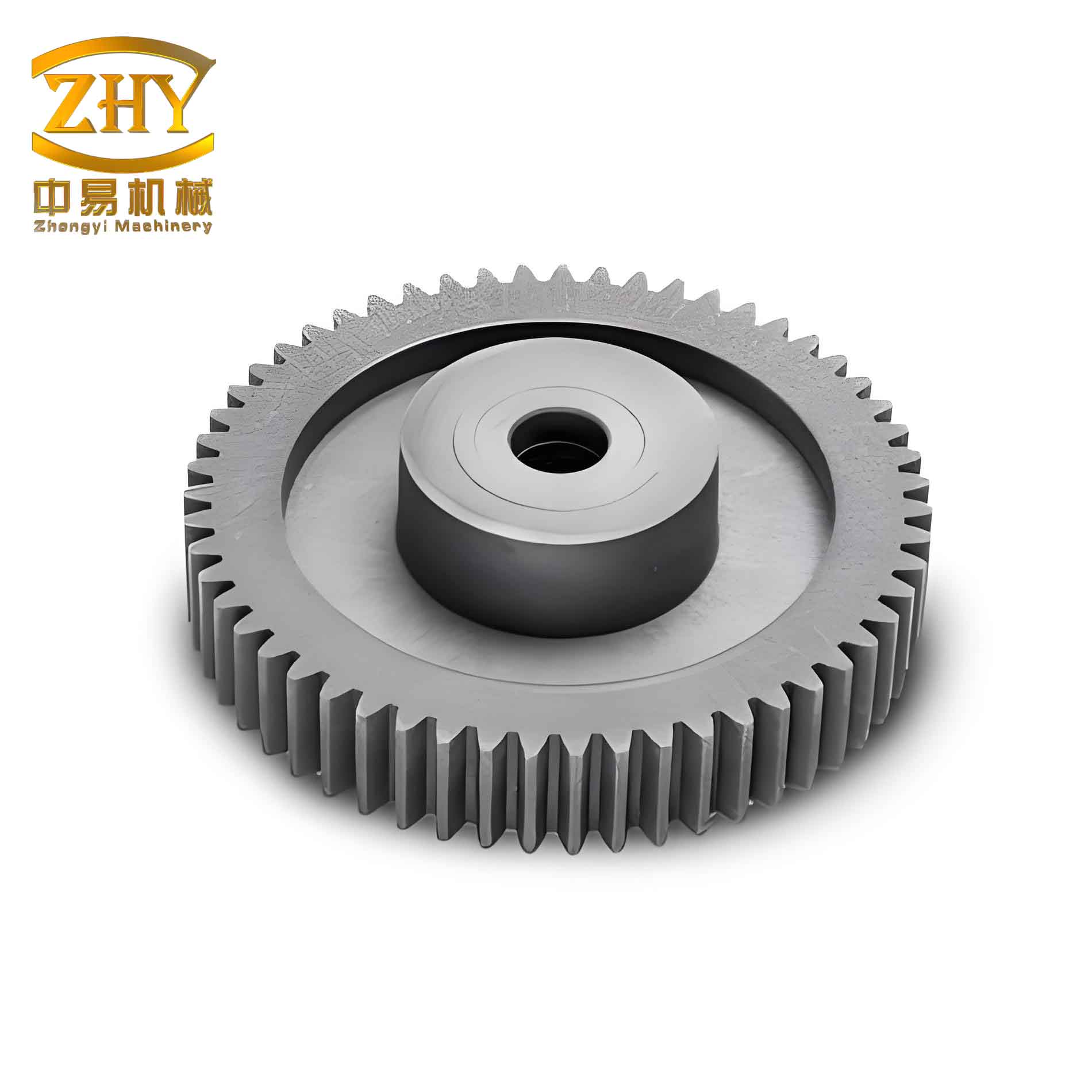
To begin, I focus on the mesh stiffness of cylindrical gears, which is a key indicator of their load-carrying capacity and dynamic response. Traditional models calculate mesh stiffness based on potential energy theory, incorporating components such as Hertzian contact stiffness, bending stiffness, shear stiffness, axial compression stiffness, and fillet-foundation stiffness. However, for cylindrical gears, the structural coupling effect—where the deformation of one gear pair influences adjacent pairs—is often neglected. In my improved model, I introduce an extended fillet-foundation stiffness component to account for this coupling. For a cylindrical gear pair under load, the total mesh stiffness \( K \) can be expressed as a combination of these components. Considering that the contact ratio for cylindrical gears is typically less than 2, with a maximum of two tooth pairs in contact, the interaction between pairs becomes significant. The extended fillet-foundation stiffness for a loaded cylindrical gear pair, influenced by an adjacent pair, is derived using rotational displacement coordination principles.
Let me define the parameters: for a cylindrical gear pair, let \( i \) and \( m \) represent the tooth pair indices, with \( i = 1, 2 \) and \( m = 1, 2 \). The total mesh stiffness \( K_i^j \) at contact position \( j \) is given by:
$$ \frac{1}{K_i^j} = \frac{1}{k_{ih}^j} + \frac{1}{k_{it}^j} = \frac{1}{k_{ih}^j} + \sum_{i=1}^{l} \left( \frac{1}{k_{ib}^j} + \frac{1}{k_{is}^j} + \frac{1}{k_{ia}^j} + \frac{1}{k_{if}^j} \right) $$
where \( l \) is the number of simultaneously meshing tooth pairs (here, \( l=2 \) for cylindrical gears in double-contact regions), \( k_{ih} \) is the Hertzian contact stiffness, \( k_{ib} \) is the bending stiffness, \( k_{is} \) is the shear stiffness, \( k_{ia} \) is the axial compression stiffness, and \( k_{if} \) is the fillet-foundation stiffness. To incorporate structural coupling, I add an extended fillet-foundation stiffness component \( K_{\text{extend}} \):
$$ \frac{1}{(K_{\text{extend}})_i^j} = \frac{1}{(k_{ipfim})^j} + \frac{1}{(k_{iwfim})^j} \quad \text{for} \quad m \neq i $$
Here, \( k_{ipfim} \) and \( k_{iwfim} \) represent the extended fillet-foundation stiffness for the pinion and wheel, respectively, reflecting the coupling effect. For cylindrical gears, the fillet-foundation stiffness can be derived from geometric parameters. Let \( \alpha_c \) be the contact angle at the meshing point, \( \alpha \) be the pressure angle, and \( z \) be the number of teeth. The deformation due to fillet-foundation is influenced by factors like the gear body geometry. Using potential energy methods, I express the stiffness in terms of dimensionless coefficients, as referenced in prior studies. This approach ensures that the model accurately captures the elastic behavior of cylindrical gears under load.
Next, I turn to the quasi-static transmission error (QSTE) for cylindrical gears. QSTE is a measure of the deviation between the theoretical and actual rotational positions of gears, crucial for assessing smoothness and noise. In practical cylindrical gear systems, tooth profile errors from modification or wear introduce separations along the line of action, requiring additional displacement for proper meshing. This leads to increased QSTE. Moreover, angular contact—where the actual contact points shift due to deformations—further complicates QSTE prediction. My model integrates these factors by extending the rotational displacement coordination principle. For a cylindrical gear pair in double-contact regions, the QSTE for the meshing-in process at position \( j \) is given by:
$$ \Delta^2 \text{QSTE}_j = A_2^j F_2^j + A_{2f21}^j F_1^j + E_{2P}^j + S_{a2}^j $$
$$ \Delta^1 \text{QSTE}_j = A_1^j F_1^j + A_{1f12}^j F_2^j + E_{1P}^j $$
where \( A_i^j = 1/K_i^j \) is the compliance, \( A_{if12}^j \) and \( A_{if21}^j \) are compliance components from adjacent loaded pairs (e.g., \( A_{1f12}^j = 1/(K_{\text{extend}})_1^j \)), \( F_i^j \) is the meshing force, \( E_{iP}^j \) is the total profile deviation comprising modification \( \delta_{Mi} \) and wear \( \delta_{Wi} \), and \( S_{ai}^j \) is the separation distance after unloading, accounting for angular contact. For cylindrical gears, \( \delta_{Mi} \) and \( \delta_{Wi} \) can be decomposed into pinion and wheel components. The total profile deviation \( E_{iP}^j \) is:
$$ E_{iP}^j = \delta_{Mi}^j + \delta_{Wi}^j = (\delta_{m1}^j + \delta_{m2}^j) + (\delta_{w1}^j + \delta_{w2}^j) $$
To solve for \( \Delta \text{QSTE} \), \( F_1 \), and \( F_2 \), I derive expressions based on force equilibrium and displacement compatibility. For the meshing-in process in cylindrical gears:
$$ \Delta \text{QSTE}_j = \frac{F_{\text{tm}} (A_1^j \cdot A_2^j – A_{1f12}^j \cdot A_{2f21}^j) + (A_1^j – A_{1f12}^j) S_{aj} + (A_1^j – A_{1f12}^j) E_{2P}^j + (A_2^j – A_{2f21}^j) E_{1P}^j}{A_1^j + A_2^j – A_{1f12}^j \cdot A_{2f21}^j} $$
$$ F_1^j = \frac{F_{\text{tm}} (A_2^j – A_{1f12}^j) + S_{aj} + (E_{2P}^j – E_{1P}^j)}{A_1^j + A_2^j – A_{2f21}^j – A_{1f12}^j} $$
$$ F_2^j = \frac{F_{\text{tm}} (A_1^j – A_{2f21}^j) – S_{aj} – (E_{2P}^j – E_{1P}^j)}{A_1^j + A_2^j – A_{2f21}^j – A_{1f12}^j} $$
Similarly, for the meshing-out process in cylindrical gears, the equations are adjusted with \( S_{rj} \) representing separation during unloading. The actual mesh stiffness \( K_T \) is then computed from QSTE by subtracting the non-load static transmission error (NLST):
$$ K_{Tj} = \frac{F_{\text{tm}}}{\Delta \text{QSTE}_j – \Delta \text{NLST}_j} $$
$$ \Delta \text{NLST}_j = \begin{cases} \min(E_{1P}^j, E_{2P}^j + S_{aj}) & \text{for meshing-in} \\ \min(E_{1P}^j + S_{rj}, E_{2P}^j) & \text{for meshing-out} \end{cases} $$
This model effectively incorporates wear effects, tooth profile errors, angular contact, and structural coupling for cylindrical gears. To account for wear, I use the Archard wear model, where the total wear depth \( \delta_{W} \) after \( N \) cycles is:
$$ \delta_{iW}^j = \sum_{n=1}^{N} L \cdot (h_{ip}^j + h_{iw}^j) = \sum_{n=1}^{N} 2L \cdot K_w \cdot P_{mj} \cdot a_j \cdot |u_{pj} – u_{wj}| \cdot \left( \frac{1}{u_{pj}} + \frac{1}{u_{wj}} \right) $$
Here, \( h_{ip} \) and \( h_{iw} \) are wear depths for pinion and wheel, \( u_p \) and \( u_w \) are sliding velocities, \( a \) is the half-width of Hertzian contact, \( P_m \) is mean contact pressure, \( L \) is a parameter to reduce cycle counts (set to 1000), and \( K_w \) is the wear coefficient, which depends on lubrication conditions. For cylindrical gears under mixed lubrication, \( K_w \) varies with the film thickness ratio \( \lambda \).
To validate my analytical model for cylindrical gears, I compare it with finite element method (FEM) results from literature. The gear parameters used are summarized in Table 1. These parameters are typical for cylindrical gear applications, ensuring relevance to real-world scenarios.
| Parameter | Gear Pair 1 | Gear Pair 2 |
|---|---|---|
| Number of Teeth, \( z \) | \( z_1 = z_2 = 30 \) | \( z_1 = 20, z_2 = 30 \) |
| Module, \( m \) (m) | 0.002 | 0.004 |
| Face Width, \( B \) (m) | 0.02 | 0.04 |
| Pressure Angle, \( \alpha \) (°) | 20 | 20 |
| Addendum Coefficient, \( h_a^* \) | 1 | 1 |
| Dedendum Coefficient, \( c^* \) | 0.25 | 0.25 |
| Input Torque, \( T \) (N·m) | 150 | 98 |
| Pinion Speed, \( N_1 \) (rpm) | 100 | 100 |
| Bore Radius, \( r_{\text{int}} \) (m) | \( r_{\text{int1}} = 0.0063 \), \( r_{\text{int2}} = 0.0063 \) | \( r_{\text{int1}} = 0.0117 \), \( r_{\text{int2}} = 0.0383 \) |
The comparison shows excellent agreement between my analytical model and FEM for both unmodified and modified cylindrical gears. For instance, the mesh stiffness curves overlap closely in single and double-contact regions, with deviations less than 5%. Moreover, the computational efficiency of my model is significantly higher, reducing calculation time to about 1.67 seconds compared to hours for FEM. This makes it suitable for iterative design analyses of cylindrical gear systems. The accuracy extends to QSTE predictions, where my model captures the nuances introduced by profile deviations.
Now, I investigate the effects of tooth profile modification and wear on cylindrical gear transmission characteristics. Tooth profile modification involves intentionally altering the tooth shape to reduce stress concentrations and noise. The modification is characterized by the amount \( C_a \) (normalized as \( C_n = C_a / (0.02m) \)) and length \( L_a \) (normalized as \( L_n = L_a / (0.06m) \)). The deviation \( \delta_m \) due to modification at a contact point with meshing angle \( \alpha_c \) is:
$$ \delta_m = \cos(\tan \alpha_c – \alpha_2) \cdot C_a \cdot \left( \frac{l}{L_a} \right)^s $$
where \( \alpha_2 = \pi/(2z) + 2(\tan \alpha – \alpha) \), \( l \) is the vertical distance from the modification start point, and \( s \) is the modification index (set to 1 for linear modification). For cylindrical gears, this deviation affects the initial contact conditions, leading to changes in mesh stiffness and QSTE.
I analyze mesh stiffness variations under different modification parameters for cylindrical gears. The results are summarized in Table 2, which shows the mesh stiffness at the boundary between single and double-contact regions. As \( C_n \) increases, the mesh stiffness decreases due to the additional displacement required to compensate for the gap. For example, at \( C_n = 0.4 \), the stiffness reduction is about 10.17% compared to unmodified cylindrical gears. In contrast, changes in \( L_n \) have a more constant effect, with a reduction rate of 7.6% across values from 0.2 to 1.0. This indicates that the modification amount has a more significant impact on cylindrical gear mesh stiffness than the modification length.
| Modification Amount, \( C_n \) | Mesh Stiffness at Boundary (N/m) – Worn | Mesh Stiffness at Boundary (N/m) – Unworn | Change Rate |
|---|---|---|---|
| 0.2 | 2.16E+08 | 2.13E+08 | 0.0126 |
| 0.4 | 2.10E+08 | 1.90E+08 | 0.1017 |
| 0.6 | 1.99E+08 | 1.85E+08 | 0.0759 |
| 0.8 | 1.85E+08 | 1.85E+08 | 0.0001 |
| 1.0 | 1.85E+08 | 1.85E+08 | 0.0001 |
When wear is introduced, the effects become more pronounced. After 40,000 wear steps (simulating long-term operation), the mesh stiffness distribution smoothens, and the differences due to modification diminish. This is because wear depth gradually overshadows initial profile errors in cylindrical gears. Table 3 illustrates how wear step count influences mesh stiffness. As wear progresses, the change rate decreases from -0.1963 at 10,000 steps to -0.0196 at 100,000 steps, indicating that wear becomes the dominant factor over time. Additionally, angular contact reappears as wear increases, altering the transition regions in stiffness curves.
| Wear Step Count, \( n \) | Mesh Stiffness at Boundary – Worn (N/m) | Mesh Stiffness at Boundary – Unworn (N/m) | Change Rate |
|---|---|---|---|
| 10,000 | 1.85E+08 | 2.31E+08 | -0.1963 |
| 20,000 | 1.86E+08 | 2.25E+08 | 0.1718 |
| 40,000 | 1.99E+08 | 2.20E+08 | 0.0928 |
| 60,000 | 2.08E+08 | 2.18E+08 | 0.0463 |
| 100,000 | 2.13E+08 | 2.18E+08 | -0.0196 |
For quasi-static transmission error in cylindrical gears, the impact of profile deviations is even more significant. As shown in Table 4, the QSTE at the boundary increases with modification amount, with a maximum change rate of 0.3926 at \( C_n = 1.0 \). This rise in QSTE correlates with increased noise and vibration in cylindrical gear systems. Modification length has a negligible effect on QSTE, as seen in Table 5, where change rates remain around 0.2938 across different \( L_n \) values. This suggests that for cylindrical gears, controlling the modification amount is more critical for managing transmission error.
| Modification Amount, \( C_n \) | QSTE at Boundary – Worn (m) | QSTE at Boundary – Unworn (m) | Change Rate |
|---|---|---|---|
| 0.2 | 3.09E-05 | 2.50E-05 | 0.2383 |
| 0.4 | 3.36E-05 | 2.80E-05 | 0.2003 |
| 0.6 | 3.71E-05 | 2.87E-05 | 0.2938 |
| 0.8 | 3.99E-05 | 2.87E-05 | 0.3926 |
| 1.0 | 3.99E-05 | 2.87E-05 | 0.3926 |
| Modification Length, \( L_n \) | QSTE at Boundary – Worn (m) | QSTE at Boundary – Unworn (m) | Change Rate |
|---|---|---|---|
| 0.2 | 3.72E-05 | 2.87E-05 | 0.2936 |
| 0.4 | 3.72E-05 | 2.87E-05 | 0.2938 |
| 0.5 | 3.72E-05 | 2.87E-05 | 0.2938 |
| 0.6 | 3.72E-05 | 2.87E-05 | 0.2939 |
| 0.8 | 3.72E-05 | 2.87E-05 | 0.2939 |
Under wear conditions, QSTE values increase substantially, as detailed in Table 6. After 40,000 wear steps, the QSTE change rate is 0.2725, and it decreases to 0.2009 after 100,000 steps, confirming that wear gradually reduces the influence of initial modification. This trend highlights the importance of considering long-term wear in the design phase of cylindrical gears. The smoothing of QSTE curves with wear also implies that cylindrical gears may exhibit more predictable behavior over time, albeit at higher error levels.
| Wear Step Count, \( n \) | QSTE at Boundary – Worn (m) | QSTE at Boundary – Unworn (m) | Change Rate |
|---|---|---|---|
| 10,000 | 3.15E-05 | 2.41E-05 | 0.3074 |
| 20,000 | 3.42E-05 | 2.60E-05 | 0.3194 |
| 40,000 | 3.72E-05 | 2.92E-05 | 0.2725 |
| 60,000 | 3.99E-05 | 3.23E-05 | 0.2367 |
| 100,000 | 4.60E-05 | 3.83E-05 | 0.2009 |
In discussion, I emphasize that the interaction between modification and wear in cylindrical gears is complex. Initially, profile modification can optimize mesh stiffness and QSTE by reducing peak loads and smoothing transitions. However, as wear accumulates, its effects dominate, leading to increased compliance and transmission error. This has practical implications for cylindrical gear maintenance: regular inspection and potential re-profiling may be necessary to sustain performance. My model provides a tool for predicting these changes, enabling proactive management of cylindrical gear systems. Additionally, the inclusion of structural coupling and angular contact in the model offers a more realistic simulation compared to traditional approaches, which often treat cylindrical gears as isolated pairs.
To further illustrate the applicability of my model, I consider a case study involving cylindrical gears in a wind turbine gearbox. In such high-stress environments, understanding the evolution of mesh stiffness and QSTE over time is crucial for preventing failures. Using the derived formulas, I can simulate different operational scenarios, such as varying loads or lubrication conditions, and assess their impact on cylindrical gear life. For instance, if the wear coefficient \( K_w \) increases due to poor lubrication, the model predicts accelerated degradation, highlighting the need for effective maintenance schedules. This underscores the versatility of my analytical approach for cylindrical gears across industries.
In conclusion, I have developed an improved analytical model for cylindrical gears that incorporates tooth profile errors, wear, structural coupling, and angular contact. The model demonstrates high accuracy when validated against finite element methods, with computational efficiency suitable for design optimization. My findings reveal that both tooth profile modification and wear significantly affect mesh stiffness and quasi-static transmission error in cylindrical gears. While modification initially plays a key role, wear becomes the dominant factor over time, leading to greater impacts on transmission characteristics. This study provides valuable insights for the design and maintenance of cylindrical gear systems, emphasizing the need to account for long-term wear effects. Future work could extend this model to helical or bevel cylindrical gears, exploring more complex gear geometries. Ultimately, by advancing our understanding of cylindrical gear behavior, we can enhance the reliability and efficiency of mechanical transmissions worldwide.