
Skiving, an advanced machining process combining the principles of hobbing and shaping, has emerged as a highly efficient and precise method for manufacturing cylindrical gears. This process involves a cutter and a workpiece rotating at a constant speed ratio with a fixed crossing angle, while a relative feed motion along the workpiece axis completes the tooth profile. Its advantages in terms of high precision, high material removal rates, and environmental friendliness are significant for modern gear production. The core of this technology lies in the design of the skiving tool itself.
Current mainstream design methodologies for skiving tools are predominantly based on the principle of conjugate surface generation with two degrees of freedom. This is essentially a reverse-engineering approach where the workpiece tooth surface is used to inversely solve for the cutter’s cutting edge. While effective, this method presents notable limitations. Primarily, the designed cutting edge is intrinsically linked to the specific helical angle of the target cylindrical gear. Any change in the workpiece’s helical angle necessitates a complete re-calculation of the cutter’s conjugate surface and its cutting edge. Furthermore, the inverse solution process for the cutting edge curve can be numerically unstable, potentially leading to divergent solutions or physically unrealistic, intersecting edge curves. Additionally, for gears defined only by discrete coordinate points rather than a complete analytical model, this reverse method struggles to yield a continuous, accurate cutting edge equation.
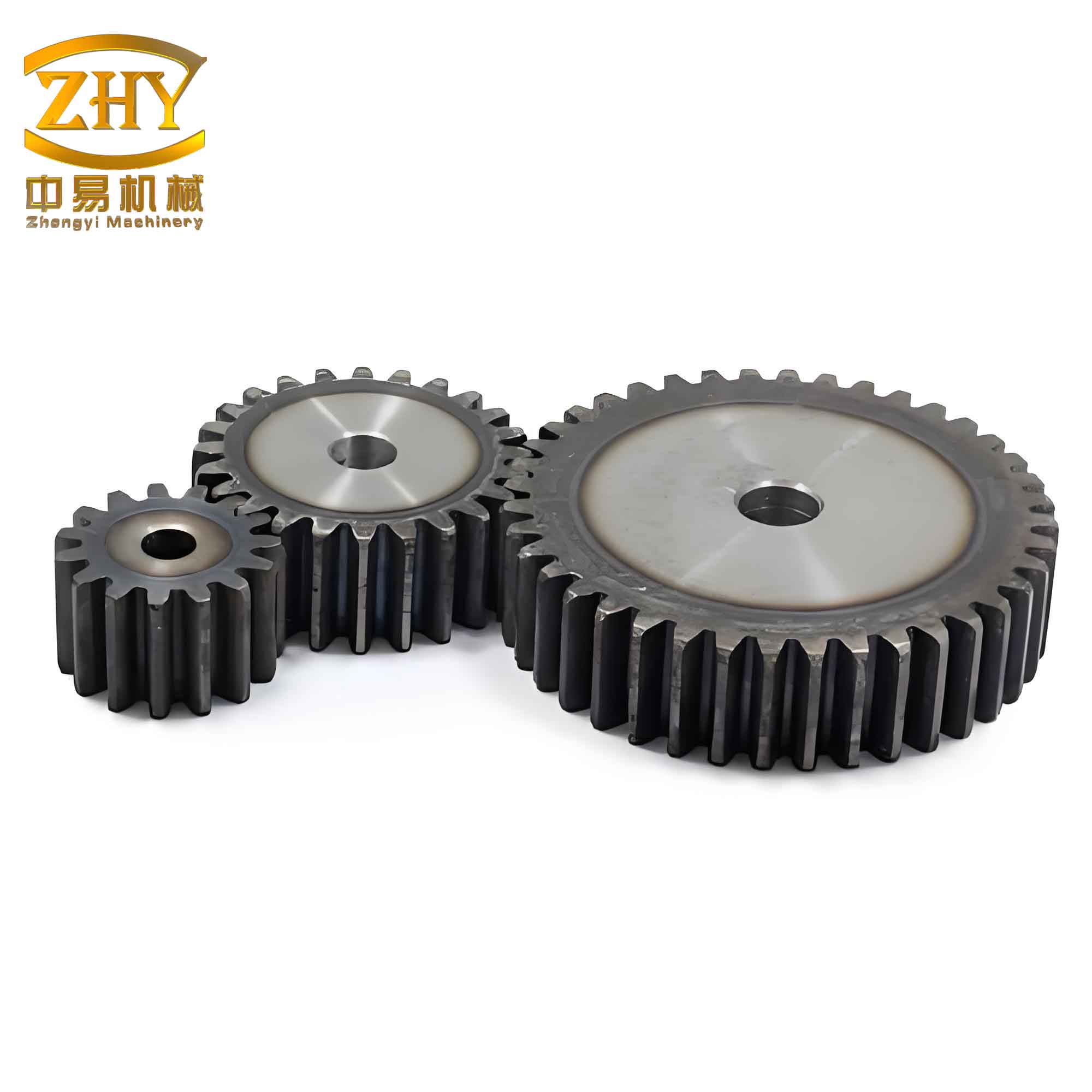
Addressing these challenges requires a new perspective focused on universality and a more direct cutting edge derivation. This work introduces a novel, universal design method for skiving tools intended for involute cylindrical gears. The foundation is the line-contact meshing condition between two involute helical surfaces on crossed axes. Starting directly from a defined involute helicoid as the tool’s design conjugate surface, the cutting edge is obtained explicitly through intersection with a predefined rake face. This forward design approach eliminates theoretical edge form errors. Crucially, a single designed conjugate surface can mesh correctly with cylindrical gears of different helical angles by simply adjusting the installation crossing angle, thereby granting the tool its “universal” characteristic. The flank face is also constructed to ensure the cutting edge accuracy remains unchanged after tool regrinding. This paper details the skiving principle, establishes the mathematical conditions for line-contact meshing, presents the comprehensive tool design procedure, derives the necessary machining parameters, and validates the method’s feasibility and universality through simulation cases.
Fundamental Principle of Skiving Process
The skiving process operates on the principles of spatial meshing and conjugate rotary cutting. The cutter and the workpiece are positioned with their axes crossed at a fixed angle Σ. They rotate about their own axes at angular velocities ω_t and ω_p, respectively, maintaining a constant speed ratio. This primary rotary motion, combined with the specific geometry of the cutter, generates the relative cutting velocity responsible for the material removal, effectively performing the generating motion of the workpiece tooth profile. For this generation to be accurate, the cutting edge curve must maintain continuous tangency (or more precisely, a defined cut-contact curve) with the theoretical tooth surface of the cylindrical gear. Simultaneously, a linear feed motion f, typically along the workpiece axis, is applied to complete the machining of the entire tooth width.
Line-Contact Conjugate Meshing of Crossed-Axis Involute Helical Surfaces
The tooth surface of a standard cylindrical gear is an involute helicoid. This surface can be generated by a straight line (the generatrix) lying on a tangent plane to the base cylinder. As this plane rolls without slipping over the base cylinder, the line sweeps out the involute helicoid. When this generatrix is parallel to the cylinder axis, a spur gear tooth surface results; when it is inclined at an angle β_b (the base helix angle), a helical gear tooth surface is formed.
The mathematical model of an involute helicoid in a coordinate system O-xyz (with the z-axis along the gear axis) can be expressed using two parameters: the roll angle θ and the distance t along the generatrix.
Let r_b be the base radius and λ_b be the base lead angle (where λ_b = 90° – β_b). The position vector of a point on the right-hand involute helicoid is given by:
$$ \mathbf{r} = \begin{bmatrix} x \\ y \\ z \end{bmatrix} = \begin{bmatrix} r_b \cos\theta + t \cos\lambda_b \sin\theta \\ r_b \sin\theta – t \cos\lambda_b \cos\theta \\ p \theta – t \sin\lambda_b \end{bmatrix} $$
where p is the helix parameter, defined as p = r_b \tan\lambda_b = r_b / \tan\beta_b.
The unit normal vector to this surface is:
$$ \mathbf{n} = (-\sin\lambda_b \sin\theta, \sin\lambda_b \cos\theta, -\cos\lambda_b) $$
In general, conjugate motion between two crossed-axis involute helical surfaces results in point contact. However, under specific geometrical conditions, line-contact conjugation can be achieved. This occurs when the two base cylinders share a common tangent plane Q. This condition is met when the center distance a and the shaft angle Σ satisfy the following relationships for external and internal meshing:
| Meshing Type | Center Distance (a) | Shaft Angle (Σ) |
|---|---|---|
| External | a = r_{b1} + r_{b2} | Σ = β_{b1} + β_{b2} |
| Internal | a = | r_{b1} – r_{b2} | | Σ = | β_{b1} – β_{b2} | |
Here, r_{b1}, β_{b1} and r_{b2}, β_{b2} are the base radii and base helix angles of the two involute helicoids, respectively. When these conditions hold, the common generatrix lying in the shared tangent plane Q becomes the line of contact between the two surfaces.
To ensure proper conjugate motion along this contact line, the rotational speeds must satisfy the meshing equation derived from the condition that the relative velocity has no component along the common normal at the contact point. For line contact, this condition must hold for all points along the generatrix. The analysis yields the required speed ratio condition:
$$ n \cdot v_{12} = 0 \Rightarrow r_{b1} \cos\beta_{b1} \omega_1 + \eta \ r_{b2} \cos\beta_{b2} \omega_2 = 0 $$
where η = -1 for external meshing and η = +1 for internal meshing. Therefore, the rotational speeds must maintain the ratio:
$$ \frac{\omega_1}{\omega_2} = -\eta \frac{r_{b2} \cos\beta_{b2}}{r_{b1} \cos\beta_{b1}} $$
This fundamental principle of line-contact meshing between crossed-axis involute helicoids is the cornerstone of the proposed universal skiving tool design. One surface (the tool’s conjugate surface) with fixed parameters (r_{bt}, β_{bt}) can mesh in line contact with various workpiece cylindrical gear surfaces (r_{bp}, β_{bp}) by appropriately setting the machine’s center distance a, shaft angle Σ, and speed ratio according to the formulas above.
Design Methodology for the Universal Skiving Tool
Design of the Conjugate Surface
The tool’s cutting edges are defined on an involute helicoid, chosen as the design conjugate surface. For a tool with a right-hand helix, each tooth has a left flank (cutting edge I) and a right flank (cutting edge II). Taking the left flank as an example, its surface equation is offset from the basic helicoid equation by the base tooth thickness semi-angle μ_b, which is calculated from the tool’s nominal parameters (module m, pressure angle α, number of teeth z):
The semi-angle on the base circle is:
$$ \mu_b = \frac{s_b}{2 r_b} = \frac{\pi m \cos\alpha + 2 m z \cos\alpha \cdot \text{inv}(\alpha)}{4 r_b} $$
where inv(α) = \tan\alpha – \alpha.
The parametric equation for the left flank (conjugate surface I) becomes:
$$ \mathbf{r}_t(\theta, t) = \begin{bmatrix} r_b \cos(\theta – \mu_b) + t \cos\lambda_b \sin(\theta – \mu_b) \\ r_b \sin(\theta – \mu_b) – t \cos\lambda_b \cos(\theta – \mu_b) \\ p \theta – t \sin\lambda_b \end{bmatrix} $$
This designed involute helicoid, with its specific base radius r_{bt} and base helix angle β_{bt}, serves as the universal conjugate surface. By calculating the required shaft angle Σ = |β_{bt} ± β_{bp}| for a given workpiece cylindrical gear, this single surface can theoretically generate the correct tooth form for cylindrical gears with different helix angles.
Determination of the Cutting Edge
The cutting edge is defined as the intersection curve between the designed conjugate surface (involute helicoid) and the tool’s rake face. A simple planar rake face is used here, defined in the tool coordinate system. Let γ be the rake angle. The equation of a plane passing near the tool’s base cylinder and inclined by γ can be expressed as:
$$ z \cos\beta_b + y \sin\beta_b = (x – r_b) \tan\gamma $$
Solving the system of equations formed by the conjugate surface and the rake face plane eliminates the parameter t, yielding the cutting edge curve as a function of the single parameter θ. The coordinates of a point on the left cutting edge, \mathbf{r}_e(θ), are:
$$ \begin{aligned}
x_e(\theta) &= r_b \cos(\theta – \mu_b) + T(\theta) \cos\lambda_b \sin(\theta – \mu_b) \\
y_e(\theta) &= r_b \sin(\theta – \mu_b) – T(\theta) \cos\lambda_b \cos(\theta – \mu_b) \\
z_e(\theta) &= p \theta – T(\theta) \sin\lambda_b
\end{aligned} $$
where T(θ) is the solution for t from the plane equation:
$$ T(\theta) = \frac{p\theta \cos\beta_b + r_b[\sin(\theta-\mu_b)\sin\beta_b – \cos(\theta-\mu_b)\tan\gamma] + r_t \tan\gamma}{\sin\lambda_b \cos\beta_b + \cos\lambda_b[\cos(\theta-\mu_b)\sin\beta_b + \sin(\theta-\mu_b)\tan\gamma]} $$
Here, r_t is a reference radius for defining the rake face location. This provides an explicit, error-free definition of the cutting edge.
Modeling of the Flank Face
The flank face design must fulfill two objectives: provide adequate clearance angles (side and top), and ensure that the cutting edge geometry remains accurate after the tool is reground (i.e., after the rake face is resharpened).
The top flank is designed as a conical surface. Its axis is aligned with the tool’s helix direction (at angle β_b relative to the tool axis), its base radius is the tool tip radius r_{at}, and its cone angle is (90° – α_e), where α_e is the top clearance angle.
The side flank is generated by subjecting the cutting edge curve to a helical motion around the tool axis. The key is to vary the base tooth thickness parameter μ_b in the cutting edge equation as a function of the helical motion parameter θ_c. This variation, Δμ, is calculated to provide the desired side clearance angle α_c. The relationship is:
$$ \Delta\mu(\theta_c) = \frac{p_c \theta_c [\tan(\beta_b + \alpha_c) – \tan\beta_b]}{r_b} $$
where p_c is the helix parameter for the flank generation motion, typically chosen to create radial relief.
The family of cutting edge curves generated with the varying parameter μ_b – Δμ(θ_c) forms the side flank surface. When the tool is reground, the new rake face intersects this same set of conjugate surfaces (with different μ_b offsets), producing a new cutting edge that still lies on a valid conjugate involute helicoid, just with a slightly modified tooth thickness. This guarantees that the regenerated edge can still accurately machine the standard involute cylindrical gear profile without theoretical error.
Calculation of Machining Parameters
To correctly set up the skiving process using the designed universal tool, the following machine parameters must be calculated based on the tool (subscript t) and workpiece cylindrical gear (subscript p) data.
| Parameter | Symbol | Calculation Formula | Notes |
|---|---|---|---|
| Shaft Angle | Σ | Σ = |β_{bt} ± β_{bp}| | Use ‘+’ for external, ‘-‘ for internal cylindrical gear machining. |
| Center Distance | a | a = r_{bp} ± r_{bt} | Use ‘+’ for external, ‘-‘ for internal cylindrical gear machining. |
| Offset Distance | ρ | Solved from system (Eq. 1 or 2) | Ensures tool tip correctly machines gear root. Direction determines which flank is cut. |
| Rotational Speeds | ω_t, ω_p | ω_t = ± (k ω_p) – (C f) where k = (r_{bp}cosβ_{bp})/(r_{bt}cosβ_{bt}), C = (sinβ_{bp})/(r_{bt}cosβ_{bt}) |
‘±’ is ‘+’ for internal, ‘-‘ for external gear. f is axial feed rate. This accounts for feed motion breaking conjugate contact. |
The offset ρ is critical to position the tool tip correctly relative to the workpiece cylindrical gear root. It is found by solving a system of equations that enforces tangency between the tool tip ellipse (projected onto the workpiece transverse plane) and the workpiece root circle. For internal cylindrical gears, the system is:
$$
\begin{cases}
\rho = r_{fp} \cos\theta_p – r_{at} \cos\Sigma \cos\theta_t \\
a = r_{fp} \sin\theta_p – r_{at} \sin\theta_t \\
\cos\theta_p \sin\theta_t – \sin\theta_p \cos\Sigma \cos\theta_t = 0
\end{cases}
$$
For external cylindrical gears, the system is:
$$
\begin{cases}
\rho = r_{fp} \cos\theta_p + r_{at} \cos\Sigma \cos\theta_t \\
a = r_{fp} \sin\theta_p + r_{at} \sin\theta_t \\
\cos\theta_p \sin\theta_t + \sin\theta_p \cos\Sigma \cos\theta_t = 0
\end{cases}
$$
where r_{fp} is the workpiece root radius, r_{at} is the tool tip radius, and θ_p, θ_t are the angular parameters on the root circle and tool tip ellipse, respectively.
Simulation Verification
To validate the proposed universal design method for cylindrical gear skiving tools, a detailed simulation study was conducted using VERICUT software. A skiving tool model was designed according to the method described, with the parameters listed below.
Common Parameters (for tool and all workpieces):
Normal Module m_n = 4 mm, Normal Pressure Angle α_n = 20°, Addendum Coefficient h_a* = 1, Dedendum Coefficient c* = 0.25.
Designed Universal Skiving Tool Parameters:
| Parameter | Value |
|---|---|
| Number of Teeth z_t | 41 |
| Base Helix Angle β_{bt} | 18.7472° |
| Base Radius r_{bt} | 81.3719 mm |
| Tip Radius r_{at} | 93 mm |
| Root Radius r_{ft} | 83 mm |
| Rake Angle γ | 15° |
| Top Clearance Angle α_e | 9° |
| Side Clearance Angle α_c | 4° |
This single tool was then used to simulate the skiving of four different cylindrical gear workpieces, demonstrating its universality.
| Workpiece & Parameter | Workpiece 1 | Workpiece 2 | Workpiece 3 | Workpiece 4 |
|---|---|---|---|---|
| Gear Type | Internal Spur | External Spur | Internal Helical | External Helical |
| Number of Teeth z_p | 125 | 125 | 100 | 70 |
| Base Helix Angle β_{bp} | 0° | 0° | -14.0761° | 18.7472° |
| Base Radius r_{bp} (mm) | 234.9232 | 234.9232 | 193.7563 | 138.9277 |
| Shaft Angle Σ | 18.7472° | 18.7472° | 32.8233° | 37.4945° |
| Center Distance a (mm) | 153.5512 | 316.2951 | 112.3844 | 220.2996 |
| Offset ρ (mm) | 53.1482 | 117.4599 | 43.6174 | 80.6880 |
| Workpiece Speed ω_p (rpm) | 246 | 246 | 246 | 246 |
| Tool Speed ω_t (rpm) | 750 | 750 | 600.0189 | 420.0252 |
| Feed Rate f (mm/min) | 6 | 6 | 6 | 6 |
The simulation successfully performed the material removal process for all four cylindrical gear configurations. After machining, the automatic comparison function in VERICUT was used to analyze the deviation between the simulated machined tooth surfaces and the theoretical ideal surfaces. The results showed that for all workpieces, the major part of the active tooth profile (the involute flank) exhibited deviations well within 0.01 mm, confirming high accuracy. A small, predictable residual material (approximately 0.1 mm) was observed in the root fillet region, which is a standard outcome as the tool tip generates the transition curve rather than the perfect theoretical form. No significant gouging or undercut was present on the functional flanks. These simulation results conclusively verify the feasibility and universality of the proposed skiving tool design method for various types of cylindrical gears.
Conclusion
This work has presented a comprehensive and novel design methodology for universal skiving tools intended for involute cylindrical gears. The method is fundamentally based on the established condition for line-contact conjugate meshing between crossed-axis involute helical surfaces. The key advantage of this approach is its forward design logic: starting from a specified involute helicoid as the tool’s conjugate surface, the cutting edge is derived explicitly via intersection with a defined rake face. This eliminates the complexities and potential instabilities associated with inverse problem-solving from the workpiece cylindrical gear surface.
The design method is inherently universal. A single designed conjugate surface on the tool can correctly mesh with cylindrical gears of varying helical angles by the appropriate calculation and setting of the machining parameters—primarily the shaft angle Σ. This addresses a significant limitation of conventional methods. Furthermore, the flank face model is constructed to ensure that the essential cutting edge geometry is preserved after tool regrinding, maintaining the tool’s accuracy throughout its life.
Explicit formulas have been provided for all critical steps: the line-contact meshing conditions, the cutting edge derivation, the flank surface generation, and the calculation of essential machining setup parameters (Σ, a, ρ, ω_t/ω_p). The method’s validity and universal applicability have been successfully demonstrated through detailed numerical simulations on four distinct cylindrical gear types (internal/external, spur/helical) using a single designed tool model. The simulation results confirmed that the machined tooth profiles of the cylindrical gears align with their theoretical forms with high precision. This design framework offers a simple, robust, and theoretically accurate alternative for developing advanced skiving tools for modern cylindrical gear manufacturing.