
In modern gear manufacturing, the skiving process has emerged as a high-precision and efficient method for machining involute cylindrical gears. This process combines the principles of hobbing and shaping, enabling rapid material removal while maintaining excellent surface quality. As a researcher in this field, I have focused on developing a universal design method for skiving tools that can accommodate various gear parameters, particularly for involute cylindrical gears. The design approach is based on the line-contact meshing of staggered-axis involute helical surfaces, which eliminates theoretical edge errors and ensures tool versatility. In this article, I will detail the principles, mathematical derivations, and validation of this method, emphasizing its applicability to different types of cylindrical gears. Throughout the discussion, I will incorporate formulas and tables to summarize key concepts, and I will ensure that the term “cylindrical gear” is frequently referenced to highlight its centrality in this work.
The skiving process operates on the principle of spatial conjugate cutting, where the tool and workpiece rotate at high speeds with a fixed axis crossing angle and speed ratio. This generates a relative velocity along the tooth direction of the cylindrical gear, facilitating efficient machining. The tool’s cutting edges must precisely conjugate with the workpiece tooth surface to achieve accurate gear profiles. Traditional design methods for skiving tools often rely on inverse calculations from the workpiece tooth surface, which can lead to issues such as solution divergence or edge crossover. To address these limitations, I propose a forward design method that starts from the involute helical surface of the tool, ensuring simplicity and universality. This method is particularly suited for involute cylindrical gears, as it leverages the geometric properties of involute helicoids to maintain line-contact meshing under specific conditions.
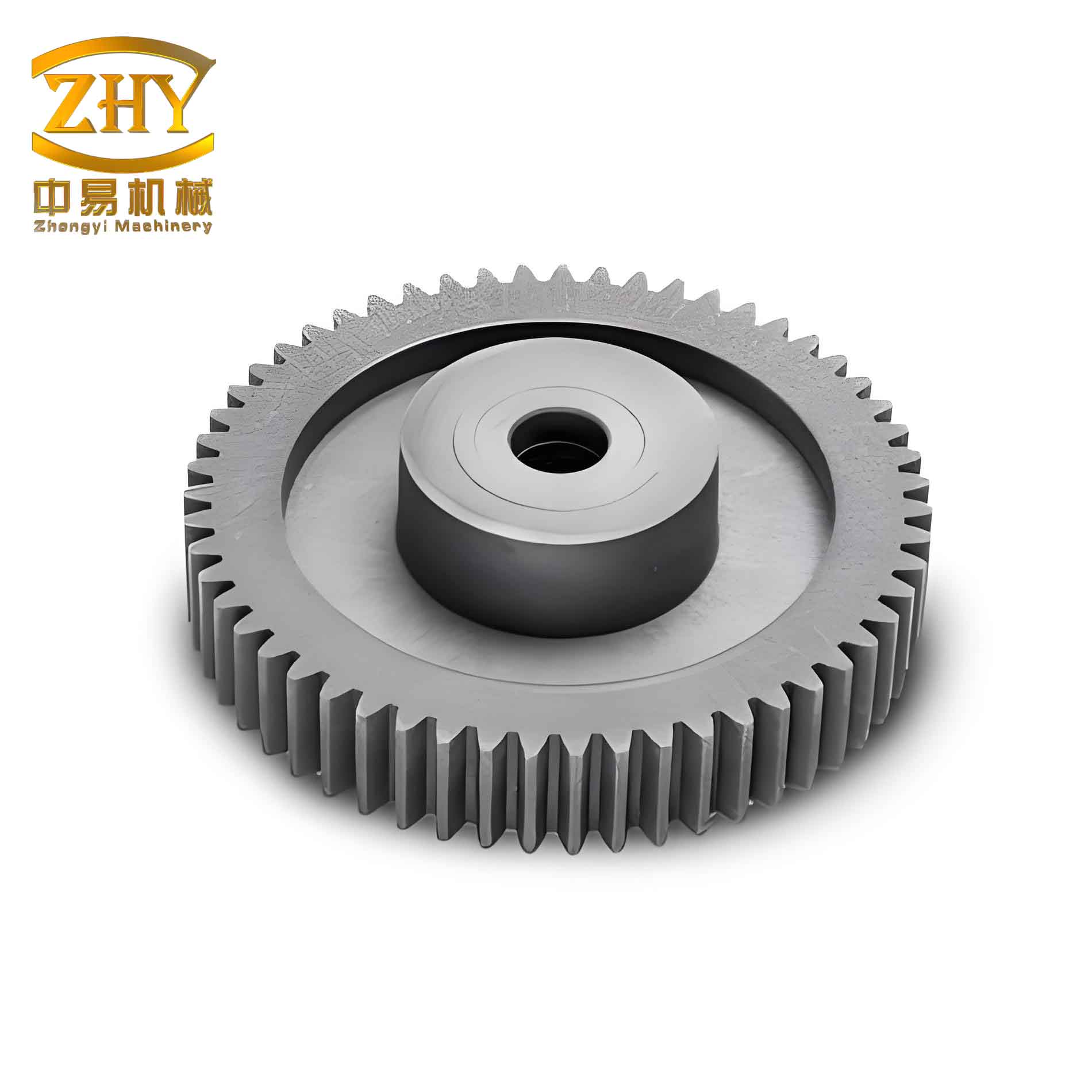
The core of this design method lies in the analysis of line-contact meshing between two staggered-axis involute helical surfaces. For involute cylindrical gears, the tooth surface can be represented as an involute helicoid, which is generated by a straight line (the generatrix) rolling on a base cylinder. When two such surfaces are arranged with their base cylinders tangent and with specific axis angles, they can achieve line-contact conjugation. This is crucial for skiving tools, as it allows a single tool design to mesh correctly with cylindrical gears of different helical angles. The mathematical formulation begins with the parametric equation of an involute helical surface. In a coordinate system Oxyz, let the base cylinder radius be $$r_b$$, the base helix angle be $$\beta_b$$, and the spiral parameter be $$p = r_b \tan \lambda_b$$, where $$\lambda_b$$ is the base lead angle (complementary to $$\beta_b$$). The surface equation is:
$$ x = r_b \cos \theta + t \cos \lambda_b \sin \theta $$
$$ y = r_b \sin \theta – t \cos \lambda_b \cos \theta $$
$$ z = p \theta – t \sin \lambda_b $$
Here, $$\theta$$ is the rotation parameter, and $$t$$ is the distance along the generatrix. The unit normal vector of the surface is:
$$ \mathbf{n} = (-\sin \lambda_b \sin \theta, \sin \lambda_b \cos \theta, -\cos \lambda_b) $$
For two involute helical surfaces to achieve line-contact meshing, their base cylinders must be tangent, and the axis crossing angle must satisfy specific conditions. Consider two surfaces with base radii $$r_{b1}$$ and $$r_{b2}$$, and base helix angles $$\beta_{b1}$$ and $$\beta_{b2}$$. For external meshing of cylindrical gears, the center distance $$a$$ and axis angle $$\psi$$ are:
$$ a = r_{b1} + r_{b2} $$
$$ \psi = \beta_{b1} + \beta_{b2} $$
For internal meshing, such as when machining an internal cylindrical gear, the conditions become:
$$ a = |r_{b1} – r_{b2}| $$
$$ \psi = |\beta_{b1} – \beta_{b2}| $$
Under these conditions, the two surfaces share a common tangent plane, and their generatrices coincide, enabling line-contact along a straight line. The relative velocity at any contact point must satisfy the meshing equation $$\mathbf{n} \cdot \mathbf{v} = 0$$, where $$\mathbf{v}$$ is the relative velocity vector. Through coordinate transformations and vector analysis, the speed ratio for proper conjugation is derived as:
$$ r_{b1} \cos \beta_{b1} \omega_1 = – r_{b2} \cos \beta_{b2} \omega_2 $$
for external meshing, and:
$$ r_{b1} \cos \beta_{b1} \omega_1 = r_{b2} \cos \beta_{b2} \omega_2 $$
for internal meshing. This relationship ensures that the tool and workpiece maintain correct meshing during skiving, which is fundamental for designing a universal tool for cylindrical gears.
Based on this meshing theory, I develop the skiving tool design method. The tool’s cutting edges are derived from an involute helical surface, which serves as the conjugate surface. By selecting a base helix angle for the tool, it can mesh with cylindrical gears of various helical angles by adjusting the axis crossing angle. This universality is key for manufacturing different types of involute cylindrical gears. The design process involves three main steps: conjugate surface design, cutting edge calculation, and flank surface modeling.
First, the conjugate surface for a tool tooth is defined as an involute helicoid. For a right-hand helical tool, the left and right cutting edges lie on two separate helicoidal surfaces. In the tool’s transverse plane, the tooth profile is symmetric about the x-axis. The base tooth thickness half-angle $$\mu_b$$ is calculated from the tool parameters:
$$ \mu_b = \frac{s_b}{2r_b} = \frac{\pi m \cos \alpha + 2 m z \cos \alpha \cdot \text{inv} \alpha}{4 r_b} $$
where $$m$$ is the module, $$\alpha$$ is the pressure angle, $$z$$ is the tool tooth number, and $$\text{inv} \alpha = \tan \alpha – \alpha$$. The parametric equation for the left flank surface (for example) is:
$$ x = r_b \cos(\theta – \mu_b) + t \cos \lambda_b \sin(\theta – \mu_b) $$
$$ y = r_b \sin(\theta – \mu_b) – t \cos \lambda_b \cos(\theta – \mu_b) $$
$$ z = p \theta – t \sin \lambda_b $$
Second, the cutting edge is obtained as the intersection of this conjugate surface with the rake face. For simplicity, a planar rake face is used, defined by:
$$ z \cos \beta_b + y \sin \beta_b = (x – r_b) \tan \gamma $$
where $$\gamma$$ is the rake angle. Solving this equation with the surface equations eliminates $$t$$, yielding the cutting edge curve as a function of $$\theta$$:
$$ \mathbf{r}_e(\theta) = \begin{cases} x = r_b \cos(\theta – \mu_b) + T \cos \lambda_b \sin(\theta – \mu_b) \\ y = r_b \sin(\theta – \mu_b) – T \cos \lambda_b \cos(\theta – \mu_b) \\ z = p \theta – T \sin \lambda_b \end{cases} $$
with:
$$ T = \frac{p \theta \cos \beta_b + r_b [\sin(\theta – \mu_b) \sin \beta_b – \cos(\theta – \mu_b) \tan \gamma] + r_t \tan \gamma}{\sin \lambda_b \cos \beta_b + \cos \lambda_b [\cos(\theta – \mu_b) \sin \beta_b + \sin(\theta – \mu_b) \tan \gamma]} $$
Here, $$r_t$$ is a reference radius. This explicit formula ensures no theoretical error in the cutting edge shape, which is essential for precision machining of cylindrical gears.
Third, the flank surface is designed to provide proper relief angles and to maintain edge accuracy after regrinding. The flank consists of the top flank and side flanks. The top flank is a conical surface with its axis inclined by the base helix angle $$\beta_b$$, providing a top relief angle $$\alpha_e$$. The side flank is generated by sweeping the cutting edge along a helical path with a spiral parameter $$p_c = r_b \tan(\pi/2 – \beta_b)$$. This ensures that after regrinding, the new cutting edge (with a modified base tooth thickness parameter $$\mu_b – \Delta \mu$$) still lies on the conjugate surface, preserving accuracy for cylindrical gear machining. The side flank surface equation is:
$$ \mathbf{A}_{\alpha_e}(\theta, \theta_c) = \mathbf{M}_{13} \mathbf{r}_e^i(\theta) $$
where $$\mathbf{M}_{13}$$ is the transformation matrix for helical motion, and $$\mathbf{r}_e^i(\theta)$$ is the cutting edge after regrinding. The parameter $$\Delta \mu$$ is related to the side relief angle $$\alpha_c$$ by:
$$ \Delta \mu = \frac{p_c \theta_c [\tan(\beta_b + \alpha_c) – \tan \beta_b]}{r_b} $$
This design guarantees that the tool remains effective over its lifetime, which is critical for cost-efficient production of cylindrical gears.
To implement skiving with the designed tool, several processing parameters must be calculated. These include the tool installation settings and motion parameters. For a given cylindrical gear workpiece, the key parameters are:
1. Axis crossing angle $$\psi$$: Determined by the tool and workpiece base helix angles. For external cylindrical gears, $$\psi = \beta_{bt} + \beta_{bp}$$; for internal cylindrical gears, $$\psi = |\beta_{bt} – \beta_{bp}|$$.
2. Center distance $$a$$: For external gears, $$a = r_{bp} + r_{bt}$$; for internal gears, $$a = |r_{bp} – r_{bt}|$$.
3. Offset distance $$\rho$$: This ensures proper engagement of the tool tip with the gear root. It is calculated by solving geometric equations based on the tool tip ellipse and workpiece root circle. For internal cylindrical gears, the equations are:
$$ \rho = r_{fp} \cos \theta_p – r_{at} \cos \psi \cos \theta_t $$
$$ a = r_{fp} \sin \theta_p – r_{at} \sin \theta_t $$
$$ \cos \theta_p \sin \theta_t – \sin \theta_p \cos \psi \cos \theta_t = 0 $$
where $$r_{fp}$$ is the workpiece root radius, $$r_{at}$$ is the tool tip radius, and $$\theta_p$$ and $$\theta_t$$ are parameters on the workpiece and tool circles, respectively. For external cylindrical gears, similar equations apply with sign changes.
4. Speeds and feed rate: The rotational speeds $$\omega_t$$ and $$\omega_p$$ must satisfy the meshing condition, and an additional component is added to compensate for the feed motion $$f$$ along the workpiece axis. The relationship is:
$$ \omega_t = i \frac{r_{bp} \cos \beta_{bp}}{r_{bt} \cos \beta_{bt}} \omega_p – \frac{\sin \beta_{bp}}{r_{bt} \cos \beta_{bt}} f $$
where $$i = 1$$ for internal gears and $$i = -1$$ for external gears. This ensures continuous conjugate meshing during the skiving process for cylindrical gears.
To validate the universality and feasibility of this design method, I conducted simulation studies using VERICUT software. A skiving tool was designed with the parameters listed in Table 1, and four different cylindrical gear workpieces were simulated, as detailed in Table 2. The tool model was created based on the derived equations, and the machining parameters were calculated according to the above formulas.
| Parameter | Value |
|---|---|
| Normal module (mm) | 4 |
| Normal pressure angle (°) | 20 |
| Addendum coefficient | 1 |
| Dedendum coefficient | 0.25 |
| Parameter | Value |
|---|---|
| Number of teeth | 41 |
| Base helix angle (°) | 18.7472 |
| Base radius (mm) | 81.3719 |
| Tip radius (mm) | 93 |
| Root radius (mm) | 83 |
| Rake angle (°) | 15 |
| Top relief angle (°) | 9 |
| Side relief angle (°) | 4 |
The workpiece parameters and calculated processing parameters are summarized in Table 3. This includes internal and external cylindrical gears, both spur and helical, to demonstrate the tool’s versatility.
| Parameter | Workpiece 1 | Workpiece 2 | Workpiece 3 | Workpiece 4 |
|---|---|---|---|---|
| Number of teeth | 125 | 125 | 100 | 70 |
| Gear type | Internal spur | External spur | Internal helical | External helical |
| Base helix angle (°) | 0 | 0 | -14.0761 | 18.7472 |
| Base radius (mm) | 234.9232 | 234.9232 | 193.7563 | 138.9277 |
| Tip radius (mm) | 246 | 254 | 203.0552 | 152.9849 |
| Root radius (mm) | 255 | 245 | 212.0522 | 143.9849 |
| Axis crossing angle (°) | 18.7472 | 18.7472 | 32.8233 | 37.4945 |
| Center distance (mm) | 153.5512 | 316.2951 | 112.3844 | 220.2996 |
| Offset distance (mm) | 53.1482 | 117.4599 | 43.6174 | 80.6880 |
| Workpiece speed (rpm) | 246 | 246 | 246 | 246 |
| Tool speed (rpm) | 750 | 750 | 600.0189 | 420.0252 |
| Feed rate (mm/min) | 6 | 6 | 6 | 6 |
The simulation results showed that the designed skiving tool successfully machined all four cylindrical gear workpieces. The tooth surfaces were compared to theoretical profiles using VERICUT’s automatic comparison function. The deviation analysis indicated that in the root region, a transition surface with about 0.1 mm of stock remained, which is acceptable for subsequent finishing processes. On the rest of the tooth flank, the overcut or undercut did not exceed 0.01 mm, confirming high precision. These results validate that the universal design method produces tools capable of accurately machining various involute cylindrical gears without theoretical errors.
In conclusion, the proposed design method for skiving tools of involute cylindrical gears offers significant advantages. By leveraging the line-contact meshing of staggered-axis involute helical surfaces, it provides a straightforward and error-free approach. The method eliminates the complexities of inverse calculations, ensures tool universality across different helical angles, and maintains accuracy after regrinding. The mathematical formulations for cutting edges, flank surfaces, and processing parameters are derived in detail, enabling practical implementation. Simulation studies on multiple cylindrical gear types demonstrate the method’s feasibility and effectiveness. This work contributes to the advancement of gear manufacturing technologies, particularly for high-precision cylindrical gears, and offers a reliable tool design solution for industry applications.
Future work could explore extensions to non-standard cylindrical gears or integration with real-time monitoring systems. Nonetheless, the current method establishes a solid foundation for universal skiving tool design, promising enhanced efficiency and quality in cylindrical gear production. As the demand for precise cylindrical gears grows in industries like automotive and aerospace, such innovative design approaches will play a crucial role in meeting manufacturing challenges.