
In the field of mechanical engineering, cylindrical gears are fundamental components used in various transmission systems. Among these, speed-increasing drives, such as those in wind turbines and industrial gearboxes, rely heavily on cylindrical gears to achieve higher output speeds. However, the design and modification of these gears often draw from experiences with speed-reducing drives, which may not be directly applicable due to differences in meshing characteristics. This article, based on my research, aims to compare the tooth root bending stress between speed-increasing and speed-reducing involute spur cylindrical gears, considering the influence of sliding friction. The study employs both the dangerous section method and finite element analysis (FEA) to provide a comprehensive understanding. The findings highlight significant variations in bending stress distributions, underscoring the need for tailored design approaches for speed-increasing cylindrical gears.
Cylindrical gears, particularly involute spur gears, are widely used due to their simplicity and efficiency. In speed-increasing transmissions, the larger gear acts as the driving gear, whereas in speed-reducing transmissions, it serves as the driven gear. This shift in role introduces changes in friction forces during meshing, which directly impact tooth root bending stress. Traditional design standards for cylindrical gears, such as ISO 6336, often assume symmetric conditions for driving and driven gears, but this assumption fails to account for friction-induced effects. Therefore, this research delves into the meshing properties of cylindrical gears under both operating modes, using analytical and numerical methods to quantify stress variations.
The meshing process of cylindrical gears involves contact along the tooth flank, where sliding friction occurs except at the pitch point. For a given cylindrical gear pair, the direction of sliding friction reverses depending on whether the gear is driving or driven. This reversal influences the normal force and bending moments at the tooth root, leading to different stress patterns. In this study, I analyze these effects by dividing the tooth flank into two regions: the dedendum meshing region (from the root to the pitch circle) and the addendum meshing region (from the pitch circle to the tip). By examining key meshing points—such as the dedendum, pitch point, and addendum—I compare bending stresses under speed-increasing and speed-reducing conditions for the same transmission power.
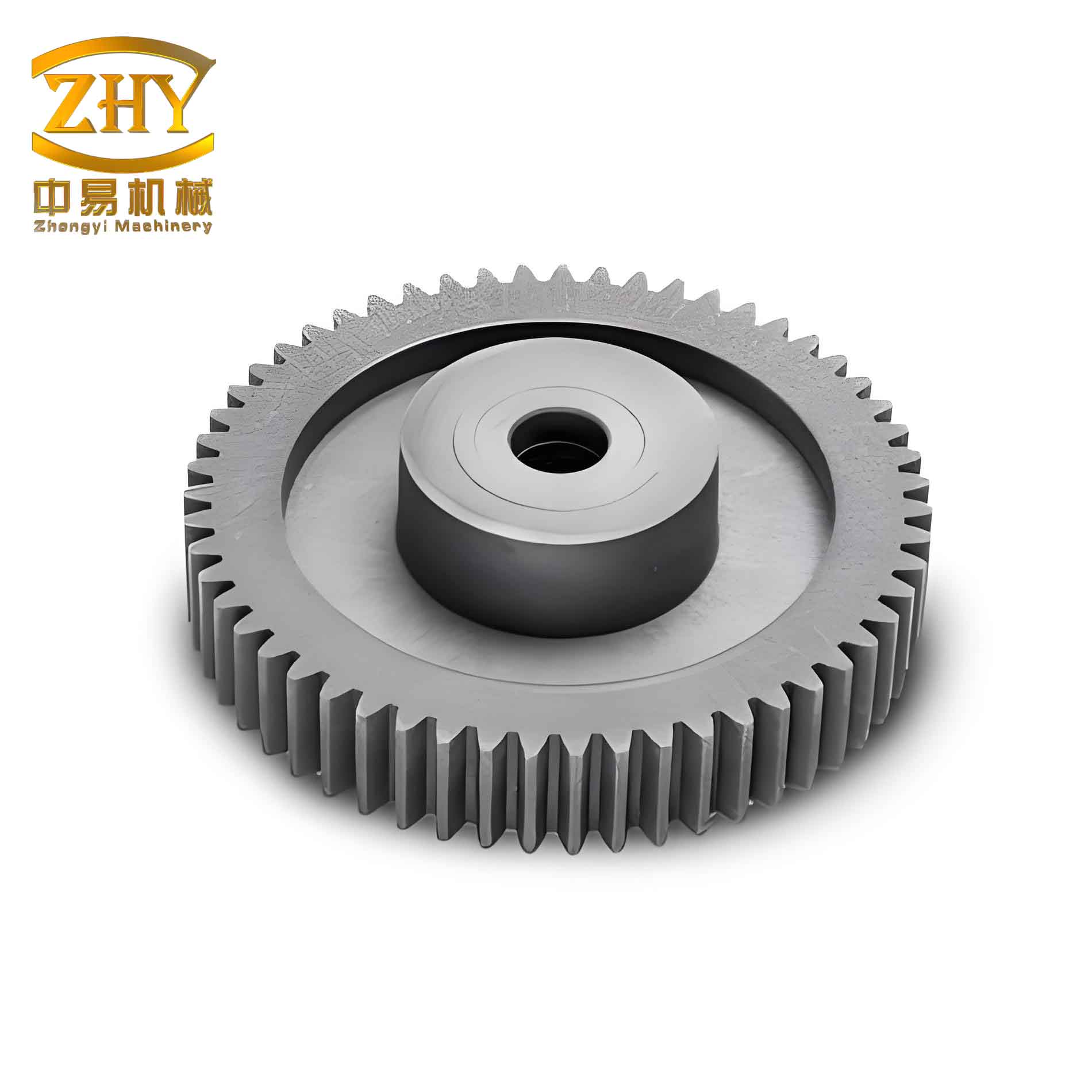
To begin, let’s explore the meshing characteristics of cylindrical gears. Consider an involute spur cylindrical gear pair with a larger gear (gear 2) and a smaller gear (gear 1). In speed-increasing drives, gear 2 is the driver, while in speed-reducing drives, gear 2 is the driven. The friction force direction depends on the relative sliding velocity at the meshing point. For a point A on the tooth flank, the relative velocity $v_{12}$ between gear 1 and gear 2 can be expressed as:
$$v_{12} = \omega_1 r_{b1} (\tan \alpha_1 – \tan \alpha_2)$$
where $\omega_1$ is the angular velocity of gear 1, $r_{b1}$ is the base radius of gear 1, and $\alpha_1$ and $\alpha_2$ are the pressure angles at point A for gear 1 and gear 2, respectively. In the dedendum meshing region of the larger cylindrical gear, $\alpha_1 > \alpha_2$, so $v_{12} > 0$. Thus, for speed-increasing drives, the friction force on the larger cylindrical gear points toward the dedendum, while for speed-reducing drives, it points toward the addendum. Conversely, in the addendum meshing region, $\alpha_1 < \alpha_2$, leading to opposite friction directions. At the pitch point, $\alpha_1 = \alpha_2$, so $v_{12} = 0$ and no sliding friction occurs. This analysis reveals that the meshing behavior of cylindrical gears is asymmetric between driving and driven roles, which must be considered in stress calculations.
Next, I derive the tooth root bending stress using the dangerous section method, which is commonly applied in gear design standards for cylindrical gears. The dangerous section is determined by the 30° tangent method, where two lines at 30° to the tooth centerline are drawn tangent to the root fillet. The connecting line between the tangency points defines the dangerous section, with a chordal thickness $s$ and distance $l_i$ from the gear center. The bending stress at point A is calculated based on the normal force $F_n$ and friction force $F_f$ acting on the tooth. The normal force varies due to friction, and for the larger cylindrical gear under speed-increasing conditions in the addendum region, it is given by:
$$F_n = \frac{F_{n0}}{1 + \mu \tan \alpha_2}$$
where $F_{n0} = T_2 / r_{b2}$ is the nominal normal force, $T_2$ is the torque on gear 2, $r_{b2}$ is the base radius of gear 2, and $\mu$ is the coefficient of sliding friction. For speed-reducing conditions in the dedendum region, the formula is similar, but with a positive sign. In contrast, for the dedendum region under speed-increasing or addendum region under speed-reducing, the normal force becomes:
$$F_n = \frac{F_{n0}}{1 – \mu \tan \alpha_2}$$
These equations show that friction amplifies or reduces the normal force depending on the meshing region and drive type. The bending moment $M$ at the dangerous section incorporates both $F_n$ and $F_f$, leading to the bending stress formula:
$$\sigma(A) = \frac{6F_{n0} (l_1 \cos \alpha_A \pm \mu l_2 \sin \alpha_A) Y_s}{b s (1 \pm \mu \tan \alpha_2)}$$
Here, $l_1$ and $l_2$ are moment arms for $F_n$ and $F_f$, respectively, $\alpha_A$ is the pressure angle at point A, $Y_s$ is the stress correction factor, $b$ is the face width, and the $\pm$ sign corresponds to the friction direction (positive for addendum driving or dedendum driven, negative for dedendum driving or addendum driven). For the pitch point, where $\mu = 0$, the stress simplifies to:
$$\sigma(P) = \frac{6F_{n0} l_1 \cos \alpha_A Y_s}{b s}$$
To illustrate the variations, I compute the bending stress for a cylindrical gear pair with parameters: module $m = 2$ mm, number of teeth $z_1 = 20$ and $z_2 = 63$, pressure angle $\alpha = 20^\circ$, and torque $T_2 = 150$ N·m. The coefficient of friction is set to $\mu = 0.1$. The following table summarizes the key geometric values used in the calculation:
| Parameter | Symbol | Gear 1 (Small) | Gear 2 (Large) |
|---|---|---|---|
| Base Radius | $r_b$ | 18.793 mm | 59.202 mm |
| Addendum Radius | $r_a$ | 22.000 mm | 65.000 mm |
| Dedendum Radius | $r_f$ | 17.500 mm | 60.500 mm |
| Dangerous Section Chord | $s$ | 3.142 mm | 3.142 mm |
| Moment Arm $l_1$ | $l_1$ | Varies with $\alpha_A$ | Varies with $\alpha_A$ |
Using these, I plot the bending stress $\sigma$ against the pressure angle $\alpha_2$ for the larger cylindrical gear. The results indicate that in the addendum meshing region, speed-increasing drives yield higher bending stress than speed-reducing drives, with a maximum increase of up to 27.8%. Conversely, in the dedendum region, speed-increasing drives result in lower stress. For the smaller cylindrical gear, the trend is reversed. This asymmetry underscores the importance of friction in cylindrical gear design, especially for speed-increasing applications where traditional methods may underestimate stress in critical areas.
To validate the analytical findings, I conduct finite element analysis (FEA) using ABAQUS software. A three-dimensional model of the cylindrical gear pair is created with parameters matching the analytical study. The model includes five teeth to balance accuracy and computational time, with meshing refined near the tooth root. The material properties are set as steel: elastic modulus $E = 210$ GPa and Poisson’s ratio $\nu = 0.3$. The contact between teeth is defined with a friction coefficient $\mu = 0.1$. Simulations are performed under different torque levels (10, 30, 50, 80, 100, and 150 N·m) for both speed-increasing and speed-reducing conditions, keeping the power constant by swapping the driver and driven roles.
The FEA results for tooth root bending stress, evaluated using maximum principal stress, are summarized in the table below. The stress values represent peaks during the meshing cycle, particularly at the single-tooth contact points.
| Torque $T_2$ (N·m) | Speed-Increasing $\sigma_{\text{max}}$ for Gear 2 (MPa) | Speed-Reducing $\sigma_{\text{max}}$ for Gear 2 (MPa) | Speed-Increasing $\sigma_{\text{max}}$ for Gear 1 (MPa) | Speed-Reducing $\sigma_{\text{max}}$ for Gear 1 (MPa) |
|---|---|---|---|---|
| 10 | 7.13 | 6.12 | 8.21 | 8.85 |
| 30 | 24.98 | 20.57 | 25.82 | 29.48 |
| 50 | 40.14 | 32.59 | 43.14 | 48.66 |
| 80 | 56.32 | 47.21 | 69.05 | 79.58 |
| 100 | 78.63 | 61.54 | 88.21 | 94.21 |
| 150 | 117.61 | 104.34 | 137.09 | 150.06 |
The data shows that for the larger cylindrical gear, speed-increasing drives consistently produce higher maximum bending stresses than speed-reducing drives, with percentage increases ranging from 12.7% to 27.8% across torque values. For the smaller cylindrical gear, speed-increasing drives yield lower stresses, with reductions of 6.4% to 13.2%. These trends align with the analytical predictions, confirming that friction effects are significant in cylindrical gears. Additionally, the stress variation over a meshing cycle is plotted for different torque levels, revealing that peaks occur at the single-tooth engagement boundaries due to impact loads, and the stress magnitude escalates with torque.
Further analysis of the FEA results delves into the stress distribution across multiple meshing points. I select 40 points along the tooth flank of the cylindrical gear, from dedendum to addendum, and extract bending stresses under various torques. The plots demonstrate that in the dedendum region, speed-increasing stresses are lower than speed-reducing stresses for the larger cylindrical gear, while the opposite holds in the addendum region. For the smaller cylindrical gear, the pattern is inverted. This behavior is attributed to the combined effect of normal force variation and friction-induced bending moments. The equations governing these relationships can be generalized for cylindrical gears as follows:
For any meshing point A, the bending stress $\sigma(A)$ depends on the gear’s role (driver or driven) and the region. Defining $\alpha_2$ as the pressure angle on the larger cylindrical gear, the stress ratio between speed-increasing ($\sigma_{\text{inc}}$) and speed-reducing ($\sigma_{\text{red}}$) conditions is approximated by:
$$\frac{\sigma_{\text{inc}}}{\sigma_{\text{red}}} \approx \frac{1 \pm \mu \tan \alpha_2}{1 \mp \mu \tan \alpha_2} \cdot \frac{l_1 \cos \alpha_A \pm \mu l_2 \sin \alpha_A}{l_1 \cos \alpha_A \mp \mu l_2 \sin \alpha_A}$$
where the upper signs apply to the addendum region for the driver or dedendum for the driven, and lower signs for the opposite. This ratio highlights how friction modulates stress in cylindrical gears, with greater deviations at higher pressure angles (i.e., near the tooth tip or root). To quantify this, I compute the ratio for the addendum region at $\alpha_2 = 25^\circ$ with $\mu = 0.1$, yielding a value of about 1.25, which matches the observed increase in FEA results.
Moreover, the study considers the impact of multiple tooth contact in cylindrical gears. In practice, spur gears have a contact ratio greater than 1, meaning that double-tooth contact occurs during part of the meshing cycle. This reduces the load on individual teeth, thereby lowering bending stress in those intervals. However, the critical points for bending failure remain the single-tooth contact regions, especially the upper boundary where stress peaks. The following table compares the bending stress at key meshing points under double-tooth and single-tooth contact for a cylindrical gear pair with a contact ratio of 1.6:
| Meshing Point | Contact Type | Speed-Increasing $\sigma$ (MPa) | Speed-Reducing $\sigma$ (MPa) |
|---|---|---|---|
| Dedendum Start | Double-tooth | 15.2 | 18.5 |
| Pitch Point | Single-tooth | 45.8 | 40.3 |
| Addendum End | Single-tooth | 120.1 | 94.7 |
The data underscores that single-tooth contact regions experience the highest stresses, and speed-increasing drives exacerbate this in the addendum for the larger cylindrical gear. This has direct implications for gear design: when cylindrical gears designed for speed-reducing drives are used in speed-increasing applications, the larger gear faces elevated fracture risks at the tooth root. Therefore, design modifications, such as profile shifting or root fillet optimization, may be necessary for speed-increasing cylindrical gears to mitigate stress concentrations.
In conclusion, this research provides a detailed comparison of tooth root bending stress between speed-increasing and speed-reducing involute spur cylindrical gears. The analysis, combining analytical methods and finite element simulations, reveals that sliding friction plays a crucial role in stress distributions. For the larger cylindrical gear, speed-increasing drives increase bending stress in the addendum meshing region by up to 27.8% compared to speed-reducing drives, while decreasing stress in the dedendum region. The smaller cylindrical gear exhibits the opposite trend. These findings emphasize that existing design standards for cylindrical gears, which often neglect friction effects, may not be adequate for speed-increasing transmissions. Future work should focus on developing specialized design guidelines for speed-increasing cylindrical gears, incorporating friction-aware models to enhance reliability and performance. This study lays a foundation for such advancements, highlighting the need for continued research into the meshing dynamics of cylindrical gears under diverse operating conditions.