
In power transmission systems across numerous industries, cylindrical gear pairs serve as fundamental components. The meshing and dynamic characteristics of these cylindrical gear transmissions are critical to the overall stability and reliability of machinery. However, manufacturing and assembly errors are prevalent in engineering practice. These deviations inevitably alter the contact conditions on gear tooth flanks, thereby influencing the progression of surface damage mechanisms such as pitting, wear, and scuffing, which in turn affect the dynamic behavior of the gear system. This study focuses specifically on the influence of a common manufacturing error—cumulative pitch error—on the dynamic wear process of cylindrical gears.
Cumulative pitch error is a systematic deviation where the actual positions of teeth around a gear wheel differ from their theoretical equidistant spacing. This error leads to some tooth pairs engaging earlier or later than designed, disrupting uniform load sharing among simultaneous contact lines in a cylindrical gear pair. While prior research has extensively analyzed the impact of pitch errors or surface damage on gear mesh characteristics and dynamic response, a significant gap remains. Existing dynamic wear models typically assume uniform load and wear distribution across all teeth of a cylindrical gear, an idealization that overlooks the inherent non-uniformity introduced by real-world manufacturing errors like cumulative pitch deviation. This work aims to bridge that gap by developing a coupled dynamic wear prediction model that explicitly accounts for cumulative pitch errors, enabling a quantitative analysis of their effect on wear distribution uniformity across the teeth of a cylindrical gear.
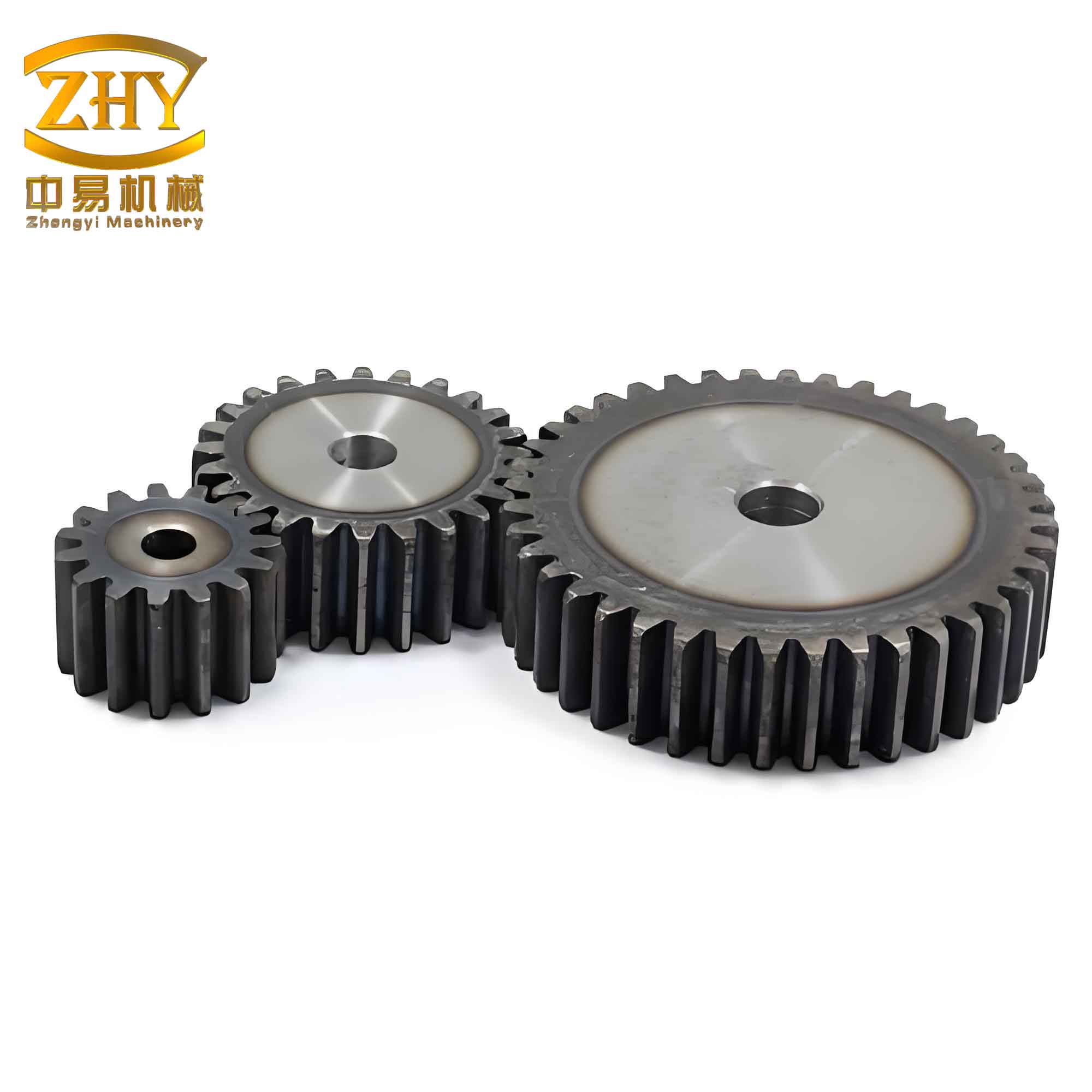
1. Integrated Dynamic Wear Prediction Model Considering Pitch Errors
The proposed framework integrates three core components: a quasi-static Loaded Tooth Contact Analysis (LTCA) model for load distribution under error conditions, a gear rotor dynamic model for calculating vibration response, and a dynamic wear model based on Archard’s theory. The coupling between dynamics and wear progression is handled through an iterative, multi-stage simulation process.
1.1 Load Distribution Model with Cumulative Pitch Error
Cumulative pitch error alters the angular position of each tooth. For a cylindrical gear, if $P_t$ is the theoretical circular pitch and $f_{pt}^{(k)}$ is the pitch error for the k-th tooth (positive indicating a thicker tooth), the cumulative pitch error $F_{pk}$ for that tooth is the algebraic sum of pitch errors up to tooth $k$. This angular error is projected onto the direction normal to the tooth flank for contact analysis:
$$E_{pt} = f_{pt} \cos\alpha_t \cos\beta_b$$
where $\alpha_t$ is the transverse pressure angle and $\beta_b$ is the base helix angle of the cylindrical gear.
We employ the LTCA method to obtain the load distribution, mesh stiffness $k(t)$, and no-load transmission error (NLTE) $e(t)$. The method separates global tooth body deflection (calculated via a parameterized finite element model built in MATLAB for generality) from local contact deformation. The governing iterative equation for the quasi-static equilibrium of the cylindrical gear pair is:
$$
\begin{bmatrix}
-(\boldsymbol{\lambda_c} + \boldsymbol{\lambda_b}) & \boldsymbol{I}_{n \times 1} \\
\boldsymbol{I}_{1 \times n} & 0
\end{bmatrix}
\begin{bmatrix}
\boldsymbol{F_n} \\
\delta_s
\end{bmatrix}
=
\begin{bmatrix}
\boldsymbol{\varepsilon} \\
F_s
\end{bmatrix}
$$
where $\boldsymbol{F_n}$ is the vector of normal contact forces at potential contact points, $\delta_s$ is the static transmission error, $F_s = T / r_{b1}$ is the static mesh force (T is input torque, $r_{b1}$ is base radius of the driving cylindrical gear), $\boldsymbol{\varepsilon}$ is the composite deviation vector including tooth spacing errors, profile modifications, and unloaded tooth separations, $\boldsymbol{I}$ is a vector of ones, and $\boldsymbol{\lambda_c}$ and $\boldsymbol{\lambda_b}$ are the local contact and global body flexibility matrices, respectively. The time-varying mesh stiffness is then:
$$k = \frac{F_s}{\delta_s – e}.$$
The presence of cumulative pitch error causes both $k(t)$ and $e(t)$ to vary not just within a single mesh cycle but over a much longer “hunting tooth” period.
1.2 Gear Rotor Dynamic Model
The dynamic model considers a cylindrical gear pair mounted on flexible shafts supported by bearings. The system degrees of freedom include transverse, axial, and rotational motions for each gear. The gear mesh is modeled as a nonlinear spring acting along the line of action, defined by the time-varying stiffness $k(t)$ and NLTE $e(t)$ from the LTCA. The equation of motion is:
$$\boldsymbol{M}\ddot{\boldsymbol{X}} + (\boldsymbol{C} + \boldsymbol{G})\dot{\boldsymbol{X}} + \boldsymbol{K}(t)\boldsymbol{X} = \boldsymbol{F}$$
where $\boldsymbol{M}$, $\boldsymbol{C}$, $\boldsymbol{G}$, $\boldsymbol{K}(t)$ are the mass, damping, gyroscopic, and stiffness matrices, $\boldsymbol{F}$ is the force vector, and $\boldsymbol{X}$ is the displacement vector. The dynamic mesh force $F_d(t)$ is:
$$F_d(t) = k(t)(\delta(t) – e(t)) = k(t)(\boldsymbol{V_m} \boldsymbol{x_m} – e(t))$$
where $\delta(t)$ is the dynamic transmission error (DTE), $\boldsymbol{V_m}$ is the projection vector mapping gear displacements to the line of action, and $\boldsymbol{x_m}$ contains the gear coordinates.
Due to cumulative pitch errors in the cylindrical gear, the system’s response is periodic over the hunting tooth period $T_{ht}$, not just the mesh period $T_m$. This period corresponds to the time it takes for a specific tooth on the driving cylindrical gear to realign with a specific tooth on the driven cylindrical gear:
$$T_{ht} = \frac{1}{f_{ht}} = \text{lcm}(z_1, z_2) \cdot T_m = \frac{z_1 z_2}{N_{ap}} \cdot T_m$$
where $z_1$, $z_2$ are tooth numbers, $N_{ap}$ is their greatest common divisor, $f_{ht}=f_m N_{ap}/(z_1 z_2)$ is the hunting tooth frequency, and $f_m$ is mesh frequency. Related to this is the assembly phase frequency: $f_{ap} = f_m / N_{ap}$.
1.3 Dynamic Wear Model Based on Archard’s Theory
Wear depth per cycle at a contact point is calculated using the Archard model, modified for gear contact kinematics:
$$
\begin{aligned}
\Delta h_p &= 2k_w \bar{\sigma}_H a_H |1 – v_g/v_p| \\
\Delta h_g &= 2k_w \bar{\sigma}_H a_H |1 – v_p/v_g|
\end{aligned}
$$
where subscript $p$ and $g$ denote pinion and gear of the cylindrical gear pair, $v$ is the sliding velocity, $a_H$ is the Hertzian contact half-width, and $\bar{\sigma}_H$ is the average contact stress. The wear coefficient $k_w$ depends on the lubrication regime determined by the film thickness ratio $\lambda$. To couple dynamics and wear efficiently, an iterative multi-stage approach is used: dynamics and LTCA are solved to get load distribution; wear is accumulated over many cycles until a wear depth update threshold (e.g., 2 $\mu$m) is reached; then the tooth flank geometry is updated, and the process repeats.
2. Analysis of Meshing, Vibration, and Wear Characteristics
The analysis uses parameters for a spur cylindrical gear pair (though the model handles helical gears). Key parameters are summarized in Table 1.
| Parameter | Pinion / Gear | Parameter | Pinion / Gear |
|---|---|---|---|
| Number of Teeth, $z$ | 28 / 56 | Face Width (mm) | 40 |
| Module, $m_n$ (mm) | 4 | Pressure Angle, $\alpha$ (°) | 20 |
| Helix Angle, $\beta$ (°) | 0 | Input Torque (Nm) | 500 |
| Young’s Modulus (GPa) | 210 | Pinion Speed (rpm) | 2865 |
Cumulative pitch error profiles from a measured cylindrical gear are applied.
2.1 Influence on Mesh Stiffness and Wear Progression
Figure 8 shows the time-varying mesh stiffness. For a perfect cylindrical gear, stiffness is identical every mesh cycle. With cumulative pitch error, stiffness varies between different mesh cycles within the hunting period. The error primarily affects stiffness in the double-tooth contact regions; single-tooth region stiffness remains largely unchanged. After significant wear (e.g., $400 \times 10^6$ cycles), wear at the tooth root and tip flattens the stiffness transition, effectively reducing the contact ratio of the cylindrical gear pair.
Wear depth distribution across the face width at the mid-plane of the pinion cylindrical gear is shown in Figure 7. As expected, zero wear occurs at the pitch point due to zero relative sliding. Maximum wear accumulates at the root and tip regions initially. As wear progresses, contact pressure in these heavily worn zones decreases, leading to a reduction in the local wear rate.
2.2 Influence on Vibration Response and Dynamic Factor
The frequency spectrum of the Dynamic Transmission Error (DTE) for a worn cylindrical gear with pitch errors is rich in spectral content (Figure 9). Besides the mesh frequency $f_m$ and its harmonics, distinct low-frequency components appear at the hunting tooth frequency $f_{ht}$, the assembly phase frequency $f_{ap}$, and sidebands around $f_m$ modulated by the rotational frequencies ($f_{s1}$, $f_{s2}$). In contrast, a model ignoring pitch-error-induced non-uniformity predicts only $f_m$ and its harmonics.
The dynamic factor (ratio of maximum dynamic mesh force to static force) over the wear lifecycle is shown in Figure 10. During initial run-in (mild wear), wear acts as a “passive profile correction,” alleviating interference during tooth engagement transitions and slightly improving meshing smoothness. As severe wear progresses, increasing backlash (reflected in growing NLTE) degrades performance, causing vibration to rise sharply. A traditional uniform-wear model underestimates the dynamic factor by about 10% compared to the proposed model for the worn cylindrical gear, highlighting the importance of modeling load non-uniformity.
2.3 Analysis of Wear Non-Uniformity Among Teeth
A key outcome of the proposed model is its ability to predict non-uniform wear distribution across the different teeth of a cylindrical gear (Figure 11). This stems directly from the non-uniform load sharing caused by cumulative pitch errors. The pinion teeth generally experience more severe wear than the gear teeth because they mesh more frequently over the hunting period.
We define a wear non-uniformity coefficient $c_{wear}$ to quantify this disparity for the cylindrical gear:
$$c_{wear} = \frac{\text{std}(\boldsymbol{h_{root}})}{\text{mean}(\boldsymbol{h_{root}})}$$
where $\boldsymbol{h_{root}}$ is a vector of wear depths at the tooth root for all teeth on a gear. Figure 12 shows the progression of $c_{wear}$ alongside root wear depth. The coefficient’s trend mirrors the dynamic factor: initial mild wear reduces non-uniformity, while severe wear exacerbates it. The divergence between the proposed model and the traditional uniform-wear model grows with cumulative operating cycles, underscoring the necessity of the proposed approach for accurate lifecycle prediction of cylindrical gears.
The tooth number combination of the cylindrical gear pair fundamentally influences wear uniformity. Different designs are evaluated in Table 2.
| Gear Set | Teeth ($z_1, z_2$) | $N_{ap}$ | $f_{ap}$ (Hz) | Hunting Tooth Coef. $c_{ht}=N_{ap}/\max(z_i)$ | $f_{ht}$ (Hz) |
|---|---|---|---|---|---|
| A | 27, 56 | 1 | 1289.25 | 0.018 | 0.85 |
| B | 26, 56 | 2 | 620.75 | 0.036 | 1.71 |
| C | 24, 56 | 8 | 143.25 | 0.143 | 6.82 |
| D (Original) | 28, 56 | 28 | 47.75 | 0.5 | 23.88 |
| E | 28, 28 | 28 | 47.75 | 1.0 | 47.75 |
Figure 13 reveals a strong correlation: as the hunting tooth coefficient $c_{ht}$ increases, wear non-uniformity $c_{wear}$ increases. Set A, with teeth numbers that are co-prime ($N_{ap}=1$, known as a hunting tooth design), exhibits the most uniform wear because its very long hunting period ensures each pinion tooth meshes with every gear tooth many times before re-pairing, promoting wear evening-out. Compared to the original design (Set D), the hunting tooth design (Set A) reduces the wear non-uniformity coefficient by approximately 30%. Set E represents the worst case where specific tooth pairs repeatedly mesh, leading to localized severe wear. This highlights the importance of considering the hunting tooth effect during the design phase of a cylindrical gear transmission to mitigate risk of localized failure.
Figure 14 shows the dynamic factor for different levels of cumulative pitch error (with 100% representing the original measured error). The hunting tooth design consistently yields lower vibration. However, when the manufacturing quality of the cylindrical gear is high (low pitch error, e.g., 20% level), the vibration advantage of the hunting tooth design diminishes. Therefore, if high-precision manufacturing of the cylindrical gear is achievable, the constraint for hunting tooth design can be relaxed when other design factors take precedence.
3. Conclusion
This study developed an integrated dynamic wear prediction model for cylindrical gear pairs that explicitly accounts for the influence of cumulative pitch errors. The model couples a Loaded Tooth Contact Analysis (LTCA) for load distribution, a gear rotor dynamic model, and Archard’s wear theory. The primary findings are:
- Spectrum Enrichment: Cumulative pitch errors in a cylindrical gear introduce rich spectral components into the vibration response, including shaft rotational frequencies, hunting tooth frequency ($f_{ht}$), assembly phase frequency ($f_{ap}$), and associated sidebands. Traditional models that ignore these errors predict only mesh frequency content.
- Non-Uniform Wear Prediction: The model successfully captures the non-uniform wear distribution among the teeth of a cylindrical gear caused by uneven load sharing due to pitch errors, overcoming the idealized uniform-wear assumption of prior models. Mild run-in wear can alleviate initial non-uniformity, but severe wear exacerbates load imbalance and accelerates vibration degradation.
- Design Guidance – Hunting Tooth Effect: A strong correlation exists between the hunting tooth coefficient ($c_{ht}$) and wear non-uniformity. Adopting a hunting tooth design (co-prime tooth numbers) for the cylindrical gear pair can reduce the wear non-uniformity coefficient by about 30%, promoting more even wear and potentially extending service life. This requirement can be relaxed if the cylindrical gear is manufactured with high precision (very low pitch errors).
The proposed model provides a more realistic framework for analyzing the wear mechanism and lifetime prediction of cylindrical gears operating under realistic manufacturing error conditions, offering valuable theoretical guidance for the design and maintenance of cylindrical gear transmissions.