
The analysis of gear dynamics, particularly for high-performance configurations like the high contact ratio (HCR) cylindrical gear, is a cornerstone of modern mechanical design. These gears, characterized by a theoretical contact ratio greater than 2, offer superior load distribution, reduced dynamic tooth loads, and lower noise and vibration compared to standard cylindrical gears. This makes them indispensable in applications demanding high power density and quiet operation, such as in aerospace transmissions, high-speed turbines, and precision machinery. However, the very feature that grants them superior performance—multiple tooth pairs in simultaneous contact—also introduces complexity in accurately modeling their dynamic behavior, especially when long-term degradation mechanisms like surface wear are considered. Wear is an inevitable, progressive process that alters the gear tooth profile, thereby changing the fundamental excitation source within the gear system: the meshing stiffness. This article presents a comprehensive, integrated methodology for modeling the dynamic response of a high contact ratio cylindrical gear system under the influence of non-uniform tooth surface wear, bridging the gap between tribological wear prediction and nonlinear system dynamics.
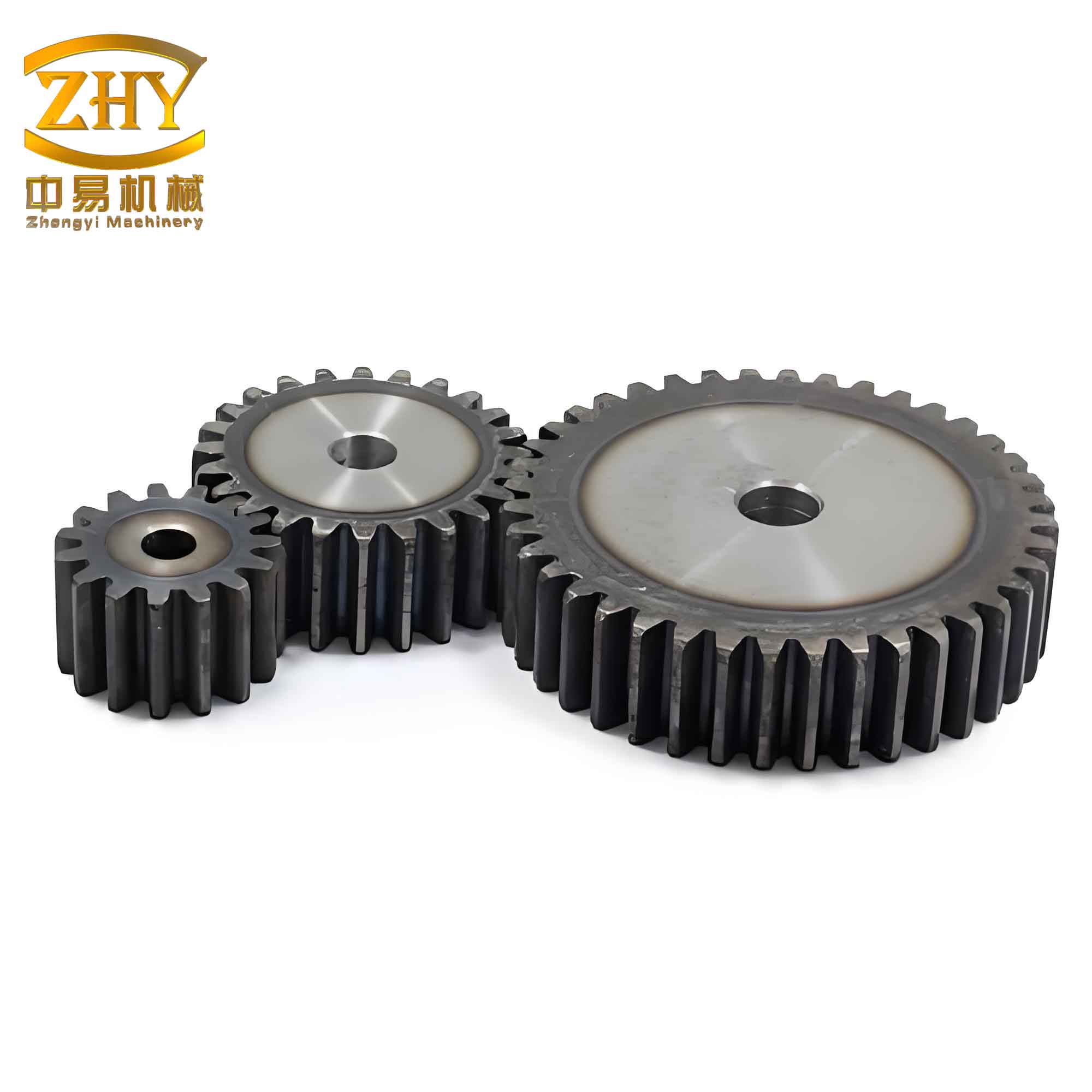
The accurate calculation of the time-varying meshing stiffness (TVMS) is the critical first step in any gear dynamics study. For a high contact ratio cylindrical gear, the meshing stiffness is a periodic function that switches between two distinct states: a three-tooth contact zone and a two-tooth contact zone within a single meshing cycle. The foundation for calculating the stiffness of a single tooth pair lies in the potential energy method. This method considers the elastic energy stored in a gear tooth due to bending, shear, axial compression, and Hertzian contact deformation, as well as the deflection of the gear body. The total compliance is the sum of the individual compliances, and the stiffness is its inverse. For a gear tooth modeled with specific geometric segments (e.g., from the root fillet to the tip along the involute and modified profile), the bending stiffness \(k_b\), shear stiffness \(k_s\), and axial compressive stiffness \(k_a\) for a single tooth under a unit load \(F\) applied at the contact point can be derived from integrals along the tooth profile. The contact point is defined by its pressure angle \(\alpha_K\).
The formulas are as follows:
Bending Stiffness:
$$ \frac{1}{k_b} = \frac{1}{F^2} \left[ \int_{x_G}^{x_E} \frac{M_1^2}{EI_{x1}} dx_1 + \int_{x_E}^{x_D} \frac{M_2^2}{EI_{x2}} dx_2 + \int_{x_D}^{x_C} \frac{M_3^2}{EI_{x3}} dx_3 + \int_{x_C}^{x_K} \frac{M_4^2}{EI_{x4}} dx_4 \right] $$
Shear Stiffness:
$$ \frac{1}{k_s} = \frac{1}{F^2} \left[ \int_{x_G}^{x_E} \frac{1.2 (F \cos \beta)^2}{GA_{x1}} dx_1 + \int_{x_E}^{x_D} \frac{1.2 (F \cos \beta)^2}{GA_{x2}} dx_2 + \int_{x_D}^{x_C} \frac{1.2 (F \cos \beta)^2}{GA_{x3}} dx_3 + \int_{x_C}^{x_K} \frac{1.2 (F \cos \beta)^2}{GA_{x4}} dx_4 \right] $$
Axial Compressive Stiffness:
$$ \frac{1}{k_a} = \frac{1}{F^2} \left[ \int_{x_G}^{x_E} \frac{(F \sin \beta)^2}{EA_{x1}} dx_1 + \int_{x_E}^{x_D} \frac{(F \sin \beta)^2}{EA_{x2}} dx_2 + \int_{x_D}^{x_C} \frac{(F \sin \beta)^2}{EA_{x3}} dx_3 + \int_{x_C}^{x_K} \frac{(F \sin \beta)^2}{EA_{x4}} dx_4 \right] $$
Where \(E\) is Young’s modulus, \(G\) is the shear modulus, \(v\) is Poisson’s ratio, \(I_{xi}\) and \(A_{xi}\) are the area moment of inertia and cross-sectional area at coordinate \(x_i\), respectively. \(M_i\) represents the bending moment along segment \(i\). The parameter \(\beta\) is defined as \(\beta = \alpha_K – \theta_K\), where \(\theta_K\) is related to the gear geometry. The contact stiffness \(k_h\) is derived from Hertzian contact theory, and the gear body foundation stiffness \(k_f\) is calculated using a dedicated analytical formula. Consequently, the comprehensive meshing stiffness for a single tooth pair of the cylindrical gear is given by:
$$ k = \left( \frac{1}{k_h} + \frac{1}{k_{b1}+k_{s1}+k_{a1}} + \frac{1}{k_{f1}} + \frac{1}{k_{b2}+k_{s2}+k_{a2}} + \frac{1}{k_{f2}} \right)^{-1} $$
Here, subscripts 1 and 2 denote the driving and driven gear, respectively.
To model the long-term behavior of the cylindrical gear system, wear must be incorporated. The Archard wear model is widely adopted for this purpose. Under constant load conditions, the wear depth \(h\) at a specific point on the tooth flank of a cylindrical gear can be expressed as:
$$ h = 2 a \lambda n t \epsilon_{\alpha} I_h $$
In this equation, \(a\) is the semi-half width of the contact zone at the meshing point, \(\lambda\) is the sliding coefficient (a key parameter defining the relative sliding between tooth surfaces), \(n\) is the rotational speed, \(t\) is the total operating time, \(\epsilon_{\alpha}\) is the contact ratio, and \(I_h\) is the dimensionless wear rate integral, dependent on material properties and lubrication. The sliding coefficient \(\lambda\) varies along the tooth profile, being zero at the pitch point (pure rolling), positive on the dedendum, and negative on the addendum. This leads to a characteristic non-uniform wear profile: wear is minimal at the pitch point and increases towards the tip and root of the cylindrical gear tooth.
The calculated wear depth modifies the effective tooth profile. In the stiffness calculation, this is accounted for by effectively reducing the tooth thickness and slightly altering the path of the contact force, thereby reducing the calculated single-tooth stiffness \(k(t)\). The total meshing stiffness \(K(t)\) for the high contact ratio cylindrical gear pair is the sum of the stiffnesses of all tooth pairs in simultaneous contact. With a contact ratio of \(\epsilon\), the function \(K(t)\) is periodic and piecewise. If \(T\) is the mesh period and \(Y(t) = \text{mod}(t, T)\), it can be expressed as a segmented function:
$$ K(t) =
\begin{cases}
k(Y(t)) + k(Y(t)+T) + k(Y(t)+2T), & 0 \leq Y(t) \leq (\epsilon-2)T \\[6pt]
k(Y(t)) + k(Y(t)+T), & (\epsilon-2)T \leq Y(t) \leq T
\end{cases} $$
This formulation elegantly captures the transition between double and triple contact zones inherent to the high contact ratio cylindrical gear.
| Parameter | Driving Gear | Driven Gear |
|---|---|---|
| Number of Teeth, \(z\) | 32 | 25 |
| Module, \(m\) (mm) | 3.25 | 3.25 |
| Pressure Angle, \(\alpha_0\) | 20° | 20° |
| Addendum Coefficient | 1.35 | 1.35 |
| Profile Shift Coefficient | -0.19 | -0.14 |
The dynamic behavior of the cylindrical gear system is modeled using a classic single-degree-of-freedom (SDOF) torsional model. The equation of motion is:
$$ m_e \ddot{x}(t) + c \dot{x}(t) + k(t) f(x) = F_m + F_h(t) $$
Here, \(m_e\) is the equivalent mass, \(c\) is the damping coefficient, \(k(t)\) is the time-varying meshing stiffness (now \(K(t)\) including wear effects), \(f(x)\) is a nonlinear displacement function often representing backlash, \(F_m\) is the average force from the transmitted torque, and \(F_h(t)\) represents internal static transmission error excitation, typically modeled as \(F_h(t) = m_e f_h \omega_h^2 \cos(\omega_h t + \phi_h)\).
For numerical analysis and generality, the equation is non-dimensionalized. Defining the natural frequency \(\omega_n = \sqrt{K_m / m_e}\) (where \(K_m\) is the average mesh stiffness) and the non-dimensional time \(\tau = \omega_n t\), the equation becomes:
$$ \bar{x}” + 2\xi \bar{x}’ + \bar{K}(\tau) \bar{f}(\bar{x}) = \bar{F}_m + \bar{F}_h(\tau) $$
Where \(\xi = c / (2 \sqrt{K_m m_e})\) is the damping ratio, \(\bar{K}(\tau) = k(t)/K_m\), \(\bar{F}_m = F_m/(K_m l)\), \(\bar{F}_h(\tau) = \bar{\omega}_h^2 \cos(\bar{\omega}_h \tau + \psi)\), \(\bar{\omega}_h = \omega_h/\omega_n\), and \(l\) is a characteristic length. This non-dimensional form is solved numerically (e.g., using the Runge-Kutta method) to obtain the dynamic transmission error \(\bar{x}(\tau)\).
The interaction between wear and dynamics is profound, particularly for a high contact ratio cylindrical gear. Wear progressively reduces the mesh stiffness \(K(t)\). For the example gear parameters in Table 1 (\(\epsilon \approx 2.23\)), the stiffness reduction over different numbers of meshing cycles \(N\) can be quantified. Initially, the wear impact is small; after \(N=2 \times 10^6\) cycles, the average stiffness may reduce by only ~0.23%. However, as wear accumulates to \(N=10^7\) cycles, the reduction can reach ~1.26%. While this seems modest, its effect on the nonlinear dynamic response of the cylindrical gear system can be dramatic and highly sensitive to the operating load.
| Load Condition | Wear State (Meshing Cycles, \(N\)) | Observed Dynamic Response |
|---|---|---|
| Light Load (\(\bar{F}_m = 0.04\)) | 0 (No Wear) | Periodic or Quasi-Periodic Motion (e.g., 5x period) |
| \(2 \times 10^6\) | Chaotic Motion | |
| \(6 \times 10^6\) | Approximate Periodic Motion | |
| \(10^7\) | Chaotic Motion | |
| Heavy Load (\(\bar{F}_m = 0.08\)) | All States (0 to \(10^7\)) | Stable Periodic Motion (e.g., 2x period), negligible change |
Under light load conditions, the system’s dynamic response is highly sensitive to the precise form of the stiffness excitation. The small but wear-induced changes in the amplitude and shape of \(K(t)\) can shift the system between different attractors in the phase space. As shown in Table 2, the system may transition from a quasi-periodic state (characterized by discrete lines in the frequency spectrum and a closed orbit in the Poincaré map) into a chaotic state (characterized by a broad-band spectrum and a fractal-looking Poincaré map) with initial wear. Further wear may momentarily pull the system back towards a periodic regime before driving it into chaos again. This complex, non-monotonic transition highlights the strongly nonlinear interaction between the time-varying stiffness of the cylindrical gear and the system’s inertial and damping forces.
In contrast, under heavy load conditions, the system exhibits remarkable robustness to wear. The increased mean load \(\bar{F}_m\) dominates the dynamics, effectively “linearizing” the system’s response by minimizing the influence of the nonlinear backlash function \(\bar{f}(\bar{x})\) and reducing the relative impact of stiffness variations. Consequently, as indicated in Table 2, the cylindrical gear system remains in a stable periodic motion (e.g., period-2) regardless of the level of wear progression. The wear primarily causes a slight, steady shift in the mean dynamic transmission error but does not trigger bifurcations or chaos.
In conclusion, the dynamic analysis of a high contact ratio cylindrical gear must account for the evolving state of tooth surface wear to accurately predict its long-term vibrational behavior. By integrating the Archard wear model with an energy-based stiffness calculation method, a time-varying mesh stiffness function that degrades with operation can be formulated. Solving the nonlinear dynamics equations with this stiffness function reveals a critical load-dependence in the wear-impact mechanism. For lightly loaded cylindrical gear systems, even minor wear-induced stiffness changes can precipitate complex bifurcations and chaotic motions, which are detrimental to noise, vibration, and long-term reliability. For heavily loaded cylindrical gear systems, the dynamics are largely immune to such wear-induced stiffness changes, remaining periodic and predictable. This insight is crucial for the condition monitoring and predictive maintenance of cylindrical gear transmissions, suggesting that vibration-based wear detection may be significantly more effective and sensitive in applications where gears operate under moderate to light loads. Future work could extend this integrated model to include more sophisticated wear models incorporating dynamic loads and thermal effects, and to investigate the dynamics of helical or other advanced cylindrical gear geometries under wear progression.