
This study investigates the influence of key operational and structural parameters on the metrological performance of cylindrical gear flowmeters. As a positive displacement meter, the cylindrical gear flowmeter is prized for its compact size, high accuracy, and wide rangeability. However, its performance is intrinsically linked to internal leakage flows that occur through necessary assembly clearances. Understanding and quantifying the impact of these clearances and the physical properties of the fluid medium is crucial for optimizing design, assembly, and application. This paper presents a comprehensive analysis using Computational Fluid Dynamics (CFD) simulations based on a six-degree-of-freedom (6-DOF) motion model. We systematically examine how variations in assembly clearances and fluid viscosity affect the meter factor and linearity error of a DN16 cylindrical gear flowmeter, providing insights into the underlying flow mechanisms.
Fundamental Operating Principle and Leakage Paths
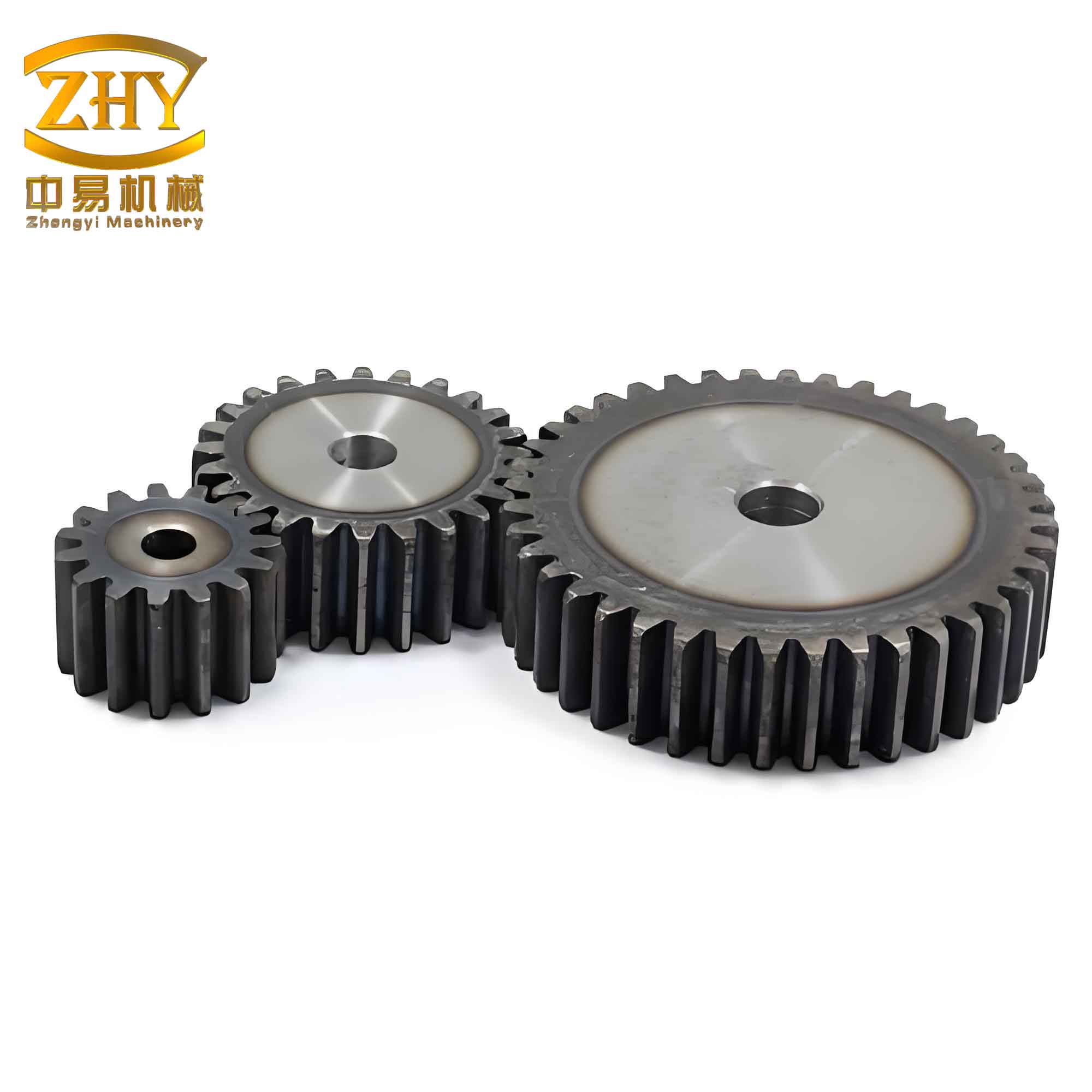
The core of a cylindrical gear flowmeter consists of two identical, meshing cylindrical gears housed in a precisely machined chamber. Fluid entering the meter creates a differential pressure across the gears, causing them to rotate. The geometry of the gears and the chamber forms sealed pockets of fluid between the gear teeth and the chamber wall. As the gears rotate, these pockets of fluid are transported from the inlet side to the outlet side. The theoretical volume of fluid displaced per revolution, \( V_{th} \), for a pair of gears is given by:
$$ V_{th} = 2 N v $$
where \( N \) is the number of teeth on each gear, and \( v \) is the volume of the fluid pocket formed between two teeth and the housing. The theoretical instantaneous flow rate, \( q_{th} \), is proportional to the rotational speed \( n \):
$$ q_{th} = V_{th} \cdot n = 2 N v \cdot n $$
In an ideal, leak-proof meter, the actual flow rate would equal the theoretical flow rate. However, in reality, clearance gaps are essential to prevent mechanical seizure and allow for thermal expansion. These clearances create paths for leakage, causing the actual flow rate \( q_{act} \) to be less than \( q_{th} \). The primary leakage paths in a cylindrical gear flowmeter are:
- Radial Clearance Leakage: Flow between the gear tip (addendum circle) and the meter housing.
- Axial (Side) Clearance Leakage: Flow between the side faces of the gears and the lateral covers of the housing.
- Meshing Clearance Leakage: Flow through the small gap at the point where the two gears mesh.
For most cylindrical gear designs operating with common fluids, the meshing leakage is significantly smaller (often around 5% of total leakage) compared to radial and axial leakage. Therefore, this analysis focuses primarily on the effects of radial and axial clearances.
CFD Simulation Methodology: The 6-DOF Motion Model
To accurately simulate the dynamic interaction between the fluid and the moving gears, a transient CFD approach coupled with a 6-DOF rigid body motion model is employed. This method is critical for predicting the cylindrical gear flowmeter’s performance under realistic conditions where the gear motion is not prescribed but is a result of the fluid dynamic forces acting upon it.
The motion of each cylindrical gear is governed by the equations for a rigid body in an inertial frame. The angular momentum \( \mathbf{L} \) is related to the angular velocity \( \boldsymbol{\omega} \) and the inertia tensor \( \mathbf{I} \):
$$ \mathbf{L} = \mathbf{I} \cdot \boldsymbol{\omega} $$
According to Newton’s second law for rotation, the time derivative of angular momentum equals the net torque \( \mathbf{T} \):
$$ \frac{d\mathbf{L}}{dt} = \mathbf{T} $$
Combining these, the equation of motion for the cylindrical gear is:
$$ \mathbf{I} \cdot \frac{d\boldsymbol{\omega}}{dt} + \boldsymbol{\omega} \times (\mathbf{I} \cdot \boldsymbol{\omega}) = \mathbf{T} $$
The net torque \( \mathbf{T} \) includes the driving torque from the fluid pressure difference and the resisting torques from viscous shear and mechanical friction. In the simulation, the cylindrical gear is constrained to rotate only about its central axis, fixing five degrees of freedom. The rotational moment of inertia is specified. For a given inlet flow rate or pressure condition, the CFD solver calculates the instantaneous pressure and shear stress fields on the gear surfaces, integrates them to compute the net torque \( \mathbf{T} \), and then solves the 6-DOF equation to update the angular velocity and position of the cylindrical gear at each time step. This creates a fully coupled fluid-structure interaction simulation.
Simulation Setup and Validation
The subject of this study is a DN16 cylindrical gear flowmeter. The three-dimensional flow domain, including the inlet/outlet pipes, the gear chamber, and the critical clearance gaps, was created based on actual dimensions. The computational mesh was meticulously generated, with significant refinement in the clearance regions to resolve the thin, high-shear flows. For instance, over 18 cell layers were placed across the radial and meshing clearances to ensure accuracy. The total mesh count was approximately 660,000 cells.
The working fluid was modeled with properties matching YH-15 aviation hydraulic oil. The simulations were run for several steady flow rates within the meter’s operational range. At each flow point, after the solution reached a periodic state, the average rotational speed \( \bar{n} \) of the cylindrical gear was determined over multiple cycles. The simulated meter factor \( K_s \) at that flow rate \( q_v \) was then calculated as:
$$ K_s = \frac{f}{q_v} = \frac{\bar{n} \cdot N}{60 \cdot q_v} $$
where \( f \) is the gear rotation frequency in Hz.
To validate the fidelity of the CFD model and the 6-DOF approach, simulation results were compared against experimental data obtained from a pipe prover standard flow facility with an expanded uncertainty of 0.05% (k=2). The comparison, shown in the table below, indicates a consistent trend: the meter factor increases with flow rate. The quantitative discrepancy in the average meter factor is within 9%, which is considered acceptable for engineering analysis and confirms the reliability of the proposed simulation methodology for performance prediction and parametric studies of the cylindrical gear flowmeter.
| Flow Rate (L/min) | Simulated Meter Factor \( K_s \) (1/L) | Experimental Meter Factor \( K_e \) (1/L) | Relative Deviation |
|---|---|---|---|
| 20 | 1068.5 | 1160.2 | -7.9% |
| 40 | 1074.1 | 1170.8 | -8.3% |
| 60 | 1077.9 | 1174.5 | -8.2% |
| 80 | 1079.4 | 1175.9 | -8.2% |
Influence of Assembly Clearances on Cylindrical Gear Flowmeter Performance
Assembly clearances are a critical design parameter for the cylindrical gear flowmeter. They must be large enough to prevent binding but small enough to minimize leakage. To quantify this effect, a series of CFD simulations were performed on the DN16 cylindrical gear model with varying radial (tip) and axial (side) clearance combinations. The baseline model had a radial clearance of 180 µm and an axial clearance of 140 µm (values represent bilateral clearance). Six different configurations were simulated, as detailed in Table 2.
For each configuration, the average meter factor \( \bar{K} \) over the simulated flow range and the linearity error \( E_L \) were calculated. The linearity error, representing the flowmeter’s deviation from a constant meter factor, is defined as:
$$ E_L = \frac{K_{max} – K_{min}}{K_{max} + K_{min}} \times 100\% $$
where \( K_{max} \) and \( K_{min} \) are the maximum and minimum meter factors within the flow range, respectively.
| Model | Radial Clearance (µm) | Axial Clearance (µm) | Avg. Meter Factor \( \bar{K} \) (1/L) | Linearity Error \( E_L \) (%) |
|---|---|---|---|---|
| 1 (Baseline) | 180 | 140 | 1074.95 | 0.63 |
| 2 | 170 | 130 | 1072.18 | 0.41 |
| 3 | 160 | 120 | 1069.55 | 0.30 |
| 4 | 150 | 110 | 1067.25 | 0.22 |
| 5 | 140 | 100 | 1065.85 | 0.13 |
| 6 | 120 | 80 | 1064.62 | 0.18 |
The results reveal a clear trend: as the assembly clearances decrease, both the average meter factor and the linearity error generally decrease. The average meter factor drops from 1074.95 L⁻¹ to 1064.62 L⁻¹, while the linearity error improves significantly from 0.63% to an optimum of 0.13% for Model 5. This improvement occurs because smaller clearances provide a more restricted path for leakage flow \( q_{leak} \), bringing the actual flow rate closer to the theoretical displacement rate of the cylindrical gear. The theoretical flow rate \( q_{th} \) can be estimated from the simulated gear speed, and the leakage flow can be approximated as:
$$ q_{leak} \approx q_{in} – q_{th} = q_{in} – (2 N v \cdot \bar{n}) $$
However, the benefit of reducing clearances has a limit. Model 6, with the smallest clearances, shows a slight increase in linearity error compared to Model 5. This can be explained by analyzing the pressure loss \( \Delta P \) across the cylindrical gear flowmeter. While smaller clearances reduce the leakage area, they also increase flow resistance and viscous shear stresses in the gaps. This leads to a higher pressure drop required to drive the cylindrical gear at a given speed. For very small clearances, the increased pressure drop can paradoxically enhance the driving force for leakage through other paths or alter the flow distribution, slightly degrading linearity. Therefore, an optimal clearance range exists that balances minimal leakage with acceptable pressure loss and mechanical considerations.
Influence of Fluid Viscosity on Cylindrical Gear Flowmeter Performance
The viscosity of the process fluid is another major factor influencing cylindrical gear flowmeter behavior, especially as viscosity changes with temperature. To isolate this effect, simulations were conducted using the optimal clearance configuration (Model 2: Radial=170µm, Axial=130µm) with fluid kinematic viscosity \( \nu \) varying from 5.6 mm²/s to 42.7 mm²/s, covering a typical operational range for hydraulic oils.
The meter factor curves for different viscosities are plotted in the figure below. A key observation is that for all viscosities, the meter factor of the cylindrical gear flowmeter increases with flow rate, which is characteristic of positive displacement meters where leakage constitutes a smaller proportion of the total flow at higher rates. More importantly, the overall value of the meter factor and its linearity are strongly viscosity-dependent.
| Kinematic Viscosity \( \nu \) (mm²/s) | Avg. Meter Factor \( \bar{K} \) (1/L) | Linearity Error \( E_L \) (%) |
|---|---|---|
| 5.6 | 1068.1 | 0.52 |
| 7.1 | 1069.5 | 0.48 |
| 9.7 | 1071.0 | 0.39 |
| 13.9 | 1072.8 | 0.29 |
| 22.5 | 1074.9 | 0.21 |
| 42.7 | 1077.5 | 0.03 |
The data demonstrates that as fluid viscosity increases, the average meter factor increases, and the linearity error decreases substantially. At the highest viscosity of 42.7 mm²/s, the cylindrical gear flowmeter achieves excellent linearity with an error of only 0.03%. The primary mechanism is the effect of viscosity on leakage flow. Leakage through the narrow clearances of a cylindrical gear flowmeter is largely governed by viscous forces and pressure differentials. Higher viscosity fluid experiences greater resistance to flow in these narrow passages. Consequently, the leakage flow rate \( q_{leak} \) is significantly reduced for a given pressure drop. Since the theoretical displacement \( q_{th} \) of the cylindrical gear is largely independent of viscosity, a reduction in \( q_{leak} \) means the actual flow rate \( q_{act} \) is closer to \( q_{th} \), resulting in a higher meter factor (less fluid is “lost” to leakage). The improved linearity stems from the fact that viscous-dominated leakage flow has a more predictable, less turbulent nature compared to lower-viscosity flows, which may experience transition effects across the flow range.
Conclusions
This study successfully employed a high-fidelity CFD simulation approach based on a 6-DOF motion model to analyze the performance of a cylindrical gear flowmeter. The investigation focused on the effects of two critical parameters: assembly clearances and fluid viscosity. The results provide valuable guidance for the design and application of cylindrical gear flowmeters.
- Simulation Method Validity: The proposed CFD methodology reliably predicts the performance trends of the cylindrical gear flowmeter, validating its use for parametric studies and design optimization.
- Optimal Assembly Clearance: There exists an optimal range for radial and axial clearances in a cylindrical gear flowmeter. Reducing clearances generally improves performance by decreasing leakage. For the studied DN16 meter, the combination of a 140 µm radial clearance and a 100 µm axial clearance yielded the best linearity error of 0.13%. Excessively small clearances can increase pressure loss and potentially degrade performance.
- Viscosity Dependence: The performance of the cylindrical gear flowmeter is highly dependent on fluid viscosity. Higher viscosity fluids significantly reduce internal leakage, leading to an increased meter factor and dramatically improved linearity. The cylindrical gear flowmeter demonstrated near-ideal linearity (0.03% error) at a high viscosity of 42.7 mm²/s, indicating its suitability for high-viscosity fluid applications.
In summary, to achieve high accuracy across a wide flow range, the cylindrical gear flowmeter should be designed with carefully selected assembly clearances and must be calibrated for the specific viscosity of the intended operating fluid. The insights gained from this CFD-based analysis can directly inform the manufacturing, assembly, and application-specific selection of cylindrical gear flowmeters.