
In the field of mechanical design, engineering drawings are indispensable blueprints that transform conceptual ideas into tangible products. These drawings provide comprehensive information about the shape, dimensions, geometric features, and tolerance requirements of parts. However, a persistent issue in current three-dimensional modeling is the unclear expression of tolerances, which are critical for manufacturing accuracy and performance. To address this, we propose a novel method for reconstructing cylindrical gear parts from DXF files, enabling the integration of key tolerance information into 3D models. This approach leverages advanced techniques such as K-means clustering, BP neural networks, and parametric modeling to automate the extraction and representation of design specifications. The method not only enhances the clarity of tolerance expression but also offers a scalable solution for digitizing legacy drawings into intelligent 3D assets.
Our work focuses on cylindrical gear components, which are widely used in mechanical systems for power transmission. The reconstruction process begins with parsing DXF files, a common format for CAD drawings. We extract entity information (e.g., lines, circles, arcs) and annotation data (e.g., dimensions, tolerances), then employ clustering algorithms to organize views. Subsequently, a BP neural network identifies critical parameters, and template matching handles geometric tolerances. Finally, we use VBA-based parametric modeling in SolidWorks to generate 3D models with embedded roughness and shape tolerance data. This pipeline ensures that important design intent is preserved in the digital twin, facilitating better communication between design and manufacturing stages.
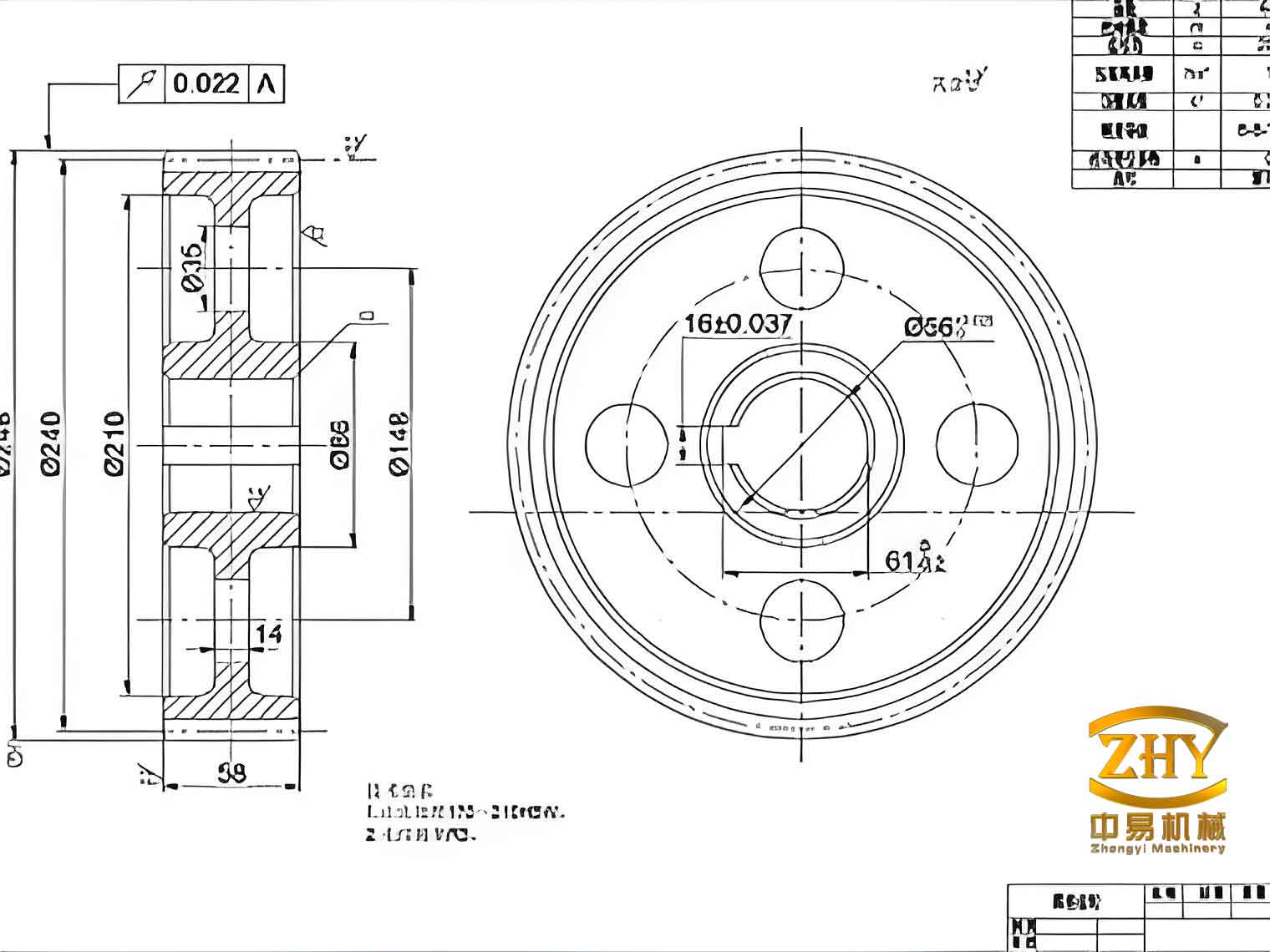
The core of our method lies in the intelligent processing of DXF files. DXF (Drawing Exchange Format) stores vector graphics and metadata, making it suitable for programmatic analysis. We categorize the extracted information into several types, as summarized in Table 1. This structured data forms the foundation for subsequent steps, including view clustering and parameter prediction.
| Information Type | Examples | Purpose in Reconstruction |
|---|---|---|
| Entity Information | Lines, circles, arcs, polylines | Defines geometric shape of the cylindrical gear |
| Annotation Information | Linear dimensions, diameter, radius, angles | Provides key size parameters for the cylindrical gear |
| Roughness Symbols | Ra values with leader lines | Specifies surface finish requirements on cylindrical gear faces |
| Datum Symbols | Benchmarks like A, B, C | Establishes reference planes for tolerance analysis |
| Geometric Tolerances | Shape, orientation, and position tolerances | Indicates allowable deviations in cylindrical gear geometry |
To handle the complexity of multi-view drawings, we use the K-means clustering algorithm to segregate entities into respective views. This is essential because a cylindrical gear drawing typically includes front, side, and top views, each containing overlapping entities. The algorithm groups entities based on their spatial coordinates, with cluster centers derived from intersection points of centerlines. The mathematical formulation of K-means involves minimizing the sum of squared Euclidean distances between points and cluster centroids. For a set of data points \( X = \{x_1, x_2, \dots, x_n\} \) and k clusters, the objective is to find centroids \( C = \{c_1, c_2, \dots, c_k\} \) that minimize:
$$ J = \sum_{i=1}^{k} \sum_{x \in S_i} \|x – c_i\|^2 $$
where \( S_i \) represents the set of points in cluster i. In our context, x corresponds to the coordinates of entities (e.g., endpoints of lines, centers of circles), and k is determined by the number of views in the drawing. By applying this, we can automatically assign each entity to a specific view, such as the main view for the cylindrical gear profile or the sectional view for internal features. This clustering step significantly reduces manual intervention and improves accuracy in reconstructing the cylindrical gear geometry.
Following view separation, we employ a BP neural network to predict critical parameters of the cylindrical gear. The network takes as input features derived from annotation text and associated entity geometries. For instance, dimensions like addendum circle diameter, dedendum circle diameter, and tooth thickness are extracted from the drawing. The BP network consists of an input layer, multiple hidden layers, and an output layer. We use the Xavier method for weight initialization in hidden layers, which draws weights from a uniform distribution to maintain stable gradients:
$$ w \sim U\left(-\frac{\sqrt{6}}{\sqrt{n_{\text{in}} + n_{\text{out}}}}, \frac{\sqrt{6}}{\sqrt{n_{\text{in}} + n_{\text{out}}}}\right) $$
where \( n_{\text{in}} \) and \( n_{\text{out}} \) are the number of input and output neurons, respectively. The input to a hidden layer neuron i is computed as:
$$ \text{net}_i = \sum_{j=1}^{M} w_{ij} x_j + \theta_i $$
where \( x_j \) are the input features, \( w_{ij} \) are weights, and \( \theta_i \) is the bias. The output \( o_i \) of the neuron uses the tanh activation function for non-linearity:
$$ o_i = \phi(\text{net}_i) = \tanh(\text{net}_i) = \frac{e^{\text{net}_i} – e^{-\text{net}_i}}{e^{\text{net}_i} + e^{-\text{net}_i}} $$
This function outputs values in the range \([-1, 1]\), centered at zero, which accelerates convergence compared to sigmoid. For the output layer, the k-th node’s input and output are:
$$ \text{net}_k = \sum_{i=1}^{q} w_{ki} \phi\left( \sum_{j=1}^{M} w_{ij} x_j + \theta_i \right) + a_k $$
$$ o_k = \sum_{i=1}^{q} w_{ki} \phi\left( \sum_{j=1}^{M} w_{ij} x_j + \theta_i \right) + a_k $$
The loss function is mean squared error (MSE), measuring the difference between predicted values \( o_k \) and true values \( y_k \):
$$ L = \frac{1}{2} \sum_{k=1}^{K} (y_k – o_k)^2 $$
We train the network on a dataset of cylindrical gear drawings, with features like dimension values and geometric attributes. After training, the network can predict parameters such as the addendum circle diameter for unseen cylindrical gear drawings. Table 2 illustrates a subset of prediction results, showing high accuracy with low root mean square error (RMSE).
| Parameter | True Value (mm) | Predicted Value (mm) | RMSE |
|---|---|---|---|
| Addendum Circle Diameter | 190 | 189.9996 | 0.00004 |
| Dedendum Circle Diameter | 180 | 180.0001 | 0.00003 |
| Tooth Thickness | 60 | 59.9998 | 0.00002 |
| Keyway Width | 14 | 14.0002 | 0.00005 |
For geometric tolerance recognition, we use normalized cross-correlation template matching. This method compares extracted tolerance symbols from the DXF file with a pre-built template library. The correlation coefficient R(x, y) at position (x, y) in the image is calculated as:
$$ R(x, y) = \frac{\sum_{x’,y’} (T'(x’, y’) \cdot I'(x + x’, y + y’))}{\sqrt{\sum_{x’,y’} T'(x’, y’)^2 \cdot \sum_{x’,y’} I'(x + x’, y + y’)^2}} $$
where \( T(x’, y’) \) is the template image, \( I(x + x’, y + y’) \) is the input image, and the prime notation indicates mean subtraction:
$$ T'(x’, y’) = T(x’, y’) – \frac{\sum_{x”,y”} T(x”, y”)}{w \cdot h} $$
$$ I'(x + x’, y + y’) = I(x + x’, y + y’) – \frac{\sum_{x”,y”} I(x + x”, y + y”)}{w \cdot h} $$
Here, w and h are the width and height of the images. This approach effectively identifies symbols for shape tolerances (e.g., circular runout) and orientation tolerances (e.g., symmetry) associated with the cylindrical gear. The matching process ensures that even complex symbols are accurately recognized, enabling the integration of tolerance data into the 3D model.
Once all critical information is extracted, we proceed to 3D reconstruction using parametric modeling in SolidWorks via VBA macros. The predicted parameters and tolerance data are mapped to a cylindrical gear template. For example, key dimensions like pitch circle diameter, face width, and hub dimensions are set programmatically. The roughness values and geometric tolerances are assigned to specific faces of the cylindrical gear, such as the tooth flanks or bore surfaces. This step ensures that the 3D model not only represents the geometry but also conveys manufacturing requirements. A summary of mapped data for a web-type cylindrical gear is shown in Table 3, highlighting how annotations correspond to 3D features.
| Feature | Dimension (mm) | Upper Deviation | Lower Deviation | Roughness (Ra) | Geometric Tolerance |
|---|---|---|---|---|---|
| Addendum Circle | 190 | 0 | 0 | 3.2 | Circular Runout |
| Pitch Circle | 184 | 0 | 0 | 3.2 | None |
| Dedendum Circle | 180 | 0 | 0 | 3.2 | None |
| Shaft Diameter | 45 | +0.33 | -0.02 | N/A | Datum A |
| Keyway Width | 14 | +0.24 | -0.02 | N/A | Symmetry to Datum A |
| Web Thickness | 24 | 0 | 0 | N/A | None |
The parametric modeling script generates a 3D cylindrical gear with features like teeth, web, hub, and keyway. Tolerances are expressed as annotations on the model, adhering to GD&T standards. For instance, the shaft diameter is marked as a datum (A), and the keyway has a symmetry tolerance relative to it. This enhances the model’s utility for downstream processes like CNC programming or quality inspection. The entire workflow, from DXF parsing to 3D generation, is automated, reducing human error and saving time in reconstructing cylindrical gear parts.
In conclusion, our method provides a robust framework for reconstructing cylindrical gear models from DXF files with integrated tolerance expression. By combining clustering, neural networks, and template matching, we achieve high accuracy in parameter extraction and symbol recognition. The use of parametric modeling ensures that the 3D output faithfully represents design intent, including critical tolerances for manufacturing. This approach has significant implications for digital twin creation and legacy drawing digitization, offering a pathway toward smarter manufacturing systems. Future work could extend this method to other gear types or complex assemblies, further advancing the field of computer-aided design and manufacturing.