
In the realm of power transmission systems, the demand for components capable of operating under high speeds and heavy loads with exceptional reliability and minimal noise is ever-increasing. Among these components, spiral bevel gears hold a pivotal position, particularly in critical applications such as helicopter main reducers and automotive differentials. Their ability to transmit motion and power between intersecting shafts with high efficiency and smoothness makes them indispensable. The fundamental challenge in designing these gears lies in optimizing their meshing performance—specifically, transmission error, contact pattern, and contact ratio—to achieve superior load capacity, durability, and quiet operation. While traditional designs have served well, the evolution towards more demanding operating conditions necessitates advanced design methodologies that proactively control the gear tooth contact behavior.
This article delves into a sophisticated approach for designing spiral bevel gears with a high contact ratio (HCR). The core of this methodology is the presetting of desired meshing performance characteristics—namely, a target contact ratio, a specific amplitude and symmetric shape of the transmission error curve—before the gear geometry is fully defined. By strategically optimizing key parameters in the local synthesis process, we can generate tooth surfaces that yield a predetermined, favorable contact path. We will explore and contrast two primary strategies for achieving a high contact ratio: the established inner diagonal contact path design and a novel approach where the contact path is oriented predominantly along the face width direction. The latter offers significant potential advantages in load distribution and error sensitivity. Through comprehensive tooth contact analysis (TCA) and loaded tooth contact analysis (LTCA), we will quantitatively compare these two HCR designs across critical performance metrics, including tooth bending strength, surface contact strength, and the amplitude of loaded transmission error.
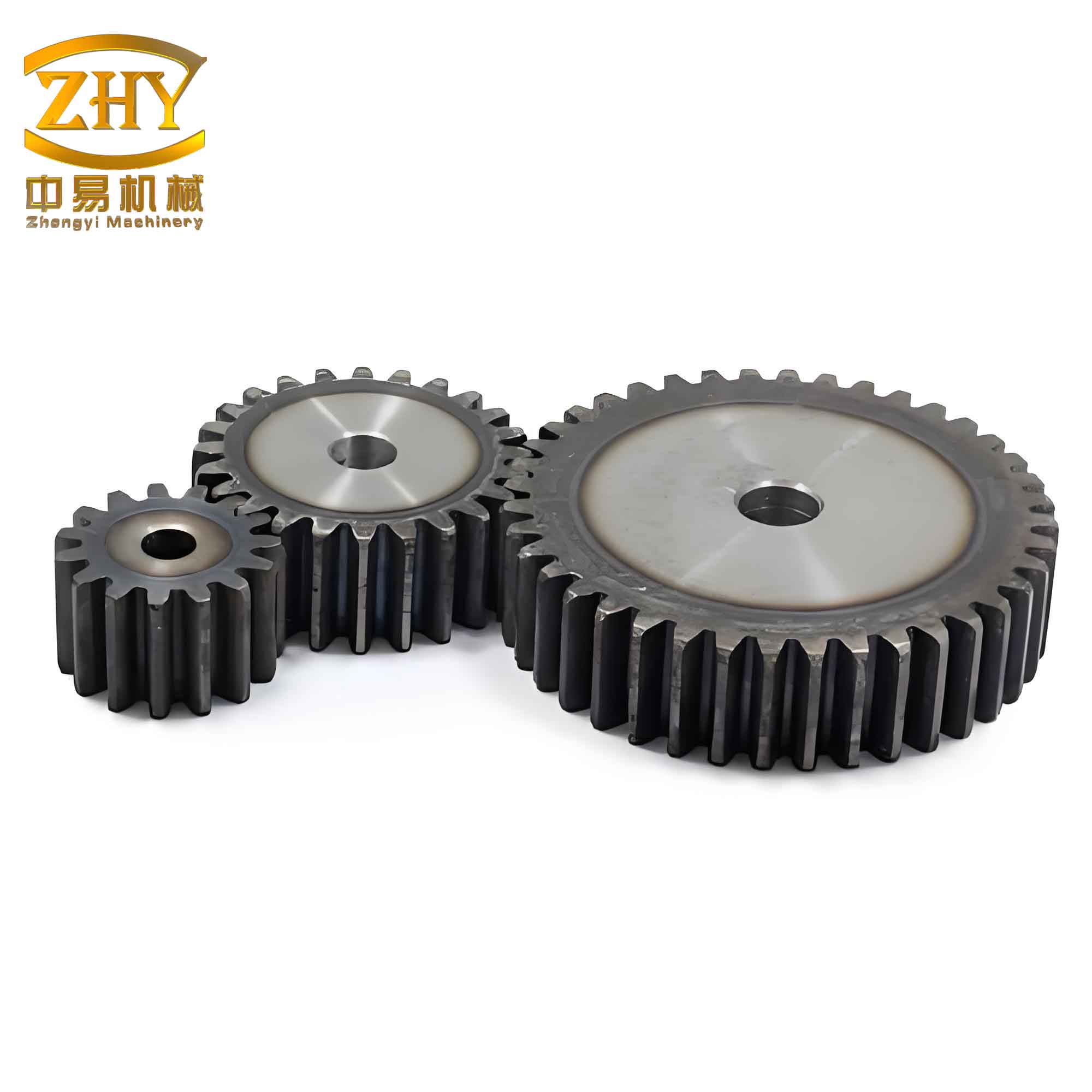
The pursuit of higher performance in gear drives is a continuous endeavor. For parallel axis applications, the concept of a high contact ratio in cylindrical gear design is well-established, effectively reducing transmission error fluctuation and increasing load-sharing among multiple tooth pairs. Translating this benefit to intersecting axis gears, like spiral bevel and hypoid gears, presents unique geometric challenges due to their complex curvature. Early spiral bevel gear designs often featured contact paths that were nearly perpendicular to the root line, analogous to some fundamental cylindrical gear contact conditions. These designs, however, suffered from limited contact ratio, suboptimal tooth strength, and pronounced vibration and noise, making them unsuitable for modern high-performance requirements.
Preset Meshing Performance: A Theoretical Foundation
The proposed design philosophy shifts from a reactive to a proactive stance. Instead of generating a tooth surface and then analyzing its properties, we begin by defining the desired performance outputs. The three primary meshing performance indicators for a spiral bevel gear pair are:
- Transmission Error (TE): The deviation from the perfect, theoretical angular position of the driven gear. A parabolic or low-amplitude linear TE curve is often targeted to minimize dynamic excitation.
- Contact Pattern (CP): The elliptical area of contact on the tooth flank under lightly loaded conditions. Its location, size, and orientation are crucial for avoiding edge contact and ensuring proper lubrication.
- Geometric Contact Ratio (εγ): The average number of tooth pairs in contact during the meshing cycle. A higher contact ratio promotes load sharing and smoothness, similar to the advantages seen in high-contact-ratio cylindrical gear designs.
The control of these outputs is exercised through the parameters of the local synthesis method at a pre-defined reference point \( M_0 \) on the tooth surface. The key parameters, often visualized on the pitch plane, are:
- Contact Path Direction (ψ): The angle of the tangent to the contact path relative to the root line. This is the most critical parameter for controlling the contact ratio.
- Reference Point Position (Δx, Δy): The coordinates of \( M_0 \) relative to the pitch point, controlling the initial location of the contact pattern.
- First Derivative of the Inverse Ratio of Roll (m’21): This parameter directly governs the amplitude of the transmission error at the pitch point, often designed to induce a symmetric parabolic function.
The mathematical foundation relies on the TCA equations. The condition for continuous contact between the pinion (subscript 1) and gear (subscript 2) tooth surfaces, represented by their position vectors \( \mathbf{r} \) and unit normals \( \mathbf{n} \), in a fixed coordinate system \( S_h \) is given by:
$$
\begin{cases}
\mathbf{r}_h^{(1)}(\theta_1, \phi_1, \varphi_1) = \mathbf{r}_h^{(2)}(\theta_2, \phi_2, \varphi_2) \\
\mathbf{n}_h^{(1)}(\theta_1, \phi_1, \varphi_1) = \mathbf{n}_h^{(2)}(\theta_2, \phi_2, \varphi_2)
\end{cases}
$$
where \( \theta, \phi \) are surface parameters and \( \varphi \) are angles of rotation. By solving this system along with boundary conditions defining the start (mesh-in) and end (mesh-out) of contact—such as the contact point lying on the tip line of one gear—the entire path of contact and the corresponding transmission error function \( \Delta \varphi_2(\varphi_1) \) can be determined. The contact ratio \( \epsilon_{\gamma} \) is calculated as the angular distance between mesh-in and mesh-out points divided by the angular pitch.
The design process becomes an iterative optimization loop:
- Set target values for \( \epsilon_{\gamma} \), TE amplitude \( \delta \), and symmetry \( \varsigma \) (ratio of mesh-in to mesh-out intervals).
- Choose initial local synthesis parameters \( (\psi, \Delta x, \Delta y, m’_{21}) \).
- Generate machine tool settings for the gear pair via a “pinion-driven” or “function-oriented” design approach.
- Perform TCA to compute the actual \( \epsilon_{\gamma} \), TE curve, and symmetry.
- Adjust parameters systematically: primarily \( \psi \) to hit the target \( \epsilon_{\gamma} \), and \( \Delta y \) to achieve symmetry \( \varsigma \approx 1 \).
- Iterate until all preset performance targets are met with acceptable tolerance.
Two Pathways to High Contact Ratio: Design Strategies
Manipulating the contact path direction \( \psi \) allows us to create distinctly different HCR designs. The primary classification is based on the orientation of the contact path relative to the root line and the face width.
1. Inner Diagonal Contact Path Design:
This is a conventional HCR strategy. By reducing the angle \( \psi \) between the contact path and the root line, the path traverses a longer distance across the tooth flank from the toe (or heel) to the opposite edge. Typically, the contact path starts near the toe and gear tip and ends near the heel and gear root, or vice-versa, creating a diagonal trace. This effectively increases the contact ratio. However, this design can lead to high sliding velocities at the ends of the contact path, increasing the risk of scoring and wear. Furthermore, the diagonal path can be more sensitive to assembly errors, potentially causing the contact ellipse to shift towards the thin edge of the tooth, leading to detrimental edge contact.
2. Face Width Direction Contact Path Design:
This novel approach aims to orient the contact path more parallel to the face width direction. Ideally, the path would run from the toe to the heel, staying near the center of the tooth height. This design mimics the favorable contact conditions of a well-aligned helical cylindrical gear, where the contact line is parallel to the axis. The primary benefits are a more uniform distribution of sliding velocities and a contact pattern that is inherently less likely to run off the edges of the tooth when minor misalignments occur. Achieving this requires careful selection of the spiral angle. For larger spiral angles (e.g., >30°), a nearly straight path along the face width is feasible. For smaller spiral angles, a slight inclination may be necessary to maintain an adequate size of the contact ellipse and a sufficiently high contact ratio.
| Feature | Inner Diagonal Design | Face Width Direction Design |
|---|---|---|
| Contact Path Trajectory | Diagonal across flank (e.g., toe/top to heel/root) | Primarily along face width (toe to heel) |
| Primary Control Parameter | Low contact path direction angle ψ | ψ ≈ 90° (relative to root line), adjusted for spiral angle |
| Sliding Velocity Distribution | Higher at path extremes, can promote wear | More uniform across the face width |
| Error Sensitivity (Theoretical) | Higher risk of edge contact with misalignment | Lower sensitivity; pattern shifts along face width |
| Analogous Cylindrical Gear Trait | Less direct analogy | Similar to contact lines in helical cylindrical gear |
Design Methodology and Optimization Flow
Implementing the preset performance design, particularly for the face width direction strategy, requires a structured computational approach. The following flow details the process:
- Input Basic Gear Data: Number of teeth (Np, Ng), module, shaft angle, face width, spiral angle, pressure angle.
- Define Performance Targets:
- Target Contact Ratio: \( \epsilon_{\gamma}^{target} \) (e.g., 2.2 to 2.5).
- Target TE: Parabolic form with amplitude \( \delta^{target} \) (e.g., 10-20 arc-seconds).
- Target Symmetry: \( \varsigma^{target} = 1 \).
- Initial Local Synthesis Setup:
- For Face Width Design: Set initial \( \psi \) close to 90°, \( \Delta y \) to position M0 at mid-face and mid-height, \( m’_{21} \) based on desired TE amplitude.
- For Inner Diagonal Design: Set a lower initial \( \psi \) (e.g., 30°-60°).
- Machine Setting Generation: Use mathematical models (e.g., based on cradle-style hypoid generator) to compute pinion and gear machine settings (cutter radius, blade angles, machine root angles, sliding base, swivel angle, etc.) from the local synthesis parameters.
- Tooth Surface Modeling: Compute the coordinates of points on the pinion and gear tooth surfaces using the generated machine settings and the principle of gear generation.
- Tooth Contact Analysis (TCA): Solve the meshing equation system numerically to find the line of contact and transmission error for the unloaded case.
$$
\mathbf{f}(\theta_1, \phi_1, \varphi_1, \theta_2, \phi_2, \varphi_2) = \begin{bmatrix}
\mathbf{r}_h^{(1)} – \mathbf{r}_h^{(2)} \\
\mathbf{n}_h^{(1)} – \mathbf{n}_h^{(2)}
\end{bmatrix} = 0
$$
Extract computed \( \epsilon_{\gamma}^{calc} \), \( \delta^{calc} \), and \( \varsigma^{calc} \). - Performance Evaluation & Optimization Loop:
- Define an error function, e.g., \( F = w_1(\epsilon_{\gamma}^{target} – \epsilon_{\gamma}^{calc})^2 + w_2(\delta^{target} – \delta^{calc})^2 + w_3(\varsigma^{target} – \varsigma^{calc})^2 \).
- Employ an optimization algorithm (e.g., Levenberg-Marquardt, genetic algorithm) to adjust the local synthesis parameters \( (\psi, \Delta x, \Delta y, m’_{21}) \) to minimize \( F \).
- The loop iterates between steps 4, 5, and 6 until convergence.
- Output Final Design: The optimized machine tool settings and the predicted performance data (TE curve, contact pattern location/size).
Case Study: Performance Analysis of Two HCR Designs
To substantiate the theoretical advantages, let’s consider a comparative analysis based on a typical spiral bevel gear set. The geometric parameters are standard for a moderate-duty application. The core of the study is the generation of two distinct tooth surface sets derived from the two design strategies, both targeting identical preset performance: \( \epsilon_{\gamma} = 2.5 \), parabolic TE amplitude of 20 arc-seconds, and perfect symmetry (\( \varsigma = 1 \)).
| Parameter | Pinion | Gear |
|---|---|---|
| Number of Teeth | 23 | 65 |
| Module (mm) | 3.9 | |
| Normal Pressure Angle (°) | 25 | |
| Mean Spiral Angle (°) | 35 | |
| Shaft Angle (°) | 90 | |
| Face Width (mm) | 37 | |
After applying the optimization flow, two sets of final machining parameters are obtained, one yielding an inner diagonal contact path and the other a face width direction path. The unloaded TCA results confirm both designs successfully achieve the preset targets for TE and contact ratio. The visual difference is stark: the inner diagonal pattern runs from the toe/top to the heel/root corner, while the face width design pattern is a long, nearly straight ellipse spanning the entire face width at a consistent height.
1. Sensitivity to Assembly Errors
A critical performance metric is the robustness of the contact pattern to inevitable manufacturing and assembly inaccuracies. We analyze the sensitivity to four common errors: pinion axial offset (\( \Delta A_p \)), gear axial offset (\( \Delta A_g \)), offset error (\( \Delta E \)), and shaft angle error (\( \Delta \Sigma \)).
- Inner Diagonal Design: This design shows high sensitivity. Under axial offsets, the contact pattern shifts diagonally, with a high risk of migrating to the thin toe or heel edge, potentially causing severe stress concentrations. The shaft angle error is particularly detrimental, causing a significant tilt and shift of the pattern.
- Face Width Direction Design: This design demonstrates superior robustness. Axial offsets primarily cause the contact pattern to shift along the face width (from toe towards heel or vice-versa) while largely staying within the tooth boundaries. The offset error \( \Delta E \) has a more direct, one-to-one effect on pattern shift, but the risk of edge contact is lower because the pattern’s length is aligned with the strongest dimension of the tooth. The shaft angle error causes a controlled rotation of the pattern rather than a destructive drift to a corner.
This reduced sensitivity is a major practical advantage, as it can lower assembly precision requirements and improve operational reliability under real-world conditions, much like how a well-designed helical cylindrical gear maintains contact across its face under minor parallel misalignments.
2. Loaded Performance: Strength and Transmission Error
Unloaded analysis tells only part of the story. Loaded Tooth Contact Analysis (LTCA) is essential to evaluate performance under working conditions. LTCA solves a system of equations that includes the tooth compliance (modeled via influence coefficients or finite element methods), the geometric separation of the unloaded surfaces (from TCA), and the equilibrium condition under an applied torque. It outputs the load distribution along the contact lines, the resulting contact and bending stresses, and the loaded transmission error (LTE).
Applying LTCA to our two example designs under a nominal load torque (e.g., 1000 Nm) yields the following comparative results:
| Performance Metric | Inner Diagonal Design | Face Width Direction Design | Improvement |
|---|---|---|---|
| Max Pinion Bending Stress (MPa) | σb_pinion = 110.2 | σb_pinion = 95.2 | ≈ 13.6% Reduction |
| Max Gear Bending Stress (MPa) | σb_gear = 127.7 | σb_gear = 114.9 | ≈ 10.1% Reduction |
| Max Contact (Hertzian) Stress (MPa) | σH = 1033.4 | σH = 973.7 | ≈ 5.8% Reduction |
| Loaded TE Amplitude (arc-sec) | LTEamp = 13.53 | LTEamp = 9.29 | ≈ 31.3% Reduction |
The equations governing the LTCA for a single mesh position can be summarized as finding the load vector \( \mathbf{P} \) that satisfies:
$$
\mathbf{K} \cdot \mathbf{\delta} + \mathbf{g}(\varphi) = \mathbf{P}
$$
$$
\sum P_i = T / r_b
$$
where \( \mathbf{K} \) is the stiffness matrix (combining tooth bending, shear, and contact compliance), \( \mathbf{\delta} \) is the deformation vector, \( \mathbf{g}(\varphi) \) is the initial geometric separation (unloaded transmission error) from TCA as a function of roll angle \( \varphi \), \( T \) is the applied torque, and \( r_b \) is the base radius. The face width design, with its longer, more centralized contact pattern, naturally leads to a lower peak load intensity and more favorable load sharing between simultaneously contacting tooth pairs. This directly translates to lower peak bending and contact stresses.
The reduction in loaded transmission error amplitude is particularly significant for dynamic performance. A lower LTE amplitude means less variable meshing stiffness and reduced dynamic forces, leading to lower vibration and noise levels. This principle is directly borrowed from the design philosophy of high-contact-ratio cylindrical gear systems, where increasing the overlap ratio is a primary method for smoothing transmission.
Conclusion and Engineering Significance
The advanced design methodology of presetting meshing performance for spiral bevel gears, followed by iterative optimization of local synthesis parameters, provides a powerful tool for engineering high-performance gear sets. The comparative analysis between the traditional inner diagonal HCR design and the novel face width direction HCR design reveals compelling advantages for the latter in many applications.
The face width direction design fundamentally alters the contact regime. By aligning the principal direction of contact motion with the geometrically robust face width dimension, it achieves:
- Enhanced Strength: Significant reductions in both bending and contact stress, directly increasing the gear pair’s load capacity and service life.
- Superior Dynamic Performance: A markedly lower amplitude of loaded transmission error, which is a key predictor of reduced vibration and acoustic emission.
- Improved Robustness: Lower sensitivity to common assembly errors, making the gear set more forgiving and reliable in practical installations. This characteristic enhances its functional similarity to a robust helical cylindrical gear assembly.
While the inner diagonal design remains a valid method for increasing contact ratio, the face width direction approach offers a more comprehensive optimization of meshing performance, particularly for applications where reliability, durability, and quiet operation are paramount. The successful implementation of this design hinges on sophisticated computational tools for TCA, LTCA, and numerical optimization, underscoring the modern trend of simulation-driven design in advanced gear engineering. Future work may explore the application of this principle to hypoid gears and the integration of multi-objective optimization to balance contact ratio, stress, and efficiency under a wider range of operating conditions.