
In mechanical transmission systems, cylindrical gears are fundamental components, and their reliability is paramount. Contact fatigue failure, originating from the initiation and propagation of micro-cracks on or beneath the tooth surface, is a primary mode of failure that directly impacts the overall performance and service life of gear systems. Understanding the mechanisms governing this crack propagation is crucial for design optimization, risk mitigation, and lifespan extension. This article delves into the specific contact fatigue crack propagation behavior of a novel type of cylindrical gear: the cylindrical gear with Variable Hyperbolic Circular-Arc-Tooth-Trace (VH-CATT). Compared to traditional involute spur or helical cylindrical gears, VH-CATT cylindrical gears offer superior meshing performance, higher load capacity, and increased transmission efficiency, all while generating no additional axial force. However, their unique point-contact geometry and complex curvature characteristics necessitate a dedicated study into their failure mechanisms under cyclic contact loading.
This work aims to elucidate the crack propagation mechanisms in VH-CATT cylindrical gears. We establish a numerical model to analyze the contact ellipse based on the gear’s curvature, identify critical locations prone to crack initiation via finite element analysis, and employ the Extended Finite Element Method (XFEM) to simulate the propagation of contact fatigue cracks. Furthermore, we develop a model to analyze the Stress Intensity Factor (SIF) at the crack front, investigating the influence of key design and operational parameters such as module, tooth trace radius, and initial crack angle on the crack driving force. The findings provide essential insights for designing more robust and durable VH-CATT cylindrical gear transmissions.
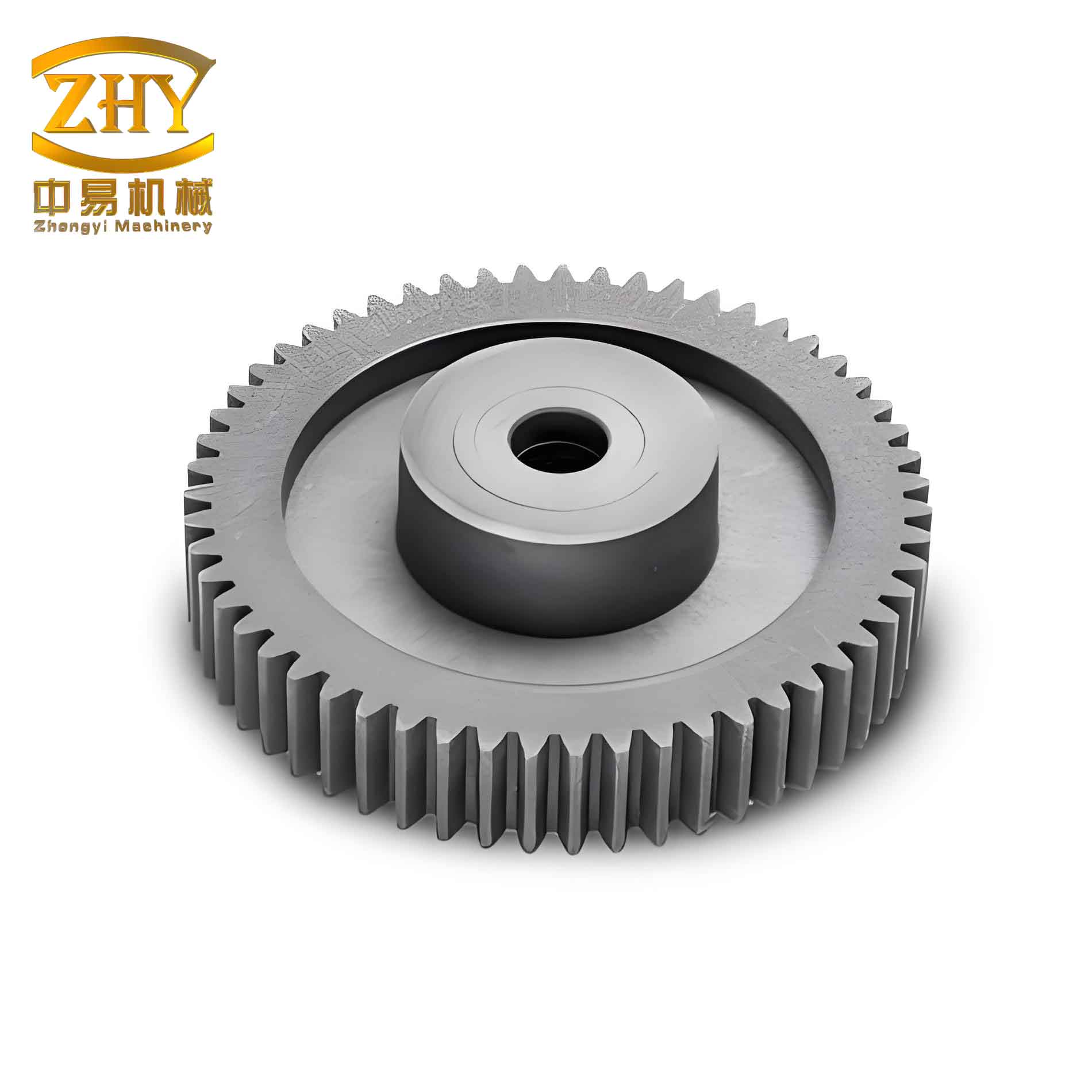
Theoretical Foundation of VH-CATT Cylindrical Gears
Tooth Surface Generation and Mathematical Model
The VH-CATT cylindrical gear is characterized by its tooth trace, which is a circular arc in the direction of the face width, while the tooth profile at the mid-face width is a standard involute. Profiles at other sections are envelopes of a family of variable hyperbolas. Its generation is analogous to the machining of hypoid gears, typically using a dual-blade milling cutter on a rotating cradle. The coordinate systems for the workpiece and cutter are established to derive the mathematical model of the tooth surface.
The position vector and unit normal vector of the cutter in the cutter coordinate system $O_cx_cy_cz_c$ are defined. For the straight blade portion:
$$ {}^{(c)}\mathbf{r}_i = \left[ -u \sin\alpha \pm \left( R_T + \frac{\pi m}{4} \right) \cos\alpha \right] \mathbf{i}_c + u \mathbf{k}_c $$
$$ {}^{(c)}\mathbf{n}_i = \mp \cos\alpha \, \mathbf{i}_c + \sin\alpha \, \mathbf{k}_c $$
For the cutter tip fillet portion:
$$ {}^{(c)}\mathbf{r}_{ir} = \left[ -\left( u \tan\alpha \pm (R_T – mh_a^* – mr^*) \right) \cos\beta \right] \mathbf{i}_c + \left[ h_a^*m + r^*(1 – \sin\alpha) \right] \mathbf{k}_c $$
$$ {}^{(c)}\mathbf{n}_{ir} = \mp \cos\alpha \, \mathbf{i}_c + \sin\alpha \, \mathbf{k}_c $$
where $u$ and $\beta$ are blade parameters, $R_T$ is the nominal cutter radius, $m$ is the module, $\alpha$ is the pressure angle, $h_a^*$ is the addendum coefficient, and $r^*$ is the tip radius coefficient. The upper signs correspond to the convex side (outer blade), and the lower signs to the concave side (inner blade).
Through coordinate transformations using matrices $\mathbf{M}_{di}, \mathbf{M}_{1i}, \mathbf{L}_{di}, \mathbf{L}_{1i}$, the tooth surface equation in the gear coordinate system $O_dx_dy_dz_d$ is obtained. The working flank equation is:
$$
\begin{cases}
x_{di} = A \cos\theta_i – (R_T \cos\phi_i + R_i \pm u \sin\alpha) \cos\phi_i + R_T \\
y_{di} = -A \sin\theta_i + (R_T \cos\phi_i + R_i \pm u \sin\alpha) \sin\phi_i \\
z_{di} = A \\
A = u \cos\alpha \pm \left( R_T \sin\phi_i – R_i \phi_i + R_T \frac{\pi}{4} \pm R_T m \right) \\
\theta_i = \arctan\left( \frac{\pm R_T \cos\phi_i – R_i + R_T}{A} \right)
\end{cases}
$$
where $R_i$ is the gear’s pitch radius and $\phi_i$ is the gear rotation angle. These equations fully describe the complex geometry of VH-CATT cylindrical gears, which is the foundation for all subsequent contact and crack analysis.
Contact Ellipse Analysis and Critical Location Identification
The contact between two meshing VH-CATT cylindrical gear teeth is a point contact that expands into an elliptical area under load due to the local elastic deformation. Determining the size and orientation of this contact ellipse is critical for calculating contact stresses and identifying potential failure initiation zones. The principal curvatures of the gear surfaces are derived from the tooth surface model. The effective radii of curvature in the tooth trace direction ($x$) and profile direction ($y$) at the contact point are:
$$ \frac{1}{R_x} = \frac{1}{R_{x}^{(p)}} + \frac{1}{R_{x}^{(g)}} = K_{I}^{(p)} + K_{I}^{(g)} $$
$$ \frac{1}{R_y} = \frac{1}{R_{y}^{(p)}} – \frac{1}{R_{y}^{(g)}} = K_{II}^{(p)} – K_{II}^{(g)} $$
where $K_I$ and $K_{II}$ are the normal curvatures, and superscripts $(p)$ and $(g)$ denote the pinion and gear, respectively.
Based on Hertzian contact theory, the semi-major axis $a$ and semi-minor axis $b$ of the contact ellipse under a load $W$ are given by:
$$ a = k_a \sqrt[3]{\frac{3W}{2E'(A+B)}}, \quad b = k_b \sqrt[3]{\frac{3W}{2E'(A+B)}} $$
where $E’$ is the equivalent elastic modulus, $k_a$ and $k_b$ are coefficients dependent on the ellipticity $e$ of the contact ellipse, and $A$, $B$ are parameters related to the effective radii:
$ A+B = \frac{1}{2}\left( \frac{1}{R_x} + \frac{1}{R_y} \right), \quad B-A = \frac{1}{2}\left( \frac{1}{R_x} – \frac{1}{R_y} \right) $.
The ellipticity $e = \sqrt{1 – (b/a)^2}$ is related to the ratio $B/A$ through complete elliptic integrals of the first and second kinds, $K(e)$ and $E(e)$.
Using a parameterized design system, a gear pair model was created with the specifications listed in the table below.
| Design Parameter | Pinion | Gear |
|---|---|---|
| Number of Teeth, $Z$ | 21 | 29 |
| Module, $m$ (mm) | 4 | 4 |
| Tooth Trace Radius, $R_T$ (mm) | 200 | 200 |
| Face Width, $B$ (mm) | 40 | 40 |
| Pressure Angle, $\alpha$ (°) | 20 | 20 |
| Elastic Modulus, $E$ (GPa) | 210 | 210 |
| Poisson’s Ratio, $\mu$ | 0.3 | 0.3 |
A finite element model of a five-tooth segment was analyzed. The contact stress distribution and the corresponding elliptical contact path were extracted. Comparing the numerical Hertzian model results with FE simulations for the single-tooth contact zone showed consistent trends in the evolution of the contact ellipse. The analysis confirmed that the highest contact pressure and most severe loading condition typically occur at the start of the single-tooth engagement zone. This location, subjected to a load “step-up” from double-tooth contact, is therefore identified as the critical location most susceptible to the initiation of contact fatigue cracks in these cylindrical gears.
Modeling Crack Propagation Using the Extended Finite Element Method (XFEM)
XFEM Fundamentals
Modeling crack growth in complex geometries like cylindrical gears requires advanced numerical techniques. The Extended Finite Element Method (XFEM) is particularly suited for this task as it allows cracks to propagate through finite elements without requiring the mesh to conform to the crack geometry. The displacement approximation in XFEM enriches the standard finite element approximation with additional functions to capture discontinuities and singularities:
$$ \mathbf{u}^{h}(\mathbf{X}) = \sum_{i \in N} N_i(\mathbf{X}) \mathbf{u}_i + \sum_{j \in S} N_j(\mathbf{X}) H(\mathbf{X}) \mathbf{a}_j + \sum_{k \in T} N_k(\mathbf{X}) \left( \sum_{l=1}^{4} \Phi_l(\mathbf{X}) \mathbf{b}_k^l \right) $$
where:
- $N_i(\mathbf{X})$ are the standard nodal shape functions.
- $\mathbf{u}_i$ are the standard nodal degrees of freedom.
- $H(\mathbf{X})$ is a discontinuous jump function across the crack face, defined using the level set function $\phi(\mathbf{X})$: $H(\mathbf{X}) = \text{sign}(\phi(\mathbf{X}))$.
- $\mathbf{a}_j$ are the enriched degrees of freedom for nodes whose support is cut by the crack.
- $\Phi_l(\mathbf{X})$ are the crack tip enrichment functions that model the $\sqrt{r}$ displacement field singularity in linear elastic fracture mechanics. In 3D, these are often based on the asymptotic crack tip fields: $ \left\{ \sqrt{r} \sin\frac{\theta}{2}, \sqrt{r} \cos\frac{\theta}{2}, \sqrt{r} \sin\frac{\theta}{2} \sin\theta, \sqrt{r} \cos\frac{\theta}{2} \sin\theta \right\} $.
- $\mathbf{b}_k^l$ are the corresponding enriched degrees of freedom for nodes around the crack tip.
Crack propagation is governed by a fracture criterion, such as the maximum principal stress criterion, which determines the direction of crack growth based on the stress state near the crack tip.
Crack Model Setup and Propagation Law for Cylindrical Gears
Based on the identified critical contact location on the pinion’s convex flank, a semi-circular initial crack with a radius of 0.2 mm was embedded, oriented perpendicular to the tooth surface. A five-tooth FE model was used, with the central pair positioned near the critical meshing point. A cyclic torque of 140 N·m was applied to the pinion to simulate the periodic loading experienced during gear meshing. The crack propagation was simulated using XFEM with a maximum principal stress-based damage initiation and evolution law.
The simulation revealed a distinct crack propagation trajectory. The crack initially grew slowly towards the gear core, then its growth in that direction arrested. Subsequently, the primary propagation direction shifted towards the gear faces (along the tooth width). After reaching the tooth end face, the crack then propagated again towards the gear core, ultimately leading to tooth fracture. The crack path formed a symmetric arc opposite to the direction of the tooth trace curvature, making an angle of approximately 50° with the tooth surface tangent at the initiation point.
Influence of Design and Load Parameters on Crack Growth Rate
To guide the design of more durable cylindrical gears, the influence of key parameters on the crack growth rate was investigated.
1. Effect of Tooth Trace Radius ($R_T$): Simulations were conducted for $R_T = 100$ mm, $200$ mm, and $300$ mm.
- Along Face Width: Crack growth rate decreased with increasing $R_T$. Larger tooth trace radii (flatter tooth trace) result in lower stress concentration, slowing down lateral crack propagation.
- Towards Gear Core: Crack growth rate increased with increasing $R_T$. This suggests that in cylindrical gears with a flatter tooth trace, the crack tends to spend more of its energy propagating in-depth once it starts growing laterally.
2. Effect of Module ($m$): Simulations were conducted for modules ranging from 1.5 mm to 5 mm.
- Along Face Width & Towards Core: The crack growth rate in both directions increased with increasing module. Larger, more robust gears experience higher absolute stress intensity at the crack tip under the same nominal stress, leading to faster crack propagation. The stable crack length in the core direction also increased with module size.
| Parameter | Trend | Crack Growth Rate Along Face Width | Crack Growth Rate Towards Core | Remarks |
|---|---|---|---|---|
| Module $(m) \uparrow$ | Increases | Increases | Increases | Larger gears propagate cracks faster. |
| Tooth Trace Radius $(R_T) \uparrow$ | Increases | Decreases | Increases | Flatter tooth trace slows lateral spread but promotes in-depth growth. |
3. Effect of Applied Torque ($T$): Higher applied torque (250 N·m, 360 N·m) significantly accelerated the crack growth rate in both directions and reduced the number of load cycles required for crack initiation and the initial growth phase.
Stress Intensity Factor Analysis at the Crack Front
Theory and Calculation Method
The Stress Intensity Factor (SIF) is a fundamental parameter in fracture mechanics that quantifies the magnitude of the stress singularity at a crack tip. It directly governs the crack propagation rate and direction. For three-dimensional cracks, three modes exist: Mode I (opening, $K_I$), Mode II (sliding, $K_{II}$), and Mode III (tearing, $K_{III}$). In this study, the interaction integral (M-integral) method, implemented via a combined ABAQUS/FRANC3D simulation workflow, was used to compute these SIFs along the front of a semi-elliptical crack in the VH-CATT cylindrical gear tooth.
The interaction integral $M^{(1,2)}$ for two admissible states (1) and (2) over a volume $V$ surrounding the crack front is:
$$ M^{(1,2)} = \int_V \left[ \sigma_{ij}^{(1)} \frac{\partial u_i^{(2)}}{\partial x_j} + \sigma_{ij}^{(2)} \frac{\partial u_i^{(1)}}{\partial x_j} – W^{(1,2)} \delta_{1j} \right] \frac{\partial q}{\partial x_j} \, dV $$
where $W^{(1,2)} = \sigma_{ij}^{(1)}\epsilon_{ij}^{(2)} = \sigma_{ij}^{(2)}\epsilon_{ij}^{(1)}$ is the interaction strain energy density, and $q$ is a smooth weight function. The SIFs are then extracted from the M-integral values. For example, by choosing state (2) as the pure Mode I asymptotic field, $K_I$ is obtained:
$$ K_I = \sqrt{ \frac{E’}{2(1-\nu^2)} \, M^{(I, \text{aux})} \, A_q } $$
where $E’ = E/(1-\nu^2)$ for plane strain, and $A_q$ is a crack front area parameter related to the $q$-function.
SIF Evolution During Crack Propagation
Analysis of the SIFs as the crack grew from its initial size (0.2 mm) through the short-crack stage (0.3-1.0 mm) revealed a clear evolution in the dominant fracture mode:
- Crack Initiation Stage (Size < 0.3 mm): $K_I$, $K_{II}$, and $K_{III}$ were of comparable magnitude. This indicates a mixed-mode stress state at the incipient crack, where all three modes contribute to the initial damage evolution.
- Crack Propagation Stage (Size 0.3–1.0 mm): $K_I$ increased significantly with crack growth in both the face-width and core directions. In contrast, $K_{II}$ and $K_{III}$ remained small, stable, or even decreased. This demonstrates that the propagation of contact fatigue cracks in these cylindrical gears is predominantly driven by Mode I (tensile opening) forces.
Parametric Study on Mode I Stress Intensity Factor
The influence of module, tooth trace radius, and initial crack angle on the Mode I SIF was systematically studied for various crack sizes (represented by its semi-major axis $a$ and semi-minor axis $b$).
1. Effect of Module ($m$): The table below summarizes the SIF values for different crack sizes and modules.
| Crack Size (a, b) mm | Module, $m$ = 3 mm | Module, $m$ = 4 mm | Module, $m$ = 5 mm | ||||||
|---|---|---|---|---|---|---|---|---|---|
| $K_I$ (Width) | $K_I$ (Core) | Trend | $K_I$ (Width) | $K_I$ (Core) | Trend | $K_I$ (Width) | $K_I$ (Core) | Trend | |
| (0.2, 0.2) | ~2.1 | ~2.5 | $K_{I,core} > K_{I,width}$ | ~2.2 | ~2.6 | $K_{I,core} > K_{I,width}$ | ~2.3 | ~2.7 | $K_{I,core} > K_{I,width}$ |
| (0.5, 0.9) | ~3.8 | ~4.0 | Values close | ~4.0 | ~4.2 | Values close | ~4.3 | ~4.5 | Values close |
| (1.2, 2.1) | ~5.5 | ~5.0 | $K_{I,width} > K_{I,core}$ | ~6.0 | ~5.3 | $K_{I,width} > K_{I,core}$ | ~6.8 | ~5.8 | $K_{I,width} > K_{I,core}$ |
| (5.0, 2.7) | ~8.0 | ~7.8 | Large $m$ → Larger $K_I$ | ~9.5 | ~9.0 | Large $m$ → Larger $K_I$ | ~11.5 | ~10.5 | Large $m$ → Larger $K_I$ |
Key Finding: During long-crack propagation, a larger module results in higher $K_I$ values in both the face-width and core directions, explaining the observed faster growth rates in larger cylindrical gears.
2. Effect of Tooth Trace Radius ($R_T$): For a given crack size in the propagation stage, a smaller $R_T$ (sharper tooth curvature) leads to higher $K_I$ values. However, during the long-crack stage (e.g., $a=5$ mm), a significantly larger $R_T$ (300 mm) effectively reduced the $K_I$ at the crack front compared to smaller radii (100 mm, 200 mm). This suggests that increasing the tooth trace radius is a beneficial design strategy for retarding long-crack growth in these cylindrical gears.
3. Effect of Initial Crack Angle ($\alpha_{crack}$): The orientation of the initial flaw significantly impacts the SIF. Cracks with a 90° pre-set angle (perpendicular to the surface) exhibited higher initial $K_I$ values. However, during the long-crack propagation phase, cracks with a 135° pre-set angle developed higher $K_I$ values in both directions. This indicates that while steep cracks may initiate more easily, shallow-angle cracks can become more potent drivers of propagation once they reach a critical size.
Conclusions
This comprehensive investigation into the contact fatigue crack propagation characteristics of VH-CATT cylindrical gears yields several key conclusions crucial for the design and application of this advanced gear type:
- Critical Failure Location: The region at the start of the single-tooth engagement zone is identified as the most critical location for contact fatigue crack initiation in VH-CATT cylindrical gears, due to the load “step-up” effect.
- Crack Propagation Path: The typical propagation path for a surface-initiated crack is initially towards the gear core, followed by dominant growth along the face width, and final fracture towards the core after reaching the tooth edge. The life of the gear is largely determined by the crack growth period along the face width.
- Influence of Gear Parameters:
- Module: Larger modules lead to faster crack growth rates and higher Mode I Stress Intensity Factors during the long-crack stage in both the width and core directions.
- Tooth Trace Radius: Increasing the tooth trace radius slows the crack growth rate along the face width but may accelerate the initial growth towards the core. Most importantly, a sufficiently large tooth trace radius can effectively reduce the Stress Intensity Factor during the long-crack propagation stage, enhancing gear durability.
- Load: Higher applied torque accelerates all stages of crack growth.
- Fracture Mode Dominance: While crack initiation involves a mixed-mode (I, II, III) stress state, the propagation phase is overwhelmingly dominated by Mode I (opening mode) fracture. This simplifies life prediction models, allowing them to focus on $K_I$ as the primary driving force.
- Initial Crack Orientation: The angle of initial flaws significantly affects the stress intensity. Pre-existing cracks at a 135° angle can develop higher driving forces ($K_I$) during long-crack growth compared to perpendicular (90°) cracks.
These findings provide a fundamental understanding and quantitative guidelines for optimizing the design of VH-CATT cylindrical gears against contact fatigue failure. By carefully selecting the module, maximizing the tooth trace radius within design constraints, and considering the implications of initial defect orientation, engineers can develop more reliable and longer-lasting gear transmissions for demanding applications.