
In the field of mechanical transmission, cylindrical gears play a pivotal role due to their high efficiency, compact structure, and precision. Traditional cylindrical gears, such as spur, helical, and herringbone gears, have inherent limitations, including limited load-bearing capacity, axial forces, and complex manufacturing processes. To address these issues, a novel type of cylindrical gear—the circular arc tooth line cylindrical gear—has emerged. This gear features a tooth line that is a spatial curve, typically an arc, which can significantly enhance meshing performance, reduce noise, and eliminate axial forces. In this article, I explore the modeling and contact stress analysis of these cylindrical gears, focusing on the effects of tooth width and tooth line radius. The insights gained provide a theoretical foundation for the design and application of circular arc tooth line cylindrical gears in industrial settings.
The machining principle of circular arc tooth line cylindrical gears is crucial for understanding their geometry. The most common method is the rotating cutter disk milling process, which involves three simultaneous motions: high-speed rotation of the cutter disk for cutting, rotation of the gear blank around its axis, and horizontal movement of the cutter disk for feed motion. The relationship between the cutter disk’s translational velocity \(V_T\) and the gear blank’s rotational velocity at the pitch circle \(V_R\) is given by \(V_T = V_R\), ensuring proper generation of the tooth surface. This process results in a tooth line that is an arc segment, contributing to the unique characteristics of cylindrical gears. The coordinate systems used in machining include a stationary frame \(S_0(X, Y, Z)\), a moving frame \(S_1(X_1, Y_1, Z_1)\) fixed to the gear, and a frame \(S_T(X_T, Y_T, Z_T)\) attached to the cutter disk. The cutter disk’s average generating radius \(R_t\) and the gear’s pitch radius \(R\) are key parameters. For ideal line-contact meshing, the generating radii for convex and concave tooth surfaces are equal, leading to uniform tooth thickness along the width. This contrasts with point-contact meshing, where differences in generating radii cause localized contact. The machining trace left by this method may require further finishing, but it ensures high efficiency and accuracy for cylindrical gears.
The tooth surface equation of circular arc tooth line cylindrical gears is derived based on the geometry of the base cylinder and the arc tooth line. Consider a coordinate system \(S_1(X_1, Y_1, Z_1)\) where the \(X_1O_1Y_1\) plane passes through the mid-section of the base cylinder with radius \(R_{b1}\), and \(Z_1\) aligns with the base cylinder axis. The tooth surface \(\Sigma\) is generated by sweeping an involute tooth profile \(T\) along the base cylinder tooth line \(S\). At a distance \(h\) from the mid-section, in the coordinate system \(S_h(X_h, Y_h, Z_h)\), the involute profile \(T_h\) is expressed as:
$$x_h = R_{b1} \cos \alpha_h + \alpha R_{b1} \sin \alpha_h$$
$$y_h = R_{b1} \sin \alpha_h – \alpha R_{b1} \cos \alpha_h$$
where \(\alpha\) is the involute unfolding angle. The tooth line position angle \(\beta\) is related to the tooth line radius \(R_T\) and the distance \(h\) by:
$$\beta = \frac{R_T – \sqrt{R_T^2 – h^2}}{R}$$
Here, \(R\) is the pitch radius. The transformation matrix from \(S_h\) to \(S_1\) is:
$$M_h = \begin{bmatrix}
\cos \beta & \sin \beta & 0 & 0 \\
-\sin \beta & \cos \beta & 0 & 0 \\
0 & 0 & 1 & 0 \\
0 & 0 & h & 1
\end{bmatrix}$$
Through coordinate transformation \([x_1, y_1, z_1, 1] = [x_h, y_h, z_h, 1] M_h\), the tooth surface equation in \(S_1\) is obtained:
$$x_1 = R_{b1} \cos(\alpha + \beta) + \alpha R_{b1} \sin(\alpha + \beta)$$
$$y_1 = R_{b1} \sin(\alpha + \beta) – \alpha R_{b1} \cos(\alpha + \beta)$$
$$z_1 = h$$
where \(-b/2 \leq h \leq b/2\), and \(b\) is the tooth width. This equation describes the spatial geometry of cylindrical gears with an arc tooth line, enabling precise modeling and analysis. The involute profile ensures that any section parallel to the gear axis maintains a consistent tooth shape, enhancing the meshing quality of cylindrical gears.
To create a three-dimensional model of circular arc tooth line cylindrical gears, I utilized SolidWorks along with MATLAB for generating spatial guide curves. The basic parameters for the gear pair are listed in the table below, which are essential for designing cylindrical gears.
| Parameter | Value |
|---|---|
| Number of teeth \(z_1 / z_2\) | 20 / 30 |
| Module \(m\) (mm) | 4 |
| Tooth width \(b\) (mm) | 40 |
| Tooth line radius \(R_T\) (mm) | 100 |
| Pressure angle \(\alpha\) (degrees) | 20 |
The modeling process began by drawing the base circle, root circle, pitch circle, and tip circle in SolidWorks, followed by generating the involute tooth profile for the mid-section. In MATLAB, I wrote a program to compute the spatial guide curve based on the tooth surface equation, discretizing it into a series of coordinate points. These points were imported into SolidWorks to create the curve via the spline function. Since the tooth line is arc-shaped, the rotation angle for each cross-section was calculated using \(\beta\). Subsequently, lofting cuts, fillets, and patterning commands were applied to form the complete gear model. This approach ensures accurate representation of cylindrical gears with arc tooth lines, facilitating further analysis. The gear pair model demonstrates line-contact meshing, where convex and concave surfaces engage smoothly, increasing the contact area and overlap ratio. This characteristic is advantageous for cylindrical gears in high-load applications.
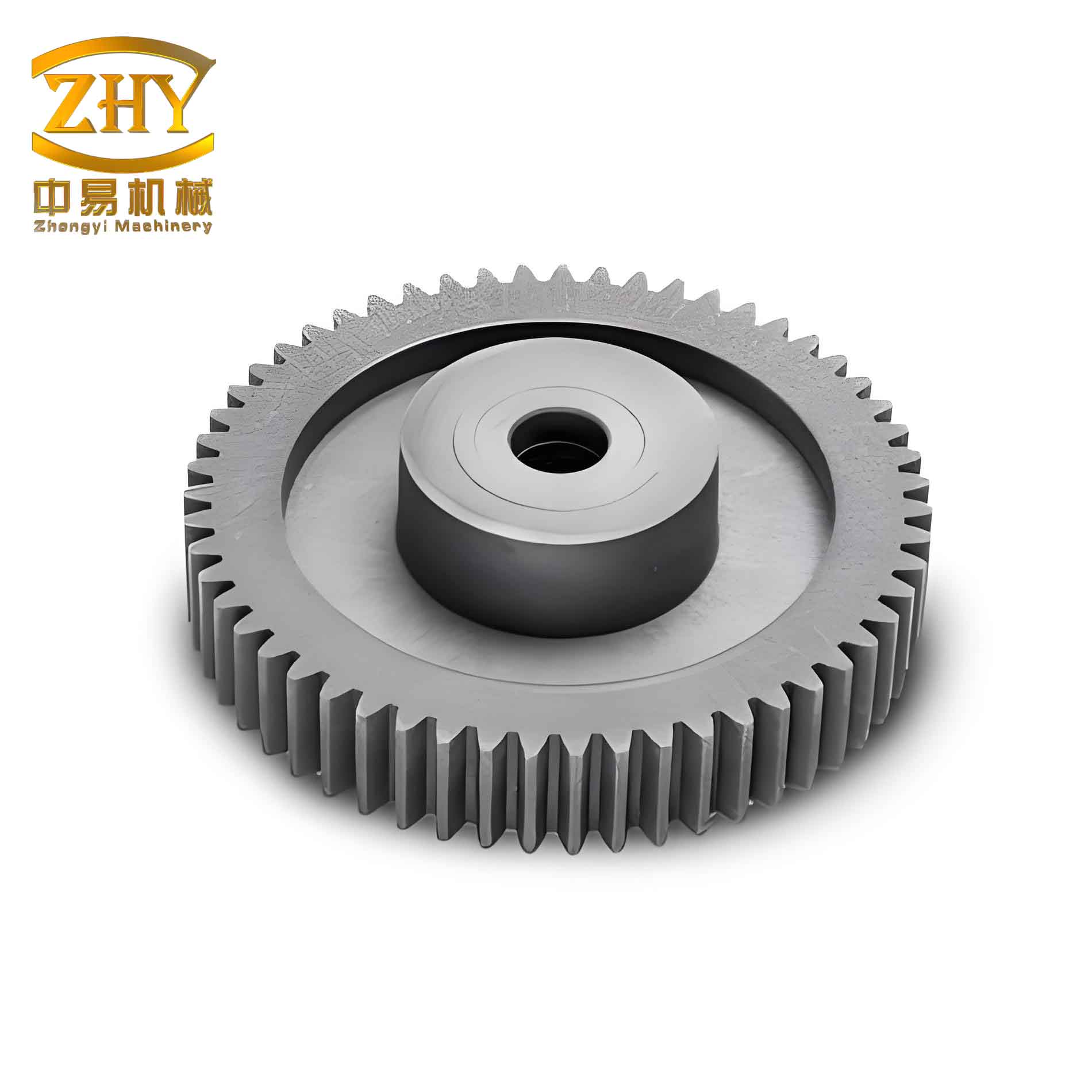
For contact stress analysis, I employed ANSYS Workbench to investigate the effects of tooth width and tooth line radius on cylindrical gears. The gear pair models were imported into the software, with material properties set to structural steel (elastic modulus \(E = 2 \times 10^{11}\) Pa, Poisson’s ratio \(\nu = 0.3\)). A torque \(T = 200\) N·m was applied to the pinion, and frictional contact was defined with a coefficient of 0.05. The contact stress distributions were analyzed under varying parameters to assess the performance of cylindrical gears.
First, the influence of tooth width on contact stress was examined by considering eight gear pairs with different tooth width coefficients \(\phi_a\), defined as the ratio of tooth width to center distance (\(\phi_a = b / a\), where \(a\) is the center distance). The other parameters remained constant as per the table above. The contact stress results are summarized in the following table, illustrating how cylindrical gears respond to changes in width.
| Gear Pair ID | Tooth Width Coefficient \(\phi_a\) | Tooth Width \(b\) (mm) | Contact Stress (MPa) |
|---|---|---|---|
| A | 0.25 | 25 | 287.01 |
| B | 0.30 | 30 | 276.60 |
| C | 0.35 | 35 | 257.21 |
| D | 0.40 | 40 | 218.12 |
| E | 0.45 | 45 | 204.14 |
| F | 0.50 | 50 | 190.02 |
| G | 0.55 | 55 | 188.69 |
| H | 0.60 | 60 | 185.56 |
The data shows that as the tooth width increases, the contact stress generally decreases, indicating improved load-bearing capacity for cylindrical gears. However, beyond \(\phi_a = 0.6\), the stress reduction plateaus, and issues such as uneven load distribution and stress concentration may arise, potentially compromising the gear’s performance. This trend can be modeled empirically using a power-law relationship:
$$\sigma_c \propto b^{-k}$$
where \(\sigma_c\) is the contact stress and \(k\) is a positive exponent. For cylindrical gears, optimizing tooth width is essential to balance strength and manufacturing constraints.
Second, the effect of tooth line radius on contact stress was analyzed by varying \(R_T\) while keeping other parameters fixed. Eight gear pairs with different tooth line radii were simulated, and the results are presented in the table below. This analysis highlights the geometric sensitivity of cylindrical gears.
| Gear Pair ID | Tooth Line Radius \(R_T\) (mm) | Contact Stress (MPa) |
|---|---|---|
| I | 30 | 278.67 |
| II | 40 | 222.87 |
| III | 50 | 236.90 |
| IV | 60 | 210.23 |
| V | 70 | 222.57 |
| VI | 80 | 178.98 |
| VII | 90 | 224.59 |
| VIII | 100 | 218.12 |
The contact stress versus tooth line radius exhibits a parabolic-like behavior, initially decreasing and then increasing. This suggests an optimal range for \(R_T\) where cylindrical gears achieve minimal stress and maximum load capacity. Based on the data, the optimal condition occurs when \(1.5b \leq R_T \leq 2.5b\). For instance, with \(b = 40\) mm, \(R_T\) between 60 mm and 100 mm yields favorable results. The relationship can be approximated by a quadratic function:
$$\sigma_c = a R_T^2 + b R_T + c$$
where \(a\), \(b\), and \(c\) are constants derived from curve fitting. As \(R_T\) approaches infinity, the gear resembles a spur gear, confirming the transition in behavior for cylindrical gears.
In conclusion, the modeling and analysis of circular arc tooth line cylindrical gears reveal significant insights for mechanical design. Through precise derivation of the tooth surface equation and advanced 3D modeling techniques, I have demonstrated how these cylindrical gears can be accurately represented for simulation. The contact stress analysis indicates that tooth width and tooth line radius are critical parameters influencing the performance of cylindrical gears. Specifically, increasing tooth width reduces contact stress up to a point, but excessive width may lead to non-uniform loading. Similarly, the tooth line radius has an optimal range where stress is minimized, enhancing the durability and efficiency of cylindrical gears. These findings underscore the potential of circular arc tooth line cylindrical gears as superior alternatives to traditional gears in applications requiring high load capacity and smooth operation. Future work could explore dynamic behavior or lubrication effects to further optimize these cylindrical gears for industrial use.
The application of cylindrical gears with arc tooth lines extends across various industries, including automotive, aerospace, and heavy machinery, where reliability and performance are paramount. By leveraging the methodologies discussed here, engineers can design cylindrical gears that mitigate common issues like noise and axial forces. Moreover, the integration of computational tools like ANSYS and SolidWorks facilitates iterative design improvements, making cylindrical gears more adaptable to specific requirements. As technology advances, the continued refinement of these cylindrical gears will likely lead to broader adoption and innovative transmission solutions. Ultimately, the study of cylindrical gears contributes to the evolution of mechanical systems, emphasizing the importance of geometry and material science in achieving optimal performance.
From a theoretical perspective, the equations governing cylindrical gears provide a foundation for further research. For example, the contact stress can be related to the Hertzian contact theory, which for cylindrical gears with curved surfaces, involves modifications due to the arc tooth line. The maximum contact stress \(\sigma_{c,\text{max}}\) can be estimated using:
$$\sigma_{c,\text{max}} = \sqrt{\frac{F E^*}{\pi R^*}}$$
where \(F\) is the normal load, \(E^*\) is the equivalent elastic modulus, and \(R^*\) is the equivalent radius of curvature. For cylindrical gears with an arc tooth line, \(R^*\) varies along the tooth width, requiring numerical integration for accurate results. This complexity highlights the need for sophisticated analysis when designing cylindrical gears for critical applications.
In practice, the manufacturing of cylindrical gears with arc tooth lines demands precision machining. The rotating cutter disk method, while efficient, must be calibrated to avoid deviations that affect meshing. Tolerances for parameters like tooth line radius and pressure angle are crucial to ensure that cylindrical gears meet performance standards. Additionally, material selection plays a key role; for instance, using hardened steels can enhance the wear resistance of cylindrical gears under high-stress conditions. As industries push for higher efficiency and longevity, the optimization of cylindrical gears through such analyses becomes increasingly valuable.
To summarize, the exploration of circular arc tooth line cylindrical gears underscores their advantages over conventional designs. By combining analytical modeling with finite element analysis, I have shown how parameters like tooth width and tooth line radius impact contact stress, offering guidelines for optimal design. These cylindrical gears represent a promising direction in transmission technology, with potential to improve reliability and reduce maintenance in mechanical systems. As research progresses, further studies could investigate thermal effects or fatigue life, expanding the understanding of cylindrical gears in diverse operating environments. For now, the insights provided here serve as a robust reference for engineers and researchers working with cylindrical gears, paving the way for innovation in gear传动 systems.